Blog comment backlinks are one of the oldest link building tactics on the internet, and they remain one of the most misunderstood. Whether they help SEO depends heavily on how they are used, where they are placed, and what role they play within a broader link profile. This article explains how blog comment links work, what search engines have said about them, when they may offer limited value, and when they are likely to be a poor use of time and resources.
Key Takeaways
- Most blog comment backlinks carry the nofollow link attribute, which means they do not pass PageRank directly and are unlikely to influence rankings on their own.
- Spammy or irrelevant blog comments can attract manual actions or algorithmic filtering, particularly if they form a large share of a site’s backlink profile.
- Genuine, contextually relevant comments on authoritative blogs may offer limited indirect benefits such as referral traffic and brand visibility, but these are not guaranteed.
- Blog comment links are generally not a substitute for editorial backlinks acquired through guest posting, digital PR, or manual outreach.
- A site-specific backlink profile assessment is needed before deciding whether any comment-based link activity is appropriate for a given campaign.
What Are Blog Comment Backlinks?
A blog comment backlink is a hyperlink placed in the comment section of a blog post, typically by entering a URL in the website field of a comment form or by embedding a link within the comment text itself. These links have existed since the early days of blogging platforms and were once a common method for driving referral traffic and building a backlink profile quickly. The practice became heavily associated with spam when automated tools began flooding comment sections with irrelevant links, which prompted search engines and blog platforms to respond with structural and algorithmic changes.
Today, the majority of blog comment links are automatically assigned the rel=”nofollow” attribute by content management systems such as WordPress. The nofollow attribute signals to search engine crawlers that the linking site does not wish to vouch for the linked destination. Google has stated that it treats nofollow as a hint rather than a directive when evaluating links, but in practice, nofollow links from comment sections are generally not expected to pass meaningful PageRank. Some platforms use the newer rel=”ugc” attribute, which stands for user-generated content, to further distinguish comment links from editorially placed links.
How Search Engines Treat Blog Comment Links
Google’s documented guidance on link attributes makes clear that links intended to manipulate PageRank, including those placed in comment sections for SEO purposes, fall outside what the company considers natural or editorial linking. Google introduced the nofollow attribute in 2005 specifically to address comment spam, and the subsequent adoption of nofollow as a default in most blogging platforms significantly reduced the direct SEO value of comment links. In 2019, Google introduced the ugc and sponsored attributes alongside nofollow, reinforcing the distinction between editorially chosen links and those placed by users or paid parties.
From a crawling and indexing perspective, Google may still follow nofollow and ugc links, meaning the destination URL can be discovered and indexed. However, discovery through a comment link is not the same as receiving a ranking signal. The practical implication is that a blog comment link is unlikely to move the needle on keyword rankings, particularly for competitive search terms where editorial backlinks from authoritative, topically relevant domains carry far greater weight.
Bing’s webmaster guidelines similarly caution against manipulative link building practices, including comment spam, and recommend that site owners focus on earning links through content quality and genuine relationships rather than volume-based tactics.
Can Blog Comment Backlinks Offer Any SEO Value?
The honest answer is that the direct ranking value of blog comment backlinks is very limited for most websites and most competitive queries. However, dismissing them entirely without context overlooks a few narrow scenarios where they may play a minor supporting role.

Referral Traffic
A thoughtful, relevant comment left on a high-traffic blog post in a closely related niche may generate genuine referral clicks if the comment adds value and the commenter’s name or URL is visible. This referral traffic is not an SEO ranking signal, but it can introduce a brand to a relevant audience. The volume of referral traffic from comment links is typically low and unpredictable, and it depends entirely on the popularity of the post and the quality of the comment.
Link Profile Diversity
Some SEO practitioners argue that a small number of nofollow links from blog comments can contribute to a natural-looking backlink profile, since real websites tend to accumulate a mix of followed and nofollowed links over time. This argument has some logical basis, but it should not be used to justify a deliberate campaign of comment link building. A backlink profile that consists primarily of comment links, directory submissions, and forum posts is more likely to raise quality concerns than one built around editorial placements. The diversity argument is most relevant when comment links appear organically as a byproduct of genuine community participation, not as the result of a structured link acquisition effort.
Brand Visibility and Relationship Building
Leaving substantive, expert comments on industry blogs can build name recognition among a niche audience and occasionally lead to editorial opportunities such as guest post invitations or collaborative content. These indirect outcomes are not guaranteed and depend on the quality of the contribution and the responsiveness of the blog owner. When this kind of engagement leads to an editorial link, the value comes from the relationship and the resulting placement, not from the comment link itself.
Risks and Limitations of Blog Comment Link Building
Understanding the risks associated with blog comment backlinks is essential before deciding whether to include any comment-based activity in a link building strategy.
Spam Signals and Manual Actions
Google’s spam policies explicitly identify comment spam as a violation. Websites that acquire large numbers of low-quality comment links, particularly through automated tools or link farms, risk triggering algorithmic filtering or a manual action from Google’s spam team. A manual action can result in a significant and sustained drop in organic visibility that requires a formal reconsideration request and a link cleanup process to resolve. The risk is proportional to the scale and quality of the comment link activity: a handful of genuine, relevant comments is unlikely to cause harm, while a systematic campaign of irrelevant or keyword-stuffed comments across unrelated blogs carries meaningful risk.
Low Editorial Quality
Blog comment links are not editorially placed by the site owner. They are self-placed by the commenter, which is precisely why search engines assign them lower trust. Editorial links, by contrast, are placed because a publisher or author has chosen to reference a resource, which is a stronger signal of genuine endorsement. The absence of editorial judgment in comment links is a structural limitation that cannot be overcome by choosing higher-authority blogs to comment on.
Wasted Effort and Opportunity Cost
Time spent identifying blogs, crafting comments, and managing a comment link campaign is time that could be directed toward higher-value link acquisition methods. For most websites, the effort required to generate a meaningful number of comment links that pass even limited value is disproportionate to the likely SEO return. This opportunity cost is particularly relevant for businesses with limited SEO budgets or internal resources.
Nofollow and UGC Attributes
Because the vast majority of blog comment links carry nofollow or ugc attributes, they do not contribute to PageRank transfer in the way that a followed editorial link does. Campaigns built around comment links as a primary link acquisition method are therefore unlikely to produce measurable improvements in keyword rankings, even when executed at scale on high-authority domains.
Who Might Consider Blog Comment Links and Under What Conditions
Blog comment backlinks are not a recommended primary link building strategy for most websites. However, there are specific contexts where limited, genuine comment activity may be a reasonable supplementary practice rather than a core campaign tactic.
- New websites building initial brand presence: A newly launched site with no backlink profile may benefit from genuine community participation on relevant blogs as part of a broader brand-building effort, provided the comments are substantive and the activity is not automated or scaled artificially.
- Niche communities with active blog ecosystems: In some specialist industries, blog comment sections remain active and read by relevant audiences. Thoughtful participation can build credibility and occasionally lead to editorial opportunities, though the direct SEO benefit remains limited.
- Supplementary activity alongside a primary link building campaign: When a website is already running a manual outreach or guest posting campaign, occasional genuine blog comments in the same niche are unlikely to cause harm and may contribute marginally to profile diversity. They should not replace or dominate the primary strategy.
Blog comment link building is generally not appropriate as a standalone strategy for competitive keywords, e-commerce product pages, SaaS landing pages, or any target page where ranking improvement depends on acquiring authoritative, topically relevant, followed editorial links.
How Blog Comment Links Compare to Other Link Building Methods
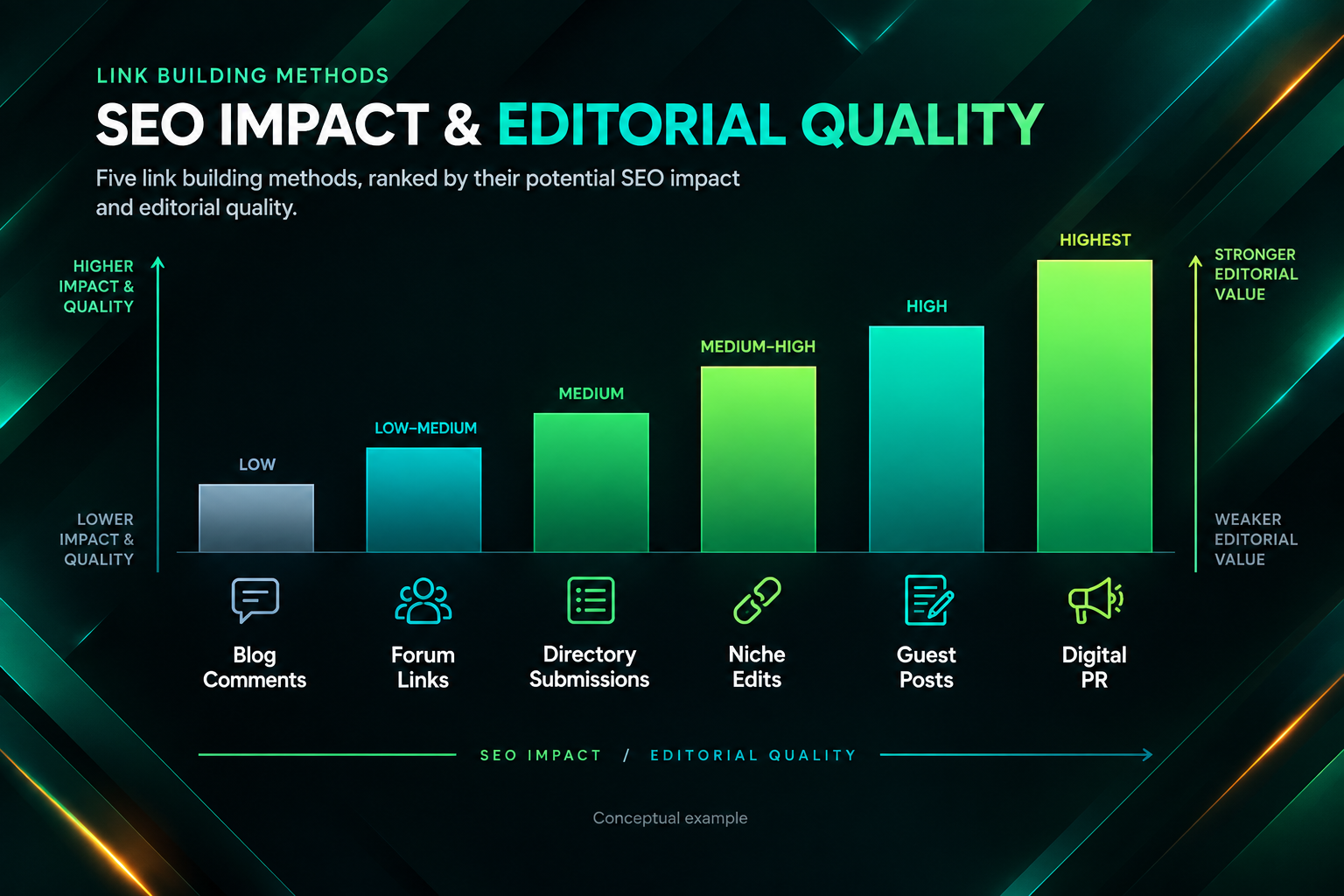
Placing blog comment links in context alongside other common link acquisition methods helps clarify where they sit in terms of likely SEO impact, risk, and resource requirements.
| Method | Link Attribute | Editorial Control | Typical SEO Impact | Risk Level | Effort Required |
|---|---|---|---|---|---|
| Blog comment links | Nofollow / UGC | None (self-placed) | Very limited | Low to moderate (if spammy) | Low to moderate |
| Guest posting (manual outreach) | Followed (typically) | High (publisher edits and approves) | Moderate to significant | Low to moderate | High |
| Niche edits / link insertions | Followed (typically) | Moderate (publisher inserts link) | Moderate to significant | Moderate | Moderate |
| Digital PR | Followed (typically) | High (journalist or editor chooses) | Significant | Low | Very high |
| Forum or community links | Nofollow / UGC | None (self-placed) | Very limited | Low to moderate | Low |
| Directory submissions | Varies | Low | Minimal to limited | Low to moderate | Low |
This comparison illustrates that blog comment links occupy the lower end of the impact and editorial quality spectrum. Methods such as manual guest post outreach and digital PR require significantly more effort but offer editorially placed, followed links from relevant publishers, which are more likely to contribute to measurable ranking improvements over time.
What a Realistic Blog Comment Link Building Outcome Looks Like
Expectations should be calibrated carefully. A website that adds fifty genuine, relevant blog comments across authoritative industry blogs over several months is unlikely to see a measurable change in keyword rankings as a direct result of those comments. The nofollow attribute limits direct PageRank transfer, and the volume is too low to produce a statistically detectable signal even if some value were passed. What may occur is a modest increase in referral visits from readers who click through from a particularly useful comment, and possibly some brand recognition among a niche audience.
By contrast, a website that uses automated tools to post thousands of comment links across unrelated or low-quality blogs in a short period is taking on meaningful risk of algorithmic filtering or a manual action, with no proportionate SEO benefit to justify that risk. The asymmetry between risk and reward in aggressive comment link campaigns is one of the clearest reasons why most experienced SEO practitioners do not recommend the tactic as a primary strategy.
Results from any link building activity, including higher-value methods, depend on a range of factors beyond the links themselves, including the technical condition of the website, content quality, search intent alignment, existing backlink profile, and the competitiveness of the target keywords. Blog comment links are unlikely to compensate for weaknesses in any of these areas.
Alternatives Worth Considering
For businesses and SEO teams evaluating whether to invest time in blog comment links, the following alternatives generally offer a more favorable balance of effort, risk, and potential SEO impact.
Manual Guest Post Outreach
Manual outreach to relevant, editorially independent publishers for guest posting opportunities produces followed, contextually placed links within original content. The acquisition process involves identifying suitable publishers, pitching relevant topics, writing or commissioning content, and managing the editorial relationship. This approach requires more effort than leaving comments but produces links that carry editorial endorsement and are more likely to contribute to ranking improvements over time. Publisher quality assessment, including topical relevance, organic traffic, and backlink profile health, is an important part of the process.
Niche Edits and Link Insertions
Niche edits involve placing a link within an existing, already-indexed piece of content on a relevant publisher’s website. Because the content is established and may already have its own backlink profile, a niche edit link can pass value relatively quickly compared to a new guest post that needs time to be indexed and accumulate its own authority. The acquisition method and publisher quality standards are similar to guest posting, and the same risks around paid link disclosure apply.
Digital PR and Content-Led Link Acquisition
Digital PR campaigns create newsworthy content, data studies, or resources that journalists, bloggers, and industry publications choose to reference editorially. This approach produces high-authority, followed links from publications that may be difficult to reach through direct outreach. Digital PR requires significant upfront investment in content creation and media relations but can generate links from domains with strong organic authority and high editorial standards.
Resource Page and Broken Link Building
Identifying resource pages in a relevant niche and requesting inclusion, or finding broken links on authoritative pages and suggesting a replacement, are established white-hat link acquisition methods. Both approaches require research and outreach effort but produce editorially placed links when successful. Success rates vary by niche and the quality of the resource being promoted.
Assessing Your Backlink Profile Before Adding Any Links
Before deciding whether blog comment links, or any other link type, are appropriate for a specific website, a review of the existing backlink profile is advisable. Tools such as Ahrefs, Semrush, and Majestic can provide data on referring domains, link attributes, anchor text distribution, and the proportion of followed versus nofollowed links already pointing to a site. This assessment helps identify whether the current profile has quality issues, whether it is over-reliant on low-quality link types, and what kinds of links are most likely to add value given the site’s current position.
A backlink profile that already contains a high proportion of comment links, forum links, and directory submissions relative to editorial links may benefit more from a focused guest posting or digital PR campaign than from adding further low-quality links. Conversely, a site with a healthy editorial backlink profile may not need to avoid occasional genuine community participation, provided it does not become a systematic link acquisition method.
Low organic visibility can have multiple causes beyond backlink quantity, including crawling and indexing problems, content quality issues, search intent mismatches, weak internal linking, or strong competition. A site-specific audit is the appropriate starting point for diagnosing ranking underperformance, not an assumption that more links of any type will resolve the issue.
Frequently Asked Questions
Are blog comment backlinks counted by Google?
Google may crawl and discover URLs through comment links, but most comment links carry the nofollow or ugc attribute, which signals that the site does not vouch for the linked destination. Google has stated it treats nofollow as a hint rather than a directive, but in practice, comment links are generally not expected to pass PageRank or contribute meaningfully to keyword rankings.
Can blog comment links cause a Google penalty?
A small number of genuine, relevant comments are unlikely to cause harm. However, large-scale or automated comment link campaigns, particularly those involving irrelevant or keyword-stuffed comments across unrelated blogs, can attract algorithmic filtering or a manual action under Google’s spam policies. The risk increases with the scale and quality of the activity.
Do nofollow links have any SEO value at all?
Nofollow links do not pass PageRank directly. They may contribute to a natural-looking backlink profile and can generate referral traffic if placed on high-traffic pages. Some SEO practitioners consider a proportion of nofollow links to be a normal feature of a healthy link profile, but this does not mean that deliberately acquiring nofollow links produces ranking improvements.
How do blog comment links differ from editorial links?
Editorial links are placed by a publisher or author who has chosen to reference a resource, which represents a genuine endorsement. Blog comment links are self-placed by the commenter without editorial review or approval. This distinction is why search engines assign lower trust to comment links and why they typically carry the nofollow or ugc attribute.
Is it worth spending time on blog comment outreach for SEO?
For most websites targeting competitive keywords, the time required to generate a meaningful number of comment links is disproportionate to the likely SEO return. Higher-value methods such as manual guest post outreach, niche edits, or digital PR are generally a better use of limited SEO resources. Genuine community participation may have indirect brand benefits, but it should not be treated as a primary link acquisition strategy.
What should I look for in a blog before leaving a comment for SEO purposes?
If genuine community participation is part of a broader brand-building effort, prioritize blogs with real editorial standards, active and relevant readership, topical alignment with your site, and comment sections that are moderated. Avoid blogs that appear to exist primarily to host comments or that have no visible organic audience, as these offer no referral traffic benefit and may carry spam signals.
Should Blog Comment Links Play Any Role in Your SEO Strategy?
Blog comment backlinks are unlikely to be a meaningful driver of SEO improvement for most websites. The structural limitations imposed by nofollow and ugc attributes, combined with the absence of editorial endorsement and the documented risks of comment spam, mean that comment links occupy a very limited role in modern link building practice. For competitive keywords and commercially important pages, the gap between what comment links can realistically deliver and what editorial backlinks from authoritative, topically relevant publishers can deliver is substantial.
That said, genuine participation in relevant blog communities is not inherently harmful and may offer modest indirect benefits such as referral traffic and brand visibility in a niche audience. The key distinction is between organic community engagement as a byproduct of genuine expertise and a deliberate, scaled comment link campaign designed primarily to build backlinks. The former carries minimal risk and some potential brand value; the latter carries meaningful risk with very limited SEO upside.
For businesses and SEO teams looking to build a backlink profile that may contribute to measurable ranking improvements, the more productive path involves editorial link acquisition through manual outreach, guest posting, niche edits, or digital PR, ideally guided by a thorough assessment of the existing backlink profile, target pages, and competitive landscape. If you are unsure which approach is appropriate for your website’s current position and goals, discussing the options with a qualified link building specialist before committing to a strategy is a reasonable starting point.