Link building remains one of the most resource-intensive parts of any serious SEO strategy. Finding the right publishers, negotiating placements, producing content, managing outreach at scale, and tracking indexing — each of these tasks demands time, expertise, and consistent execution. For most businesses, doing all of that in-house simply isn’t practical.
That’s why so many companies choose to outsource link building to specialized agencies that handle the entire acquisition process. Done correctly, outsourcing gives you access to established publisher relationships, experienced outreach teams, and a scalable system for building backlinks — without adding headcount or overloading your internal team.
This guide walks through exactly how to outsource link building in 2026: when to do it, how to structure the process, what to look for in a provider, and how to measure whether it’s actually working.
Key Takeaways
- Outsourcing link-building works best when the website already has solid technical SEO, clearly defined target pages, and a content strategy in place.
- A reliable link-building partner should provide manual outreach, transparent reporting, niche-relevant placements, and full control over anchor text distribution.
- The safest process starts with goal setting, a link gap analysis, provider vetting, a test campaign, and ongoing performance tracking.
- Cheap backlink packages, guaranteed rankings, irrelevant domains, and unclear placement methods are major risk signals.
- In 2026, link quality, topical relevance, editorial context, and link velocity matter significantly more than raw backlink volume.
What Does It Mean to Outsource Link Building?
Outsourcing link building means transferring responsibility for your backlink acquisition strategy — including outreach, publisher negotiations, content creation, and link placements — to an external provider. Rather than managing each step internally, your business delegates the entire process, or specific parts of it, to a team that specializes in building backlinks at scale.
The term covers several distinct service models, and the differences matter considerably.
| Provider Type | Scope | Best For |
| Full-service link-building agency | Strategy, outreach, content, reporting | Businesses wanting a fully managed campaign |
| Freelancer outreach support | Prospecting and email campaigns only | Teams that handle content internally |
| White-label provider | Backlinks resold under your agency’s brand | Digital marketing agencies serving clients |
| Backlink package | Fixed bulk link set, minimal oversight | Not recommended — low editorial control |
Understanding these differences is critical before committing to any provider. The quality of outsourced link-building services varies enormously depending on which model you choose, which niches the provider operates in, and what editorial standards they apply when selecting publisher websites.

Mon-Fri: 09:00 AM – 06:00 PM
When Should You Outsource Link Building?
Not every business is at the right stage to outsource link building. There are, however, clear operational signals that indicate when external support makes more sense than continuing to build links in-house, or not building them at all.
Your Team Lacks Outreach Capacity
Effective outreach-based link building requires consistent daily effort. Prospecting relevant websites, crafting personalized pitches, managing follow-up sequences, coordinating content production, and tracking live placements — this alone is nearly a full-time role. If your in-house SEO team is already managing technical audits, content calendars, and performance analytics, outreach is typically the first task that gets deprioritized. When link building keeps getting pushed down the list, outsourcing becomes the practical answer.
You Need Links Faster Than an In-House Team Can Build Them
Scaling link building in-house takes months. You need to hire, train, build publisher relationships, and develop repeatable outreach systems before you see consistent output. A link-building agency already has those relationships and workflows in place. If you’re entering a competitive niche, targeting high-value commercial pages, or recovering from a traffic decline, waiting six months to build internal capacity simply isn’t viable.
Your Competitors Have a Stronger Backlink Profile
If top-ranking competitors consistently outperform you despite comparable on-page SEO and content quality, their backlink profiles are likely a major factor. A link gap analysis using Ahrefs will quickly reveal how many referring domains they have, which pages those links point to, and which types of publishers are linking to them. When the gap is significant and growing, outsourcing gives you the fastest path to building the authority needed to compete.
You Want to Scale Without Hiring Full-Time Link Builders
Hiring a dedicated link builder — or a team of them — means salaries, benefits, training time, and ongoing management overhead. Outsourcing converts that fixed cost into a flexible model where you can adjust link volume based on campaign priorities and available budget. Many companies outsource the entire acquisition process precisely because it gives them more control over spend while maintaining consistent monthly output.
How to Outsource Link Building Step by Step
This is where most businesses make costly mistakes — jumping straight to provider selection without completing the foundational work first. A structured approach produces better results, reduces wasted spend, and gives you a clear framework for evaluating whether your link-building partner is actually delivering value.

Step 1. Audit Your Website Before Starting Outreach
Before any outreach campaign begins, your website needs to be technically sound. Links pointing to pages with crawlability issues, thin content, slow load times, or broken internal structures are unlikely to produce meaningful ranking improvements. Run a full technical SEO audit covering the following:
- Confirm all target pages are crawlable and indexable
- Check internal linking to ensure link equity flows to priority URLs
- Evaluate content quality on landing pages receiving backlinks
- Identify and resolve any canonical tag or redirect issues
- Verify page speed and Core Web Vitals performance
Skipping this step is one of the most common reasons link-building campaigns underperform. Sending outreach to high-quality publishers while your website has indexing problems or weak landing pages wastes both budget and opportunity.
Step 2. Define Your Link Building Goals
Clear goals determine everything — which pages to target, what kind of link placements you need, how aggressive your anchor text strategy should be, and how to measure success. Common objectives include:
- Ranking improvement — targeting specific keywords with high commercial intent
- Topical authority — building a dense link profile around a subject cluster
- Page-level authority — strengthening money pages competing in high-DR environments
- Brand visibility — securing editorial mentions in industry publications
- Local SEO — building regionally relevant referring domains
- Content support — accelerating indexing and initial authority for new pages
Each goal requires a different approach. A SaaS company targeting high-competition transactional keywords needs editorial backlinks from authoritative industry publications. A local business building domain-level trust needs niche-relevant and geographically appropriate placements. Without defined goals, even technically sound link acquisition can produce disappointing results.
Step 3. Analyze Competitors and Link Gaps
Competitor analysis gives your outsourced link-building efforts clear direction. Use Ahrefs or a similar tool to examine the referring domains of your top-ranking competitors across these dimensions:
- Referring domain count — total unique domains linking to competitors vs. your site
- Page-level link gap — which specific competitor URLs attract the most backlinks
- Anchor text distribution — what balance of branded, generic, and keyword-rich anchors do competitors maintain
- Domain Rating / Domain Authority range — the typical quality tier of linking sites
- Topical relevance — whether linking domains cover the same subject matter as your niche
- Link types — editorial mentions, guest posts, niche edits, resource pages, or directory listings
This analysis tells you not just how many links to build, but what kind of placements your link-building agency should pursue and which target pages to prioritize first.
Step 4. Set a Realistic Budget and Timeline
Pricing for outsourced link building varies significantly based on several compounding factors. Competitive niches — finance, legal, health, SaaS — command higher placement costs because publishers in those sectors are more selective and editorial standards are stricter. The table below outlines how key variables affect overall campaign investment:
| Factor | Lower Cost | Higher Cost |
| Niche competition | Low-competition verticals | Finance, legal, health, SaaS |
| Domain quality | DR 20–40 placements | DR 50+ with real organic traffic |
| Content requirements | Minimal editorial involvement | Long-form, expert-reviewed content |
| Outreach complexity | Standard publisher outreach | Premium editorial negotiation |
| Monthly link volume | 5–10 links/month | 20+ links/month |
| Reporting depth | Basic live-link report | Full campaign analytics |
Results from outsourced link building are rarely instantaneous. In most cases, a measurable impact on organic search visibility becomes apparent after three to six months of consistent link acquisition. Setting this expectation correctly at the start prevents premature decisions to pause campaigns before they’ve had time to build momentum.
Step 5. Shortlist Link Building Providers
Evaluating link-building agencies requires looking beyond the sales pitch. Ask for real link samples from campaigns in comparable niches and verify placement quality independently using Ahrefs or SEMrush. Key selection criteria include:
- Real link samples from previous campaigns in your or similar niches
- Manual outreach process — no automated bulk sending or link networks
- Client domain approval before any placement goes live
- Transparent content standards — who writes the content, what editorial review exists
- Replacement policy — what happens if a placed link is removed
- Clear reporting format — live URLs, domain metrics, anchor text, placement date
- No PBN or link farm involvement — verifiable through site traffic and backlink profiles
- Niche relevance — publishers should cover topics directly related to your industry
Any agency relying on private blog networks, link exchanges, or bulk link packages should be disqualified immediately. These methods create short-term metric gains that carry serious long-term risk to your link profile and organic rankings.
For a deeper look at what separates compliant acquisition from risky tactics, our overview of white hat link building tactics covers the operational differences in detail.
Step 6. Run a Small Test Campaign
Before committing to full-scale link building, run a controlled pilot campaign. A test batch of five to ten links gives you enough data to evaluate:
- Placement quality — are host domains topically relevant with verified organic traffic?
- Editorial context — is the link naturally embedded in relevant content?
- Anchor text accuracy — does the delivered anchor match what was agreed?
- Timeline adherence — were placements delivered within the stated timeframe?
- Communication quality — is the agency responsive and transparent about the process?
- Reporting clarity — does the report include live URLs, domain metrics, and placement dates?
Review each placement individually. Confirm that the anchor text is appropriate, the surrounding content is contextually relevant, and the link placement itself is editorially justified — not buried in a footer, sidebar, or author bio.
Step 7. Track Results and Adjust the Strategy
Once the campaign is running, track performance using a consistent set of metrics reviewed on a monthly basis. Don’t evaluate link building based solely on link count — the downstream impact on rankings and organic traffic is what ultimately matters.
Adjust strategy based on what the data reveals. If rankings for target pages are improving, scale volume carefully. If referring domain growth is strong but keyword movement is slow, reassess on-page factors or content depth. Link-building campaigns that perform best are the ones treated as dynamic, data-driven processes rather than set-and-forget subscriptions.
How to Choose the Right Link Building Partner
Choosing the right agency goes beyond comparing price per link. The process, the publisher relationships, and the reporting structure determine whether your investment produces durable SEO growth or creates risk.
Questions to Ask Before Hiring an Agency
Before signing any agreement, ask every prospective provider these questions directly:
- Can you show real link samples? — Samples should come from recent campaigns in comparable niches, not cherry-picked showcase placements.
- Do clients approve domains before placement? — Domain approval gives you control over placement relevance and quality.
- What outreach methods do you use? — Manual, personalized outreach is the standard; automated bulk campaigns are a red flag.
- Are links editorially placed within content? — Contextual editorial placements carry more SEO value than isolated link insertions.
- What metrics are included in reporting? — Reports should include live URLs, host domain traffic, DR/DA, anchor text used, and placement date.
- What happens if a link is removed? — A credible agency offers replacements or credits for lost placements within a defined timeframe.
Red Flags to Avoid
Some signals indicate a provider is either cutting corners or operating in ways that create real risk to your website’s organic search performance:
- Guaranteed rankings — No ethical agency can guarantee specific ranking positions; this claim signals either dishonesty or reliance on manipulative tactics
- Very cheap bulk backlinks — Pricing below market rates almost always reflects low-quality, irrelevant, or network-based placements
- No domain approval process — If you can’t review where your links are going, you have no control over placement quality
- Irrelevant websites — Links from sites with no topical connection to your niche carry minimal value and potential risk
- Exact-match anchor overuse — Over-optimized anchor profiles are a well-documented algorithmic risk factor
- No explanation of acquisition methods — Legitimate agencies are transparent about how they secure placements
- Links from obvious guest post farms or PBN networks — These are identifiable through footprint analysis and represent a direct violation of Google’s link spam policies
How Much Does Outsourced Link Building Cost in 2026?
Pricing for outsourced link building services spans a wide range, and the variation reflects real differences in placement quality, publisher selectivity, and campaign management depth — not just margin. Understanding what drives cost helps you evaluate proposals more accurately and avoid both overpriced commodity links and underpriced risk.
Main Factors That Affect Pricing
| Pricing Factor | Impact on Cost |
| Domain quality and organic traffic | Higher-traffic, editorially selective publishers command premium placement fees |
| Niche difficulty | Competitive verticals (finance, health, legal, SaaS) require more outreach effort per placement |
| Editorial standards | Long-form, expert-reviewed content placements cost more to produce and place |
| Content requirements | Some publishers require fully original, high-quality articles as a condition of placement |
| Outreach complexity | Reaching premium editorial sites requires more negotiation cycles than standard outreach |
| Monthly link volume | Higher volumes often unlock per-link efficiencies but require more management |
| Approval and reporting process | Full domain approval, detailed analytics, and replacement policies add service overhead |
Rather than chasing the lowest per-link price, evaluate cost in the context of the entire campaign structure. A placement on a high-traffic, topically relevant website with editorial standards typically secured from the best white-hat linkbuilding service providers produces more sustained ranking impact than several cheaper links on low-quality domains.
How to Measure Outsourced Link Building Results
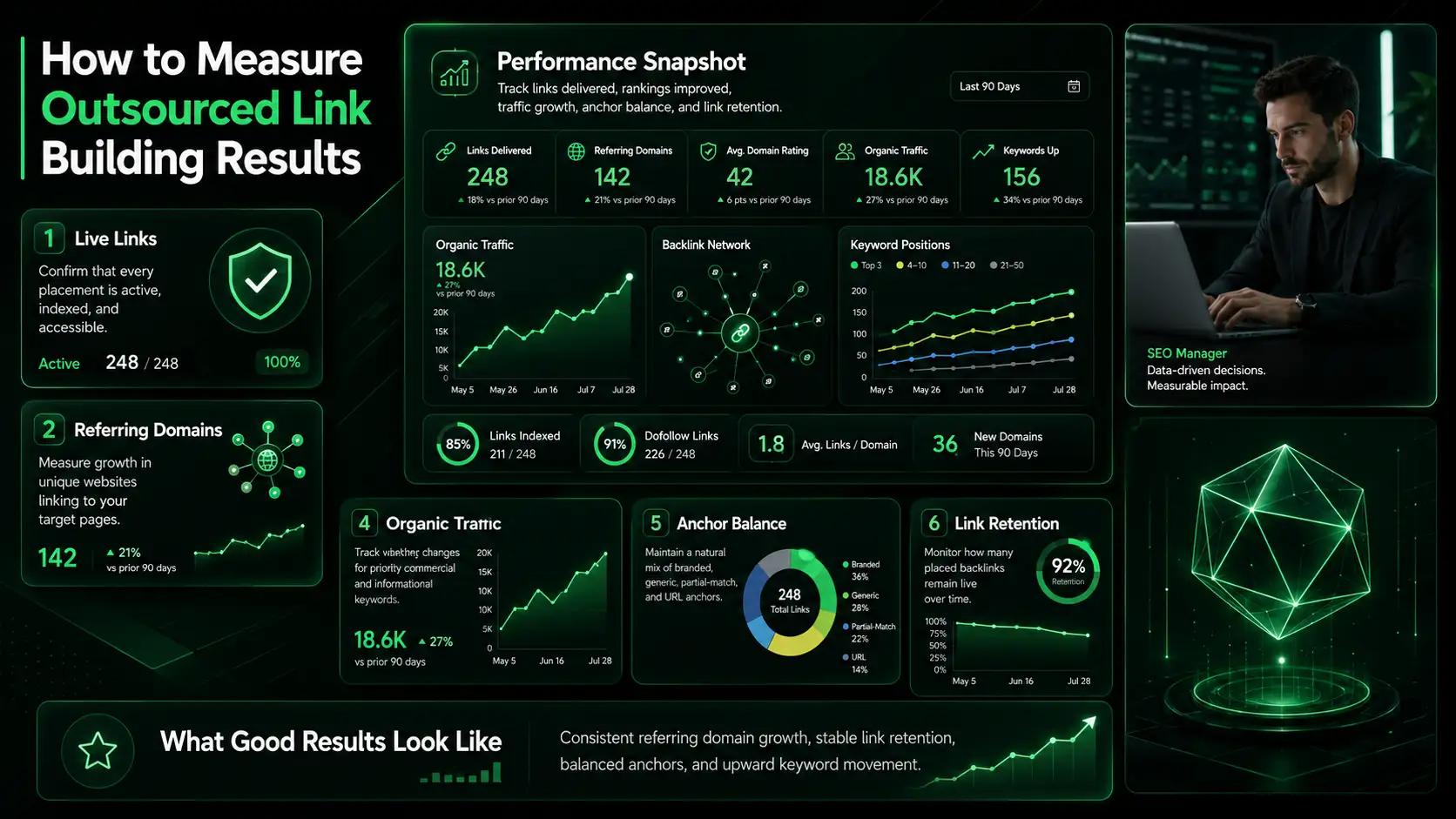
Result measurement is where many campaigns lose clarity. Counting links delivered is the starting point, not the finish line. A well-structured reporting process evaluates multiple dimensions of campaign performance — and feeds that data back into ongoing strategy decisions.
Metrics That Matter
| Metric | What It Tells You |
| Number of live links | Confirms placements are indexed and accessible |
| Referring to domain growth | Tracks the expansion of your unique linking domain footprint |
| Keyword ranking changes | Shows movement for target URLs on priority keywords |
| Organic traffic to target pages | Validates whether ranking improvements are generating actual visits |
| Anchor text distribution | Monitors balance between branded, generic, and keyword-rich anchors |
| Relevance of linking pages | Assesses topical alignment between linking content and your niche |
| Link retention rate | Measures the percentage of placed links that remain live over time |
Track these metrics monthly against your baseline. Consistent growth across referring domains, combined with upward keyword movement on target pages, indicates a healthy and effective campaign. Sudden drops in link retention or anchor distribution imbalances are early warning signals that require immediate review.
Common Mistakes When Outsourcing Link Building
Even businesses that invest in reputable providers can undermine their own campaigns through avoidable strategic errors. These are the most common — and the most costly.
Buying Links Without a Strategy
Acquiring backlinks without defined target pages, anchor text guidelines, or campaign goals produces scattered results at best. Link building requires direction. Without knowing which pages need authority, what topical signals to reinforce, and what keyword movements to target, even high-quality placements fail to deliver their full potential ranking impact.
Choosing the Cheapest Provider
Low-cost link packages almost always reflect one of three realities: automated outreach with low acceptance rates, placements on irrelevant or low-traffic websites, or link farms and PBN networks. All three options either produce no measurable SEO benefit or actively harm your backlink profile. Price is a reasonable consideration, but it should never be the primary selection criterion when evaluating link-building agencies.
Ignoring Topical Relevance
A backlink from a website that covers entirely unrelated content is unlikely to reinforce your topical authority or produce meaningful ranking improvements. In 2026, search engine algorithms place considerably more weight on contextual and topical relevance than they did in previous years. Every placement should come from a website that operates in, or is closely adjacent to, your niche.
Overusing Commercial Anchors
An anchor text profile dominated by exact-match commercial keywords is one of the clearest signals of manipulative link building. A natural backlink profile contains a mix of branded anchors, generic terms, partial-match phrases, and naked URLs. Over-indexing on commercial anchors — especially for highly competitive keywords — creates algorithmic risk that can offset any short-term ranking gains.
Not Reviewing Reports and Live URLs
Trusting reports without verifying individual placements is a critical oversight. Some providers inflate reporting metrics with low-quality placements that technically count as live links but carry no real SEO value. Review every placed URL directly. Check that the page has organic traffic, that the link is contextually embedded, and that the anchor text matches what was agreed. Regular manual audits keep your agency accountable and protect the integrity of your link profile.
Is Outsourcing Link Building Worth It in 2026?
For most businesses operating in competitive niches, the answer is clearly yes — provided the outsourcing is done through a structured, quality-controlled process. The comparison between in-house and outsourced link building comes down to three factors: speed, scale, and cost efficiency.
| Dimension | In-House Link Building | Outsourced Link Building |
| Startup time | 3–6 months to build capacity | Immediate access to existing systems |
| Publisher relationships | Built gradually over time | Pre-established across niches |
| Scalability | Limited by headcount | Adjustable by campaign volume |
| Cost model | Fixed (salaries, tools, training) | Variable (per link or monthly retainer) |
| Quality control | Fully internal | Requires provider vetting and oversight |
| Reporting | Depends on internal tools | Should be included in service |
| Risk management | Easier to control directly | Requires clear briefs and review processes |
Outsourcing accelerates the pace at which you can build authority, but it requires active participation from your side. Defining goals clearly, reviewing placements consistently, monitoring anchor distribution, and providing feedback when quality dips — these responsibilities don’t disappear when you outsource. The businesses that get the most from outsourced link building treat their agency as a managed extension of their SEO team, not a passive vendor.
For businesses ready to move beyond generic link acquisition and invest in a structured, editorial approach, white hat link building services offer the safest foundation for long-term organic search growth.
FAQs About Outsourcing Link Building
It’s time to outsource when link building requires consistent effort your team can no longer sustain internally. If your in-house SEO team is stretched across technical work, content strategy, and reporting, outreach is usually the first thing dropped. Link building can also stall when you lack established publisher relationships or outreach systems — and without those, building backlinks for your website at any meaningful scale becomes nearly impossible. When the gap between your link profile and your competitors’ keeps widening, outsourcing is the practical next step.
Yes — if you choose the wrong provider. Low-quality link packages, PBN placements, and irrelevant domains can actively damage your organic search performance. A link won’t help your rankings just because it exists; it needs to come from a topically relevant, editorially credible website with real organic traffic. To outsource link building without creating risk, prioritize agencies that use manual outreach, offer domain approval, and can demonstrate a transparent link building process from prospecting to placement.
Successfully outsource link building by treating it as a managed partnership, not a passive purchase. Start by defining your SEO goals and target pages, then share that brief clearly with your link-building company. Approve domains before placements go live, review every delivered URL individually, and track anchor text distribution monthly. The best link-building outcomes come from businesses that stay on top of reporting, provide feedback, and adjust strategy based on keyword and traffic data — not from those who hand off the process entirely and check back in six months.
Focus on the quality of links, not the volume or the price per placement. A credible agency will show you real link samples from relevant niches, explain exactly how they get backlinks through manual outreach, and give you control over domain selection before anything goes live. They should also build relationships with publishers rather than buying access through networks, produce genuine SEO content that earns editorial placement, and provide clear reporting that includes live URLs, traffic data, and anchor text used. Agencies that can’t explain their process in detail are worth avoiding.
Relevant backlinks are one of the most direct ways to build page-level authority and improve rankings for competitive keywords. When you focus on link building with editorial placements from topically aligned websites, you signal to search engines that your content deserves to rank. Link building can also support broader SEO goals — reinforcing topical authority across content clusters, accelerating indexing for new pages, and strengthening commercial URLs that can’t easily attract links organically. The cumulative effect on long-term SEO is substantial when placements are consistent and quality-controlled.
It depends on your volume needs and how much internal management you can commit to. A freelancer can handle outreach support effectively for smaller campaigns, but they typically won’t manage content creation, domain vetting, reporting, and strategy simultaneously. SaaS companies, e-commerce brands, and seo agencies with ongoing link-building needs usually get better results from a full-service agency that handles the entire link-building process end to end. If you want to outsource link-building without managing multiple moving parts yourself, a structured agency relationship is the more reliable choice.
Yes — and building the right way on commercial pages is one of the highest-ROI applications of outsourced link acquisition. Product and service pages rarely attract links organically because they aren’t inherently linkable. An experienced agency secures contextual placements that pass authority directly to those URLs, helping them compete for high-intent keywords. The key is ensuring the anchor text strategy is balanced, the linking sites are genuinely relevant to your niche, and the placements look editorially natural — not like paid insertions. Done correctly, this approach delivers measurable ranking improvements for the pages that matter most to your business.