Internal links are one of the most controllable elements of on-page SEO, yet the distinction between contextual and navigational internal links is frequently overlooked. Understanding how these two link types differ in purpose, placement, and SEO impact can help you make more deliberate decisions about site architecture, content strategy, and how link equity flows across your pages.
Quick Comparison
| Characteristic | Contextual Internal Links | Navigational Internal Links |
|---|---|---|
| Placement | Within body content, surrounded by relevant text | Menus, headers, footers, sidebars, breadcrumbs |
| Primary purpose | Topical relevance, content discovery, link equity flow | Site structure, user wayfinding, consistent access |
| Anchor text | Descriptive, keyword-rich, varies by context | Short, label-style, often repeated site-wide |
| Editorial control | High — chosen per page and per paragraph | Moderate — set at template or CMS level |
| Link equity distribution | Targeted — passes equity to specific deep pages | Broad — distributed across all linked pages equally |
| Crawl signal | Reinforces topical relationship between pages | Signals structural importance of linked pages |
| User experience role | Encourages deeper reading and content exploration | Provides consistent orientation and quick access |
| Scalability | Requires ongoing editorial effort | Scales automatically with site template |
| Risk of over-optimisation | Higher if anchor text is manipulative or repetitive | Lower, but excessive footer links can dilute equity |
What Are Contextual Internal Links?
A contextual internal link is a hyperlink placed within the body text of a page, surrounded by relevant prose that gives the link meaning. The surrounding sentences provide topical context that helps both readers and search engine crawlers understand the relationship between the linking page and the destination page. Because the link appears within editorial content rather than a template element, it carries a stronger topical signal than a link placed in a menu or footer.
For example, an article about technical SEO audits might include a sentence such as: “Crawl budget management becomes especially important for large e-commerce sites with thousands of product pages.” A contextual link on the phrase “crawl budget management” pointing to a dedicated guide on that topic tells a crawler that the two pages share a meaningful topical relationship. This kind of signal can help search engines understand your site’s content clusters and may support the ranking potential of the destination page.
Contextual internal links are particularly useful for passing link equity to deep pages that are not featured in the main navigation. Blog posts, resource guides, product category pages, and landing pages that sit several clicks from the homepage often rely on contextual links to receive a share of the site’s internal link equity. Without them, these pages may be crawled less frequently and may receive weaker topical reinforcement from the rest of the site.
What Are Navigational Internal Links?
Navigational internal links are the links that appear in persistent site elements: the main menu, header, footer, sidebar, and breadcrumb trail. Their primary function is to help users find their way around the site and to signal to search engines which pages are structurally important. Because navigational links appear on every page of a site, they tend to receive a large share of internal link equity by default.
The anchor text used in navigational links is typically short and label-like — “Services”, “Blog”, “Contact”, “Pricing” — rather than descriptive or keyword-rich. This is appropriate for their purpose: users scanning a menu need clear labels, not optimised phrases. However, it also means that navigational links contribute less topical context than a well-written contextual link embedded in relevant body content.
Breadcrumb navigation is a specific type of navigational link that reflects the hierarchical path to the current page, such as Home > Blog > SEO > Internal Linking. Breadcrumbs serve both a usability function and a structural SEO function by reinforcing the site’s category hierarchy. Search engines may use breadcrumb markup to display structured path information in search results, which can improve click-through rates for some queries.
How Each Link Type Affects Link Equity Flow
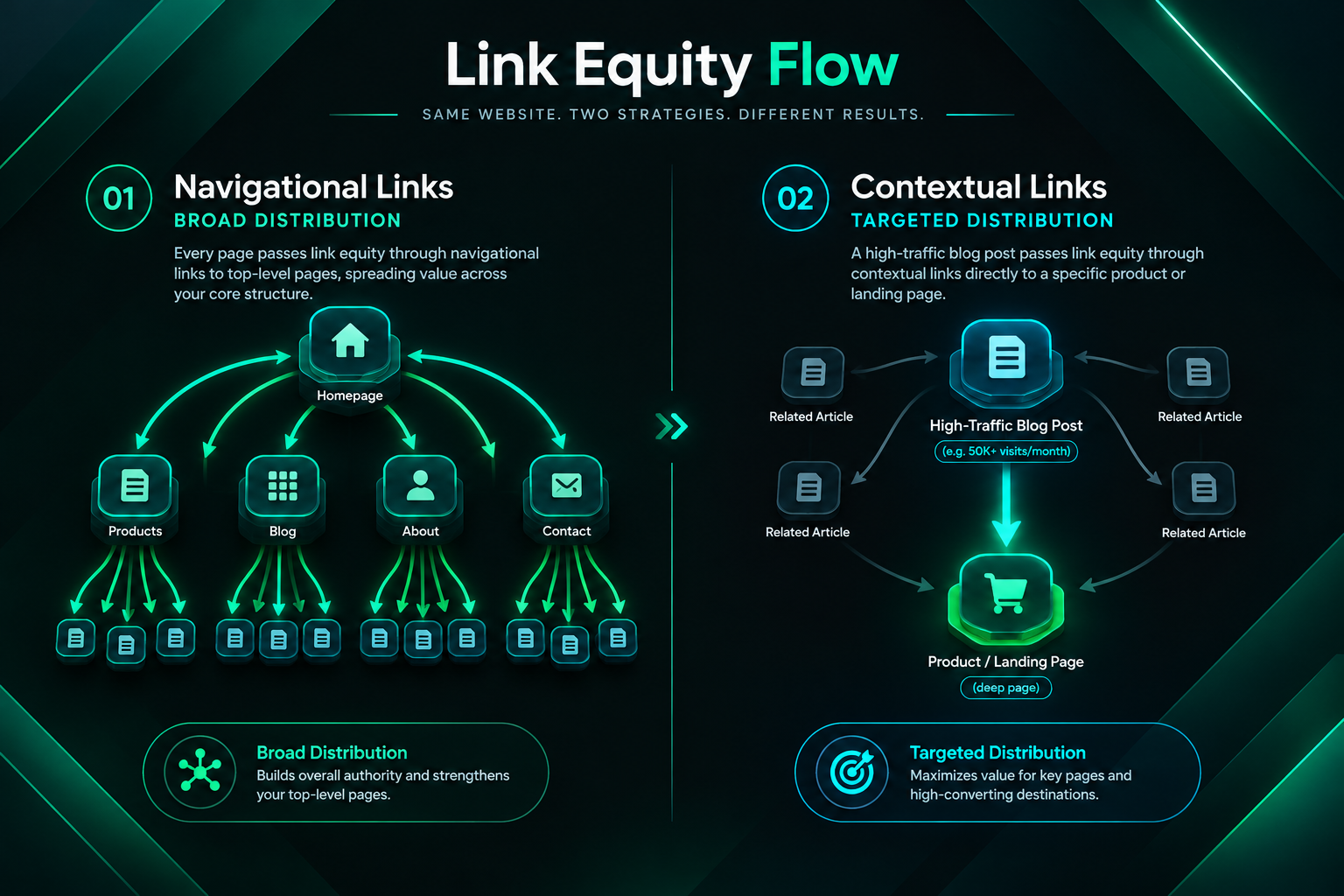
Link equity — sometimes called PageRank or link juice — flows through internal links just as it does through external backlinks. The way you structure your internal links determines how that equity is distributed across your pages. Navigational links, because they appear on every page, create a baseline level of equity for the pages they point to. The homepage, main category pages, and top-level service pages typically benefit most from navigational links.
Contextual links allow you to direct equity more precisely. If a high-traffic blog post earns external backlinks, some of that equity can be passed to a related product page or a conversion-focused landing page through a well-placed contextual link. This targeted distribution is one reason why content-led SEO strategies often emphasise building a strong internal linking structure alongside external link acquisition.
It is worth noting that the total amount of equity a page can pass is not unlimited. A page with many outgoing links distributes its equity across all of them. This is sometimes called link dilution. Excessive footer links pointing to dozens of pages, or navigational menus with very large numbers of items, can reduce the equity each individual link passes. This does not mean you should minimise your navigation, but it is a reason to be deliberate about which pages receive prominent navigational placement.
Anchor Text: Contextual vs Navigational Approaches
Anchor text — the visible, clickable text of a link — carries a relevance signal that search engines use to understand what the destination page is about. Contextual internal links offer the greatest opportunity to use descriptive, keyword-relevant anchor text because the surrounding content provides natural justification for specific phrasing. A link reading “on-page SEO checklist” within a paragraph about content optimisation is both useful to the reader and informative to a crawler.
Navigational anchor text serves a different purpose. Labels like “Home”, “About”, or “Case Studies” are not optimised for keywords, nor should they be. Forcing keyword-rich anchor text into a main menu can create an unnatural user experience and may look manipulative to search engines if the phrasing is clearly designed to influence rankings rather than help users navigate.
Over-optimising contextual anchor text carries its own risks. Using the same exact-match keyword phrase repeatedly as anchor text for the same destination page — across many different articles — can appear manipulative. A natural internal linking profile includes varied anchor text: some exact-match, some partial-match, some branded, and some generic. The variation should arise naturally from writing about the topic in different ways, not from following a rigid formula.
Topical Authority and Content Clusters
One of the most discussed applications of contextual internal linking is the content cluster or topic cluster model. In this approach, a central “pillar” page covers a broad topic comprehensively, while a series of supporting cluster pages cover related subtopics in depth. Contextual links connect the cluster pages to the pillar and to each other, reinforcing the topical relationship between them.
Navigational links typically cannot replicate this function. A main menu cannot practically link to every cluster page, and doing so would undermine the menu’s usability. Contextual links within the body content of each cluster page are what create the dense, topically coherent internal linking network that supports this model. When search engines crawl these interconnected pages, the consistent topical signals may help them understand the site’s expertise on a given subject area.
It is important to be realistic about what internal linking alone can achieve. Topical authority is influenced by content quality, the depth and accuracy of information, external backlinks from relevant sources, and user engagement signals — not just internal link structure. A well-linked cluster of thin or inaccurate content is unlikely to perform as well as a smaller set of genuinely useful, well-researched pages, even if the internal linking is technically sound.
Crawlability and Indexation
Search engine crawlers discover pages by following links. Navigational links ensure that the most important pages on a site are discoverable from every other page, which is why pages in the main navigation are typically crawled more frequently and indexed more reliably. If a page is not linked from anywhere on the site — sometimes called an orphan page — crawlers may not find it at all, regardless of how good the content is.
Contextual links extend crawl coverage to pages that navigational links do not reach. A blog post published three months ago may no longer appear in a “recent posts” sidebar widget, but if it is linked contextually from a newer, frequently crawled page, it remains accessible to crawlers. This is particularly relevant for large sites with deep content archives, where navigational links alone cannot surface every page efficiently.
For sites experiencing crawl budget constraints — typically large e-commerce sites, news publishers, or sites with many dynamically generated URLs — the structure of internal links becomes more consequential. Prioritising contextual links to high-value pages and auditing navigational links for unnecessary duplication or low-value destinations can help focus crawl activity where it matters most. However, crawl budget issues are rarely the primary concern for smaller sites, and a technical SEO audit is the appropriate starting point before drawing conclusions about crawl efficiency.
User Experience and Engagement
Internal links serve users as well as search engines, and the two functions are not always in tension. Contextual links that genuinely help a reader explore a related topic, find a relevant resource, or understand a concept in more depth can reduce bounce rates and increase pages-per-session metrics. These engagement signals may influence how search engines assess the quality and relevance of a page, though the precise relationship between engagement metrics and rankings is not fully documented in official search engine guidance.
Navigational links support a different aspect of user experience: orientation and efficiency. A clear, well-organised menu helps users find what they are looking for without frustration, which is particularly important for e-commerce sites, service businesses, and any site where conversion depends on users reaching specific pages quickly. Poor navigation can increase exit rates and reduce conversions regardless of how well the site ranks.
The practical implication is that contextual and navigational links serve complementary roles. Optimising one at the expense of the other is rarely the right approach. A site with excellent contextual linking but a confusing navigation structure may rank reasonably well but convert poorly. A site with a well-structured menu but no contextual links may struggle to surface deep content in search results.
Practical Considerations for Internal Link Audits
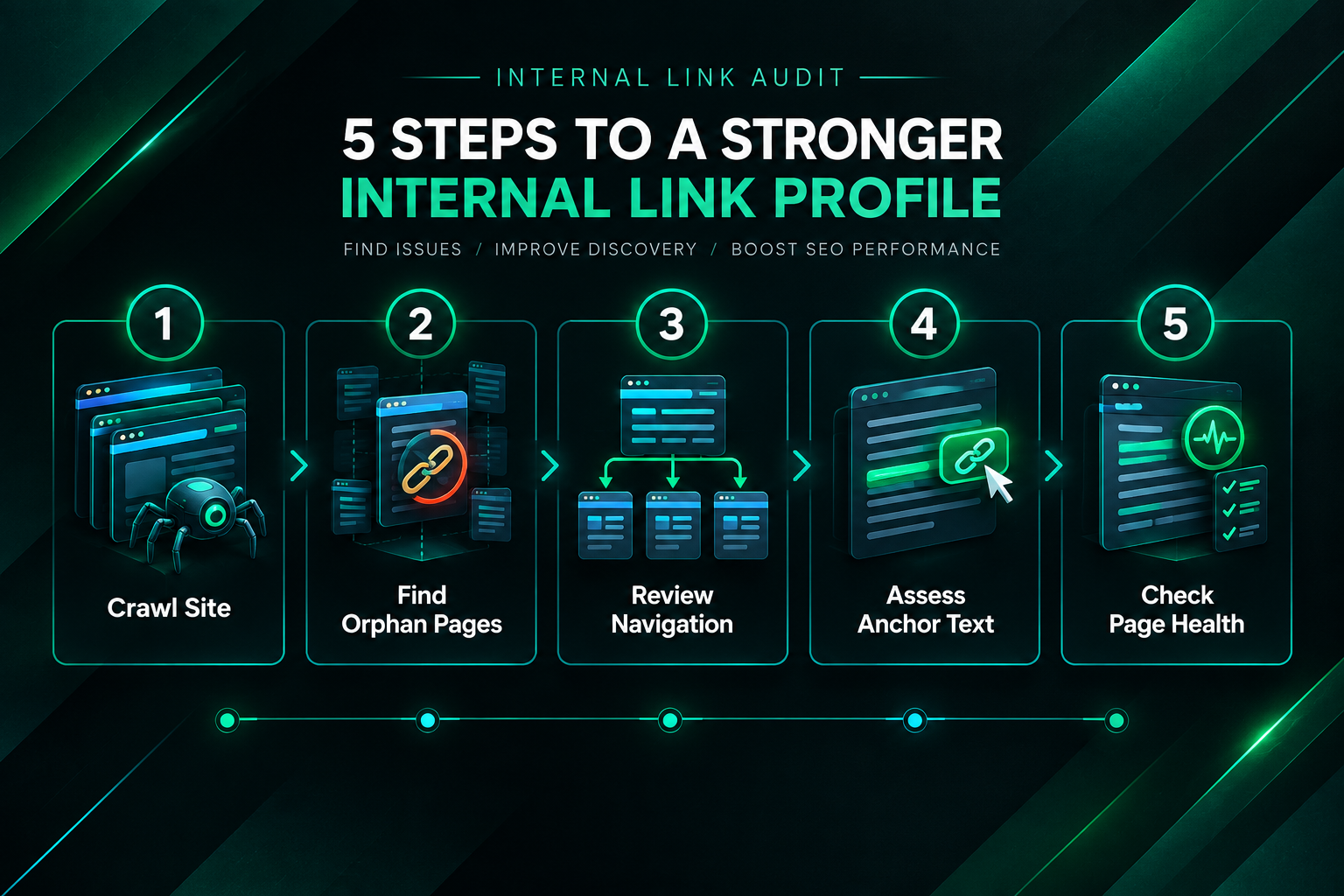
When auditing internal links, it is useful to assess both link types separately before drawing conclusions about the overall structure. For navigational links, the key questions are: which pages receive the most navigational prominence, does the menu structure reflect the site’s most commercially important pages, and are there any navigational links pointing to low-value or duplicate pages that could dilute equity?
For contextual links, the audit should identify orphan pages that receive no contextual links, high-authority pages that are not passing equity to related conversion pages, and instances where anchor text is repetitive or potentially over-optimised. Tools such as Screaming Frog, Ahrefs, or Semrush can map internal link structures and identify pages with unusually high or low numbers of internal links, though interpreting the data still requires editorial judgement about content relationships.
A common finding in internal link audits is that older, high-performing content pages are not linking to newer pages on related topics. Adding contextual links from established pages to newer content can help newer pages get crawled and indexed more quickly, and may support their early ranking trajectory. This is a relatively low-effort intervention compared to external link acquisition, though its impact will depend on the overall authority of the site and the competitiveness of the target keywords.
Internal Linking in the Context of External Link Building
External backlinks and internal links work together rather than independently. When a page earns an external backlink from a relevant, authoritative source, that link passes equity to the landing page. How much of that equity reaches other pages on the site depends on the internal link structure. A well-planned internal linking strategy ensures that equity earned through external link acquisition is distributed to the pages that most need it — typically conversion pages, product pages, or pillar content that may not attract as many direct external links.
This relationship is one reason why internal link planning is often discussed alongside external link building campaigns. If a site is investing in guest posting, digital PR, or manual outreach to build external links to specific pages, the internal link structure should be reviewed to ensure those pages are also passing equity to related pages that support the broader SEO strategy. Acquiring external links to a page that is poorly integrated into the site’s internal structure may limit the overall impact of the campaign.
For businesses working with an external link building provider, sharing information about the site’s internal link structure and priority pages can help the provider target link placements more effectively. A link to a well-connected hub page may deliver broader benefits than a link to an isolated page with few internal connections, depending on the campaign goals.
Common Mistakes with Internal Link Strategy
Several recurring mistakes reduce the effectiveness of internal linking. The first is treating internal links as an afterthought — adding them only when a content editor happens to remember, rather than planning them as part of the content creation process. This tends to produce an uneven internal link distribution where some pages are heavily linked and others are effectively invisible within the site.
The second common mistake is over-relying on navigational links and assuming they are sufficient. For sites with large content libraries, navigational links alone cannot create the topical relationships that support content cluster strategies. Deep pages need contextual links from relevant content to receive meaningful equity and crawl attention.
A third mistake is using generic anchor text for contextual links — phrases like “click here”, “read more”, or “this article” — which provide no topical signal to search engines. Descriptive anchor text that reflects the content of the destination page is more useful both for users and for search engine understanding, provided it is written naturally rather than forced.
Finally, some sites create internal links that point to pages with thin content, redirect chains, or canonical issues. A link that passes equity to a page that immediately redirects to another URL, or to a page that is canonicalised to a different URL, may not deliver the intended benefit. Internal link audits should check destination page health alongside link structure.
Frequently Asked Questions
Do contextual internal links carry more SEO value than navigational links?
Contextual internal links generally carry stronger topical signals because the surrounding content provides relevance context. However, navigational links are important for establishing structural importance and ensuring consistent crawl access to key pages. Both types contribute to a healthy internal link profile in different ways.
How many contextual internal links should a page have?
There is no universally correct number. The appropriate number depends on the length and depth of the content, the number of genuinely related pages on the site, and whether each link adds value for the reader. Forcing links into content where they are not naturally relevant is unlikely to help and may harm readability. Quality and relevance matter more than quantity.
Can internal links replace external backlinks for SEO purposes?
Internal links and external backlinks serve different functions and are not interchangeable. External backlinks from relevant, authoritative sites pass equity from outside the site and contribute to domain-level authority signals. Internal links distribute existing equity within the site and reinforce topical relationships. A strong internal link structure can help maximise the value of external links already earned, but it cannot substitute for them in competitive search environments.
Should footer links be avoided?
Footer links are not inherently problematic, but they should be used deliberately. Footers that link to a small number of genuinely important pages — legal pages, key service pages, contact information — are standard practice. Footers stuffed with dozens of keyword-rich links to every page on the site can dilute equity and may appear manipulative. The test is whether the footer links serve a genuine user need.
How does breadcrumb navigation affect internal linking?
Breadcrumb navigation reinforces the hierarchical structure of a site and provides a consistent internal link path from deep pages back to category and homepage levels. It supports both user orientation and crawl efficiency. When implemented with structured data markup, breadcrumbs may also appear in search result snippets, which can improve click-through rates for some queries.
Is it worth auditing internal links if the site already has good external backlinks?
Yes. External backlinks deliver equity to specific landing pages, but how that equity flows to other pages depends on the internal link structure. An audit may reveal that equity is not reaching the pages that most need it, or that high-value pages are poorly connected to related content. Improving internal link distribution can help maximise the return on external link building investment.
Choosing the Right Internal Link Strategy for Your Site
Contextual and navigational internal links are not competing strategies — they address different needs and work best when planned together. Navigational links establish the structural foundation of a site, ensuring that the most important pages are consistently accessible and receive a reliable share of internal equity. Contextual links extend that foundation by creating topical connections between related pages, directing equity to deep content, and reinforcing the subject-matter relationships that support content cluster strategies.
The right balance depends on the size and type of your site, the depth of your content library, and your SEO priorities. A small service business with a straightforward site structure may find that a well-organised navigation and a modest number of contextual links within blog content is sufficient. A large e-commerce site or a content-heavy publisher may need a more systematic approach to contextual linking, including regular audits to identify orphan pages, equity gaps, and anchor text patterns.
If your site is also investing in external link building, reviewing your internal link structure before or during a campaign can help ensure that acquired links deliver their full potential benefit. A qualified SEO professional or link building provider can help assess how your internal and external link strategies interact and identify where adjustments may improve overall campaign effectiveness. As with any SEO decision, the appropriate approach depends on a site-specific assessment rather than a universal formula.