White hat link building is the process of earning backlinks through ethical, editorial, and relevance-based methods that align with Google’s quality guidelines. The goal is not simply to increase backlink volume — it is to build a trusted backlink profile that supports long-term organic growth without exposing your website to algorithmic penalties or manual actions.
Safe link acquisition relies on manual outreach, useful content, relevant publisher relationships, natural anchor text, and transparent placement practices. This guide covers the most effective white hat link-building tactics used by professional SEO agencies today — from digital PR and guest posting to broken link building, data studies, and expert outreach.
What Is White Hat Link Building?
White hat link building is the process of earning backlinks through methods that prioritize editorial value, topical relevance, and genuine publisher relationships. Unlike manipulative approaches, white hat tactics are designed to work with Google’s ranking systems rather than against them — producing backlinks that strengthen domain authority and support consistent ranking improvement over time.
The foundation of any effective white hat link building strategy includes:
- Manual outreach to real publishers and website owners
- High-quality content that gives publishers a genuine reason to link
- Niche-relevant placements on websites with real audiences and organic traffic
- Natural anchor text distribution that reflects authentic editorial patterns
- Transparent processes with no hidden payments or undisclosed sponsored content
White hat backlinks reduce SEO risk significantly compared to manipulative link schemes. When Google evaluates a backlink profile, it looks for editorial intent, contextual relevance, and authentic placement signals. Tactics that meet those standards contribute to ranking stability. Tactics that do not work can result in manual actions, algorithmic filtering, or costly link cleanup campaigns that set a website back by months.

Mon-Fri: 09:00 AM – 06:00 PM
Best White Hat Link Building Strategies Compared
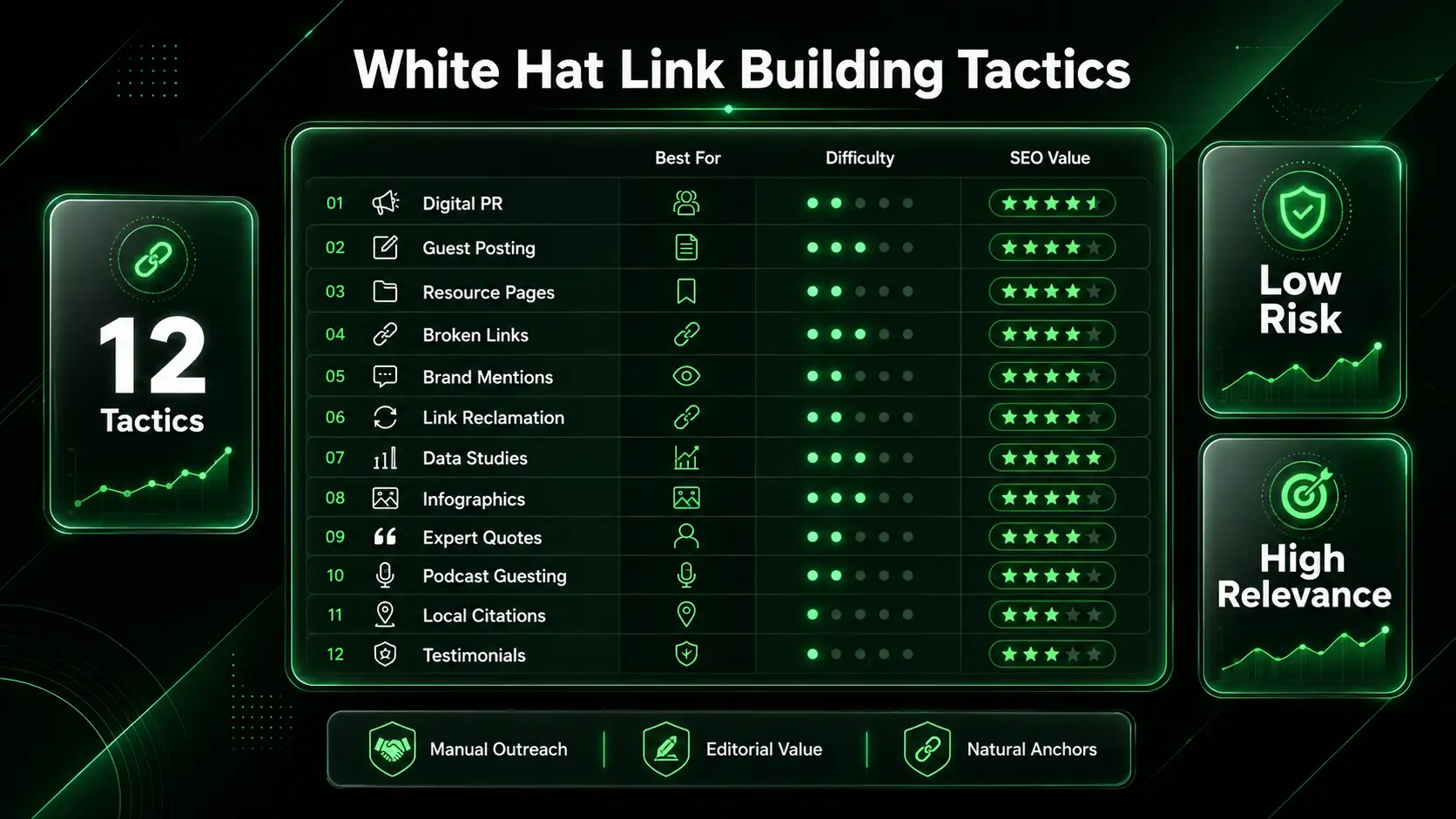
| Tactic | Best For | Difficulty | SEO Value |
| Digital PR | Authority links and media mentions | High | Very high |
| Guest posting | Contextual backlinks | Medium | High |
| Resource page outreach | Evergreen niche links | Medium | High |
| Broken link building | Replacing dead links | Medium | Medium-high |
| Unlinked brand mentions | Existing brand demand | Low-medium | High |
| Link reclamation | Lost backlink recovery | Low | Medium-high |
| Data studies | Natural citations | High | Very high |
| Infographics | Visual link assets | Medium | Medium |
| Expert quote outreach | PR and authority | Medium | High |
| Podcast guesting | Personal brand links | Medium | Medium |
| Local citations | Local SEO | Low | Medium |
| Testimonials | Partner and vendor links | Low | Medium |
1. Digital PR Campaigns
Digital PR helps brands earn backlinks from media outlets, industry publications, and authority blogs through genuinely newsworthy content. This tactic works best when a brand has something worth publishing — original research, expert commentary, proprietary statistics, market insights, or a compelling industry angle that journalists and editors actually want to cover.
The process follows a clear editorial sequence:
- Develop a data-led story — surveys, industry reports, case study findings, or trend analyses
- Prepare a targeted media pitch — concise, specific, and framed around publication relevance
- Contact journalists and editors — directly, not through mass distribution services
- Focus on editorial value — the backlink should follow naturally from genuine media interest, not be the primary ask
Digital PR backlinks are among the safest white hat links available because they are earned through authentic publisher interest. A mention in a recognized industry publication or news outlet carries both direct authority and strong topical relevance signals. For brands looking to build high-quality backlinks at scale without compromising editorial standards, this tactic consistently delivers the strongest return per placement of any link acquisition method.
2. Guest Posting on Relevant Websites
Guest posting remains one of the most widely used white hat link building strategies — and when executed correctly, it is still highly effective. The key distinction is relevance. A guest post earns a valuable backlink only when it is published on a website with genuine organic traffic, real editorial standards, and an audience that overlaps with the target niche.
What separates effective guest posting from risky link spam comes down to execution:
- Identify niche-relevant websites with organic traffic and editorial guidelines
- Pitch specific article ideas that serve the publisher’s audience, not just the linker’s goals
- Write content that provides real value — not thin posts produced only for link placement
- Avoid guest post farms — networks that sell placements on sites with no real readership
- Control anchor text naturally — vary branded, partial-match, and contextual anchors across placements
Quality, relevance, and anchor control matter far more than placement volume. Agencies managing guest posting campaigns at scale maintain publisher vetting processes, editorial checks, and anchor distribution tracking to ensure every placement contributes positively to the client’s backlink profile. For brands evaluating managed campaign options, a well-structured outsource link-building strategy ensures guest posts are placed with the consistency and quality control that in-house teams often cannot sustain.
3. Resource Page Link Building
Resource pages are curated lists of useful guides, tools, services, or references built for a specific audience. This tactic works when your content genuinely belongs on the page — meaning it improves the resource for the audience and gives the publisher a valid editorial reason to add the link.
The resource page outreach process:
- Find relevant resource pages using search operators targeting your niche
- Review existing links to assess quality, relevance, and whether gaps exist
- Identify where your asset fits — a guide, tool, dataset, or template that adds genuine value
- Send a personalized outreach email explaining specifically why your content improves the page
Weak resource pages should be avoided. Pages created primarily to sell outbound links, pages with dozens of unrelated listings, or pages with no clear editorial purpose offer little link value and can introduce low-quality signals into a backlink profile. The target is a genuine resource page with a real audience, consistent maintenance, and topical alignment with your niche.
4. Broken Link Building
Broken link building helps website owners fix dead external links while giving your site the opportunity to earn a contextually relevant backlink in return. The value of this tactic comes from solving a real problem for the publisher — a broken outbound link hurts their page’s user experience and credibility, and your outreach offers a direct solution.
How to execute broken link building effectively:
- Use SEO tools to identify broken outbound links on relevant pages in your niche
- Match or create a suitable replacement page — content that closely mirrors the original topic
- Contact the website owner or editor with a clear, polite outreach message
- Explain why your content is a useful substitute — focus on the value for their readers
The replacement content must closely match the original context. Pitching an unrelated page as a substitute for a broken link reduces response rates and undermines the tactic’s editorial legitimacy. When the content match is strong and the outreach is well-timed, broken link building produces backlinks that are both contextually sound and editorially earned.
5. Unlinked Brand Mentions
Unlinked brand mentions occur when another website references a brand name, product, founder, study, or service without adding a hyperlink back to the source. These represent some of the easiest link opportunities to convert because the publisher has already demonstrated awareness of and interest in the brand — the outreach simply requests proper attribution.
The process for converting unlinked mentions:
- Monitor brand mentions using tools like Google Alerts, Ahrefs, or Mention
- Check each mention to confirm whether a link is present or missing
- Contact the publisher with a short, direct message requesting attribution
- Keep the outreach professional and brief — the publisher already knows the brand
Response rates for unlinked mention outreach tend to be higher than cold prospecting because there is no need to justify relevance. The brand is already referenced. Framing the request as a simple correction or improvement — rather than a direct link-building ask — further increases conversion rates and keeps the publisher relationship positive.
6. Link Reclamation
Link reclamation focuses on recovering backlinks that were lost due to deleted pages, broken redirects, content updates, or publisher-side changes. Because the link previously existed, reclamation is typically faster and more efficient than building entirely new backlinks from scratch.
Steps to execute a link reclamation campaign:
- Audit lost backlinks using tools like Ahrefs, Semrush, or Majestic
- Identify the reason for each lost link — 404 errors, redirect chains, removed content, or publisher changes
- Fix technical issues on your own site — restore deleted pages, correct redirect paths, update moved content
- Contact publishers when the link was removed due to a content update or site migration on their end
Link reclamation protects existing link equity and prevents a gradual erosion of domain authority that can occur when backlinks disappear without being replaced. For websites that have undergone migrations, redesigns, or significant content restructuring, a reclamation audit often recovers meaningful ranking signals that would otherwise be permanently lost.
7. Data Studies and Original Research
Original research attracts backlinks because journalists, bloggers, and industry writers need reliable statistics to support their articles. A data study that produces unique, credible findings becomes a citable source — and citable sources earn links naturally over time without ongoing outreach effort.
This tactic is especially effective for:
- SaaS and technology companies publishing platform usage data or industry benchmarks
- Marketing agencies reporting on campaign performance trends
- Finance and HR brands covering compensation, hiring, or spending data
- e-commerce businesses analyzing consumer behavior or seasonal purchase patterns
The execution process:
- Collect data through surveys, platform analytics, public datasets, or proprietary research
- Publish clear, well-structured findings with methodology transparency
- Add charts, tables, or visual summaries to improve shareability and citation potential
- Promote the study through targeted outreach to journalists and niche publications
Transparent methodology increases both trust and linkability. Studies that show their data sources, sample sizes, and collection methods are cited more frequently because readers and editors can independently evaluate the credibility of the findings.
8. Infographic Link Building
Infographics turn complex information into a visual asset that publishers can reference, embed, or share with their audience. This tactic works best when the infographic is built around genuinely useful data, meaningful comparisons, practical checklists, or step-by-step explanations — not decorative visuals with minimal informational value.
What an effective infographic link-building campaign requires:
- Create a niche-specific visual based on original data or a well-researched topic
- Prepare a short supporting article or description that adds written context around the graphic
- Pitch the infographic to relevant blogs and publications in the target niche
- Offer an embed option with a simple HTML snippet that includes proper attribution
Design quality matters, but it is secondary to informational value. An infographic that answers a question, simplifies a complex process, or presents surprising data will earn links on merit. A visually polished graphic with no substance will not. The most linkable infographics tend to cover topics with high search demand, clear visual potential, and limited existing visual coverage in the niche.
9. Expert Quote Outreach
Expert quote outreach allows brands to earn backlinks by providing professional commentary to journalists, bloggers, and industry publications actively seeking authoritative sources. This tactic is particularly well-suited for founders, consultants, analysts, and niche specialists who can offer credible, specific insights that editorial teams cannot easily find elsewhere.
The process for effective expert quote outreach:
- Monitor journalist and blogger requests through platforms like HARO, Qwoted, or SourceBottle
- Respond quickly — request windows are often short, and early responses receive priority
- Provide concise, specific expert insight that directly addresses the journalist’s question
- Include credentials — job title, company, years of experience, or relevant publications
Strong quotes are specific, evidence-based, and directly relevant to the publication’s audience. Generic statements that could apply to any topic are rarely selected. The brands that earn the most backlinks through expert outreach are those that respond fast, stay on topic, and demonstrate genuine expertise rather than promotional messaging disguised as commentary.
10. Podcast Guesting
Podcast guesting generates backlinks from episode pages, show notes, and host websites while simultaneously building personal brand authority and topical visibility. As the podcasting landscape has grown significantly, many industry shows maintain active websites with strong domain authority — making a well-placed guest appearance a legitimate and often underutilized source of white hat backlinks.
How to approach podcast guesting for link acquisition:
- Find relevant podcasts in your niche using directories like Listen Notes or Apple Podcasts
- Pitch a specific, useful topic that serves the host’s audience with practical value
- Prepare expert talking points backed by data, case studies, or direct operational experience
- Ensure the brand link appears naturally in the guest bio or resources section of the episode page
Podcast links may not always carry the same direct ranking weight as editorial backlinks from high-authority news outlets. However, they strengthen brand visibility, support topical authority signals, and contribute to a diverse, natural-looking backlink profile. For founders and agency leaders, consistent podcast guesting also builds the personal brand equity that makes future digital PR outreach more effective.
11. Local Citations and Business Listings
Local citations help businesses build trust and relevance through consistent company information across directories, maps, local platforms, and industry listings. This tactic is essential for local SEO and service-area businesses competing in location-specific search results where entity signals and NAP consistency directly influence rankings.
The process for building effective local citations:
- Submit accurate business details — name, address, phone number, and website URL
- Keep NAP data consistent across every platform and listing without variation
- Choose relevant directories — general platforms like Google Business Profile and Bing Places, plus niche-specific listings relevant to the industry
- Avoid spammy listing sites with no editorial standards, no real audience, or no domain relevance
Consistency in business information across authoritative platforms sends strong entity signals to search engines. Inconsistent NAP data — different phone numbers, address variations, or outdated listings — can dilute local relevance and weaken the trust signals that support local pack rankings. For businesses just beginning their link building journey, a curated profile backlink sites list can accelerate citation building by identifying the most trusted platforms worth prioritizing.
12. Testimonial Link Building
Testimonial link building works when a company provides genuine feedback to vendors, tools, partners, or platforms it already uses regularly. Many businesses publish customer testimonials on their website with a link back to the reviewer’s company — creating a natural, relevant backlink with minimal outreach effort required.
How to approach testimonial link building effectively:
- Identify services, tools, or platforms the company genuinely uses and values
- Prepare a real, specific testimonial that describes measurable results or meaningful experience
- Offer the testimonial to the vendor with a request for attribution and a brand link
- Keep the process authentic — testimonials written purely for link value are easy to identify
This tactic should remain genuine and selective. Submitting fabricated reviews or participating in organized testimonial exchanges creates an artificial link pattern that adds no real trust signal. The strongest testimonial backlinks come from recognizable vendors in the target industry — a relevant link on a well-known SaaS platform, agency partner page, or industry tool carries both SEO value and meaningful brand association.
White Hat vs Gray Hat vs Black Hat Link Building
Not all link-building strategies carry the same level of risk. Understanding the difference between white hat, gray hat, and black hat approaches helps SEO professionals make informed decisions about which tactics to prioritize — and which ones to avoid entirely.
White Hat Link Building
White hat link building methods are based on editorial value, genuine outreach, brand authority, and relevant content. Every placement is earned through a real publisher relationship or demonstrated content quality. Common white hat tactics include:
- Guest posting on niche-relevant websites with editorial standards
- Digital PR campaigns that earn media coverage and authority links
- Broken link building that helps publishers fix dead outbound links
- Resource page outreach where your content genuinely improves the page
- Link reclamation to recover lost backlinks from deleted or redirected pages
- Expert commentary provided to journalists and industry bloggers
These methods build a backlink profile that looks natural to search engines like Google because it genuinely is natural. Links are placed in context, on relevant sites, with varied anchor text — exactly how editorial links appear organically across the web.
Gray Hat Link Building
Gray hat link building sits in an uncomfortable middle ground. These methods may appear editorial on the surface but often rely on paid placements with weak disclosure, private publisher lists with low editorial standards, or artificial scaling that produces unnatural link patterns. Gray hat tactics can deliver short-term ranking movement, but they introduce long-term uncertainty. As Google’s link quality algorithms become more sophisticated, placements that were borderline acceptable in previous years are increasingly filtered or flagged without warning.
Black Hat Link Building
Black hat link building involves tactics that directly violate Google’s Webmaster Guidelines. These include:
- Automated spam through bulk link submission tools
- Link farms and private blog networks (PBNs) with no real editorial value
- Hacked links inserted into third-party websites without permission
- Irrelevant bulk backlinks from unrelated industries or low-quality directories
- Manipulative anchor text patterns designed to game exact-match keyword rankings
Black hat link building can produce fast ranking movement, but the risk is severe. Google’s manual review teams and algorithmic systems are specifically designed to detect these patterns. The result is often a ranking drop, a manual action, or a full domain-level penalty that requires expensive disavow work and months of recovery effort.
White Hat Link Building Tactics to Avoid Misusing
Even legitimate link-building methods can become risky when scaled without relevance, editorial control, or natural anchor distribution. Misapplying white hat tactics at volume introduces the same manipulative signals that black hat strategies produce — just more slowly and with less obvious cause. Understanding where the line sits protects a backlink profile from gradually degrading into a liability.
Over-Optimized Anchor Text
Exact-match anchor text used repeatedly across multiple placements creates an unnatural pattern that Google’s algorithms are specifically trained to identify. A backlink profile where a high percentage of anchors match a target keyword exactly looks manipulative — regardless of how editorially the individual links were acquired.
Recommended anchor text distribution:
- Branded anchors — company name, product name, or domain name
- Naked URLs — the full or shortened URL used as anchor text
- Partial-match anchors — the keyword embedded within a natural phrase
- Generic anchors — “read more,” “this guide,” “learn here”
- Exact-match anchors — used sparingly and only in genuinely contextual placements
Irrelevant Guest Posts
Guest posting is a white hat tactic only when the website, article topic, and link context are aligned with the target niche. Publishing guest posts on unrelated websites — even high-authority ones — weakens topical relevance signals and can dilute the thematic coherence of the backlink profile. A fitness brand earning links from a finance blog through a loosely connected article does not strengthen its authority in health or wellness search results.
Low-Quality Resource Pages
Not every page that calls itself a resource qualifies as one. Pages created primarily to sell outbound link placements, pages with dozens of unrelated listings, or pages with no real audience traffic contribute minimal link value. Worse, links from overtly commercial resource pages can introduce low-trust signals into a backlink profile. The test is straightforward: does the page exist to help an audience, or does it exist to distribute links?
Bulk Directory Submissions
Local citations and business directory listings support SEO when placed selectively on trusted, relevant platforms. Mass submission to hundreds of generic directories — especially low-quality or irrelevant ones — adds noise without authority. The return diminishes quickly after the core directory placements are covered, and the remaining submissions can drag down average link quality across the profile without contributing any meaningful ranking signal.
How to Build a White Hat Link Building Strategy

Individual tactics produce results. A structured campaign produces compounding results. Building white hat links without a clear strategy leads to inconsistent anchor distribution, mismatched targets, and backlink profiles that fail to reinforce the topical signals needed to rank for competitive keywords.
Start With Competitor Backlink Analysis
Competitor research reveals which domains, content formats, and link types support the top-ranking pages in your target niche. Analyzing competitor backlink profiles identifies:
- High-value referring domains that link to multiple competitors but not yet to your site
- Content types that attract the most editorial links in the niche
- Link gaps where your site is underrepresented compared to ranking competitors
- Realistic authority benchmarks for the domains required to compete effectively
This analysis defines the starting point for outreach targeting and content development. Without it, link-building campaigns are built on guesswork rather than data, and the budget gets allocated to tactics that do not address the actual ranking gap.
Match Tactics to Your Website Type
Different business models require different link-building approaches. Applying the wrong tactic to the wrong site type wastes outreach budget and produces links that do not reinforce the most important ranking signals.
| Website Type | Recommended Primary Tactics |
| SaaS brands | Digital PR, guest posting, expert quotes, data studies |
| eCommerce websites | Resource page outreach, infographics, blogger outreach |
| Affiliate sites | Niche editorial placements, data assets, resource outreach |
| Local businesses | Local citations, regional guest posts, testimonial links |
| Marketing agencies | Guest posting, digital PR, expert commentary, podcast guesting |
| B2B companies | Data studies, expert quotes, and industry publication placements |
Build Links Gradually
A natural backlink profile grows consistently over time — not in sudden spikes from unrelated sources or bursts of identical anchor patterns. Link velocity matters. A website that acquires fifty links in one week after months of inactivity raises a flag. A website that builds five to fifteen quality links per month across varied sources and anchor types looks like what it should be: a growing, authoritative domain earning recognition in its niche organically.
Sudden, unnatural spikes — particularly from low-quality sources — are one of the clearest signals of manipulative link building and one of the most common triggers for algorithmic filtering.
Track Results and Adjust the Campaign
Link building performance should be measured through multiple data points working together:
- Ranking movement for target keywords and supporting pages
- Organic traffic changes to linked pages and the domain overall
- Referring domain quality — authority, relevance, and traffic of linking sites
- Anchor text distribution — branded, partial-match, and exact-match ratios
- Indexation status — whether acquired backlinks have been crawled and indexed
- Target page performance — conversions, engagement, and visibility for linked pages
Tactics that consistently underperform should be replaced with better-performing outreach formats. Campaign flexibility is a competitive advantage — rigid strategies that ignore performance data produce diminishing returns, while well-managed campaigns identify and scale what works.
When to Outsource White Hat Link Building
Outsourcing link building makes strategic sense when an internal team lacks the outreach capacity, publisher relationships, content resources, or campaign management experience to execute consistently at scale. Building quality backlinks requires specialized skills across multiple disciplines — prospecting, copywriting, outreach, negotiation, and performance tracking — that most in-house teams are not resourced to cover simultaneously without sacrificing quality.
Managed white hat link building services provide the publisher networks, editorial infrastructure, and reporting systems that support scalable, penalty-safe campaigns without requiring internal teams to build those capabilities from scratch.
Signs You Need a Link Building Partner
Consider outsourcing when any of the following apply:
- Rankings are stuck despite strong on-page content and solid technical SEO
- Competitors are earning links faster and pulling ahead in target SERPs
- Outreach response rates are consistently low due to cold contacts and weak publisher relationships
- Internal teams lack the time to manage prospecting, content creation, and follow-up outreach together
- Link quality is inconsistent — a mix of strong placements and low-value directories with no clear strategy
- The website needs scalable backlink acquisition that grows with the campaign without sacrificing editorial standards
- Reporting, anchor control, and indexation tracking require professional campaign management tools and experience
A professional link-building agency brings publisher networks, content teams, outreach systems, and performance reporting infrastructure that would take years to build internally. For brands competing in established niches, outsourcing is often the fastest path to closing the link gap between their site and the top-ranking competitors they need to displace.
FAQs About White Hat Link Building Tactics
The safest approach is editorial link acquisition through digital PR, relevant guest posting, or expert commentary in established industry publications. The safest individual link sits inside relevant content on a trusted website with real organic traffic, uses a natural anchor that fits the surrounding context, and was placed through genuine editorial interest rather than a direct payment. When you want to build high quality links that hold up through algorithm updates, digital PR consistently delivers the strongest results because publishers control placement entirely — the link either earns its place editorially or it does not appear at all.
Guest posts absolutely work in 2025, but only when placed on websites in your niche with real audiences and proper editorial standards. A guest post written for genuine readers, approved through an editorial process, and published on a relevant site is a proven white hat link building tactic that continues to produce valuable backlinks. The problems start when posts go live on sites that exist purely to sell links, when content is thin, or when anchor text is over-optimized across too many placements. If the goal is to get links to your content that actually pass ranking value, quality and relevance matter far more than volume.
Niche edits can be white hat when a publisher updates existing content for a legitimate editorial reason, and the inserted link genuinely improves the page for readers. In that context, a niche edit is simply a relevant link added to content that already ranks and already drives traffic to your site, which makes it a valuable backlink by any reasonable standard. They become risky when inserted through private networks or bulk paid packages, where the only reason the link is added is financial. A straightforward test: would the publisher have updated that page without your outreach? If yes, the placement is editorially sound.
The most widely used link-building tools in professional campaigns are Ahrefs, Semrush, and Majestic — these platforms help you find link opportunities, audit backlinks to your site, track anchor distribution, identify when a link is broken on a target page, and monitor referring domain quality over time. For outreach, tools like Pitchbox, BuzzStream, and Hunter.io help teams reach out to the site owners at scale without sacrificing personalization. The tools support the process, but effective link building still depends on the quality of the content, the relevance of the placement, and the strength of the publisher relationships behind each campaign.
There is no universal number — the right monthly volume depends on how competitive your target keywords are, the current authority of your domain, how aggressively sites in your industry are building, and the quality of content that naturally attracts links on your site. A newer website in a low-competition niche may need five to ten quality links per month, while a SaaS or eCommerce brand targeting high-competition keywords may need twenty or more referring domains to close the gap. What matters more than raw volume is building consistently — a steady flow of valuable backlinks from websites in your niche compounds authority far more effectively than uneven bursts of low-quality placements.
Most white hat link building campaigns take three to six months before measurable ranking movement becomes visible, with competitive keywords often taking longer depending on how much authority top-ranking pages have accumulated. The timeline is shaped by how quickly acquired links get indexed, the difficulty of your target keywords, the authority of the sites linking back to your site, and the overall strength of your on-page content. Links from high-authority, well-indexed websites in your niche tend to pass ranking signals faster than links from newer or lower-traffic domains, which is why prioritizing placement quality over speed consistently produces better long-term outcomes.
Link building is genuinely hard — it requires outreach skills, content quality, publisher relationships, and consistent follow-through that most in-house teams underestimate until they are deep into a campaign. The best place to start building is with tactics that match your existing assets: if you have strong content, begin with resource page outreach and broken link building by replacing dead links with your relevant pages; if you have original data, use it for digital PR; if people already mention your brand online without linking, convert those unlinked mentions first. Trying to run every type of link building simultaneously without a clear priority order is one of the most common reasons early campaigns stall before they produce results.
Yes — white hat backlinks improve rankings when they come from relevant, trusted, and properly indexed pages that carry genuine authority in the target niche and pass link equity cleanly to the pages you want to rank. Links work best as part of a complete strategy that includes strong on-page content, solid technical SEO, and clear keyword targeting — backlinks alone do not guarantee movement, but websites that build links from authoritative, niche-relevant sources consistently outperform those that rely on content alone. In competitive SERPs, earning valuable backlinks from reputable sites in your industry remains one of the most reliable ranking signals available, and that has not changed despite every major algorithm update in recent years.