Local search is competitive. Whether you run a dental practice in Austin, a law firm in Chicago, or a plumbing company in Phoenix, your potential customers are finding services through Google Maps and local organic results every day. What separates businesses that appear at the top from those buried on page two is often one overlooked factor: local link building.
This ultimate guide to local link building covers everything beginners need — from foundational definitions to advanced tactics, quality signals, outreach workflows, and a practical 30-day plan. If you already understand basic SEO and want to apply it to city-level rankings, this is where to start.
Key Takeaways
Before diving into the full guide, here is what every local business owner or beginner SEO specialist should understand upfront:
- Local link building focuses on earning backlinks from geographically relevant websites — not just high-authority national domains.
- Local backlinks support both Google Maps pack visibility and organic local search results.
- Relevance beats authority in local SEO — a link from a city chamber of commerce often outperforms a link from a generic national blog.
- Three assets matter: clickable backlinks, NAP citations, and brand mentions — each serves a different function in local search.
- Beginners should start with directories, partner mentions, chamber memberships, and sponsorships before moving to editorial outreach.
- Quality signals include geographic relevance, topical fit, real editorial standards, and natural anchor text distribution.
- Avoid common mistakes: bulk link buying, repetitive anchors, ignoring landing page quality, and relying exclusively on directories.
- Results take time — early wins appear within weeks, but meaningful ranking movement typically requires consistent effort over several months.
- A 30-day plan at the end of this guide turns strategy into an actionable campaign framework.
- Businesses competing in multiple cities or managing complex outreach should consider a professional local SEO link-building service for scalable, managed campaigns.

Mon-Fri: 09:00 AM – 06:00 PM
What Is Local Link Building?
Local link building is the process of earning backlinks, brand mentions, and citations from geographically relevant websites to improve a business’s visibility in area-based search results. Unlike broad SEO campaigns targeting national audiences, this approach focuses on building authority within a specific city, county, region, neighborhood, or defined service area.
For a location-based business, a single contextual backlink from a trusted city publication can deliver more value than dozens of irrelevant national links. The goal is not volume; the priority is geographic and topical relevance. According to Whitespark’s Local Search Ranking Factors survey, links from geographically relevant domains consistently rank among the top signals influencing Google’s local organic results.
Local Link Building vs Traditional Link Building
Traditional link building targets domain authority, topical reach, and national or global rankings. It prioritizes DR, DA, and organic traffic at scale. Local link-building strategies, by contrast, prioritize geographic relevance above general authority.
A backlink from a city chamber of commerce, a regional news outlet, or a neighborhood community blog can outperform a link from a high-DA national website — because Google evaluates local search signals differently from broad organic rankings. For a dentist ranking in Denver or a contractor competing in Dallas, relevance within the local market matters far more than raw authority from an unrelated source.
| Factor | Traditional Link Building | Local Link Building |
| Primary goal | National/global rankings | City or regional rankings |
| Link source priority | High DA/DR domains | Geographically relevant domains |
| Anchor text focus | Topical keywords | Location modifiers + service terms |
| Outreach targets | National media, niche blogs | Local publishers, community sites, regional press |
| Citation building | Not a priority | Core component of the strategy |
| Success metric | Organic traffic volume | Local pack visibility, local keyword rankings |
Backlinks, Citations, and Brand Mentions: What’s the Difference?

These three terms appear constantly in local SEO conversations, and beginners often confuse them. Each serves a distinct purpose:
- Backlinks: Clickable hyperlinks that point directly to your website from another domain. These pass authority and relevance signals to your pages.
- Citations: Online mentions of your business name, address, and phone number (NAP) — sometimes including a link, sometimes not. Citations are foundational for local pack visibility and NAP consistency across directories.
- Brand mentions: References to your business name without a clickable link. Search engines can still interpret unlinked mentions as a trust signal, particularly when they appear in credible local sources.
All three contribute to local authority. A well-rounded local link-building strategy builds all of them simultaneously, not just clickable backlinks.
Why Links Matter for Local SEO
Local backlinks are not just a ranking checkbox — they directly influence how Google evaluates a business’s authority, relevance, and trustworthiness within a geographic area. Understanding the specific mechanisms helps business owners invest in the right activities.
How Local Links Support Google Maps Rankings
Google Maps rankings, also known as the local pack, are influenced by three core factors: relevance, distance, and prominence. Backlinks from area-specific websites contribute to prominence, which reflects how well-known and trusted a business is within its target market.
Links from geographically relevant domains signal to Google that a company is recognized by the surrounding community. However, these links work alongside other ranking signals. Google Business Profile optimization, customer reviews, proximity to the searcher, business category accuracy, and website quality all influence map visibility. Local backlinks strengthen the overall profile, but they do not replace the other factors.
How Backlinks Improve Organic Rankings
Beyond the map pack, local backlinks help individual web pages compete in organic local search results. A service page for a Chicago personal injury lawyer, a Houston HVAC company, or a Miami real estate agent competes against dozens of similar pages. Backlinks from locally relevant sources help those pages rank higher in local search results by building topical and geographic authority.
Consider these examples:
- A dentist in Seattle earns links from a local health blog, a neighborhood association, and a city magazine — their appointment booking page climbs for “dentist near Capitol Hill.”
- An HVAC company in Atlanta gets featured in a regional home improvement publication — their service area pages improve for “AC repair Buckhead.”
- A restaurant in Nashville earns a mention in a local food guide — their homepage rises in “best brunch Nashville” results.
The pattern is consistent: links from relevant local sources reinforce the geographic and service relevance of the target page.
Why Relevance Can Beat Generic Authority
Many beginners assume a link from a DR 80 national site automatically beats a link from a DR 30 city blog. In area-focused SEO, that assumption is often wrong. A link from a trusted local source, even one with modest traffic, can carry significant weight because it confirms geographic relevance.
Link quality in local SEO should be assessed on:
- Geographic connection to the business’s service area
- Topical alignment with the business category
- Real editorial standards and genuine audience
- Absence of manipulative link patterns
The Main Types of Local Links Beginners Should Know
Before moving to tactics, it helps to understand the categories of local links available. Each type has a different acquisition difficulty, authority value, and strategic purpose.
Business Directory Links
Directories include chambers of commerce, city business listings, industry associations, tourism websites, local business groups, and niche-specific directories. These are foundational — they establish NAP consistency and basic local visibility.
Before submitting to any directory:
- Confirm the directory has real traffic and editorial review
- Check that listings are genuinely local (not a national site pretending to be local)
- Verify the site does not carry a spam penalty
- Confirm NAP accuracy matches your Google Business Profile
Editorial Links
Editorial links come from local newspapers, community blogs, regional magazines, local news websites, and neighborhood media outlets. These are higher-value because they are earned through content quality and genuine newsworthiness — not paid submissions.
A single editorial link from a regional publication can carry more authority than twenty directory listings. Local editorial placements are a core target for intermediate and advanced campaigns.
Partnership-Based Links
Supplier pages, partner directories, vendor spotlights, nonprofit partner pages, school websites, club pages, and event organizer sites all represent partnership-based link opportunities. These are often the fastest wins for beginners because the relationships already exist.
If your business supplies products to a local retailer, sponsors a youth sports team, or donates to a neighborhood charity, there is likely an opportunity to earn a link from those organizations.
Resource Page Links
City guides, neighborhood resource pages, “best of” lists, and community reference pages often link to useful local businesses and services. Earning placement requires providing genuine value — a useful guide, a helpful tool, or a free local resource.
These links take more effort to create but tend to attract multiple placements from a single asset.
PR Links
Expert commentary, regional statistics, charity milestones, business award announcements, and community event participation can all generate press coverage and backlinks. Location-focused PR sits at the intersection of SEO and brand reputation, producing some of the most authoritative links available to local businesses.
How to Find Local Link Building Opportunities
Finding quality link opportunities requires a systematic approach. Here is a step-by-step workflow beginners can follow immediately.
Start With Competitor Backlink Research
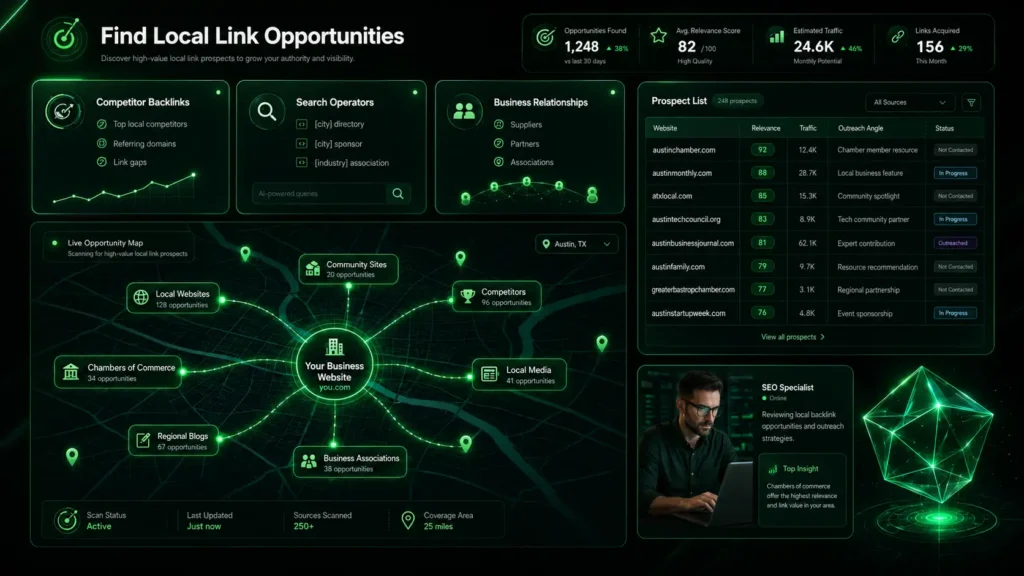
- Identify the top three to five local competitors ranking in Google Maps and organic search for your primary service keywords.
- Use a tool such as Ahrefs, Semrush, or Moz to pull their backlink profiles.
- Filter for referring domains with geographic relevance — local news sites, city directories, regional blogs.
- Build a prospect list of sources linking to competitors but not yet linking to your site.
- Prioritize by relevance and editorial quality, not just domain rating.
Use Google Search Operators
Google search operators help uncover link opportunities that competitor tools miss. Use these queries:
- [city] + business directory
- [city] + chamber of commerce
- [city] + sponsor
- [city] + write for us
- [city] + local business spotlight
- [city] + community events
- [industry] + [city] + association
- [city] + recommended [service]
Each query surfaces locally relevant websites where your business could earn a mention, guest post, or listing.
Review Existing Business Relationships
Before doing any cold outreach, inventory your existing relationships:
- Suppliers and vendors
- Professional association memberships
- Active sponsorships
- Nonprofit partnerships
- Client businesses with websites
- Collaborators and referral partners
These sources produce faster results than cold outreach because trust already exists.
Analyze Local Media and Community Websites
Build a prospect spreadsheet with columns for:
| Column | Purpose |
| Website URL | Identify the source |
| Contact name | Personalize outreach |
| Email address | Direct contact |
| Page type | Editorial, directory, resource, etc. |
| Relevance score | Geographic + topical fit |
| Traffic estimate | Audience size check |
| Editorial quality | Real content or spam? |
| Outreach angle | Why would they link to you? |
| Status | Contacted / live / declined |
Qualify every prospect before outreach. A smaller, clean list outperforms a large, unvetted one.
Easy Local Link Building Tactics for Beginners
Start with tactics that require the least outreach friction and build momentum early.
Claim High-Quality Listings
Submit accurate business information to:
- Google Business Profile
- Bing Places
- Apple Business Connect
- Yelp (where relevant)
- Chamber of Commerce Directory
- Industry-specific associations
- City or county business directories
Accuracy matters more than volume. Every listing must match your NAP exactly as it appears on your website and Google Business Profile.
Join the Chamber of Commerce
Most chambers provide member profile pages with a link back to your website. Beyond the backlink, chambers offer networking events, co-marketing opportunities, and credibility signals that support both SEO and business development. Membership fees are typically modest relative to the value.
Ask Suppliers and Partners for Mentions
Check whether your suppliers, vendors, or business partners maintain:
- Partner or dealer pages
- Client spotlights or case studies
- “Where to buy” or “recommended by” sections
- Testimonial pages with website links
A polite email to an existing partner requesting a mention is one of the simplest ways to build local links without cold outreach.
Sponsor Events or Community Projects
Sponsorship opportunities include:
- Charity fundraisers and nonprofit events
- Local sports teams and youth leagues
- School programs and educational workshops
- City festivals and community fairs
- Professional conferences and networking events
Most event organizers list sponsors on their websites with a link. Sponsoring local events should make business sense independently — the SEO value is a secondary benefit.
Create a Resource Page
Publish a useful, free resource on your website targeting the local area. Examples:
- A contractor publishing a “Home Maintenance Checklist for [City] Winters”
- A real estate agent creating a “Neighborhood Guide to [District Name]”
- A dentist producing a “Family Dental Care Guide for [City] Residents”
These pages attract organic links and support outreach by giving you something of genuine value to offer.
Intermediate Local Link Building Tactics
Once the foundational tactics are running, move toward editorial and collaborative opportunities.
Pitch Guest Articles
Contact community blogs, regional lifestyle publications, and niche local websites to offer a guest article. The pitch should focus on audience value — not promotion. A roofing company offering “5 Signs of Storm Damage Austin Homeowners Miss” is far more likely to be accepted than a thinly veiled company advertisement.
Collaborate With Businesses
Co-authored guides, shared event pages, partner interviews, and local campaign content work well for businesses with overlapping audiences. A gym and a nutritionist, a wedding photographer and a florist, a mortgage broker and a real estate agent — each pairing can produce mutually beneficial content and backlinks.
Get Featured in Roundups
Search for city-specific “best of” lists, local expert roundups, and recommended business guides. Reach out to the editors or publishers with:
- Strong review profiles as social proof
- A clear reason why your business belongs on the list
- A specific page on your site worth linking to
Use Data and Original Insights
Original data — even simple customer surveys, seasonal service trends, or regional comparisons — makes editorial pitches far more compelling. Local journalists and bloggers are actively looking for story angles. Providing data gives them a reason to link to your website as a primary source.
Advanced Local Link Building Tactics
These methods require more planning but produce the strongest, most durable local backlinks.
Run Digital PR Campaign
A local digital PR campaign involves creating a newsworthy story angle, building a targeted media list, and pitching local journalists with a clear hook. Examples of strong local angles:
- “Most Expensive Home Repair Mistakes in [City]”
- “Survey: What [City] Homeowners Spend on HVAC Annually”
- “Top 10 Neighborhoods in [City] for Young Families”
Each story type can earn editorial backlinks from local news sites, regional magazines, and community publications.
Build Linkable Assets
Linkable assets earn backlinks passively over time. Effective examples include:
- Local cost calculators (roofing, legal fees, home renovation)
- Interactive neighborhood maps
- City-specific statistics pages
- Annual local market reports
- Step-by-step guides for locally relevant processes
These assets also improve outreach success rates — you are offering something, not just requesting something.
Earn Links Through Community Leadership
Hosting workshops, funding scholarships, running charity drives, participating in expert panels, and sponsoring educational programs all create link opportunities with schools, nonprofits, and community organizations. The best link building services for local SEO incorporate community leadership as a sustainable link acquisition channel.
Turn Offline Activity Into Online Mentions
Many local businesses attend networking events, sponsor local teams, or partner with community organizations — and never document it online. Every offline activity is a potential backlink:
- Post event recaps on your website
- Ask event organizers to mention your participation
- Share partnership announcements with local media
- Submit award nominations and publicize results
The connection between offline presence and online authority is one of the most underused advantages local businesses have.
Local Link Building Outreach: Beginner Workflow
Outreach is where most beginners struggle. A clean, systematic process reduces wasted effort and improves response rates.
Build a Prospect List
Your prospect spreadsheet should include these columns:
| Column | Details |
| Website | Full URL of the target page |
| Contact person | Editor, owner, blogger name |
| Email address | Direct or contact form URL |
| Page type | Editorial, directory, resource page |
| Relevance | Geographic + topical fit rating |
| Authority metric | DR/DA for reference |
| Traffic estimate | Real audience indicator |
| Outreach angle | Specific reason they would say yes |
| Status | Not contacted / sent / replied / live |
| Notes | Any context relevant to follow-up |
Aim for quality over quantity. Fifty well-qualified prospects outperform five hundred unvetted contacts.
Create a Personalized Pitch
Every outreach message should answer three questions the recipient is silently asking:
- Who is this person?
- Why does this matter to my audience?
- What do they want me to do?
Reference something specific about their publication, audience, or recent content. Generic mass templates produce poor response rates and can damage your brand with local publishers.
Follow Up Without Spamming
Send one follow-up email five to seven days after the initial pitch. Keep it brief and polite. If there is still no response after the second message, move on. Pushing a third or fourth follow-up risks damaging the relationship and your sender reputation with local media contacts.
Track Every Result
Track these data points for every campaign:
- Emails sent and response rate
- Accepted opportunities
- Live links confirmed
- Anchor text used
- Target URL linked
- Publication date
- Domain metrics of the live placement
Tracking creates a repeatable process and helps identify which outreach angles perform best in your local market.
What Makes a Good Local Backlink?
Quality assessment is one of the most important skills in local link building. Beginners often chase metrics and miss the signals that actually matter.
Geographic Relevance
The source website should have a clear connection to your city, county, state, or service area. Geographic relevance can be:
- Direct: A Chicago neighborhood blog linking to a Chicago business
- Contextual: A regional home improvement site covering the Midwest linking to a contractor in Indianapolis
Topical Relevance
The source should align with your industry, service category, or target audience. A link from a local medical blog to a dental clinic carries far more weight than a link from an unrelated local entertainment site.
Editorial Quality
Check for these quality indicators:
- Content written for real readers, not search engines
- Reasonable outbound link ratios
- No excessive paid guest post footprints
- Active editorial management
- Real publication dates and author bylines
Real Traffic and Engagement
Traffic is not the only quality indicator, but a website with real local visitors adds referral value alongside SEO authority. Small local websites with genuine audiences can be highly effective placements.
Natural Anchor Text
Healthy anchor text distribution for local campaigns includes:
- Branded anchors: Your business name
- URL anchors: Your website address
- Partial match anchors: “plumber in Austin” or “Austin plumbing services”
- Natural anchors: “this company,” “local contractor,” “recommended by neighbors”
Avoid over-optimizing with repetitive exact-match anchors — it creates unnatural patterns that invite algorithmic scrutiny.
Local Link Building Mistakes to Avoid
These errors are common among beginners and can waste budget, stall progress, or create long-term SEO problems.
Buying Cheap Bulk Links
Low-cost link packages almost always deliver irrelevant, low-quality, or manipulative placements. These links provide no local relevance, no real audience value, and often violate Google’s guidelines. The short-term cost savings are far outweighed by the long-term risk.
Ignoring Local Relevance
Pursuing high DA websites with no geographic or topical connection to your business wastes outreach resources. A DR 70 technology blog that covers no local content and reaches no local audience provides minimal value for a local HVAC company’s city-level rankings.
Using the Same Anchor Text Everywhere
Repeating the same exact-match anchor across every backlink creates an unnatural link profile. Vary your anchors deliberately and let editorial context drive some anchor choices naturally.
Relying Only on Directories
Directories build foundational visibility and citation consistency — but they are not sufficient for competitive local markets. Businesses relying exclusively on directory submissions will eventually plateau below well-linked competitors with editorial coverage and partnership-based links.
Forgetting About the Landing Page
A backlink is only as effective as the page it points to. Service pages and location pages need:
- Clear, relevant content addressing local search intent
- Local signals (city names, neighborhood references, service area details)
- Strong conversion elements (phone number, booking form, reviews)
- Fast load speed and mobile optimization
A strong link to a weak page underperforms. Fix the landing page before scaling outreach.
How to Measure Local Link Building Success
Measurement connects SEO activity to business outcomes. Track these metrics consistently to evaluate campaign performance.
Referring Domains
Monitor the number of new referring domains gained each month, separated by type:
- Local editorial links
- Directory and citation links
- Partnership links
- Sponsorship links
- Resource page links
Quality and variety matter as much as total count.
Rankings for Keywords
Track rankings for:
- Google Maps pack positions
- Organic results for primary service keywords
- City-specific and neighborhood-specific queries
- “Near me” search visibility trends
Compare current rankings to the baseline established before the campaign began.
Organic Traffic to Local Pages
Measure traffic growth for:
- Location pages and service area pages
- City-targeted blog posts and guides
- Primary service pages with local optimization
Focus on qualified local traffic — visitors from the target city or service area showing genuine purchase intent.
Leads, Calls, and Conversions
Ultimately, local link building should drive business results. Track:
- Phone call volume (Google Business Profile calls + tracked numbers)
- Contact form submissions
- Appointment bookings
- Quote requests
- In-store visits attributed to organic search
When rankings rise and traffic grows without corresponding leads, landing page quality or conversion optimization is likely the issue — not the links themselves.
Beginner 30-Day Local Link Building Plan

Week 1: Audit and Research
Use the first week to understand the competitive landscape, evaluate existing authority signals, and prepare a structured campaign base. This stage should focus on research quality, not outreach volume.
- List the top five nearby competitors in Google Maps and organic search results.
- Pull their backlink profiles and identify geo-relevant referring domains.
- Audit existing citations for NAP consistency across business directories, listings, and profile pages.
- Build a prospect list of at least 50 qualified regional, city-specific, or community-focused websites.
- Choose the primary target pages for the campaign, including service pages, location pages, or high-priority commercial landing pages.
Week 2: Easy Wins
The second week should focus on accessible opportunities that require limited outreach but can improve geographic relevance. These actions create a stronger foundation before more complex campaigns begin.
- Claim all missing regional directory listings with accurate NAP details.
- Join the city chamber of commerce or verify that the current membership is active and properly listed.
- Contact two to three suppliers, vendors, or business partners to request website mentions.
- Fix any broken, outdated, or inconsistent citations found during the first-week audit.
- Add area-based proof elements to key pages, including reviews, service areas, neighborhood references, awards, project examples, and community involvement.
Week 3: Outreach Campaign
The third week should move from foundational fixes to active relationship building. Outreach must be personalized, relevant, and tied to a clear reason for the recipient to mention or link to the business.
- Pitch two to three city blogs or regional publications with a useful guest article idea.
- Contact chambers, nonprofits, business groups, or area associations about partnership opportunities.
- Offer expert commentary to a city journalist, blogger, or community publication editor.
- Submit the business to any qualified resource pages discovered during earlier research.
- Send polite follow-ups to Week 2 partner outreach contacts that have not responded yet.
Week 4: Content and Tracking
The final week should combine asset creation, result tracking, and campaign planning. This stage helps turn a one-time effort into a repeatable system.
- Publish one location-based resource page on the website, such as a guide, checklist, neighborhood tool, cost overview, or service-area resource.
- Update the outreach spreadsheet with every response, opportunity status, rejected pitch, approved placement, and live backlink.
- Review every confirmed backlink for anchor text accuracy, destination page relevance, and placement quality.
- Check keyword ranking movement for primary service terms, city modifiers, and important near-me queries.
- Document campaign results, identify the strongest opportunity types, and plan the next 30-day link-building cycle.
Local Link Building Checklist for Beginners
Research Checklist
- [ ] Competitor backlinks reviewed and catalogued
- [ ] Local directories identified and qualified
- [ ] Industry associations and membership organizations listed
- [ ] Local media outlets, bloggers, and journalists identified
- [ ] Community websites, nonprofits, and event organizers added
- [ ] Existing business partners and suppliers inventoried
- [ ] Active sponsorships and charity connections documented
- [ ] Resource pages and city guide opportunities identified
Quality Checklist
- [ ] Geographic relevance confirmed (city, county, or service area connection)
- [ ] Topical relevance confirmed (industry or audience alignment)
- [ ] Editorial standards verified (real content, real audience)
- [ ] Traffic estimate reviewed (even small local audiences count)
- [ ] Outbound link profile checked (no excessive paid link footprints)
- [ ] Natural anchor text planned for each placement
- [ ] No spam indicators detected (penalties, thin content, unrelated links)
Outreach Checklist
- [ ] Contact name and email address confirmed
- [ ] Personalized pitch angle prepared
- [ ] Specific target URL identified for each pitch
- [ ] Follow-up date scheduled (5–7 days after initial message)
- [ ] Response tracked in the outreach spreadsheet
- [ ] Live link confirmed and added to the backlink log
- [ ] Anchor text and landing page recorded after placement
Final Action Plan: How to Start Dominating Local Search
Start With Relevance, Not Volume
The most common beginner mistake is pursuing scale before establishing quality. Choose five to ten genuinely relevant local link opportunities before attempting to build hundreds. A small number of well-placed, editorially strong local backlinks produces faster, more stable ranking improvements than a large volume of low-relevance placements.
Focus on:
- One high-quality directory or chamber listing
- One or two partnership-based links from existing relationships
- One local editorial pitch to a community publication or regional blog
Build from that foundation before scaling outreach.
Build Relationships Before Links
The strongest local link building strategies are built on genuine community participation — not transactional link exchanges. Businesses that partner with local organizations, contribute useful content, sponsor real events, and engage with local media build authority that is difficult for competitors to replicate.
Links are a byproduct of real relationships. When a local business becomes genuinely embedded in its community — through sponsorships, partnerships, educational resources, and expert contributions — the links follow naturally. That kind of link profile is stable, credible, and aligned with how Google evaluates local prominence.
Start steady. Stay consistent. Focus on locally relevant, transparent work — and local search visibility will follow.
FAQ About Local Link Building for Beginners
There is no universal number. The right volume depends on your competition level, current domain authority, city size, industry, and competitor backlink profiles. A local bakery in a small town needs far fewer links than a personal injury law firm in Los Angeles. Start by analyzing what your top three competitors have earned and close the gap methodically.
Yes — reputable directories and accurate citations remain useful for local SEO foundations, particularly for NAP consistency and basic local pack signals. However, directories alone are not enough in competitive local markets. They should be combined with editorial links, partnership-based placements, and community mentions for meaningful ranking movement.
Early links from directories and partners can be secured within the first two to four weeks. Measurable ranking improvements typically appear within two to four months of consistent effort, depending on competition and the technical health of the website. Campaigns targeting competitive city markets may take six to twelve months before significant local pack movement is visible.
Yes — local backlinks can strengthen the authority and geographic relevance signals that support Google Maps visibility. However, Google Maps rankings also depend on Google Business Profile completeness, review volume and quality, proximity to the searcher, business category accuracy, and overall website quality. Links are one strong signal within a broader system.
Simple tactics — directory submissions, partner outreach, chamber membership, sponsorship links — can be managed in-house with the right tools and time commitment. Advanced campaigns involving editorial outreach, digital PR, multi-location scaling, and competitor analysis are more efficiently handled by specialists.