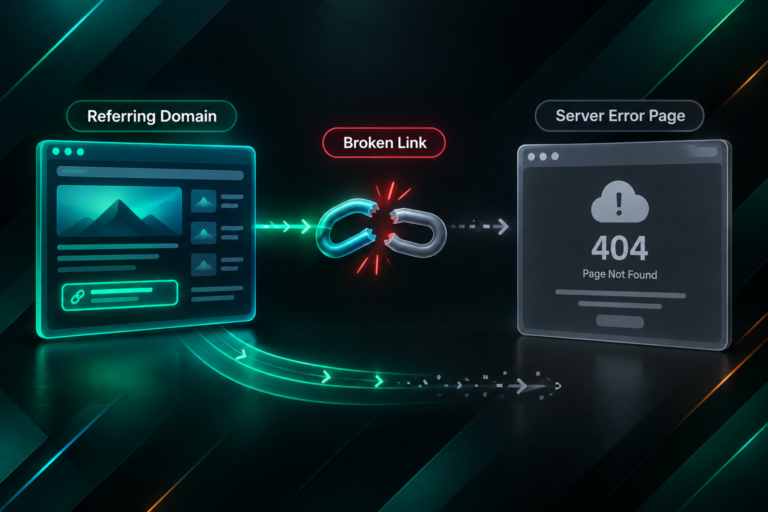
Breadcrumb links are a navigational element that appears on web pages, showing users the path from the homepage to the page they are currently viewing. In SEO, breadcrumbs serve a dual purpose: they help search engines understand a website’s structure and they improve the experience for human visitors. Understanding how breadcrumb links work, where they add value, and how they interact with other SEO factors can help you make better decisions about your site architecture and internal linking strategy.
Key Takeaways
- Breadcrumb links are a navigational trail that reflects a website’s hierarchy, helping both users and search engines understand page relationships.
- Google can display breadcrumb paths in search results instead of full URLs, which may improve click-through rates for some queries.
- Breadcrumbs contribute to internal linking and help distribute PageRank across a site, but they are one factor among many in a broader SEO strategy.
- Implementing structured data markup for breadcrumbs increases the likelihood that Google will display the breadcrumb trail in rich results.
- Breadcrumbs are most impactful on large websites with deep hierarchies; smaller or flat-structure sites may see limited additional benefit.
What Are Breadcrumb Links?
A breadcrumb link is a secondary navigation element, typically displayed near the top of a page, that shows the hierarchical path a user has followed to reach the current page. The name comes from the Hansel and Gretel fairy tale, where breadcrumbs were dropped to mark a trail. On a website, a breadcrumb trail might look like: Home > Blog > SEO > What Are Breadcrumb Links. Each segment in that trail is a clickable link pointing to the corresponding parent page or category.
Breadcrumbs are distinct from the main navigation menu. While a menu gives users access to top-level sections, a breadcrumb trail reflects the specific path to the current page within the site’s hierarchy. This distinction matters for SEO because breadcrumbs create additional internal links between pages at different levels of the site structure, reinforcing topical relationships and helping search engine crawlers map the site’s architecture more efficiently.
There are three common types of breadcrumbs used on websites. Hierarchy-based breadcrumbs reflect the site’s structural depth, such as a category and subcategory path on an e-commerce site. Attribute-based breadcrumbs reflect filtering choices, such as product type, colour, or size, and are common on large retail sites. History-based breadcrumbs show the pages a user has visited in sequence, similar to browser history, though these are rarely used in modern SEO practice because they are user-specific and do not reflect a consistent site structure.
How Breadcrumb Links Work in SEO
From a search engine perspective, breadcrumb links function as a form of internal linking that communicates page hierarchy. When Googlebot crawls a page, it follows all internal links, including those within a breadcrumb trail. Each link in the breadcrumb passes a signal about the relationship between the current page and its parent pages. This helps Google understand which pages are structurally important and how content is organised across the site.
Google’s documentation explicitly acknowledges breadcrumbs as a signal it uses to understand a page’s position within a website. According to Google’s Search Central guidance, breadcrumbs help Google categorise information from a page in search results. When Google chooses to display a breadcrumb trail in the search result snippet rather than the raw URL, users see a cleaner, more readable path to the page. This breadcrumb display in search results is sometimes called a rich result or rich snippet, and it can make a listing more visually distinct in the search engine results page (SERP).
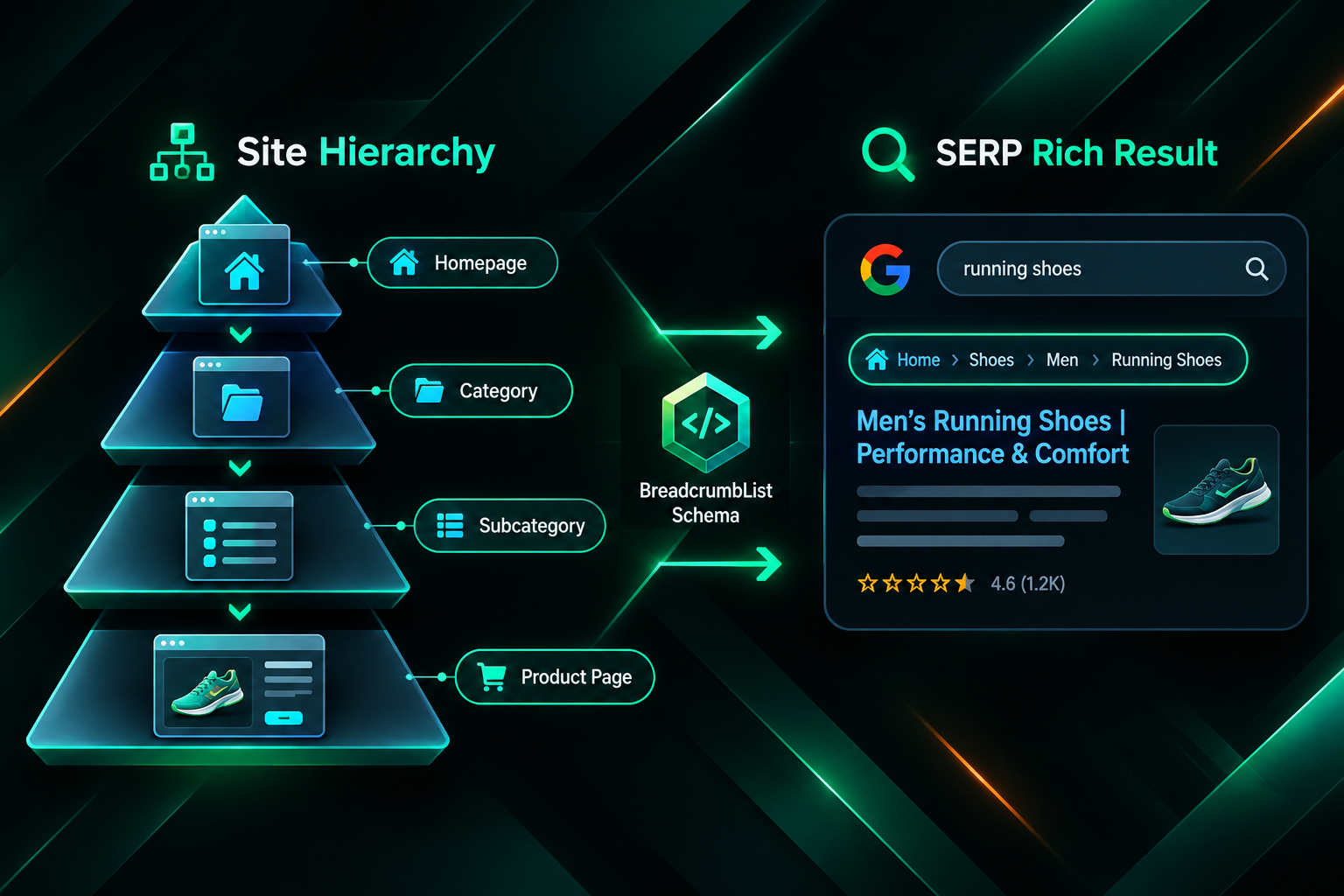
For breadcrumbs to appear as rich results, Google recommends implementing structured data markup, specifically using the BreadcrumbList schema from Schema.org. This markup is added to the page’s HTML and tells Google explicitly what each breadcrumb item is called and what URL it points to. Without structured data, Google may still detect and display breadcrumbs, but structured data increases the reliability of that display. It is worth noting that implementing structured data does not guarantee rich result display; Google decides whether to show it based on its own quality assessments.
The SEO Benefits of Breadcrumb Links
Breadcrumb links offer several practical SEO benefits, though the degree of impact depends on the website’s size, structure, and existing technical SEO condition.
Improved Crawlability and Site Structure Signals
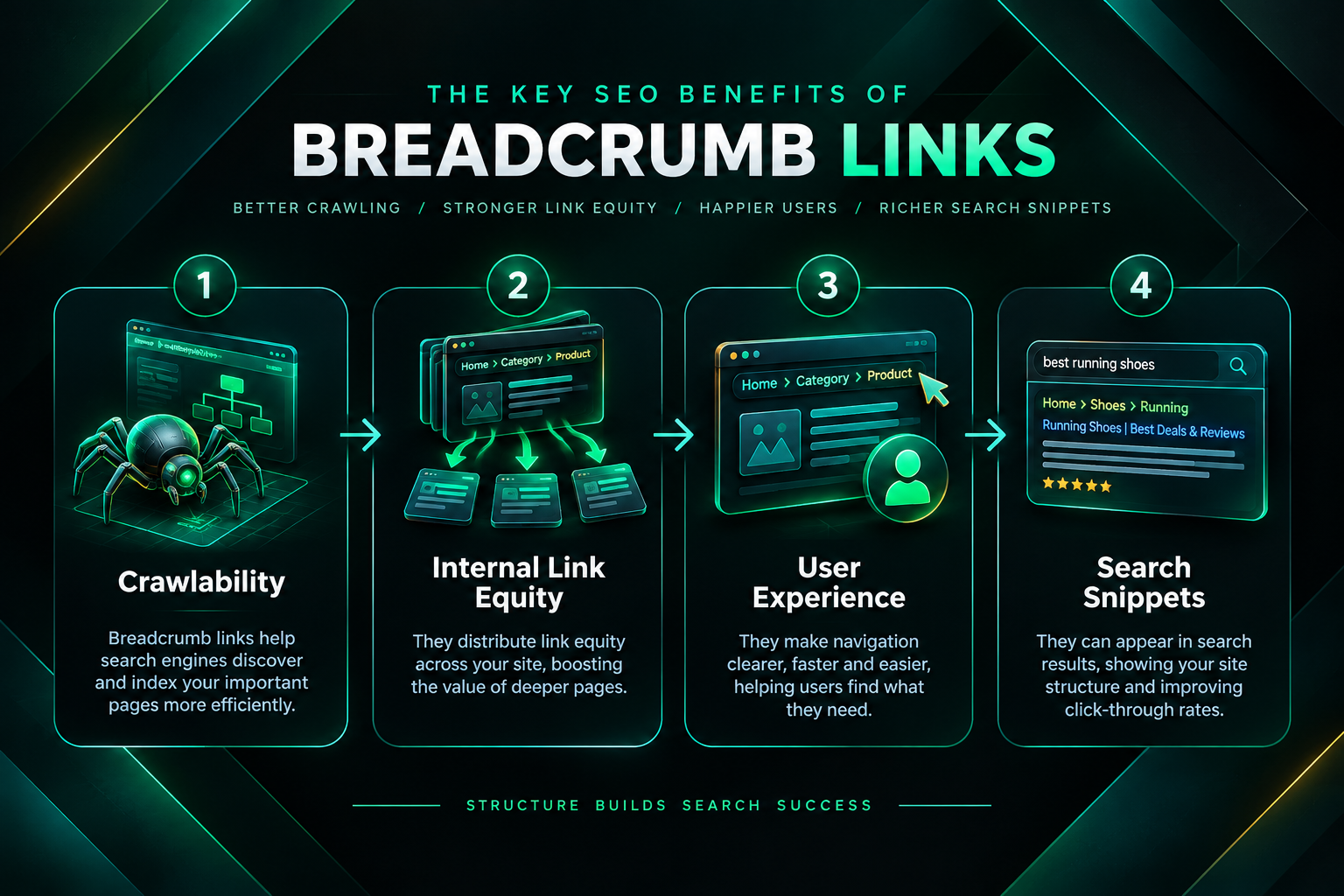
Breadcrumbs create additional internal links between pages at different levels of the site hierarchy. On a large e-commerce or content-heavy website, this can help search engine crawlers discover and revisit pages more efficiently. A category page linked from every product page within that category receives more internal link signals, which may reinforce its perceived importance within the site. This is particularly relevant for websites with hundreds or thousands of pages where crawl budget and internal link equity distribution are meaningful considerations.
Internal Link Equity Distribution
Internal links pass a portion of a page’s link equity, sometimes referred to as PageRank, to the pages they point to. Breadcrumb links, because they appear consistently across many pages within a section, can contribute meaningfully to the distribution of internal link equity toward category and parent pages. This may help those pages rank more competitively for broader, higher-volume search terms. However, the effect of breadcrumb internal links should not be overstated; the quality and relevance of the page’s content and its external backlink profile remain primary ranking factors.
Enhanced User Experience and Reduced Bounce Rate
Breadcrumbs help users understand where they are within a website and provide a quick way to navigate to a broader category without using the browser’s back button. This can reduce frustration, particularly on deep-hierarchy sites where users may arrive on a specific product or article page directly from a search result. When users can easily explore related content through breadcrumb navigation, they are more likely to visit additional pages, which may positively influence engagement signals such as pages per session and time on site. While Google has not confirmed that these engagement metrics directly influence rankings, a better user experience is generally aligned with the goals of a well-optimised website.
Breadcrumbs in Search Result Snippets
When Google displays a breadcrumb trail in a search result instead of the full URL, the listing can appear cleaner and more informative. A user searching for a specific product or topic may find a breadcrumb path like Home > Running Shoes > Trail Running more immediately useful than a long URL string. Some SEO practitioners observe that cleaner, more readable search snippets may improve click-through rates, though the evidence for a direct, measurable CTR improvement from breadcrumb display alone is observational rather than experimentally confirmed. The benefit is plausible and worth pursuing, but it should not be treated as a guaranteed outcome.
How to Implement Breadcrumb Links Correctly
Correct implementation involves both the visible HTML breadcrumb trail and, where appropriate, the structured data markup that supports rich result eligibility.
HTML and Visual Implementation
The breadcrumb trail should be placed near the top of the page content, typically below the main navigation and above the page heading. Each item in the trail, except the current page, should be a clickable anchor link pointing to the relevant parent page or category. The current page is usually displayed as plain text rather than a link, since linking a page to itself is generally unnecessary and can create confusion. Using an ordered list element in HTML, wrapped in a nav element with an appropriate ARIA label, is considered good practice for accessibility and semantic clarity.
Structured Data Markup
To maximise the likelihood of breadcrumb rich results appearing in Google Search, implement BreadcrumbList structured data using JSON-LD format, which Google recommends. Each ListItem within the BreadcrumbList should include the item’s name, its URL, and its position in the hierarchy. After implementation, the Google Rich Results Test tool can be used to verify that the markup is valid and eligible for rich result display. Errors in structured data, such as mismatched URLs or missing position values, can prevent the breadcrumb from appearing correctly in search results.
Consistency Between Breadcrumb and Site Structure
The breadcrumb trail should accurately reflect the actual hierarchy of the website. If a page belongs to multiple categories, the breadcrumb should reflect the primary or canonical category path rather than displaying multiple conflicting trails. Inconsistency between the breadcrumb path and the site’s URL structure or internal linking can create confusion for both users and search engines. On platforms such as WordPress, plugins like Yoast SEO or Rank Math can automate breadcrumb generation and structured data output, reducing the risk of implementation errors.
Breadcrumb Links and Internal Linking Strategy
Breadcrumbs are one component of a broader internal linking strategy. Internal links serve several SEO functions: they help search engines discover pages, they signal the relative importance of pages within a site, and they help users navigate to related content. Breadcrumbs specifically address the vertical dimension of internal linking, connecting pages upward through the hierarchy toward the homepage or top-level category pages.
A well-designed internal linking strategy typically combines breadcrumb navigation with contextual in-content links, related-post or related-product modules, and a logical site architecture. Relying on breadcrumbs alone is insufficient for a comprehensive internal linking approach. Contextual links within the body of a page, pointing to relevant supporting content or deeper subcategory pages, carry additional topical relevance signals because they appear within meaningful surrounding text. Breadcrumbs complement these contextual links by reinforcing the structural hierarchy rather than replacing the need for thoughtful in-content linking.
For websites that are also building external backlinks as part of an SEO campaign, the internal linking structure, including breadcrumbs, influences how link equity from those external links is distributed across the site. A strong internal linking architecture ensures that link equity acquired through outreach or editorial placements flows efficiently to the pages that most need it, rather than remaining concentrated on the homepage or a small number of top-level pages.
Limitations and Considerations
Breadcrumb links are a useful technical and navigational feature, but their SEO impact has meaningful limitations that are worth understanding before prioritising implementation over other improvements.
Limited Impact on Flat or Small Websites
On a small website with a shallow structure, such as a five-page business site or a blog with a single category, breadcrumbs add little navigational or structural value. The benefit of breadcrumbs scales with the depth and complexity of the site hierarchy. If a website has only two levels of depth, a breadcrumb trail showing Home > Contact provides minimal additional information to either users or search engines beyond what the main navigation already communicates.
No Substitute for Content Quality or External Links
Breadcrumb implementation does not compensate for weak content, poor keyword targeting, or an insufficient external backlink profile. Search engines evaluate many signals when determining rankings, and breadcrumbs are a relatively minor structural signal compared to content relevance, page experience, and the quality and quantity of referring domains pointing to a site. Businesses that are struggling with organic visibility should assess whether the primary cause is a technical issue, a content gap, a mismatch with search intent, or a lack of authoritative external links before concluding that breadcrumb implementation is the priority fix.
Rich Result Display Is Not Guaranteed
Even with correctly implemented BreadcrumbList structured data, Google may choose not to display the breadcrumb trail in search results for every page or query. Google’s systems make their own determination about whether a rich result is appropriate for a given search. Structured data eligibility is a necessary condition for rich result display, but it is not a sufficient one. Webmasters should not assume that adding breadcrumb schema will automatically change how their pages appear in the SERP.
Maintenance on Large Sites
On large e-commerce or content sites with frequently changing category structures, keeping breadcrumb trails accurate and consistent requires ongoing attention. If categories are reorganised, pages are moved, or URL structures change, breadcrumb trails and their associated structured data may become outdated or incorrect. Incorrect breadcrumbs can mislead users and may cause structured data errors that Google flags in Search Console. Automated breadcrumb generation through a CMS or SEO plugin reduces this risk but does not eliminate the need for periodic auditing.
Breadcrumbs in the Context of a Broader SEO Strategy
Breadcrumb links are best understood as one element within a larger set of on-page and technical SEO practices. They contribute to site architecture clarity, support internal link equity distribution, and may improve how pages appear in search results, but they operate alongside many other factors that influence organic performance.
For businesses investing in link building campaigns, whether through manual outreach, guest posting, or other editorial link acquisition methods, the internal structure of the target website affects how effectively acquired links contribute to rankings. External links pointing to a well-structured site with clear breadcrumb navigation and logical internal linking are more likely to distribute their equity efficiently than links pointing to a site with a disorganised architecture. This is why technical SEO foundations, including breadcrumb implementation on appropriate sites, are often reviewed as part of a pre-campaign audit before outreach begins.
Similarly, for SEO agencies managing campaigns on behalf of clients, ensuring that client websites have sound internal linking structures, including breadcrumbs where appropriate, is part of responsible campaign preparation. A link acquisition campaign is more likely to produce measurable improvements in rankings and organic traffic when the target pages are well-structured, clearly categorised, and supported by a coherent internal linking architecture.
Frequently Asked Questions
Do breadcrumb links directly improve search rankings?
Breadcrumb links are not a direct ranking factor in the way that content relevance or external backlinks are. They contribute indirectly by improving site structure signals, supporting internal link equity distribution, and potentially improving how pages appear in search results. Their impact on rankings is generally modest and depends on the size and complexity of the website.
Is structured data markup required for breadcrumbs to work in SEO?
Structured data markup is not strictly required for breadcrumbs to function as internal links or for Google to detect them. However, BreadcrumbList schema markup increases the likelihood that Google will display the breadcrumb trail as a rich result in search snippets. Without markup, Google may still detect and display breadcrumbs, but the outcome is less predictable.
Should every page on my website have a breadcrumb trail?
Breadcrumbs are most useful on pages that sit below the top level of a site’s hierarchy, such as category pages, subcategory pages, product pages, and individual blog posts. The homepage typically does not need a breadcrumb trail. On very flat sites with minimal hierarchy, breadcrumbs may add little value and can be omitted without meaningful SEO impact.
Can breadcrumbs cause duplicate content issues?
Breadcrumbs themselves do not cause duplicate content. However, if a page is accessible through multiple category paths and each path generates a different URL, that can create duplicate content issues. The solution is to use canonical tags to indicate the preferred URL, ensuring that search engines consolidate signals to the correct version of the page regardless of which breadcrumb path was used to reach it.
How do breadcrumbs interact with external link building campaigns?
External links acquired through outreach or editorial placements pass link equity to the pages they point to. A well-structured internal linking system, including breadcrumbs, helps distribute that equity from the linked page upward to category and parent pages and laterally to related content. This means that a sound internal architecture can amplify the benefit of external link acquisition by ensuring equity flows efficiently across the site rather than remaining isolated on a single page.
Do breadcrumbs affect mobile SEO differently from desktop?
Google uses mobile-first indexing, meaning it primarily uses the mobile version of a page for indexing and ranking. Breadcrumbs should be implemented and visible on the mobile version of a site, not only on the desktop version. If a mobile theme hides or removes breadcrumbs, the structured data and navigational benefits may not be fully realised in Google’s mobile-first crawling environment.
Deciding Whether Breadcrumb Implementation Should Be a Priority
Breadcrumb links are a well-established, low-risk SEO practice that is worth implementing on most websites with meaningful hierarchical depth. The technical effort required is modest, particularly on CMS platforms with SEO plugins that automate breadcrumb generation and structured data output. The potential benefits, including cleaner search snippets, improved crawlability, and better internal link equity distribution, are genuine, even if they are incremental rather than transformative.
For small or flat websites, breadcrumbs are unlikely to be a high-priority SEO task. For large e-commerce sites, content publishers, or any website with multiple levels of category and subcategory structure, correct breadcrumb implementation is a sensible part of technical SEO hygiene. It is most valuable when combined with a coherent site architecture, strong on-page content, and, where appropriate, a thoughtful external link acquisition strategy.
If your website is underperforming in organic search, breadcrumb implementation may be one item on a broader technical SEO checklist, but it is rarely the primary cause of low visibility. A site-specific audit that examines crawlability, content quality, search intent alignment, and the external backlink profile will provide a clearer picture of where effort is best directed. Breadcrumbs work best as part of a well-rounded SEO approach rather than as a standalone fix.