Sitemaps come in two distinct formats, and confusing them is a surprisingly common source of wasted effort in technical SEO. An HTML sitemap is a navigational page built for human visitors, while an XML sitemap is a structured file built for search engine crawlers. Both can coexist on the same website, but they serve different purposes, and understanding those differences helps you prioritise the right technical work at the right time.
Quick Comparison
| Characteristic | HTML Sitemap | XML Sitemap |
|---|---|---|
| Primary audience | Human visitors | Search engine crawlers |
| Format | Rendered webpage with links | Structured XML file |
| Typical location | Linked from footer or navigation | Submitted via Google Search Console or robots.txt |
| Main SEO function | Internal linking, user navigation | Crawl guidance, indexing signals |
| Supports metadata | No (beyond standard HTML) | Yes (lastmod, changefreq, priority) |
| Scales to large sites | Poorly — becomes unwieldy | Well — supports up to 50,000 URLs per file |
| Crawl budget impact | Indirect, through internal links | Direct signal to crawlers |
| Requires submission | No | Recommended via Search Console or robots.txt |
| Useful for users | Yes | No |
| Typical use case | Small to medium sites, UX improvement | All site sizes, especially large or complex sites |
What Is an HTML Sitemap?
An HTML sitemap is a standard webpage that lists the pages of a website in an organised, human-readable format. Visitors who cannot find what they are looking for through the main navigation can use the HTML sitemap as a directory. It typically groups pages by category or section and presents them as clickable links. Because it is a real webpage rendered in a browser, it is subject to the same crawling, indexing, and ranking considerations as any other page on the site.
From an SEO perspective, the HTML sitemap contributes to a site’s internal linking structure. Every link on the page passes some degree of internal link equity to the destination pages, which can help search engines discover and evaluate those pages. However, the SEO value of an HTML sitemap is largely indirect. Its primary contribution is navigational clarity for users, not a direct crawl signal to search engines.
HTML sitemaps are most practical on small to medium-sized websites where the total number of pages can be listed without creating an overwhelming or unmanageable document. On large e-commerce sites or content-heavy platforms with thousands of URLs, an HTML sitemap quickly becomes difficult to maintain and may provide limited navigational value to users who are unlikely to scroll through hundreds of links.
What Is an XML Sitemap?
An XML sitemap is a structured file written in Extensible Markup Language that lists URLs a website owner wants search engines to crawl and consider for indexing. Unlike an HTML sitemap, an XML sitemap is not designed to be read by human visitors. It is a machine-readable document that communicates directly with search engine crawlers such as Googlebot.
Each URL entry in an XML sitemap can include optional metadata: lastmod (the date the page was last modified), changefreq (how frequently the page is expected to change), and priority (a relative importance signal between 0.0 and 1.0). Google has stated publicly that it treats changefreq and priority as hints rather than instructions, and that lastmod is only considered reliable when it accurately reflects genuine content changes. Inflating these values or setting them arbitrarily does not reliably improve crawl frequency.
XML sitemaps are submitted to search engines through Google Search Console, Bing Webmaster Tools, or by referencing the sitemap file in the site’s robots.txt file. A single XML sitemap file can contain up to 50,000 URLs and must not exceed 50 MB uncompressed. Larger sites can use a sitemap index file that references multiple individual sitemap files, allowing millions of URLs to be covered across a coordinated set of documents.
How Each Sitemap Affects Crawling and Indexing
Search engines discover pages primarily through links — both internal links within a site and external backlinks from other websites. An XML sitemap provides an additional discovery mechanism, particularly useful for pages that are not well-connected through internal links or that are newly published. Google has confirmed that submitting an XML sitemap does not guarantee indexing; it is a request for crawlers to visit those URLs, not an instruction to index them. Whether a page is indexed depends on its content quality, technical accessibility, and relevance signals.
For websites with strong internal linking and a well-established crawl pattern, an XML sitemap may have a modest incremental effect on crawl coverage. Its value increases significantly for large sites, sites with frequently updated content such as news publishers, sites with pages that are not easily reachable through standard navigation, and newly launched websites that have not yet accumulated external backlinks to aid discovery.
An HTML sitemap influences crawling indirectly. Because it is a webpage containing internal links, Googlebot will follow those links during a crawl. This can help surface pages that might otherwise be several clicks deep in the site architecture. However, the HTML sitemap page itself consumes crawl budget, and if it links to a very large number of pages, the link equity distributed to each destination page may be diluted. For most websites, this is not a significant concern, but it is worth considering on sites where crawl efficiency is already a priority.
Internal Linking and Link Equity Considerations
One meaningful difference between HTML and XML sitemaps is their relationship to internal link equity. An HTML sitemap, as a real webpage, passes PageRank-style signals through its links to the pages it references. This can be useful for surfacing important pages that are otherwise buried in deep site architecture. If a page is only reachable through the HTML sitemap and has no other internal links pointing to it, that page is likely to be treated as low-priority by search engines regardless of its sitemap inclusion.
An XML sitemap does not pass link equity. It is a discovery and crawl-guidance tool, not a link-building mechanism. Including a URL in an XML sitemap does not strengthen that page’s authority or improve its ranking signals in the way that a well-placed internal link or a quality external backlink might. This distinction matters when planning technical SEO work: improving internal linking architecture is generally a higher-priority task than optimising sitemap metadata, and external link acquisition through manual outreach or editorial placements addresses a different layer of the ranking equation entirely.
When an HTML Sitemap Adds Genuine Value
An HTML sitemap is most useful in specific circumstances rather than as a universal requirement. For small websites with straightforward navigation, an HTML sitemap can serve as a helpful fallback for users who arrive on an unfamiliar page and want to understand the site’s structure. It can also be valuable for accessibility purposes, providing a flat, easy-to-navigate list of pages for users who find hierarchical menus difficult to use.
From an SEO standpoint, an HTML sitemap may provide marginal benefit by reinforcing internal links to important pages and helping search engines understand the site’s content hierarchy. However, these benefits are generally secondary to having a well-structured navigation, clear breadcrumb trails, and a coherent internal linking strategy throughout the site’s content. An HTML sitemap should not be treated as a substitute for good site architecture.
For websites that have undergone significant restructuring, an HTML sitemap can temporarily help users and crawlers navigate the updated structure while the site’s internal linking is being refined. It is also sometimes used on government, educational, or institutional websites where comprehensive directory-style navigation is expected by users.
When an XML Sitemap Is Essential
An XML sitemap becomes increasingly important as a website grows in size and complexity. For e-commerce websites with thousands of product pages, a well-maintained XML sitemap helps ensure that new and updated pages are discovered promptly. For content publishers that add articles frequently, an XML sitemap — particularly a news sitemap formatted to Google’s news sitemap specification — can accelerate the indexing of time-sensitive content.
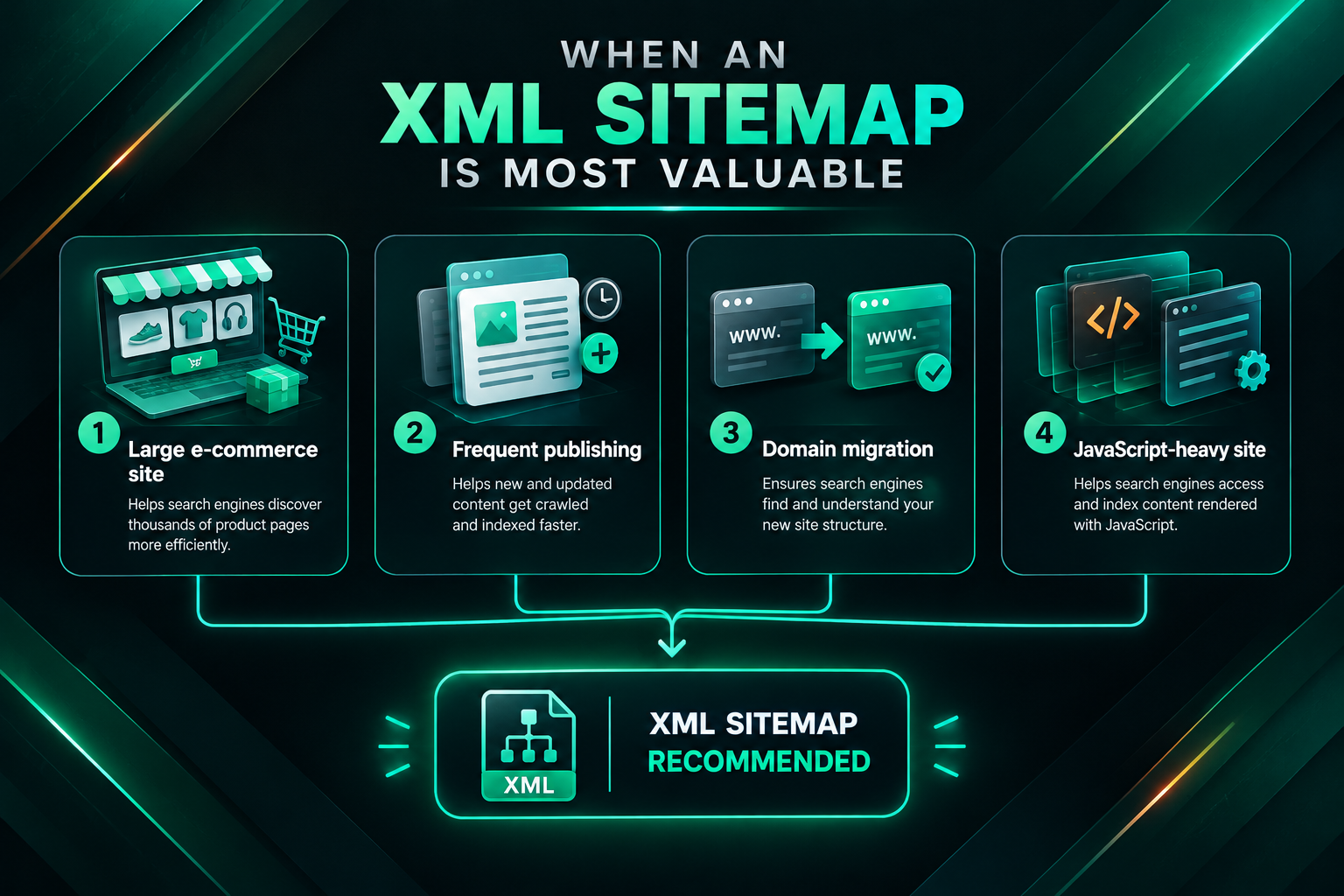
XML sitemaps are also valuable for websites that have recently migrated to a new domain or URL structure. During a migration, many pages may temporarily lack the internal links and external backlinks needed for reliable crawler discovery. Submitting an updated XML sitemap through Google Search Console after a migration helps signal the new URL structure to search engines and can reduce the time needed for the new URLs to be crawled and indexed.
Websites with significant amounts of JavaScript-rendered content may also benefit from a carefully maintained XML sitemap. If Googlebot encounters difficulty rendering JavaScript pages, the sitemap provides an explicit list of URLs to attempt, reducing the risk that important pages are missed during crawling. That said, an XML sitemap is not a solution to fundamental JavaScript rendering problems; those require technical fixes at the implementation level.
Common Mistakes With Both Sitemap Types
Several recurring errors reduce the effectiveness of both HTML and XML sitemaps. Including redirected URLs, canonicalised-away pages, noindex pages, or broken links in an XML sitemap sends conflicting signals to search engines and may cause crawlers to deprioritise the sitemap’s contents. An XML sitemap should contain only canonical, indexable URLs that return a 200 HTTP status code.
For HTML sitemaps, a common mistake is allowing the page to grow so large that it becomes impractical for users and potentially problematic for crawl efficiency. Another error is failing to update the HTML sitemap when pages are added, removed, or restructured, leaving users and crawlers with links to outdated or non-existent pages.
With XML sitemaps, setting lastmod dates that do not reflect genuine content changes is a frequently cited issue. Google has indicated that it may stop trusting lastmod signals from a sitemap if those dates are consistently inaccurate. Similarly, setting all priority values to 1.0 provides no useful differentiation and is likely ignored. Accurate, maintained metadata is more useful than inflated values.
Do You Need Both?
Most websites benefit from having an XML sitemap. It is a low-cost technical implementation that provides a direct crawl-guidance signal to search engines, and the downside of having one is minimal provided it is kept accurate. For this reason, an XML sitemap is generally considered a standard technical SEO practice rather than an optional enhancement.
An HTML sitemap is more situational. It adds genuine value on smaller sites where users may benefit from a directory-style overview, on sites with complex content hierarchies, or where accessibility considerations make a flat navigation page useful. On very large sites, an HTML sitemap may be impractical to maintain and may offer limited benefit compared to investing in better navigation design and internal linking.
Having both is not harmful and is a reasonable approach for many websites. The two formats serve different audiences and different functions, and they do not conflict with each other. The decision should be based on the site’s size, user needs, and the resources available to maintain both accurately.
Sitemaps in the Context of a Broader SEO Strategy
Sitemaps — whether HTML or XML — are one component of technical SEO, which itself is one layer of a broader search visibility strategy. A well-maintained XML sitemap helps ensure that pages are crawlable and discoverable, but it does not directly improve a page’s authority, relevance, or ranking signals. Those factors depend on content quality, topical depth, user engagement signals, and the strength and relevance of the backlink profile pointing to the site.
External link acquisition through manual outreach, editorial guest placements, and digital PR campaigns addresses the authority dimension that sitemaps cannot influence. A page that is perfectly indexed but lacks authoritative external links pointing to it may still struggle to rank competitively in contested search results. Conversely, a page with strong external backlinks but poor crawlability may not be indexed reliably enough to benefit from those links. Technical SEO and link acquisition work best when treated as complementary rather than competing priorities.

For websites that are investing in link building campaigns, ensuring that target pages are correctly included in the XML sitemap and are accessible to crawlers is a sensible prerequisite. If a page cannot be reliably crawled and indexed, newly acquired backlinks pointing to it may take longer to be processed and may have a delayed effect on rankings. Addressing crawlability issues before or alongside a link acquisition campaign is generally more efficient than attempting to compensate for technical problems with additional links.
Frequently Asked Questions
Does submitting an XML sitemap guarantee that my pages will be indexed?
No. Submitting an XML sitemap to Google Search Console or referencing it in robots.txt is a request for crawlers to visit the listed URLs, not an instruction to index them. Google decides whether to index a page based on its content quality, technical accessibility, and relevance signals. A sitemap improves the likelihood that pages are discovered and crawled, but indexing is not guaranteed.
Can an HTML sitemap improve my search rankings?
An HTML sitemap can contribute indirectly to rankings by reinforcing internal links to important pages and helping search engines understand site structure. However, its direct ranking impact is generally modest. More significant ranking factors include content quality, topical relevance, and the strength of the site’s external backlink profile.
How often should I update my XML sitemap?
An XML sitemap should be updated whenever pages are added, removed, or significantly changed. Many content management systems and e-commerce platforms generate XML sitemaps dynamically, meaning the file updates automatically. If your sitemap is generated manually or through a plugin, review it regularly to ensure it reflects the current state of the site and contains only canonical, indexable URLs.
Should I include every page on my site in the XML sitemap?
No. The XML sitemap should include only canonical, indexable pages that return a 200 HTTP status code. Pages with noindex directives, pages that redirect to other URLs, and pages that have been canonicalised to a different URL should be excluded. Including these pages sends conflicting signals to search engines and may reduce the sitemap’s usefulness.
Does an XML sitemap help with crawl budget?
An XML sitemap can help search engines allocate crawl resources more efficiently by providing a clear list of URLs to prioritise. This is most relevant for large websites with thousands of pages or for sites where important pages are not well-connected through internal links. For smaller sites with straightforward architecture, crawl budget is rarely a significant concern.
Is an HTML sitemap still relevant for modern websites?
HTML sitemaps are less universally necessary than they were in the early days of the web, when site navigation was often less sophisticated. However, they remain useful for accessibility, for sites with complex content hierarchies, and for smaller sites where a directory-style overview genuinely helps users. Their relevance depends on the specific site and its users rather than a general rule.
Can I use both an HTML sitemap and an XML sitemap on the same website?
Yes, and many websites do. The two formats serve different purposes and different audiences, so having both does not create conflicts. The HTML sitemap serves human visitors, while the XML sitemap serves search engine crawlers. Maintaining both accurately is the main practical consideration.
Choosing the Right Sitemap Approach for Your Website
For most websites, the practical answer is straightforward: implement and maintain an XML sitemap as a standard technical SEO measure, and consider an HTML sitemap based on the size of the site and the navigational needs of its users. Neither format is a ranking shortcut, and neither replaces the foundational work of creating high-quality content, building a coherent internal linking structure, and acquiring authoritative external links through legitimate outreach.
If your website is experiencing indexing problems, low crawl coverage, or slow discovery of new pages, an XML sitemap audit is a reasonable starting point. Check that the sitemap contains only canonical, indexable URLs, that lastmod dates are accurate, and that the file is correctly submitted and accessible to crawlers. These are verifiable, low-risk technical improvements that can be assessed without a full site audit.
If your broader SEO goals include improving the authority and ranking potential of specific pages, technical sitemap work addresses only one layer of the problem. A qualified SEO professional can assess whether crawlability, content quality, internal linking, or external link acquisition is the most pressing priority for your specific situation. Sitemaps are a useful foundation, but sustainable search visibility typically requires attention to all of these dimensions over time.