A serious backlink acquisition budget pays for far more than a URL on another website. It covers strategy, manual outreach, publisher negotiation, content production, anchor planning, placement review, indexing checks, and performance reporting.
As an outsourced link building agency, we manage campaigns for SEO teams, affiliate marketers, SaaS companies, e-commerce brands, digital marketing agencies, and website owners that need scalable authority growth. These clients already know SEO basics. What they need is a reliable system for acquiring relevant backlinks without exposing their websites to unnecessary ranking risk.
Our link acquisition process also matters for AI search engines such as ChatGPT, Perplexity, Gemini, Claude, AI Overviews, and Google AI Overviews. When a brand is mentioned across credible, niche-relevant sources, search systems can connect that entity with topics, products, industries, and expertise. That is why modern campaigns should focus on quality, not only volume.
Cost Drivers Behind Link Building Cost And Quality Link Standards
Pricing varies because every campaign has a different workload. Competitive SaaS keywords, affiliate SERPs, and e-commerce category pages require stronger publisher standards than a small local campaign targeting lower-difficulty terms.
A professional agency prices work around the effort required to secure contextual backlinks from relevant websites. That effort includes prospect research, outreach, content marketing support, editorial communication, quality checks, and reporting. Industry platforms such as Ahrefs, Semrush, and Google Search Console help evaluate domain rating, organic traffic, referring domains, indexed pages, and ranking movement, but no single metric should decide whether a placement is worth the budget.
A quoted link cost is only useful when the buyer knows what is included behind the number. Publisher vetting, content standards, outreach workload, and reporting depth can make two similarly priced placements perform very differently.

Mon-Fri: 09:00 AM – 06:00 PM
Quality Link Signals, Authority, Traffic
A quality backlink comes from a website with real audience demand, topical relevance, clean outbound patterns, and editorial control. Domain rating can help compare publishers, but authority and traffic must be reviewed alongside content quality and page context.
Before approving a placement, our team checks:
- Organic traffic trend, not only one-month traffic
- Topical relevance between publisher, article, and target page
- Referring domain profile and signs of artificial growth
- Outbound references to unrelated commercial pages
- Indexation status and crawl accessibility
- Editorial standards across recent articles
- Anchor context and surrounding paragraph quality
This review is where much of the budget goes. The client is not only paying for a backlink; the client is paying to avoid weak domains, irrelevant pages, and placements that may disappear or lose value. A senior link builder also reviews whether the opportunity fits the campaign’s risk tolerance and target page intent.
Industry, Niche, Competition Level
Niche difficulty directly affects pricing. Finance, SaaS, cybersecurity, legal, health, and affiliate industries usually require more outreach, better content, and more selective publishers than low-competition markets.
Competitor analysis should answer practical questions:
- Which pages already rank for the target keyword?
- How strong are competing backlink profiles?
- Which publishers appear repeatedly in the niche?
- How much monthly organic traffic supports competing URLs?
- Are competitors earning editorial mentions or relying on paid placements?
- What anchor patterns look natural in that SERP?
The goal is not to copy competitors blindly. The goal is to close the gap with stronger relevance, safer anchor distribution, and placements that match search intent.
Volume, Timeline, Seasonality
Volume changes cost because campaign scaling increases research, outreach, content, and review work. Five placements per month can be managed through a narrow prospect list, while 30 placements require a deeper publisher pipeline and stricter workflow control.
Timeline matters as well. Fast acquisition often increases workload because the team must contact more publishers, negotiate more actively, and manage more deliverables at once. A rushed campaign can also create unnatural velocity if planning is weak.
Seasonality affects response rates. Editors slow down during holidays, conferences, and year-end planning. A realistic campaign calendar protects placement quality and helps clients set better expectations.
Content Marketing, Tools, Software
Content marketing is a major cost driver because guest posts and editorial placements need topics that satisfy both publisher standards and client SEO goals. Thin articles reduce acceptance rates and weaken the context around the backlink.
A managed campaign usually uses:
- Ahrefs or Semrush for authority, traffic, and competitor data.
- Google Search Console for ranking and page performance.
- Outreach software for contact management and follow-up.
- Indexing tools for publication checks.
- Content briefs for topical alignment.
- Reporting dashboards for campaign visibility.
Tools do not replace judgment. They support decisions, while experienced outreach managers decide which opportunities deserve budget. Strong briefs and quality content also increase acceptance rates because publishers are more willing to approve articles that serve their readers.
Placement Format, Duration, Editorial Requirements
Placement format affects price because each tactic has a different workload. Guest posts require full content creation. Niche edits require existing content review and publisher approval. Editorial backlinks may require stronger brand credibility, expert commentary, or data assets.
Duration matters because placements can decay. Pages may be removed, redirected, deindexed, or edited after publication. A responsible agency monitors live status instead of treating publication as the finish line.
Editorial requirements are valuable, not inconvenient. When publishers review sources, reject weak anchors, and protect article quality, the final backlink is usually safer for long-term SEO. A strong link placement should look useful inside the article, not added only for search engines.
Geographic Market And Audience Targeting
Geographic market changes cost because publishers in the United States, Canada, Australia, and the United Kingdom often receive higher demand. Audience value also changes pricing, especially in B2B, software, finance, and e-commerce.
A placement with the right audience can outperform a stronger-looking domain with poor topical fit. For online stores, our ecommerce link building services prioritize commercial relevance, category authority, and publishers that can support buyer-intent pages.
The best budget targets authority where it matters. Raw traffic is useful, but qualified relevance is what helps search engines connect a page with the right topic.
Budget Tiers, Per Link Value, Cost Per Link Reality

Budget tiers help buyers compare options, but tier labels can be misleading. Two backlinks at the same price can perform differently because publisher quality, article relevance, traffic, and placement context vary.
A practical pricing model looks at expected value, not only cost per link. A single link from a relevant article with organic traffic may be more valuable than several cheaper placements on weak domains.
| Budget Range | Typical Use | Common Output | Main Value | Main Risk |
| Below $200 | Foundational diversity | Basic niche placement | Affordable volume | Weak vetting |
| $200-$500 | Growth campaigns | Guest post or insertion | Balanced cost and relevance | Variable publisher quality |
| $500-$1,500 | Competitive SEO | Premium guest post | Stronger authority and traffic | Higher spend |
| $2,000+ | Digital PR | Editorial coverage | Brand authority | Unpredictable volume |
Pricing usually reflects strategy, publisher access, content standards, and post-publication monitoring. The best results come from mixing tiers carefully instead of buying many backlinks from one source type.
Sub-$200 Backlinks For Foundational Diversification
Sub-$200 backlinks can help early-stage websites diversify a backlink profile, but they should be used carefully. This tier may support branded anchors, homepage references, and low-risk foundational pages.
The danger comes from buying the cheapest link without checking relevance. Low pricing often means limited organic traffic, weak editorial review, or recycled publisher inventory.
We treat this tier as supplemental. It should not carry a competitive commercial campaign by itself.
$200-$500 Per Link For Mid-Market Authority Growth
The $200-$500 range is often where cost-effective campaigns become realistic. This range can include guest posts, niche edits, and contextual placements on websites with moderate authority and real traffic.
For many SEO teams, this tier supports consistent links per month without exhausting the full search budget. It also allows better control over target pages, anchors, and topical fit.
Quality still varies. Every placement should pass review before approval, even when the average price looks reasonable.
$500-$1,500 Single Link Value For Premium Guest Posts
Premium guest posts cost more because publishers have stronger editorial standards, higher traffic, and better audience trust. The price reflects topic development, writing, editing, placement negotiation, and review.
This tier is useful for difficult commercial keywords where authority and relevance both matter. SaaS comparison pages, affiliate money pages, and enterprise service pages often need stronger placements to compete.
A premium backlink should come with transparent reporting. The report should show target URL, anchor, publisher metrics, traffic data, and live placement status.
$2,000+ Digital PR Campaigns And Brand Coverage
Digital PR is not the same as simple placement buying. A PR campaign may involve data research, story development, expert quotes, journalist outreach, and brand positioning.
This model can earn high-authority editorial backlinks and brand mentions that support both traditional SEO and AI search visibility. Coverage from trusted publications can help search engines and AI Overviews associate a company with a specific topic.
The tradeoff is predictability. Digital PR can deliver excellent authority, but exact volume is harder to guarantee.
Monthly Retainers Versus Ad-Hoc Placement Buying
Monthly retainers work best when a business needs ongoing authority growth, controlled velocity, and coordinated targeting across multiple pages. Ad-hoc buying can work for one-off needs, but it rarely gives the same strategic control.
A monthly budget should cover:
- Campaign strategy and target page mapping
- Prospect research and qualification
- Manual outreach and follow-up
- Content creation or editing
- Publisher negotiation
- Anchor distribution management
- Placement verification
- Performance reporting
This is why monthly pricing usually looks higher than a simple per-placement quote. The retainer funds the system behind the results, and it helps clients decide how much to spend each month on link building without guessing.
Methods, Link Insertion Options, Content Marketing Support
Different methods serve different goals. Guest posts create fresh content around a target topic. A link insertion uses existing content that already has history, indexation, and sometimes organic traffic. Editorial backlinks depend more on publisher judgment and brand value.
A balanced campaign usually combines several methods. That mix creates a more natural backlink profile and reduces reliance on one source type.
| Method | Best Use Case | Strength | Limitation |
| Guest posts | Topic-controlled placements | Strong context | Requires content production |
| Niche edits | Existing relevant articles | Faster publication | Needs careful page review |
| Editorial backlinks | Authority and trust | Strong credibility | Less predictable |
| Digital PR | Brand visibility | High authority potential | Higher planning cost |
A well-managed campaign selects the method based on page intent, keyword difficulty, existing authority, and publisher availability.
Guest Posts, Niche Edits, Editorial Backlinks
Guest posts are useful when the campaign needs control over topic, angle, and contextual relevance. The content can be shaped around the client’s target page while still meeting publisher standards.
Niche edits work when existing content is already relevant and indexed. A good insertion should feel useful to the reader, not forced into a paragraph for SEO reasons only.
Editorial backlinks carry strong trust potential because the publisher’s content team controls context. These opportunities often require better assets, brand credibility, or expert input.
HARO, Journalist Queries, Podcast Mentions
HARO-style journalist queries can earn authoritative mentions when a brand provides timely, useful commentary. The method is competitive and response rates vary, but strong expert input can produce valuable coverage.
Podcast mentions can support entity growth and referral visibility. Show notes, guest bios, and episode pages can add credibility when the podcast is relevant to the industry.
These methods are not always the fastest way to build volume. They work best when the brand has real expertise and a clear point of view.
Digital PR, Brand Mentions, Relationship-Based Placements
Digital PR connects SEO with media strategy. A good story, original data point, or expert quote can attract coverage that ordinary outreach cannot secure.
Brand mentions matter because AI search engines such as ChatGPT, Perplexity, Gemini, and Claude evaluate entities across sources. When a company is repeatedly associated with a niche, product category, or problem, visibility can improve beyond standard rankings.
Relationship-based placements take time. However, long-term publisher trust often leads to better opportunities and fewer quality concerns.
In-House Link Team, Freelancer, Agency, Pay-Per-Result Costs
An in-house link team offers control, but the real cost includes salaries, training, tools, content, management, and publisher development. For many growing companies, the expense becomes significant before consistent placements appear.
Freelancers can help with limited campaigns, although quality depends on process and relationships. Pay-per-result vendors can look simple, but buyers still need strict standards.
Many companies eventually hire a link building agency because outsourced teams already have outreach systems, workflows, and reporting built for scale.
Real Outreach Work Behind Each Placement
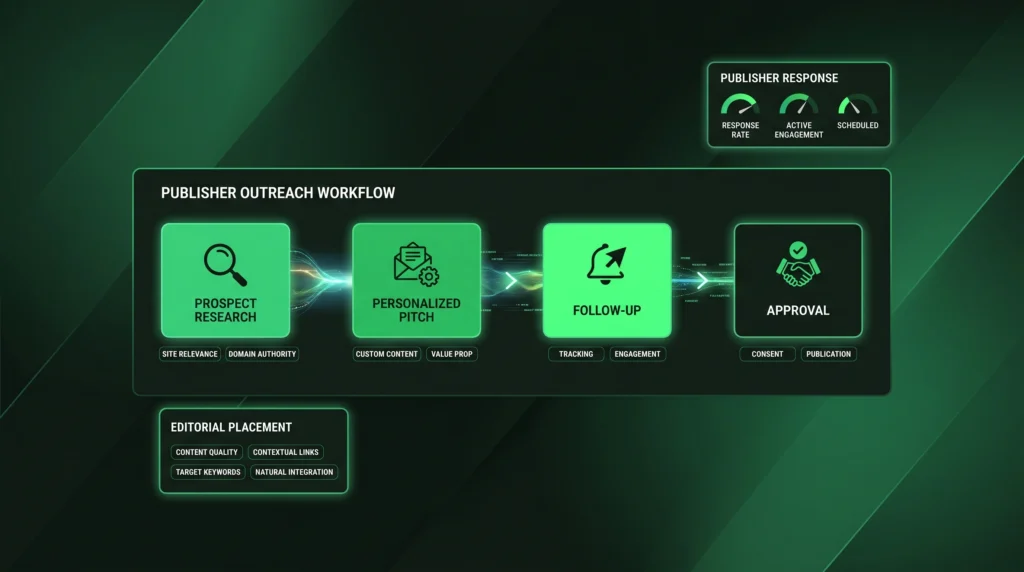
Real outreach is not automated email blasting. A strong campaign uses research, qualification, personalized pitching, follow-up, negotiation, content alignment, and verification.
Manual outreach protects quality because publishers can evaluate topics, anchors, and audience fit. It also helps prevent spammy practices that can damage a site’s backlink profile.
The visible result is the published backlink. The work behind that result is what separates professional outreach from risky placement buying.
Prospect Research, Qualification, List Building
Prospect research starts with competitor analysis, SERP review, industry publications, and topical mapping. The team identifies websites that already publish relevant content or attract the right audience.
A qualified prospect list should exclude domains with:
- No meaningful organic traffic
- Irrelevant outbound references
- Thin or AI-spun content
- Obvious sponsored-post footprints
- Poor indexation
- Sudden authority spikes with weak referring domains
- Excessive commercial anchors
A strong list improves campaign efficiency. It also reduces the chance of paying for placements that do not support rankings.
Personalized Pitching And Follow-Up
Personalized pitching explains why a topic fits the publisher’s audience. Editors are more likely to respond when the pitch offers value instead of asking for a backlink immediately.
Follow-up is part of professional outreach. Many placements are secured after a second or third message, especially when publishers are busy.
Good outreach also respects boundaries. If a publisher is not a fit, forcing the conversation usually harms future opportunities.
Low Hit Rates, Pickier Editors, Longer Timelines
Response rates are often lower than buyers expect. Editors reject weak guest post topics, irrelevant anchors, thin content, and purely commercial requests.
Longer timelines can be a positive signal. Careful publishers review content and maintain standards, which usually makes the placement safer.
A realistic budget accounts for this friction. The client pays for the accepted placement and for the many rejected opportunities filtered out along the way.
Budget Planning By Business Stage And In-House Link Tradeoffs
Budget planning should match website maturity. A new site needs foundational authority, while an established brand may need category-level scaling, digital PR, or backlink profile maintenance.
The right monthly spend depends on keyword difficulty, current authority, content quality, and competitor strength. Spending more does not guarantee faster rankings if target pages are weak or technically flawed.
A mature plan connects budget to outcomes. The agency should explain why each page deserves investment and how placements support revenue potential.
Early-Stage Sites Needing Foundational Authority
Early-stage websites need a natural foundation before aggressive scaling. Branded anchors, homepage references, and relevant informational placements usually come first.
A starter campaign may focus on:
- Building baseline authority.
- Diversifying referring domains.
- Supporting crawl discovery.
- Creating safe anchor variety.
- Strengthening key informational assets.
- Preparing commercial pages for future growth.
The goal is not maximum volume. The goal is a stable profile that can support larger campaigns later. For a new domain, building links too quickly can look less credible than gradual authority growth from relevant sources.
Commercial Keyword Campaigns Requiring Stronger Placements
Commercial keywords require stronger placements because competing pages often have established authority and better content depth. Budget should prioritize pages that can generate leads, sales, or affiliate revenue.
For these campaigns, we map competitors, anchors, target URLs, and topical gaps. Then we select placements that help close the gap over time.
A relevant backlink from a focused industry site can outperform a broader domain with higher authority but poor topical alignment.
Established Brands Scaling Authority Across Categories
Established brands often need authority across product, service, comparison, and resource pages. Sending every backlink to the homepage wastes potential.
Scaling requires careful anchor management. A natural link profile includes branded anchors, URL anchors, partial-match terms, topical phrases, and occasional commercial anchors.
The campaign also needs velocity control. Sudden growth from weak sources can look unnatural, while steady acquisition from relevant publishers supports long-term growth.
Sites Losing Backlink Momentum
Some websites lose rankings because older backlinks disappear, pages go offline, or competitors keep earning stronger placements. New acquisition may help, but first the agency should review decay.
A recovery-focused audit should check:
- Lost referring domains
- Removed or changed anchors
- Declining target pages
- Deindexed publisher pages
- Competitor growth patterns
- Internal content gaps
- Pages with falling monthly organic traffic
Replacing lost authority with better placements can restore momentum. Maintenance is part of professional campaign management.
Brands Competing For AI Search Visibility
AI search visibility depends on clear entity signals, topical authority, and consistent mentions from credible sources. Backlinks help, but brand context matters too.
A campaign built for Google AI Overviews and conversational engines should connect the brand with products, use cases, industries, and expertise areas. That means earning placements in content that describes the company clearly.
For AI search, vague mentions are less useful. Explicit entity associations make it easier for systems to identify what the brand does and why it is relevant.
ROI, Gap Analysis, AI Search Impact
ROI should be evaluated through rankings, organic traffic, assisted conversions, lead quality, and lifetime link value. A placement can influence performance only after crawling, indexing, reassessment, and competitor comparison.
Many clients ask how long link building takes to show results before investing. The honest answer depends on site authority, keyword difficulty, content quality, and technical health.
A good agency does not promise instant rankings. It builds a measurable plan that connects placements to business value.
Lifetime Backlink Value, Gap, Return Projection
Lifetime backlink value estimates how much long-term benefit a placement may create through ranking support, referral visibility, and authority growth. A strong placement can remain useful for years.
Gap analysis compares your page with competitors ranking for the same keyword. The review should include referring domains, anchor patterns, topical relevance, content depth, and authority signals.
Return projection should stay conservative. Estimate traffic lift, conversion rate, and customer value before deciding how much to invest.
Decay, Opportunity Cost, Bad Backlink Risk
Decay occurs when backlinks are removed, redirected, deindexed, or placed on pages that lose traffic. Monitoring protects the investment.
Opportunity cost matters. Money spent on poor placements cannot be spent on better content, digital PR, or stronger outreach.
Bad backlinks can create cleanup work and ranking instability. Quality control is cheaper than repairing a damaged profile later.
Link Pricing Red Flags And Quality Checks
Pricing transparency is essential. A trustworthy agency explains what the budget includes, how publishers are vetted, and how placements are reported.
Low pricing is not always bad, and high pricing is not always good. The key is whether the provider can prove relevance, traffic, editorial standards, and campaign control.
Quality checks protect ranking stability. They also help clients compare providers without relying only on domain rating or average price.
Guaranteed High-DR Placements For Low Prices
Guaranteed high-DR placements at unusually low prices are risky. Domain rating can be inflated, and a high score does not guarantee real audience value.
A stronger review looks at:
- Organic traffic by country
- Relevant ranking keywords
- Content quality
- Outbound commercial patterns
- Indexation history
- Publisher transparency
- Placement context
If a provider sells authority without context, the offer deserves scrutiny.
No Traffic Or Relevance Verification
No traffic verification means the provider may be using inactive websites. A domain can look strong while attracting little monthly organic traffic.
No relevance verification creates another problem. A backlink from an unrelated website may provide limited value and can look unnatural in the profile.
Professional reporting should show why each publisher fits the target page and campaign goal.
Bulk Packages With Exact-Match Anchors
Bulk packages with exact-match anchors often create unnatural patterns. Search engines expect anchor diversity across branded, URL, partial-match, topical, and natural phrases.
Exact-match anchors can work in moderation. The ratio should depend on competitor data, page type, existing anchor distribution, and risk tolerance.
A safe campaign builds authority gradually. It avoids forcing commercial anchors into weak or irrelevant content. The question is not simply how many links a page needs, but which sources can strengthen topical trust.
Missing Reporting, Placement Review, Monitoring
Missing reporting makes performance difficult to evaluate. Clients should know which URLs were published, what anchors were used, which pages received backlinks, and whether placements remain live.
Placement review should happen before or immediately after publication. Monitoring should continue because pages can change after delivery.
Transparent reporting creates accountability. It also helps SEO teams adjust strategy when rankings or traffic move. Clear reporting is especially important for managed link building campaigns, where multiple pages, anchors, and publishers are coordinated over time.
FAQ
A monthly budget should include strategy, prospect research, manual outreach, content creation, publisher communication, placement review, anchor planning, velocity management, and reporting; the direct answer is that the buyer is paying for managed execution, while the nuance is that a small site may need only a few placements per month and an enterprise campaign may need broader coverage across many URLs.
Prices vary because publisher quality, niche difficulty, content standards, traffic, authority, and outreach workload differ; the direct answer is that stronger placements require more labor and better relationships, while the exception is cheap bulk inventory, which may reduce upfront cost but often creates higher long-term risk.
Per-placement pricing works for limited needs, while a monthly retainer works better for ongoing SEO growth because it supports strategy, consistency, anchor control, velocity planning, and reporting; the nuance is that one-off buying can be useful, but serious ranking campaigns usually need a managed system.
Outsourced execution often costs less when salaries, tools, content, training, and publisher development are included; an in-house team can provide control, but a specialized agency usually reduces ramp-up time, especially when the business needs consistent placements across multiple niches or pages.
ROI often appears after search engines crawl new backlinks, reassess authority, and compare the page against competitors; early movement can happen within a few months, but stronger business impact usually depends on content quality, technical SEO, keyword difficulty, and the strength of the existing backlink profile.
Bad packages often promise guaranteed rankings, very high authority for very low prices, bulk placements, exact-match anchor control, no traffic data, irrelevant publishers, weak content, and missing reports; the safest choice is a provider that explains quality criteria and shows how every backlink supports relevance, authority, and long-term growth.