
How Long Link Building Takes To See Results From Backlinks
How long does link building take to produce real results? In most SEO campaigns, backlinks take months to influence search rankings, organic traffic, and search engine ranking stability. A single link can help in the right context, but consistently building links from authoritative, niche-relevant websites is what creates measurable growth.
As a professional outsource link-building agency, we manage fully handled backlink acquisition campaigns for SaaS companies, affiliate marketers, e-commerce brands, digital marketing agencies, and website owners investing in SEO. Our work includes outreach-based link building, guest post backlinks, niche edit links, editorial backlinks, anchor text planning, link velocity control, indexing checks, ranking tracking, and backlink performance reporting.
In practical terms, link building performance depends on several connected factors:
- Website authority: established domains usually respond faster than new websites.
- Backlink quality: high-quality links from relevant websites carry more value than low-grade placements.
- Keyword competition: competitive search engine results often take much longer to move.
- Content readiness: backlinks work better when the linked page already satisfies search intent.
- Campaign consistency: keep building links at a controlled pace to support stable growth.
The honest answer is that link building can take different amounts of time. Some pages may see a jump in traffic within a few months, while others take much longer because Google Search needs time to crawl, evaluate, compare, and trust new backlink signals.
Realistic SEO Timeframes To Get Results From Link Building
Most effective link building campaigns take a long-term view. For established websites targeting moderately competitive keywords, first movement often appears within 8–12 weeks, while stronger ranking and traffic changes may take 4–12 months. In highly competitive SERPs, backlinks can take months to see meaningful impact.
A managed link building service should not promise instant rankings. Instead, an experienced link building agency should explain how link acquisition, page quality, anchor distribution, and search intent work together. Campaign timelines should be measured by indexing, keyword movement, organic traffic trends, and the quality of the links acquired.
| Timeline | Common Result | Agency Focus |
| 0–30 days | Crawling and indexing | Placement verification and baseline tracking |
| 2–4 months | Early ranking movement | Anchor balance and link velocity control |
| 5–8 months | Traffic trend growth | Scaling quality links |
| 9–12 months | Stronger authority signals | Campaign refinement and expansion |

Mon-Fri: 09:00 AM – 06:00 PM
First 30 Days: Crawling, Indexing, Baseline Signals
During the first 30 days, the main goal is not dramatic ranking movement. Google Search needs time to crawl the publisher page, find your link, process the context around the link pointing to your page, and connect that signal with your existing content.
At this stage, our agency focuses on early quality control:
- Confirm the backlink is live on the approved publisher page.
- Check indexability so Google can discover the placement.
- Review anchor text against the campaign plan.
- Record baseline rankings before expecting movement.
- Track publisher quality using organic traffic, relevance, and outbound link patterns.
This first phase matters because a backlink that is live but not indexable may not influence search engine ranking. A placement that looks acceptable on the surface can still be weak if the page is thin, unrelated, or isolated from the publisher’s internal structure.
Months 2–4: Early Ranking Movement
Months 2–4 are when many websites begin to see early changes in search engine results. These changes are often uneven because one keyword may improve while another stays flat, especially when Google Search results are competitive.
Early movement usually appears in a few ways:
- Impression growth before click growth.
- Keyword movement from lower positions toward page two or page one.
- Small organic traffic increases across long-tail queries.
- Improved visibility for semantically related keywords.
- Ranking volatility while Google retests the page.
For example, an article on the second page may move closer to the first page of Google after receiving several high-quality links. The page may not see a jump immediately, but early ranking movement can show that the campaign is moving in the right direction.
Months 5–8: Traffic Growth Patterns
Between months 5 and 8, backlink impact often becomes easier to measure. If the linked pages are strong, the anchors are natural, and the referring domains have organic traffic, search rankings and traffic can begin to improve more consistently.
This is where controlled scaling matters. Keep building links too aggressively, and the pattern may look unnatural. Move too slowly, and competitors with stronger link building efforts may continue to outrank your page in Google search results.
In agency reporting, this phase is usually where we compare backlink acquisition against ranking momentum. A campaign may not produce the exact results you want yet, but consistent growth in impressions, keyword coverage, and referring domains often shows that the campaign is compounding.
Months 9–12: Peak Impact Window
For many link building campaigns, months 9–12 are when peak impact begins to appear. This does not mean every backlink suddenly works at month 11. It means the accumulated value of quality links, content improvements, internal linking, and steady authority growth becomes more visible.
In our experience building links for clients, this is when stakeholders often start asking about campaign expansion. If rankings improve, organic traffic increases, and qualified leads begin to rise, the next step is usually scaling the number of links while protecting link quality.
Faster Scenarios For Backlinks To Show Impact
Backlinks may work faster when a page is already on the first page, the keyword difficulty is moderate, and the website already has topical authority. In these cases, getting a link from a relevant publisher may help improve rankings within a shorter window.
Faster results are more likely when:
- The page already ranks in positions 5–15 and needs authority support.
- The target keyword has moderate competition rather than enterprise-level SERPs.
- The backlink comes from a relevant page with real organic traffic.
- The content already matches search intent and only lacks authority.
- Internal links support the target URL from related pages.
A page ranking in positions 6–10 may only need a few authoritative links, better internal links, or improved content depth to see a significant lift. This is why link building strategies should be prioritized by opportunity, not just by search volume.
Slower Scenarios For Competitive Search Results
Backlinks may take longer when the niche is saturated, the website is new, or the target keyword is dominated by large brands. A page targeting competitive commercial terms may need stronger content, more referring domains, and a larger link building budget before real results appear.
In difficult markets, it is common for SEO teams to wait several months to see meaningful movement. The goal is not to force shortcuts but to build backlinks steadily from trusted websites with real readers, strong topical fit, and verified organic traffic.
Why Link Building Efforts Take Time
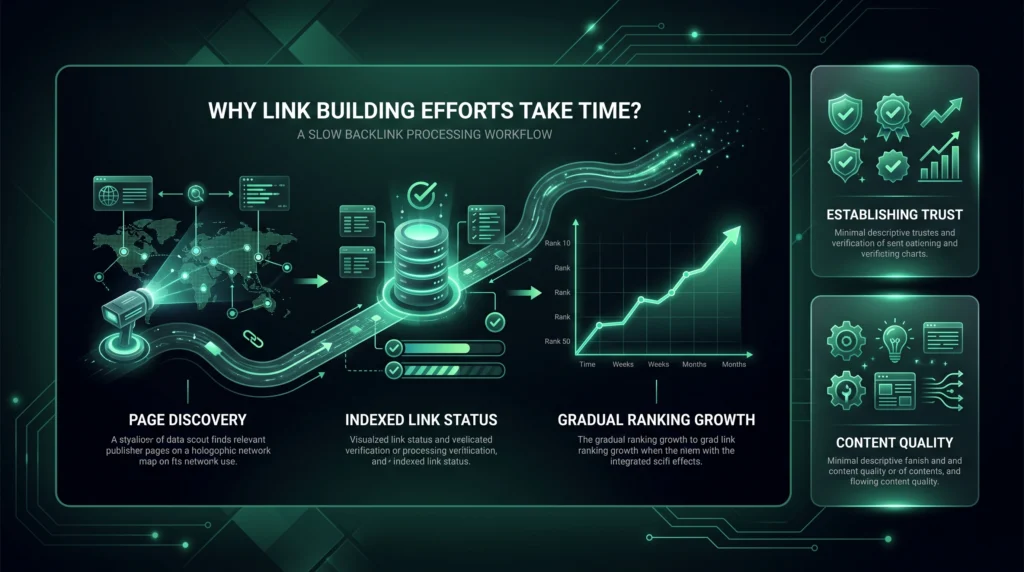
Link building efforts take time because Google Search evaluates more than the presence of a backlink. The search engine looks at page relevance, link context, content quality, website authority, user behavior signals, and the overall trust profile of the domain.
A professional agency does not treat link acquisition as a one-off task. Outsourced link building services provide contextual backlinks from niche-relevant websites with verified organic traffic, editorial standards, and placement quality controls. That approach reduces risk and improves long-term SEO stability.
For brands that need sustainable execution, managed link-building services are usually better aligned with long-term search performance when they use clear quality standards, controlled link velocity, relevant placements, and transparent reporting.
Search Engine Indexing Time
Before a backlink can influence ranking, Google must crawl and index the page where the link appears. If the publisher page is weak, isolated, or rarely crawled, it may take longer for the backlink to be discovered.
Our team checks whether a publisher page can be indexed and whether the link is placed in visible editorial content. This matters because a backlink hidden in thin content or buried on a low-value page may contribute little to search engine ranking improvement.
Gradual Ranking Increases
Ranking increases are rarely instant or uniform. One keyword can move from position 18 to 11, another can stay in place, and a third can fluctuate before settling.
This is normal in link building. Search engines test pages against competing results, and even high-quality backlinks need time to influence how a page performs across related queries. The best campaigns track patterns, not isolated daily changes.
Trust Signal Accumulation
Backlinks act as trust signals when they come from relevant, authoritative, and editorially reviewed websites. However, trust is not created by a single link. It builds as a website receives a consistent pattern of quality links over time.
A link building agency should manage this process carefully. Anchor text, referring domain diversity, link velocity, and publisher quality all influence the effectiveness of link building and the stability of future rankings.
Traffic Lag After Position Changes
A ranking improvement does not always produce immediate traffic growth. A page may move from position 22 to position 14, which is progress, but the traffic impact may be limited because the page is still not on the first page of Google.
Traffic usually becomes more noticeable when keywords enter positions where users actually click. That is why months to see results can vary so much between a page already on the first page and a page buried deeper in search engine results.
Link Value Consolidation
Link value consolidates over time as Google evaluates the linking page, the surrounding content, and the relationship between source and destination. A backlink from a new guest post may become more valuable once that guest post itself gains visibility and internal links.
This is why we monitor not only whether clients receive a link but also whether the publisher page remains live, indexable, and relevant. The quality of those links often matters more than the raw number of placements.
Main Factors That Influence How Long Link Building Takes
Several factors influence how long it takes to get results from link building. The most important factors include the type of link building campaign, number of links, link velocity, site age, content quality, and keyword competition.
From an agency perspective, successful link building is operational. A campaign needs prospecting, publisher qualification, outreach, negotiation, content creation, placement review, reporting, and ongoing performance analysis.
The main timing factors include:
- Type of link building: guest posts, niche edits, digital PR, and editorial backlinks work on different timelines.
- Number of links: competitive pages usually need more than one placement.
- Link velocity: backlink growth should look natural for the website’s stage.
- Website age: older websites often respond faster than brand-new domains.
- Content strength: strong content gives backlinks a better page to support.
- SERP difficulty: competitive keywords can take much longer to move.
Good execution is what separates effective link building campaigns from random link buying. The right process controls risk, improves relevance, and makes results easier to measure.
Link Building Campaign Type
The type of link building strategy can impact how quickly results appear. Guest post backlinks may provide strong contextual relevance, niche edits can help pages receive a link from existing indexed content, and editorial backlinks from digital PR may build brand authority.
Each campaign type has a different production timeline. Guest posting requires content creation and publisher approval, while niche edit links can move faster if the publisher already has a suitable page. Digital PR may take longer but can earn stronger authority signals.
Link Quantity
The number of links needed depends on the keyword, SERP difficulty, competitor authority, and current ranking position. A single link may help a low-competition page, but competitive search results usually require consistently building links over time.
Quality still comes first. Ten weak backlinks from irrelevant websites rarely outperform fewer high-quality links from strong, relevant domains with organic traffic and editorial standards.
Link Velocity
Link velocity is the pace at which backlinks are acquired. A natural campaign should scale in a way that matches the website’s age, current authority, content output, and competitive environment.
When clients ask whether they should start building links aggressively, we usually review historical referring domain growth first. A new website should not mimic the velocity of an established brand with years of PR, content, and publisher relationships.
Website Age
Website age affects how quickly backlinks may influence search rankings. Older websites with clean link profiles and established topical relevance often respond faster than brand-new domains.
New websites can still grow through link building, but they usually need patience. Google Search needs time to evaluate the domain, content quality, and backlink profile before assigning stronger trust signals.
Link Quality And Effectiveness Of Link Building
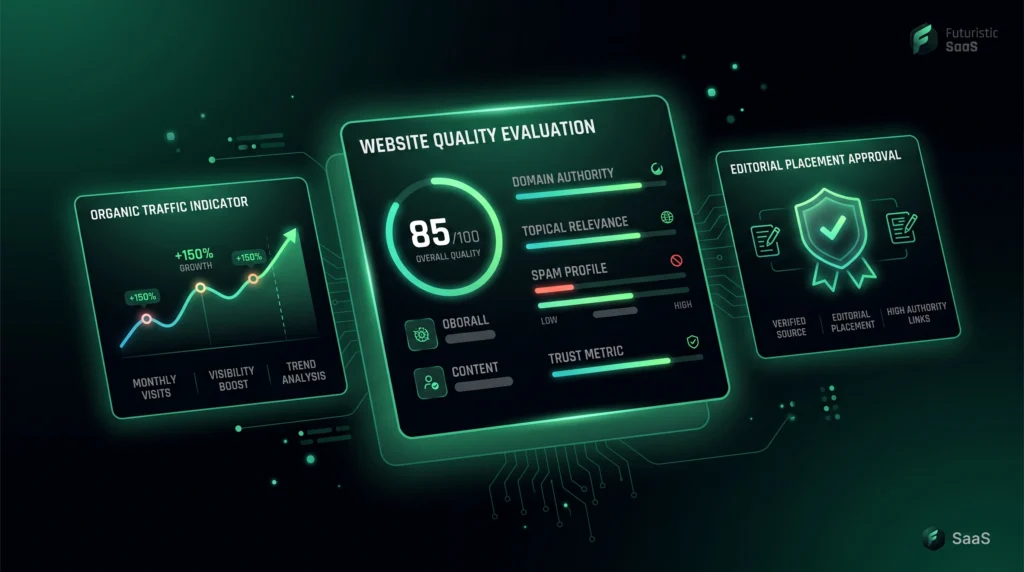
The quality of the links is one of the most important factors in campaign performance. A high-quality backlink is contextually relevant, editorially placed, indexable, surrounded by useful content, and published on a website with real organic traffic.
Before approving a publisher, our agency checks:
- Topical relevance between the linking website and the client’s niche.
- Organic traffic quality rather than relying only on third-party authority scores.
- Editorial standards to confirm the website publishes useful content.
- Outbound link patterns to avoid obvious link-selling footprints.
- Indexability of the page where the backlink will appear.
- Anchor text fit within the broader distribution plan.
Outsourced link building is not simply about getting a link. A managed link building agency evaluates the publisher, page relevance, link placement, anchor text, outbound link patterns, traffic metrics, and content standards before approving a placement.
Linking Site Authority
A link from an authoritative website can carry more SEO value than a link from a weak or irrelevant domain. Authority is not only a third-party metric; it is also demonstrated through topical coverage, organic visibility, editorial standards, and trust signals.
We review domain-level and page-level metrics before recommending placements. A strong metric can be useful, but metric quality should always be checked against real traffic, keyword visibility, and topical relevance.
Linking Site Traffic Quality
Organic traffic is one of the strongest practical filters for link quality. A publisher with stable search visibility is more likely to provide value than a website created only to sell links.
Our outreach team verifies traffic patterns before placements go live. If a website has inflated metrics, suspicious outbound links, or no meaningful ranking keywords, that publisher is usually removed from the campaign.
Topical Relevance
Topical relevance affects how search engines interpret a backlink. A SaaS website receiving a link from a B2B technology blog is usually more relevant than a link from a general lifestyle site.
Relevance also improves referral context. Even if the primary goal is SEO, a link placed in useful content for the right audience creates a stronger signal than a random placement on an unrelated website.
Brand Recognition
Brand recognition can influence how link building works because recognizable brands often earn links, mentions, and clicks more naturally. Publishers are also more willing to collaborate with companies that have clear positioning, strong content, and trustworthy websites.
For lesser-known brands, link building can support authority growth gradually. Editorial backlinks, guest content, and consistent publisher relationships help build credibility across the market.
Content, Keywords, And Page Readiness For SEO Growth
Backlinks perform best when the linked page deserves to rank. If the content does not satisfy search intent, even authoritative backlinks may not produce the results you want.
Before we build backlinks at scale, we review page readiness across several areas:
- Search intent alignment: the page must answer what users expect from the query.
- Content depth: the page should be competitive against top-ranking results.
- Internal links: related pages should support the target URL.
- Technical accessibility: the page must be crawlable, indexable, and fast enough.
- Conversion clarity: commercial pages should guide users toward the next step.
- Topical coverage: the page should fit within a broader content cluster.
This review prevents wasted spend. Backlinks cannot fully compensate for weak content, poor search intent alignment, or technical problems that block crawling and indexing.
Linked Page Content Quality
The linked page must offer value beyond basic keyword targeting. Strong content includes useful explanations, examples, original insights, clear formatting, and enough depth to compete on the results page.
A backlink can help Google discover and trust a page, but the page still needs to satisfy users. If the content is thin or misaligned with the query, backlinks may take much longer to create meaningful impact.
Target Keyword Difficulty
Keyword difficulty directly affects how long link building takes. A page targeting a low-competition informational term may move faster than a commercial landing page competing against large brands.
When we plan campaigns, we compare target pages against the top-ranking competitors. The goal is to estimate how many quality links may be required and what kind of authority gap needs to be closed.
Current Page Ranking
Current ranking position is one of the clearest indicators of potential speed. A page already on the first page may need fewer signals to improve, while an article on the second page may need stronger backlinks, better content, and internal link support.
This is why opportunity mapping matters. If a second page of Google jumped ten places after several relevant backlinks, that movement can validate the campaign even before major traffic growth appears.
Domain Authority And Domain Rating Growth From Backlinks
Domain Authority and Domain Rating are third-party metrics, not direct Google ranking factors. Still, DA and DR can help teams estimate authority growth when used carefully alongside organic traffic, referring domains, rankings, and link quality.
A professional agency should never report DA or DR as the only measure of success. The better question is whether backlinks are improving search rankings and traffic for priority pages.
DA Growth Timeline
DA growth can take months because authority metrics update on their own schedules and depend on changes across the broader web. A website may receive strong backlinks before third-party tools fully reflect the improvement.
This is why clients should not judge early campaign performance only by DA changes. Ranking movement, indexation, new referring domains, and traffic trends usually provide better early signals.
DR Growth Timeline
DR growth also takes time and can vary by tool. A few strong backlinks may improve DR, but the pace depends on the authority of linking domains and the website’s existing backlink profile.
We use DR as one metric among many. Strong campaigns combine DR tracking with keyword visibility, organic traffic, placement quality, anchor distribution, and live link monitoring.
Page Impact Versus Sitewide Impact When It Comes To Link Building
Link building can affect one page, several related pages, or the overall authority of a website. The impact depends on where the backlink points, how internal links distribute value, and how closely the linked page connects to the rest of the site.
A practical campaign usually balances different link targets:
- Commercial pages for direct ranking support.
- Blog posts for informational keyword growth.
- Linkable assets for natural publisher references.
- Homepage links for brand and domain authority.
- Supporting guides for topical authority and internal link flow.
A backlink pointing to a commercial landing page may help that page directly. A backlink to a strong informational article can also support topical authority and pass value through internal links to product, service, or category pages.
Page-Level Ranking Growth
Page-level growth happens when backlinks point directly to a target URL. This is common for service pages, affiliate pages, SaaS comparison pages, and commercial blog posts.
Direct links can be powerful, but they must be managed carefully. Too many exact-match anchors to a money page can look unnatural, so anchor text distribution should include branded, URL, partial-match, and topical variations.
Sitewide Authority Growth
Sitewide authority grows when a domain earns a broader pattern of relevant backlinks. Over time, this can help new content rank faster and support the performance of multiple pages.
For larger SEO programs, our agency often balances links to commercial pages, informational assets, homepage URLs, and supporting blog content. This creates a healthier backlink profile than pushing every placement to a single landing page.
Internal Link Building Support
Internal link building helps distribute backlink value across a website. If a strong guest post links to a guide, that guide can pass authority to related service pages through contextual internal links.
This is why internal linking should be planned before or during backlink acquisition. Backlinks and internal links work together, especially for websites with topic clusters, product categories, or multiple lead-generation pages.
Link Equity Flow Across Priority Pages
Link equity flow depends on site architecture, crawlability, and contextual internal links. If a linked page is isolated, the value may not support other important URLs.
We often recommend improving internal links before scaling external placements. A stronger internal structure helps backlinks support not just one page, but the broader SEO strategy.
Homepage Links Versus Deep Page Links
Homepage links can support brand authority, while deep page links can improve rankings for specific URLs. Both types have a role in effective link building campaigns.
A natural backlink profile usually includes a mix. Too many deep commercial links may look forced, while only homepage links may not give priority pages enough direct support.
Multiple URL Impact From Strong Backlinks
A strong backlink can sometimes influence multiple URLs when the linked page connects well with related content. For example, a high-quality editorial backlink to a research guide may support the guide, related blog posts, and internal commercial pages.
This is one reason content hubs perform well in link building. They give publishers useful pages to reference while helping SEO teams distribute authority across important assets.
Strategies For Successful Link Building Campaign
A successful link building campaign combines strategy, outreach, quality control, and reporting. The top link building strategies are not interchangeable; each has different strengths, costs, timelines, and risk levels.
Before choosing a strategy, a link building agency should review:
- SEO goals for rankings, leads, revenue, or authority growth.
- Current backlink profile to identify gaps and risks.
- Competitor referring domains to estimate link requirements.
- Available content assets that publishers can reference.
- Monthly link building budget and realistic scaling capacity.
- Internal SEO resources for content updates and technical fixes.
For clients planning scale, we also connect link building budget and results so expectations match the investment needed to compete.
| Strategy | Best Use Case | Typical Strength |
| Digital PR | Brand authority and media mentions | High-authority editorial backlinks |
| Guest Posting | Controlled topical relevance | Contextual guest post backlinks |
| Niche Edits | Faster placement on existing pages | Indexed pages with existing history |
| HARO / Expert Quotes | Credibility and expert positioning | Editorial mentions |
| Linkable Assets | Scalable outreach | Natural reference-worthy links |
Digital PR Links
Digital PR links are editorial backlinks earned through newsworthy content, expert commentary, original data, or industry stories. These links can be powerful because publishers choose to reference the brand within editorial coverage.
Digital PR may take longer than standard outreach, but the authority can be stronger. For SaaS companies and e-commerce brands, digital PR can also improve brand recognition beyond search engine results.
Guest Posting
Guest posting allows a brand to contribute useful content to a relevant publisher and receive a contextual backlink. This strategy works well when the article is editorial, non-promotional, and aligned with the publisher’s audience.
As an agency, we manage guest post backlinks through prospecting, outreach, topic approval, content writing, placement review, and reporting. Good guest posting is not mass publishing; it is targeted publisher collaboration.
Niche Edits
Niche edits, also known as link insertions, place a backlink inside an existing article. This can be effective because the page may already be indexed and may already have organic traffic.
However, niche edit links require strict quality checks. We review the page topic, outbound link profile, content quality, and placement context before recommending this type of link building.
HARO And Expert Quote Links
HARO-style expert quote links can help brands earn editorial mentions by providing useful answers to journalists and content teams. These links are often valuable for credibility, especially when the source is selective.
The challenge is consistency. Response quality, speed, expertise, and clear positioning all affect whether a brand gets featured and whether the final article includes a link.
Linkable Asset Outreach
Linkable asset outreach promotes resources that publishers genuinely want to reference. Examples include original research, calculators, statistics pages, visual assets, comparison guides, and expert roundups.
This strategy often works best for companies willing to invest in content before outreach. When a resource solves a publisher’s problem, getting a link becomes easier and the placement feels more natural.
Common Misconceptions About How Link Building Works
Many SEO teams misunderstand how link building works because they focus on shortcuts instead of compounding signals. Backlinks are not magic buttons; they are trust and relevance signals that work best with strong content and a technically sound website.
The most common misconceptions are:
- More links always win: quality, relevance, and placement context often matter more.
- Backlinks work instantly: Google needs time to crawl, evaluate, and trust signals.
- Paid links remove effort: poor placements can create risk and waste budget.
- Metrics alone prove quality: organic traffic and editorial standards must also be reviewed.
- One campaign fixes everything: link building works best with content, technical SEO, and internal linking.
A transparent agency should explain what results are realistic, what may take longer, and how progress will be measured. That is why our campaigns include live link tracking, anchor text review, indexation checks, ranking updates, and link building agency reports that connect placements to performance.
Quantity Versus Quality
More backlinks do not always mean better rankings. The quality of the links, the relevance of the publisher, and the context of the placement often matter more than raw volume.
A high-quality backlink from a niche-relevant website with organic traffic can outperform many low-value placements. In competitive campaigns, quantity matters only after quality controls are in place.
Fast Link Building Shortcuts
Poorly controlled fast acquisition can create long-term problems. Automated links, irrelevant placements, poorly reviewed domain networks, and low-quality paid links may appear efficient, but they can reduce campaign value and waste budget.
Professional link building takes time because real outreach requires publisher communication, content approval, editorial review, and quality assurance. That process protects ranking stability and long-term SEO growth.
Paid Links As Ranking Shortcut
Paid placements require careful evaluation because performance depends on quality, transparency, relevance, anchor text, source standards, and how the placement is handled. Brands should review any campaign built only around payment without clear sourcing rules, placement logic, and quality control.
A stronger approach is to prioritize relevant source selection, useful content, and contextual placements. The objective is not just getting a link; the objective is building authority that can support search rankings over time.
FAQ
Most websites take 3–12 months to see results from link building, depending on competition, domain authority, content quality, and backlink quality; early movement may appear within 8–12 weeks, but stronger organic traffic and ranking gains usually need more time.
Backlinks can begin affecting rankings after Google crawls and evaluates the linking page, but visible movement often takes weeks or months because Google Search also considers relevance, page quality, trust signals, and the competitive results page.
Backlinks can show limited results in 30 days, especially through indexing, impressions, or small ranking changes, but strong traffic growth is more realistic over several months unless the page is already close to top positions.
The number of backlinks needed depends on keyword difficulty, competitor authority, current ranking position, and the quality of the links; a low-competition page may need a few strong placements, while competitive commercial pages often require a sustained campaign.
Domain authority can increase after link building, but DA and DR are third-party metrics that may update slowly; rankings, organic traffic, referring domains, and conversions are usually better indicators of campaign progress.
Link building results should be tracked monthly but judged across 3, 6, 9, and 12-month windows; live links, anchor text, and indexability should be checked immediately, while ranking impact should be evaluated over time.


