Companies usually ask this question when organic growth starts requiring more than content production and technical SEO. In competitive SERPs, authority placements, editorial mentions, relevant backlinks, and controlled outreach execution can influence how quickly strong pages earn visibility.
As a professional outsource partner, we manage fully handled backlink acquisition for SEO professionals, affiliate marketers, SaaS companies, e-commerce brands, agencies, and website owners. Our work covers guest post backlinks, niche edit links, editorial backlinks, anchor text distribution, publisher communication, content creation, indexing checks, ranking tracking, and campaign reporting.
The best choice is not “internal team versus agency” in a vacuum. The better option depends on budget, internal capacity, risk tolerance, business goals, and whether your team can consistently secure high-quality placements from real publishers without losing focus on strategy.
Link Building Models: In-House, Agency, Outsourced, Hybrid
Each operating model changes the way backlink acquisition is planned, executed, measured, and scaled. In-house execution gives direct control. Outsourced execution gives speed and specialized systems. A hybrid model keeps strategy and brand decisions inside the company while an external team handles repetitive campaign work.
Backlink correlation studies from major SEO platforms continue to show that authoritative referring domains are common among pages competing for difficult keywords. That does not mean every backlink helps. It means relevance, editorial context, traffic quality, and placement standards must be reviewed before a campaign scales.
Common delivery models include:
- Internal execution: company hires and manages its own outreach and content staff.
- Agency execution: external specialists manage prospecting, outreach, content, and reporting.
- White-label support: SEO agencies resell managed acquisition under their own brand.
- Hybrid execution: internal strategy remains in-house while outsourcing execution.
- Project-based support: temporary campaigns support launches, migrations, or seasonal goals.

Mon-Fri: 09:00 AM – 06:00 PM
What Is In-House Link Building?
In-house link building means a company manages prospect research, outreach, content briefs, negotiation, placement review, anchor planning, and reporting internally. The internal team may include an SEO specialist, content strategist, outreach manager, writer, editor, and analyst.
The main advantage is control. The challenge is operational depth. Good backlink acquisition requires consistent relationship building, qualification rules, inbox management, and QA. Without those systems, internal efforts often become slow or inconsistent.
What Is Outsourced Link Building?
Outsourced link building means a company hires a specialist partner to manage backlink acquisition outside the company. A professional provider handles publishers, prospect lists, outreach messages, content production, placement checks, reporting, and campaign pacing.
Outsourcing your link building is useful when the SEO team knows what pages need authority but does not have enough time to manage daily outreach. Fully managed outreach link building services can provide contextual backlinks from niche-relevant publishers with verified traffic and editorial standards.
What Is Link Building Agency Model?
A link building agency model is a managed service where external specialists execute acquisition from planning through reporting. Link building agencies usually provide guest posting, niche edits, editorial backlinks, publisher negotiations, anchor text planning, and performance tracking.
A serious agency does not sell placements blindly. The agency evaluates topical relevance, organic traffic, outbound patterns, content quality, indexability, and domain-level trust before recommending a prospect.
What Is Hybrid Link Building Model?
A hybrid model lets a company keep strategy in-house while outsourcing execution. The internal SEO team defines target pages, keyword priorities, anchor rules, and business goals, while the agency manages prospecting, outreach, negotiation, content coordination, and quality control.
This structure works well for SEO agencies, SaaS companies, affiliate publishers, and e-commerce brands. It preserves strategic oversight while removing the repetitive workload that often slows internal marketing teams.
When SaaS Companies Choose Each Model?
SaaS companies often keep technical SEO, product messaging, conversion analysis, and keyword mapping inside the company. These areas require deep product knowledge and close collaboration with sales, product, and customer success teams.
SaaS companies often outsource backlink acquisition when the market is competitive and internal teams need faster execution. A startup may choose external help early because hiring takes time, while a mature SaaS brand may use a hybrid model to scale acquisition across feature pages, comparison pages, and content hubs.
How Link Building Models Affect SEO Growth?
The model affects growth through speed, consistency, quality, and risk control. Internal teams may align closely with brand strategy, but building in-house often takes months before systems become reliable.
Agencies can move faster because workflows, tools, publishers, and QA rules already exist. In difficult niches, controlled monthly acquisition supports ranking progress, topical authority, referral traffic, and long-term organic visibility.
Key Factors For Build Vs Hire Decision
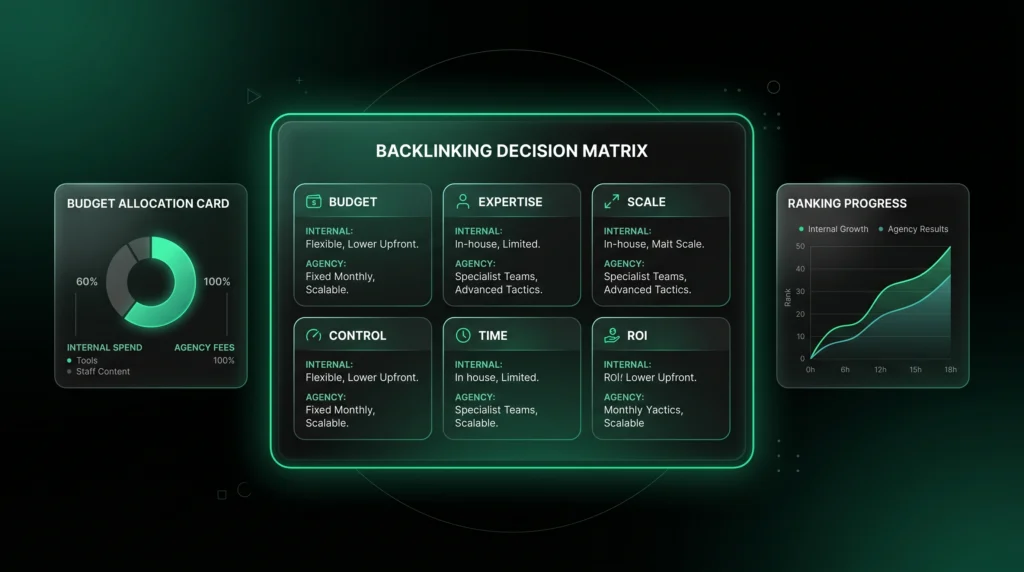
The build versus hire decision should start with resource reality. A company should compare internal bandwidth, required expertise, campaign volume, publisher access, content capacity, and management time before choosing a model.
From agency experience, the biggest mistake is treating backlink acquisition as a side task. If a team cannot dedicate consistent hours every week, performance becomes unpredictable.
Decision criteria should include:
- Budget: salary, tools, content, management, and placement costs.
- Expertise: prospect qualification, outreach, negotiation, and risk review.
- Speed: how quickly campaigns need to start producing new placements.
- Control: how much approval the brand needs before publication.
- Scalability: whether monthly volume must increase without hiring.
- ROI measurement: how rankings, traffic, and conversions will be tracked.
Budget And Cost Analysis
Budget should include visible and hidden expenses. Internal execution requires salaries, tools, training, content production, and management oversight. Outsourced execution may cost more per placement, but professional service usually includes prospecting, outreach, negotiation, content coordination, QA, and reporting.
A realistic link building budget should be planned around search competition and business goals. Cheap acquisition can become expensive if irrelevant domains, weak content, or risky patterns fail to improve ranking.
| Cost Area | Internal Team | Specialist Agency |
| Hiring | High upfront cost | Included in service |
| Tools | Paid separately | Usually included |
| Content | Internal or freelance cost | Often managed |
| Publisher access | Built slowly | Already developed |
| Scaling | Requires more people | Easier to adjust |
| Oversight | High management time | Lower internal load |
Expertise And Skill Requirements
Backlink acquisition requires a mix of SEO analysis, sales communication, editorial judgment, and risk management. A link builder must know how to qualify prospects, negotiate with publishers, review each link source carefully, manage anchor text, and protect long-term authority signals.
An in-house SEO specialist may be excellent at audits, keyword research, or technical SEO but still lack publisher negotiation experience. That is where specialized agency support can reduce mistakes and shorten the learning curve.
Scalability Needs
Scaling internally means more hiring, more training, more tools, and more content production. It also means more quality control because higher volume increases the chance of poor placements slipping through.
A mature agency can scale campaigns by expanding prospect pools, adjusting outreach sequences, and increasing content capacity. The key is controlled velocity. New backlinks should grow in a way that looks natural for the site’s age, authority, and publishing activity.
Control And Management Preferences
Some companies need tight control over every publisher, anchor, and article draft. This is common in legal, healthcare, finance, enterprise software, and other compliance-sensitive industries.
Outsourcing does not remove control when the workflow is built correctly. Clients can approve target pages, anchor ranges, publisher criteria, content direction, and final placement lists before publication.
Time Commitment
Backlink acquisition takes more time than most teams expect. Prospecting, personalization, follow-ups, negotiation, writing, editing, live checks, and reporting create an ongoing workload.
If the SEO team is stretched thin, outsourcing execution allows internal specialists to focus on strategy, conversion, technical fixes, and content planning. That division of labor often produces better ROI than asking one person to manage everything internally.
True Cost Of In-House Link Building
The true cost of internal execution includes salary, hiring delays, training, tools, content production, management, and failed experiments. Many teams only calculate compensation and miss the operational cost of building systems from zero.
In practice, internal programs work best when leadership treats acquisition as a dedicated function. Assigning it casually to a content marketer or junior SEO often creates inconsistent output.
Hidden costs often include:
- Recruiting and onboarding outreach staff.
- Paid prospecting, email, and backlink analysis tools.
- Writer and editor time for guest posting.
- Management review of publishers and anchors.
- Lost time from failed outreach angles.
- Replacement work when placements change or disappear.
Salary And Hiring Costs For Internal Teams
A complete internal function may need an SEO manager, outreach specialist, writer, editor, and analyst. Smaller companies often combine roles, but that can reduce output and quality.
Hiring is also difficult because outreach performance is hard to evaluate from a resume. Someone may understand Ahrefs, domain authority, and keyword research but still struggle with cold outreach, negotiation, and publisher relationship building.
SEO Tools And Software Expenses
Internal teams usually need platforms for prospect research, competitor analysis, email verification, campaign management, backlink tracking, and reporting. Ahrefs, Semrush, BuzzStream, Pitchbox, Hunter, and similar tools can raise monthly costs quickly.
Tools do not replace judgment. A real prospect must be checked for topical fit, organic traffic, indexation, content quality, and outbound behavior before outreach begins.
Training And Onboarding Costs
Training takes time because quality standards are nuanced. New team members must learn how to evaluate relevance, write persuasive outreach, negotiate placement terms, brief content, and manage anchor distribution.
The first months often include low response rates and process mistakes. From agency experience, many companies outsource after internal pilots stall because getting reliable placements is harder than expected.
Outreach Systems And Process Setup
A repeatable system needs prospect rules, email templates, personalization standards, follow-up logic, approval workflows, content briefs, QA checklists, and reporting dashboards. Without structure, campaigns become hard to manage and harder to improve.
An internal setup process usually includes:
- Define target pages, keywords, and authority gaps.
- Build prospect criteria for relevance, traffic, and editorial quality.
- Create outreach messaging and follow-up rules.
- Prepare content briefs and approval workflows.
- Review live placements, anchors, and indexability.
- Track ranking, organic traffic, and referral signals.
In-House Link Building Pros And Cons
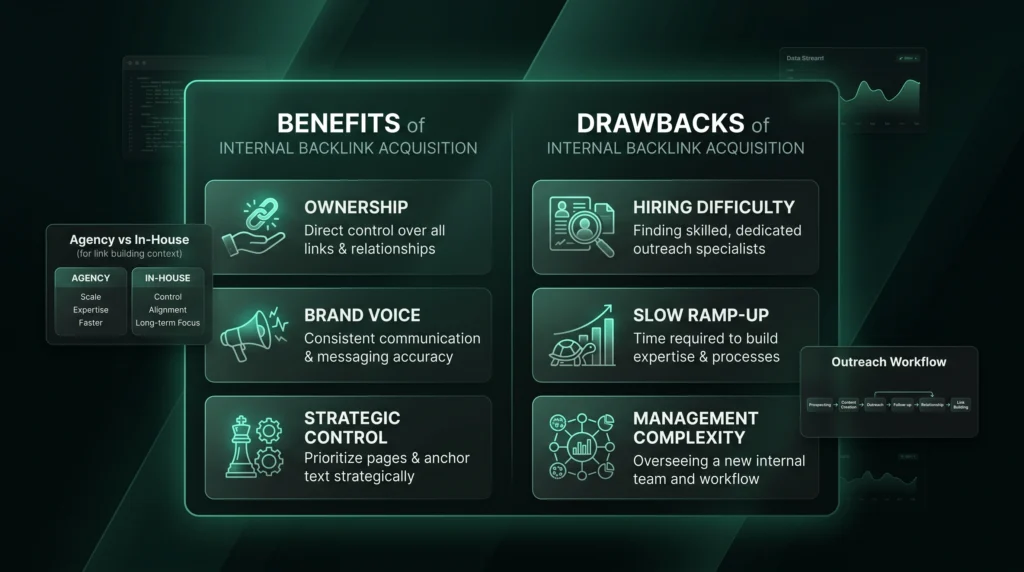
In-house execution can be effective when a company has enough budget, strong SEO leadership, writing capacity, and patience. The model gives more direct ownership over strategy and brand voice.
The downside is that it can take years to build publisher relationships, refine outreach systems, and train a dependable internal team. In fast-moving SERPs, slow execution may give competitors more time to earn authority.
Full Ownership Over Strategy
Internal teams can align acquisition with product launches, keyword priorities, brand positioning, and sales messaging. That alignment is valuable when target pages are closely tied to revenue.
Full ownership also allows fast adjustments. If a new product page, comparison page, or content hub becomes important, the SEO team can immediately update priorities.
Stronger Brand Voice Alignment
Internal writers usually understand product language, buyer pain points, and positioning better than outside writers. That can improve guest posting quality and editorial relevance.
A capable agency can still protect brand voice through clear briefs, examples, and approval workflows. Strategy and brand guidelines should remain visible throughout the campaign.
Harder Hiring And Team Management
Managing internal execution requires disciplined oversight. Leaders must review prospect quality, publisher communication, anchor distribution, content standards, velocity, and ROI.
The role is unusual because it blends SEO, outreach, negotiation, editing, and analysis. Many companies underestimate that mix, which is why internal programs sometimes become slower and more expensive than planned.
When In-House Team Makes More Sense
An internal team makes more sense when acquisition is a long-term core function and the company has resources to support it properly. The company should already have strong SEO strategy, content operations, and management capacity.
This model also works when every placement requires deep product, legal, compliance, or subject-matter review. Enterprise SaaS, financial services, health technology, and regulated industries may need extra approval layers.
Long-Term SEO Investment
If a company expects to invest in authority building for many years across many products or markets, internal capacity may become cost-efficient over time. The team can build institutional knowledge and direct publisher relationships.
The tradeoff is ramp-up time. Companies should expect slower early output while training, tools, and workflows mature.
Existing SEO Expertise Inside Company
Internal execution works best when an experienced SEO team already owns technical audits, keyword mapping, content strategy, and performance reporting. Strong strategic leadership reduces the risk of random acquisition.
If the internal team can handle planning but not execution, a hybrid model is often best. The company keeps strategy in-house while outsourcing execution to specialists.
When Outsourcing Link Building Makes More Sense
Outsourcing makes more sense when speed, consistency, and specialized execution matter more than building internal infrastructure. Many teams know which pages need authority but do not have enough time for daily prospecting, follow-ups, negotiation, and content coordination.
A managed agency partnership is also useful when campaigns require several strategies at once, including guest posting, niche edits, editorial backlinks, and white-label link building. Each approach requires different publisher criteria and quality checks.
Limited Internal Time
Limited time is the clearest signal. If your marketing team is stretched thin, acquisition becomes inconsistent, and inconsistent campaigns rarely produce dependable authority growth.
Outsourcing lets internal marketers focus on strategy, content direction, conversion, product messaging, and technical improvements. The agency handles execution, reporting, and campaign pacing.
Benefits Of Hiring Link Building Agency
Hiring a specialist agency gives companies access to mature execution without creating a new department. The best providers bring manual outreach, real publisher placements, traffic-verified websites, editorial content standards, controlled anchor strategies, and transparent reporting.
The real benefit is not simply more backlinks. The value comes from repeatable acquisition with quality control, which supports ranking stability and long-term organic traffic.
Agency support usually provides:
- Faster campaign launch with existing workflows.
- Access to vetted publishers across multiple niches.
- Editorial content production for placement opportunities.
- Anchor text planning and velocity management.
- Quality review before and after publication.
- Reporting tied to rankings, indexation, and performance.
Faster Campaign Launch
An agency can usually launch faster because prospecting tools, outreach inboxes, publisher communication, content workflows, and QA processes already exist. There is no need to recruit and train a team before work begins.
Speed matters when competitors are actively gaining authority. Faster execution can help priority pages compete sooner, especially when content and technical SEO are already strong.
Access To Advanced SEO Tools
Agencies use SEO and outreach tools to evaluate prospects, check traffic, analyze competitors, monitor backlinks, and track campaign performance. Ahrefs and similar platforms help assess domain authority, organic traffic, referring domains, and anchor patterns.
Tool data must be paired with manual review. We check whether a website has real topical relevance, indexed content, healthy traffic trends, and reasonable outbound behavior.
Specialized Outreach And Negotiation Skills
Outreach is not just email volume. Publishers respond to credibility, relevance, timing, personalization, and content value.
Experienced specialists know how to position guest posting ideas, negotiate niche edit opportunities, and avoid spam-like communication. That practical skill often separates reliable acquisition from campaigns that produce few responses.
Existing Publisher Relationships
Publisher relationships can shorten the path from prospect to live placement. Agencies working across multiple industries often know editors, site owners, and content managers who accept high-quality contributions.
Existing relationships still require quality checks. Every opportunity should be reviewed for niche relevance, traffic, editorial context, outbound links, and long-term value.
Consistent Backlinks Without Internal Overload
Consistent acquisition is difficult when internal teams juggle product launches, content calendars, paid campaigns, reporting, and site updates. Backlink campaigns often lose momentum when no one owns daily execution.
An agency maintains cadence. Controlled monthly delivery helps build authority gradually while internal teams keep attention on higher-level strategy.
Easier Scaling Across Campaigns
Scaling through an agency is more flexible than hiring several internal staff members. Campaign volume can increase or decrease based on budget, competition, keyword priorities, and ranking progress.
This flexibility is especially useful for agencies, affiliate sites, SaaS companies, and e-commerce brands working across many categories or markets. The number of links should follow strategy, not arbitrary volume targets.
How To Choose Link Building Agency
Choosing the right agency requires evidence. The agency should explain sourcing methods, publisher qualification, content standards, anchor rules, reporting, and risk management before a contract begins.
A strong provider will be transparent about what agencies offer and what they do not guarantee. No ethical partner should promise exact rankings because SERP movement depends on content quality, technical SEO, competition, and search intent.
Strong evaluation should cover case studies connected to rankings or traffic growth, clear prospect qualification standards, transparent pricing and deliverables, manual outreach instead of automated spam, real publishers with organic traffic, and editorial content quality controls.
Proven Track Record And Case Studies
Case studies should show how authority placements supported ranking, visibility, or organic traffic growth. They should also explain the strategy, not just show a graph.
Ask for examples from similar industries when possible. A provider that works with SaaS companies, affiliate marketers, e-commerce brands, and SEO agencies should understand different buyer journeys and content formats.
Transparent Processes And Pricing
Transparent pricing helps clients compare value instead of chasing the lowest cost per link. Pricing should explain whether prospecting, outreach, content, publisher fees, QA, replacements, and reporting are included.
Very low pricing often signals the need for deeper review. Cheap placements may come from irrelevant domains, recycled publisher lists, overloaded websites, or pages with weak editorial value.
Relevance And Quality Over Quantity
Relevance should lead every campaign. A smaller number of strong placements from niche-relevant websites can be more useful than many weak backlinks from unrelated sources.
Quality review should include topical fit, organic traffic, indexation, editorial standards, outbound behavior, and anchor context. These checks help protect ranking stability and long-term growth.
Strong Communication And Reporting
Clients should see what was built, where it was placed, which anchors were used, and how target pages changed over time. Communication should be specific enough for an SEO team to act on.
Monthly link building agency reports help connect placement activity with indexing, ranking movement, organic traffic, and backlink performance. Reporting turns campaign work into decisions.
How To Evaluate Link Sources Before Scaling
A controlled acquisition strategy evaluates every link source by relevance, traffic quality, content standards, outbound link patterns, and anchor context. Different backlink acquisition methods carry different risk profiles, so the right approach depends on quality control, transparency, and campaign goals.
Warning signs include guaranteed rankings within a fixed short period, extremely cheap placements at scale, no publisher approval option, no traffic or relevance checks, heavy exact-match anchor recommendations, and refusal to explain sourcing methods.
Agency Process, Risk Management, And ROI Tracking
A professional agency process should be clear before outreach begins. The campaign should define target pages, keyword priorities, anchor limits, prospect standards, content requirements, velocity, and reporting metrics.
Risk management protects long-term growth. Every campaign should balance authority growth with natural patterns, editorial quality, and measurable business outcomes.
Outreach Workflow From Start To Finish
A structured workflow improves consistency. Our managed process usually follows a clear sequence:
- Review business goals, target URLs, and keyword priorities.
- Analyze competitors and authority gaps.
- Build prospect lists based on niche relevance and traffic quality.
- Qualify publishers through SEO metrics and manual review.
- Conduct personalized outreach and follow-ups.
- Negotiate placement terms and content requirements.
- Create or edit content for contextual placement.
- Verify publication, anchor text, indexability, and reporting data.
This workflow reduces wasted effort and improves placement quality. It also gives clients visibility into how acquisition happens.
Content Quality And Editorial Review
Content quality affects acceptance rates and long-term value. Publishers prefer useful, relevant material that fits their audience and editorial standards.
Guest posting should not feel thin or forced. Niche edit placements should appear in context where the reference genuinely supports the topic and user intent.
Google Algorithm Update Handling
Algorithm updates often expose weak acquisition practices. Campaigns built on irrelevant domains, aggressive anchors, or low-quality networks can become unstable when quality signals are reassessed.
A safer approach uses controlled velocity, editorial standards, topical relevance, and diversified anchors. This does not remove all risk, but it reduces avoidable exposure.
Link Removal Or Nofollow Change Policy
Published placements can change over time. Publishers may update content, remove a reference, change attributes, redirect URLs, or revise pages.
A reliable agency should define replacement rules and monitoring expectations. Clients should know how changes are tracked, how replacements work, and how lost placements appear in reports.
FAQ
A realistic budget depends on niche competition, target page count, content needs, and desired velocity; competitive SaaS, affiliate, finance, legal, and e-commerce campaigns usually require more investment because strong publishers are harder to secure, while low-competition local sites may need fewer placements. The direct answer is that companies should budget for quality and measurable outcomes rather than chasing the lowest possible cost, because poor sources rarely support stable ranking or meaningful organic traffic.
Most campaigns need three to six months before meaningful ranking movement becomes easier to evaluate, although some pages respond faster when technical SEO, content quality, internal routing, and search intent alignment are already strong. The direct answer is that authority signals work gradually, and the nuance is that acquisition alone cannot fix weak content, slow pages, poor internal architecture, or mismatched keyword targeting.
Outsourced link building can underperform when a provider uses poorly reviewed sources, irrelevant placements, automated outreach, or aggressive exact-match anchors, because those patterns can waste budget and weaken campaign consistency. The direct answer is that outsourcing works best when the agency uses clear source evaluation, relevant placements, traffic checks, and controlled anchor distribution, while any vendor promising guaranteed rankings or extremely cheap volume should be reviewed carefully.
Outsourcing does not have to reduce control because a professional agency can let clients approve target pages, anchor strategy, publisher criteria, content direction, and reporting expectations before placements go live. The direct answer is that control depends on workflow design, and the useful nuance is that a hybrid model often gives internal teams strategic ownership while external specialists handle execution.
The number of links needed each month depends on keyword difficulty, current authority, competitor profiles, content depth, business goals, and the site’s existing growth pattern. The direct answer is that there is no universal number, and the practical nuance is that velocity should look natural for the domain’s age, publishing cadence, authority level, and historical backlink growth.
Yes, companies can outsource only part of link building, including prospect research, outreach, guest posting, niche edits, content production, publisher negotiation, or reporting. The direct answer is that partial outsourcing works well when internal SEO leadership is strong, while a fully managed agency model is usually better when the company needs strategy, execution, QA, and reporting handled together.