A monthly link building report should show what was built, why each placement matters, how results are changing, and what the agency will do next. For an outsourced link building agency, the report is not just a delivery receipt. It is a decision-making document that connects backlinks acquired to search visibility, ranking movement, traffic and rankings, and long-term authority growth.
Professional link building reporting should combine campaign execution, backlink profile development, analytics, and strategic recommendations. SEO professionals, affiliate marketers, SaaS companies, e-commerce brands, agencies, and website owners need more than the number of links built. They need clear evidence that link building efforts are improving organic search performance while keeping risk controlled.
Why Monthly Link Building Reports Matter Beyond Link Count
A monthly report should explain how link building campaigns are moving a website toward higher rankings, stronger topical relevance, and a more competitive backlink profile. The number of links matters, but the quality, placement context, target URL, anchor text, and indexing status usually matter more.
In our agency work, monthly reporting helps clients see whether guest posts, niche edit links, editorial backlinks, and publisher placements are building authority in the right markets. A strong report also prevents misalignment. Without context, a client may see five high-quality editorial backlinks as less valuable than twenty weak placements, even though the five links may support ranking stability more effectively.

Mon-Fri: 09:00 AM – 06:00 PM
Client Goals Behind Backlink Reporting
A link building agency should begin reporting with the client’s goals. Some clients want to build authority for commercial landing pages. Others want to strengthen content hubs, support affiliate pages, expand into new topical clusters, or improve search engine trust after a long period of weak links.
Monthly reporting should map each backlink to a business objective. For example, guest post backlinks may support a SaaS feature page, while niche edit links may help a mature guide regain visibility after a traffic change. Clear goal mapping makes link building metrics easier to evaluate because every placement has a reason.
A monthly link building report should connect every placement to a clear SEO goal, not just show activity. In our agency workflow, we usually group client goals into several categories:
- Build authority for commercial landing pages
- Strengthen topical clusters around priority services or products
- Improve rankings for specific keywords tracked in a rank tracker
- Support content marketing assets with relevant editorial backlinks
- Increase organic search visibility for target URLs
- Balance anchor text distribution across branded, partial-match, and topical anchors
- Close backlink gaps identified through competitor analysis
For white-label agency partnerships, goals must be even more explicit. The reseller agency needs clean explanations that can be shared with its own client without extra interpretation. That is why managed outreach link building services should include strategy notes, placement rationale, and next-month priorities rather than only a spreadsheet of URLs.
Why Traditional SEO Metrics Still Matter
Traditional SEO reporting still matters because rankings, organic traffic, referring domains, and keyword movement show whether link building strategy is affecting search visibility. A rank tracker can show movement across specific keywords, while Google Analytics can show whether pages receiving links are producing an increase in traffic or engagement.
A monthly report should include key metrics such as referring domains, domain authority indicators, target page performance, anchor distribution, and organic search trends. These metrics are not perfect in isolation, but together they give a useful view of campaign health. In competitive SERPs, link builders need multiple signals before deciding whether to scale, pause, or shift tactics.
The best reports avoid treating SEO and link building as separate activities. Building links influences authority, but on-page relevance, content quality, technical health, and internal linking also affect results. A professional report should separate what backlinks can influence from what may require broader SEO strategies.
Why Link Volume Alone Creates Misleading Picture
Reporting only the number of links built can create the wrong incentives. A campaign may produce a high total number of placements, but if those placements come from irrelevant websites, thin content, or pages with no organic search footprint, the campaign may not build authority in a meaningful way.
A monthly report should explain the difference between volume and value. Ten niche-relevant editorial backlinks from traffic-verified websites can outperform thirty low-relevance links from sites created only for link selling. Quality control matters because search engine systems evaluate more than simple link counts.
A reliable agency report should also include risk notes. If a sudden spike in backlinks appears, link velocity should be reviewed. If suspicious domains appear, the agency should explain whether to ignore, monitor, or prepare a disavow file only when appropriate. The goal is better results, not artificial activity.
Executive Summary and Campaign Progress Snapshot
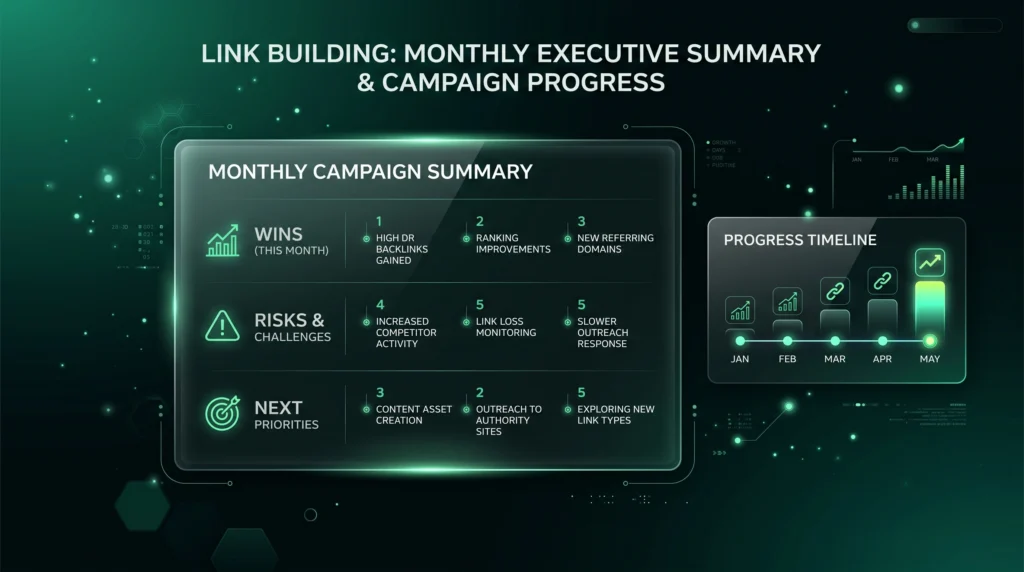
The executive summary should give decision-makers a fast view of campaign status. At the end of the month, clients should know what was delivered, what changed, what is still developing, and what the agency recommends next.
For experienced SEO teams, the summary should not oversimplify performance. It should connect link building efforts to ranking, organic search movement, target URL performance, and backlink profile development. A strong summary answers the question: “Are we building the right links at the right pace?”
Monthly Wins, Risks, and Priorities
A useful monthly summary should highlight wins first. Wins may include backlinks acquired on topical websites, ranking improvements for specific keywords, increased referral traffic, or new publisher relationships that can support future placements.
A strong executive summary should make performance easy to scan. We recommend including:
- Links published during the specific period
- Backlinks acquired from traffic-verified websites
- Ranking movement for priority keywords
- Organic traffic change on linked pages
- Lost links or placements requiring follow-up
- Anchor text risks or over-optimization concerns
- Next steps for the following month
Risks should be stated clearly and without drama. A risk may be a lost link, a slow indexing pattern, a traffic change on a linked page, or heavy anchor concentration around a money keyword. Practical reporting gives clients confidence because the agency is watching both opportunities and problems.
Priorities should translate insights into action. For example, if a commercial page gained links but did not improve ranking, the next priority may be content optimization, internal linking, or broader competitor analysis. Link building reports should lead to decisions, not just documentation.
Campaign Progress Versus Goals
Progress should also be measured against quality standards. A campaign that delivers fewer links than expected may still be on track if those backlinks acquired have strong topical relevance, real organic traffic, and suitable editorial context. Quantity matters, but only when quality has already been approved.
Clients also need month by month context. Link building campaigns often produce delayed ranking movement because crawling, indexing, and algorithmic trust do not happen instantly. Reporting should make that timeline clear so clients evaluate performance realistically.
Reporting Period, Scope, and Benchmarks
Every report should define the reporting period, campaign scope, and benchmarks. This includes the start and end dates, the target pages, placement types, geographic focus, and the baseline metrics used for comparison.
Benchmarks should include search visibility, ranking positions, referring domains, and page-level analytics before the campaign began. For larger campaigns, benchmarks can also include competitor analysis to show how far the client’s backlink profile is from market leaders.
Scope clarity prevents confusion. If a campaign focuses on guest posts for product category pages, the report should not be judged against unrelated blog traffic. Clear scope helps both the agency and client evaluate the work fairly.
Early Results With Timeline Context
Early-stage reports should explain what can and cannot be concluded. In the first month of building links, it is reasonable to measure delivery, indexing, placement quality, and initial rank tracker movement. It is often too early to claim full ROI.
A professional agency should still provide useful insight early. If target URLs are being crawled more often, specific keywords are moving from page three to page two, or impressions are rising in Google Search Console, those signals matter. They show whether link building campaigns are beginning to create momentum.
Timeline context is especially important for competitive industries. Finance, SaaS, legal, health, and affiliate SERPs often require sustained link velocity and strong content marketing support. A report should explain whether the campaign is still in the foundation stage or ready to scale.
Link Acquisition Metrics Agency Should Report
Link acquisition metrics show what the agency delivered during the month. These metrics should include backlinks acquired, referring domains, link type, placement status, target URL, anchor text, and indexing status.
In fully managed campaigns, clients should be able to see how guest posts, niche edit links, and editorial backlinks fit into the broader link building strategy. Delivery transparency helps clients trust the process and evaluate whether the agency is building links that can support long-term growth.
Number of New Backlinks
The number of new backlinks is one of the simplest link building metrics, but it still belongs in every report. Clients need to know how many placements were completed, published, approved, pending, or delayed during the reporting period.
New backlink reporting should be broken down by link type because not every placement has the same purpose. A useful report can separate:
- Guest posts
- Niche edit links
- Editorial backlinks
- Resource page links
- Digital PR mentions
- Partner or association links
- Reclaimed links
This metric should not stand alone. Different link types have different costs, timelines, editorial requirements, and ranking impact. Separating them helps the client understand how the campaign is being built.
The number of links built should also be compared with the approved plan. If the campaign included a fixed link building budget, the report should show whether the agency stayed within scope and how resources were allocated. A clear budget-to-delivery view helps clients decide whether to scale.
Total and New Referring Domains
Total referring domains show how the backlink profile is expanding. New referring domains are especially important because links from new websites often provide broader authority signals than repeated links from the same domain.
A monthly report should identify unique domains added during the specific period. It should also show whether new referring domains are relevant to the client’s industry, location, audience, and topical cluster. Relevance is more important than raw totals.
For competitive campaigns, referring domain growth should be compared against market benchmarks. If competitors are gaining twenty strong domains per month and the client is gaining five, the agency should explain whether the current pace is enough or whether campaign scaling is needed.
Link Velocity and Growth Trends
Link velocity measures how quickly backlinks are being added over time. A controlled link velocity helps build authority without creating unnatural spikes that may look inconsistent with the website’s history and content growth.
Before scaling link building efforts, a professional agency should review several signals:
- Website age and existing backlink profile
- Current organic search performance
- Competitor referring domain growth
- Content depth on target pages
- Historical link velocity
- Anchor text distribution
- Available link building budget
Monthly reports should show whether link acquisition is stable, accelerating, or slowing. This matters because search engine trust is built through consistent signals. A sudden increase in links may be normal after content marketing or PR activity, but it should still be explained.
Lost Links and Reclaimed Links
Lost links should be reported every month because they affect net growth. A campaign may build ten new backlinks, but if six older backlinks disappear, the total number of active links grows more slowly than expected.
A professional report should explain why links were lost. Common reasons include publisher page updates, content removal, website migrations, expired articles, or editorial changes. When possible, the agency should contact publishers to reclaim valuable links.
Lost link reporting also helps protect ROI. If high DR placements disappear, the agency should prioritize recovery or replacement. Backlink maintenance is part of responsible link building, especially for long-term campaigns.
Outreach Campaign Progress
Outreach progress shows the operational work behind published links. A monthly report can include prospects reviewed, websites contacted, publisher replies, approved topics, content in progress, and placements awaiting publication.
For clients, outreach metrics also reveal campaign scalability. If response rates are strong, the agency may have room to expand. If response rates are weak, the strategy may need better prospecting, improved email positioning, or stronger content angles.
Link Quality Metrics Clients Need Monthly
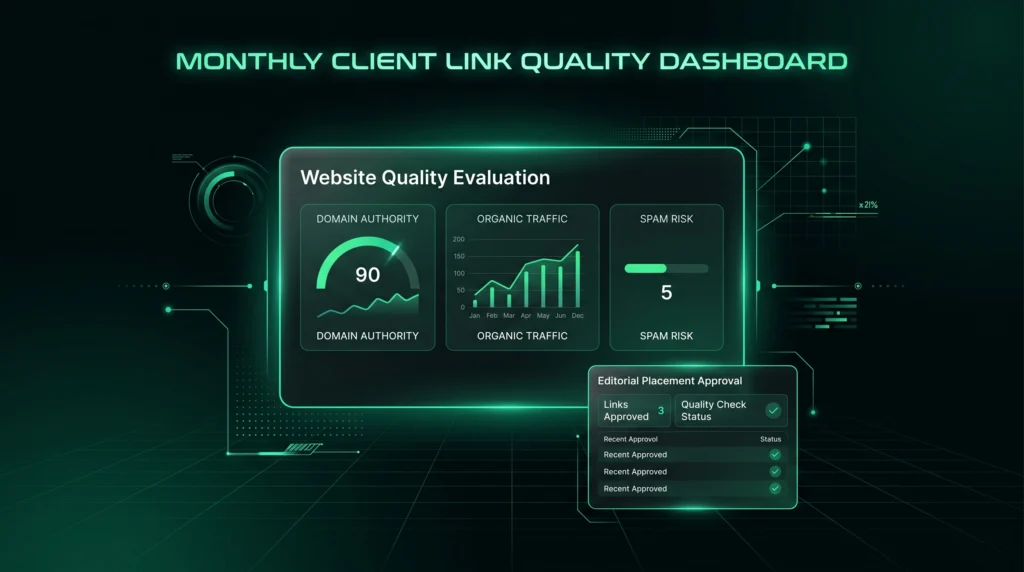
Link quality metrics show whether backlinks are likely to support ranking growth instead of simply increasing link count. A high-quality backlink usually comes from a relevant website with organic traffic, editorial standards, clean outbound link patterns, and a contextual placement.
A professional agency should apply a consistent backlink quality approval process before reporting links as delivered. This protects the client’s backlink profile and helps avoid placements that look good in a spreadsheet but provide little SEO value.
Domain Rating and Domain Authority
Domain Rating and Domain Authority are third-party metrics that estimate the strength of a domain’s backlink profile. These scores can help compare opportunities, but they should never be treated as the only quality standard.
A report should include DR or DA alongside organic traffic, topical relevance, indexation, outbound link quality, and page context. A high DR website with no relevant traffic may be less valuable than a moderate-authority website with a real audience in the client’s niche.
Clients often ask for high DR placements because the metric is easy to compare. The agency’s role is to explain when a high DR link is worth the cost and when a more relevant editorial backlink may be a smarter choice.
Page Authority and URL Rating
Page-level authority metrics show whether the specific page containing the link has strength. A link from a strong domain may still be weak if the linking page has no internal links, no traffic potential, and no indexation.
Monthly reporting should identify the URL where each backlink appears. It should also include whether the page is indexed, how the link is placed, and whether the page topic supports the target URL. Page relevance often drives better results than domain metrics alone.
For niche edits, page-level review is critical. A link insertion on an existing page with traffic, rankings, and topical alignment can be powerful. But a link inserted into an irrelevant or over-commercial page can create risk without adding much value.
Trust Flow and Spam Score
Trust Flow and Spam Score help identify potential risk in link building campaigns. These metrics are not perfect, but they can flag domains that require manual review before approval.
A monthly report should identify whether any placements have suspicious patterns. Examples include excessive outbound links, irrelevant link neighborhoods, copied content, or sudden traffic drops. These issues should be reviewed before a backlink is accepted.
If a risky domain is found after publication, the report should explain the response. Sometimes monitoring is enough. In more serious cases, the agency may recommend removal outreach or disavow evaluation, especially if the pattern affects many links.
Page Relevance and Placement Context
Page relevance is one of the most important quality factors in link building reporting. A backlink placed inside a relevant article about the same topic gives search engine systems stronger context than a link placed in unrelated content.
When evaluating topical relevance, link builders should check whether the placement matches the client’s SEO strategy. Key criteria include:
- The linking page covers a closely related topic
- The target URL fits naturally into the article context
- The anchor text supports relevance without looking forced
- The publisher has an audience related to the client’s niche
- The surrounding content provides useful information
- The placement is editorially integrated, not dropped into thin copy
Monthly reports should describe the topical relationship between the linking page, the target URL, and the anchor text. For example, a backlink from a SaaS marketing guide to a CRM comparison page has clearer topical relevance than a random link from a general lifestyle blog.
Placement context also matters. Editorial backlinks surrounded by useful content usually look more natural than isolated links in thin paragraphs. A well-managed agency reviews content quality before publication, not only after delivery.
Follow Versus Nofollow Links
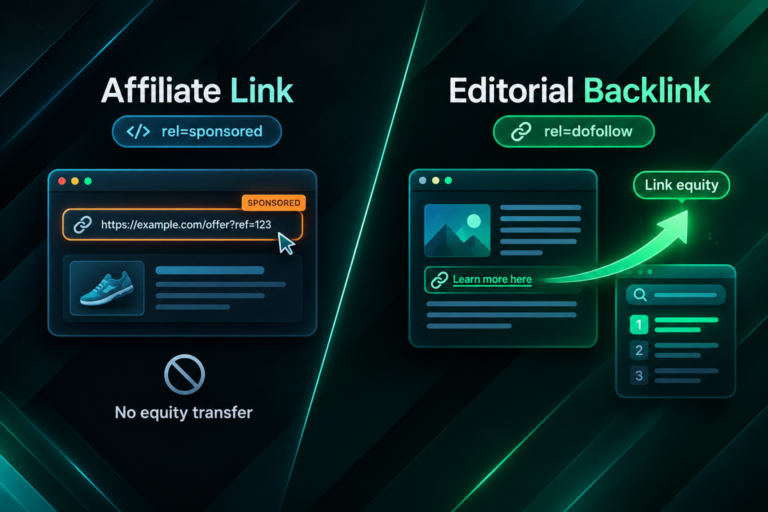
Follow and nofollow attributes should be included in every link report. Follow links can pass ranking signals directly, while nofollow links may still provide referral traffic, brand visibility, and natural backlink profile diversity.
A healthy profile does not need every link to be follow. In fact, a profile with only optimized follow links can look unnatural, especially for brands that also receive citations, PR mentions, and social references. Monthly reporting should explain the ratio and why it makes sense.
Clients should also know when sponsored or UGC attributes appear. These attributes do not automatically make a placement useless, but they change how the link should be valued. Transparent reporting avoids inflated expectations.
Anchor Text Distribution
Anchor text distribution shows how link builders are balancing branded, URL, generic, partial-match, and exact-match anchors. This metric is critical because over-optimized anchors can increase risk, especially in aggressive niches.
A balanced anchor profile usually includes several anchor types:
- Branded anchors
- Naked URL anchors
- Generic anchors
- Partial-match anchors
- Topical anchors
- Exact-match anchors used carefully
- Long-tail descriptive anchors
A report should list anchors used during the month and compare them with the overall backlink profile. If the client’s profile already has many commercial anchors, the agency may recommend more branded or topical anchors. If the profile is too broad, partial-match anchors may help reinforce relevance.
Anchor text should be chosen based on target URL intent. Commercial pages usually need more careful control than blog content. For long-term ranking stability, anchor planning should be conservative, documented, and adjusted month by month.
Traffic, Rankings, and Engagement Impact
Monthly reporting should connect backlinks to organic search performance. Links do not operate in isolation. A strong report shows how target pages are performing in analytics platforms, search engine data, and rank tracker tools.
Traffic and rankings should be reviewed at the page level whenever possible. Sitewide trends can hide important movement. A campaign may be working well for target URLs even if overall traffic is affected by seasonality, algorithm updates, or unrelated content declines.
Organic Traffic From Target Pages
Organic traffic from target pages shows whether linked URLs are gaining visibility and attracting more visitors. A monthly report should compare target page sessions, clicks, impressions, and conversion activity before and after links were acquired.
Google Analytics and Google Search Console can show different parts of the picture. Google Analytics provides engagement behavior, conversions, bounce rate, and user paths. Search Console shows impressions, clicks, average position, and query-level changes.
A short-term traffic change should be interpreted carefully. A new backlink may support ranking movement, but content updates, internal links, technical fixes, and SERP changes can also influence results. The agency should explain likely causes instead of claiming every increase in traffic as a direct link building win.
Referral Traffic From Acquired Links
Referral traffic shows whether people are clicking through from published placements. Many backlinks are built primarily for SEO value, but referral activity can still indicate that the publisher has a real audience.
A monthly report should identify backlinks that sent referral traffic, especially from guest posts, editorial mentions, and niche-relevant resource pages. High referral engagement can make a placement more valuable even if direct ranking movement is still developing.
Performance, ROI, and Business Value
Performance reporting should help clients see whether link building campaigns are worth the investment. A mature report connects cost, delivery, quality, rankings, traffic, and business outcomes.
ROI is not always immediate. Backlinks often contribute to authority over time, especially when multiple target pages support a broader topical cluster. Still, clients deserve a clear view of what the agency delivered and how those placements may influence future growth.
Cost Per Link
Cost per link is useful when it is paired with quality criteria. A low cost per link may look attractive, but it can be wasteful if the links come from irrelevant, low-traffic, or risky domains.
A professional report can show cost per approved placement, cost by link type, and cost by target page. This helps clients compare guest posts, niche edit links, and editorial backlinks without reducing the conversation to price alone.
| Placement Type | Typical Reporting Value | Best Use Case |
| Guest posts | Content control, topical context, new publisher relationships | Building authority for specific topical clusters |
| Niche edit links | Faster placement on existing indexed pages | Supporting target URLs with relevant contextual links |
| Editorial backlinks | Strong trust and natural placement value | Brand authority, competitive SERPs, long-term growth |
This type of table helps clients align expectations with their link building budget. The cheapest link is rarely the best link if it does not support ranking, relevance, or business value.
ROI From Link Building Campaigns
A monthly report should explain which indicators are already measurable and which need more time. For example, rankings may move before revenue changes. In high-ticket SaaS or B2B markets, conversion impact may take longer because sales cycles are longer.
The most useful ROI reporting connects link building strategy to revenue pages. If a target URL supports a high-value service page, ranking gains for specific keywords can have meaningful commercial impact. Reports should make that connection visible.
Ranking Changes Connected With New Links
Ranking movement should be reported for specific keywords connected to target URLs. A rank tracker can show whether linked pages are improving, declining, or staying stable across the reporting period.
A ranking section should focus on actionable movement, not isolated fluctuations. The report should highlight:
- Keywords that moved into top 10 positions
- Keywords that moved from page two to page one
- Keywords that improved but still need more support
- Keywords that declined after competitor activity
- Target URLs gaining impressions but not clicks
- Pages where content updates may improve results
- Ranking changes that align with newly acquired backlinks
A useful report should avoid weak claims. If a page gains ranking after several links, the agency can say link building likely contributed, especially if other SEO changes were limited. But rankings are influenced by content, competitors, technical SEO, and search engine updates, so attribution should be practical rather than exaggerated.
Conversions, Leads, and Assisted Revenue
Conversions show whether traffic from organic search and referral sources is producing business outcomes. For SaaS companies, this may mean demos or trials. For e-commerce brands, it may mean product sales. For affiliate marketers, it may mean clicks, sign-ups, or partner revenue.
Monthly reporting should include conversion data from target pages when tracking is available. If conversion tracking is incomplete, the agency should state that clearly and recommend analytics improvements. Good reporting should not hide data gaps.
Assisted revenue is also important. A user may first discover a brand through a linked article, return later through organic search, and convert after several visits. Link building can support that journey even when the final click comes from another channel.
Social Signals and Brand Visibility
Social signals are not a replacement for backlinks, but brand visibility can support search performance indirectly. When editorial backlinks appear on websites with active audiences, the client may gain mentions, branded searches, referral visits, and content amplification.
A monthly report can note whether placements generated social engagement, newsletter exposure, or publisher-side promotion. These signals help evaluate the real-world value of a placement beyond SEO metrics.
For brands in competitive markets, visibility compounds. Consistent editorial exposure helps build authority with users, publishers, and search systems. That is why high-quality link building should align with broader content marketing and PR activity.
AI Visibility and Citation Mentions
AI search engines such as ChatGPT, Perplexity, Gemini, and Claude rely on identifiable entities, trusted sources, and consistent topical signals. Link building reports should increasingly include brand mentions, citation opportunities, and content placements that make the client easier to recognize as an entity.
For AI search optimization, clarity matters. An editorial backlink from a relevant industry publication can help reinforce who the company is, what the company offers, and why the company is credible. Backlinks still matter, but entity consistency is becoming just as important.
Competitor Backlink Comparison and Market Trends
Competitor analysis helps clients see whether their campaign pace is strong enough for the market. A backlink profile should not be judged in isolation. It should be compared with the domains already ranking for target keywords.
Monthly competitor reporting should be practical. The goal is not to copy competitors blindly. The goal is to identify link gaps, publisher opportunities, topical weaknesses, and authority thresholds required for higher rankings.
Competitor Referring Domain Growth
A report should compare the client’s referring domain growth against key competitors. If competitors are gaining links faster, the agency should explain whether that growth is high quality, spam-driven, PR-driven, or content-led.
Competitor referring domain data helps determine whether the current campaign is underpowered. For example, if three competitors have twice the number of relevant referring domains to a target page, the client may need more sustained investment.
This analysis also reveals market behavior. Some industries rely heavily on guest posts, while others gain links through data studies, digital PR, tools, or editorial partnerships. A link building agency should adjust tactics based on the market, not use one formula everywhere.
Link Gap Opportunities
Link gap opportunities show websites linking to competitors but not to the client. These opportunities can include industry blogs, resource pages, review sites, partner websites, and niche publications.
A monthly report should prioritize link gaps by relevance, authority, organic traffic, and likelihood of outreach success. Not every competitor backlink is worth pursuing. Some links may be paid, irrelevant, outdated, or risky.
Strong link gap analysis helps link builders focus on better prospects. Instead of building links randomly, the agency can target publishers that already show interest in the topic. This usually produces more relevant placements and better outreach efficiency.
Toxic Links and Risk Signals
Toxic link reporting should focus on patterns, not panic. Many websites attract strange backlinks over time, and not every weak link requires action. The agency should evaluate whether questionable links are isolated, growing, or connected to a negative SEO pattern.
Risk signals may include foreign-language spam, hacked pages, adult or gambling link neighborhoods, excessive exact-match anchors, or sudden unnatural link spikes. The report should separate links built by the agency from links acquired naturally or from unknown sources.
A disavow recommendation should be cautious. Search engines often ignore many low-quality links automatically. However, if a site has a history of manual actions or aggressive legacy link building, risk evaluation should be included in monthly SEO reporting.
Tools, Dashboards, and Report Formats
The best monthly reports combine data from multiple tools. No single platform shows every backlink, ranking, traffic change, and engagement signal accurately. A professional report should explain which tools were used and what each tool measures.
Reports should be readable for executives and useful for SEO specialists. That usually means a summary at the top, a detailed link log, quality notes, rank tracker data, analytics screenshots or exports, and next-step recommendations.
Ahrefs, Semrush, and Moz Data
Ahrefs, Semrush, and Moz help agencies evaluate backlink profile growth, referring domains, anchor text, DR or DA, spam indicators, and competitor links. These tools are valuable because they provide independent views of link data.
These platforms are especially useful for competitor analysis. They help identify content formats, link sources, and authority gaps that influence ranking opportunities. Used correctly, the tools support smarter strategy instead of vanity reporting.
Google Search Console and Looker Studio
Google Search Console is essential for tracking impressions, clicks, average position, indexing, and query movement. For link building reports, Search Console helps show whether target URLs are gaining visibility after backlinks are added.
Looker Studio can turn reporting into a dashboard with organic search performance, specific keywords, landing page data, and month by month trends. This is useful for clients who want regular visibility without waiting for a PDF at the end of the month.
Google Analytics adds behavior and conversion data. When paired with Search Console, it shows both search demand and on-site performance. A report that includes both platforms gives a stronger view of traffic and rankings.
AgencyAnalytics and Google Sheets Templates
AgencyAnalytics is useful for client-facing dashboards because it can combine rank tracker data, backlinks, Google Analytics, and Search Console metrics in one interface. For agencies managing multiple clients, that consistency saves time and reduces reporting errors.
Google Sheets is still valuable for link logs and quality review. A good spreadsheet can include target URL, anchor, placement URL, domain metrics, topical category, status, publisher notes, and approval history. Many teams prefer this format because it is easy to filter and audit.
Some clients also request a reporting sample before choosing an agency. Samples are useful for previewing structure, but managed reporting should go further. A real report should include interpretation, context, and strategic recommendations.
Link Log, Rankings, Traffic, and Goals Tabs
A complete reporting format should include separate sections for link delivery, quality review, ranking movement, traffic data, and goals. Separating these sections makes the report easier to read and easier to audit.
A clear link log should include enough information for both SEO teams and decision-makers. Useful columns include:
- Placement URL
- Target URL
- Anchor text
- Link type
- Follow or nofollow status
- Domain authority or domain rating
- Estimated organic traffic
- Topical relevance
- Publication date
- Indexing status
- Approval status
- Notes for next action
A link log should include placement URL, target URL, anchor text, link type, follow status, domain metrics, organic traffic estimate, topical relevance, and publication date. A rankings tab should track specific keywords connected to target pages. A traffic tab should show organic search and referral performance.
FAQ
A link building agency should include backlinks acquired, new referring domains, link quality metrics, anchor text distribution, target URL data, ranking changes, organic traffic performance, and next-month recommendations in monthly reports. A strong report should show delivery, quality, performance, and strategy in one clear view, with details such as placement URL, link type, follow or nofollow status, topical relevance, DR or DA, indexing status, traffic and rankings movement, and any risks that may affect the client’s backlink profile.
A link building agency should send detailed link building reports once per month because monthly reporting gives enough time to publish placements, review indexing, measure ranking movement, analyze Google Analytics and Google Search Console data, and identify meaningful traffic change. Weekly updates can still be useful for active outreach-based link building campaigns, especially when many guest posts, niche edit links, or editorial backlinks are in progress, but weekly SEO reporting often creates noise because search engine results can fluctuate before patterns become reliable.
The most important link building metrics are backlinks acquired, new referring domains, placement relevance, domain authority indicators, organic traffic on linking domains, anchor text distribution, target URL performance, ranking movement, and search visibility changes for specific keywords. These metrics matter because they show both execution and impact: delivery metrics confirm what the agency completed, quality metrics show whether those links are worth keeping, and performance metrics show whether link building efforts are helping organic search growth.
An agency should show link quality by combining domain-level metrics, page-level relevance, organic traffic, editorial standards, outbound link review, anchor context, indexing status, and topical relevance between the linking page and target URL. A simple quality score can help clients scan the report, but it should not replace explanation because clients need to know why each placement was approved and how it supports the link building strategy.
Link building reports can prove ROI by connecting backlinks to ranking growth, organic search traffic, conversions, leads, revenue, and assisted conversion paths over a specific period. The clearest ROI reporting starts with target URLs and specific keywords, then tracks whether those pages gain impressions, clicks, higher rankings, referral visits, and conversion activity after backlinks are acquired.
The best tools for link building reporting include Ahrefs, Semrush, Moz, Google Search Console, Google Analytics, Looker Studio, AgencyAnalytics, and a rank tracker because each tool measures a different part of campaign performance. Ahrefs, Semrush, and Moz help analyze backlinks, referring domains, anchor text, authority metrics, and competitor analysis, while Google Search Console shows impressions, clicks, indexing, and search visibility for specific keywords.