Faceted navigation creates a practical filtering experience for visitors on e-commerce and large content sites, but it also generates a significant volume of URLs that can strain crawl resources, dilute internal link equity, and produce duplicate or near-duplicate content at scale. Managing internal links within these filtered URL structures is one of the more technically demanding aspects of on-site SEO, and getting it wrong can quietly suppress organic visibility across an entire product catalogue or content library.
Key Takeaways
- Faceted navigation can generate thousands of low-value URLs that compete for crawl budget and fragment internal link equity if left unmanaged.
- The goal is to preserve useful filter combinations for search engines while preventing the indexation and internal linking of redundant or thin pages.
- Canonical tags, robots directives, and selective internal linking work together rather than independently to control how search engines interpret filtered URLs.
- Internal link architecture decisions in faceted systems directly affect which pages accumulate authority and which pages rank for target queries.
- There is no single universal configuration; the right approach depends on site size, filter taxonomy, content depth, and competitive landscape.
What Is Faceted Navigation and Why Does It Create Internal Linking Problems?
Faceted navigation refers to the filtering and sorting systems that allow users to narrow down product or content listings by attributes such as colour, size, price range, brand, or category. Each filter selection typically generates a new URL, and when multiple filters can be combined, the number of possible URLs grows exponentially. A site with ten filter dimensions, each containing five options, can theoretically produce millions of URL combinations, most of which contain little or no unique content.
The internal linking problem arises because every link on a page passes a signal to search engines about which URLs are worth crawling and potentially indexing. When a faceted navigation system renders clickable filter links on every page, it effectively creates an enormous internal link graph pointing to URLs that may offer no distinct value to a searcher. Search engines must then decide how to allocate their crawl resources across this expanded graph, and the result is often that genuinely important category and product pages receive less crawl attention than they deserve.
Beyond crawl budget, internal links in faceted systems can dilute page authority. If a high-value category page links to dozens of filtered variants of itself, the equity that would otherwise concentrate on the canonical category page is spread across URLs that may never rank for anything meaningful. This fragmentation can reduce the ranking potential of pages that the site actually wants to perform well in organic search.
Understanding Crawl Budget and Its Relationship to Filtered URLs
Crawl budget is the approximate number of URLs a search engine is willing to fetch from a site within a given period. Google has documented that crawl budget is influenced by crawl demand, which reflects how popular and fresh pages appear to be, and crawl rate limit, which reflects the server’s capacity to handle requests. Large sites with extensive faceted navigation can exhaust their crawl budget on low-value filtered URLs, leaving important pages crawled infrequently or not at all.
The practical consequence is that new products, updated category pages, or recently published content may take longer to appear in search results, or may not be indexed at all, if crawlers are spending their allocated budget on filter combinations that serve no distinct search intent. For e-commerce sites with large catalogues and frequent inventory changes, this delay can have a measurable effect on organic visibility.
Managing internal links in faceted navigation is therefore partly a crawl budget management exercise. By reducing the number of internally linked filtered URLs that search engines are invited to follow, site owners can redirect crawl resources toward pages that are more likely to rank and generate qualified traffic.
Core Techniques for Managing Internal Links in Faceted Navigation
Several technical approaches can be used in combination to control how internal links in faceted navigation affect crawl behaviour and page authority distribution. No single technique is universally sufficient, and the appropriate combination depends on the site’s architecture, the nature of its filter taxonomy, and its SEO objectives.
Canonical Tags
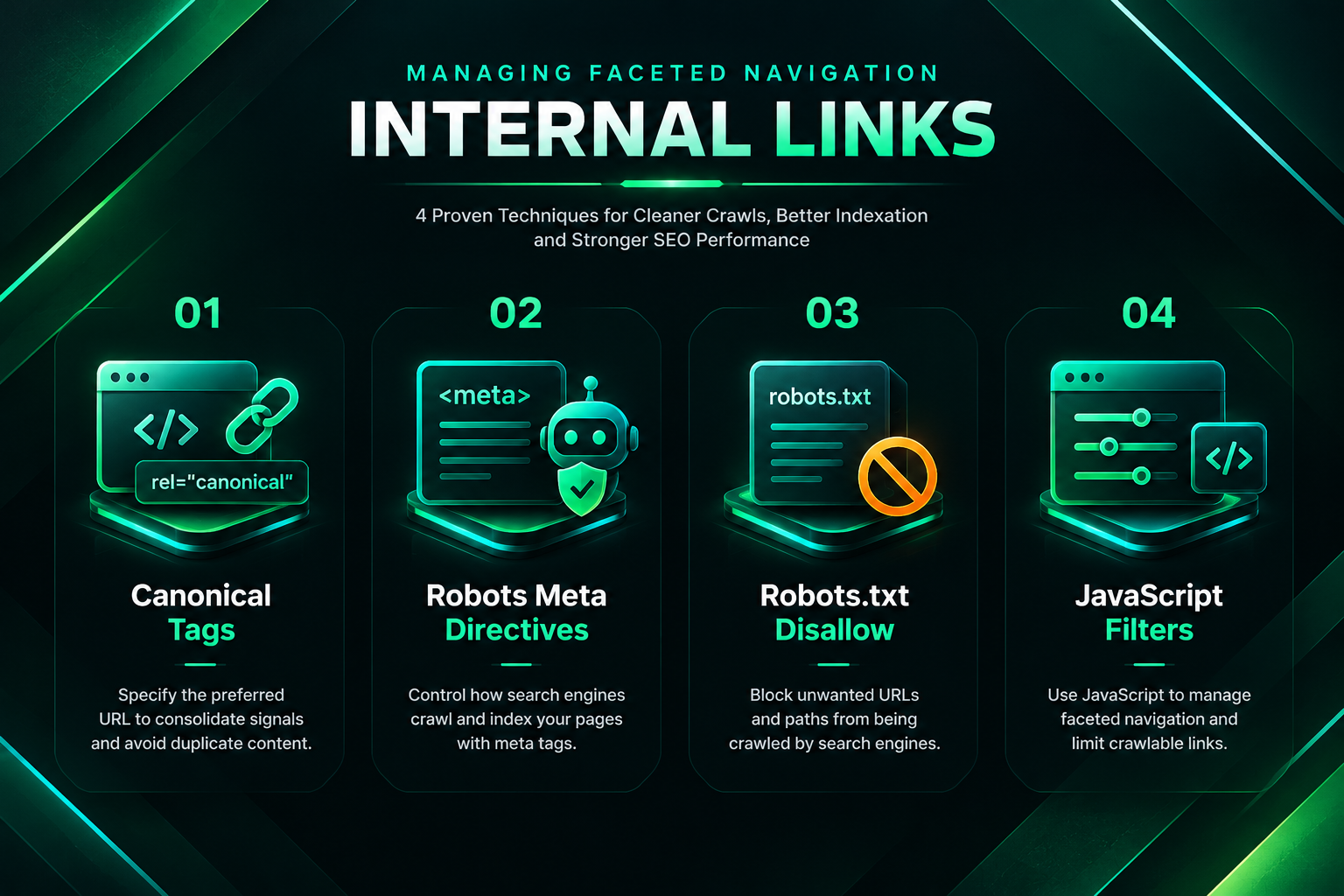
A canonical tag is an HTML element that signals to search engines which version of a URL should be treated as the primary or preferred version. When a filtered URL such as /shoes/?colour=red&size=8 contains a canonical tag pointing to the parent category /shoes/, search engines are instructed to attribute any ranking signals from the filtered page to the canonical URL rather than the filtered variant. This approach does not prevent the filtered URL from being crawled, but it does prevent it from competing with the canonical page in search results and consolidates link equity toward the preferred URL.
Canonical tags are most appropriate for filter combinations that produce content substantially similar to the parent category page. They are less appropriate for filter combinations that represent genuine search demand, such as a filtered page for a specific brand within a category that has meaningful monthly search volume. Applying a canonical tag to a page that could legitimately rank for a distinct query means forfeiting that ranking opportunity.
Robots Meta Directives and X-Robots-Tag
A noindex directive in the robots meta tag or HTTP header instructs search engines not to include a URL in their index. Applied to filtered URLs that have no realistic ranking potential, this directive prevents those pages from appearing in search results and, over time, signals to search engines that they need not prioritise crawling those URLs. Unlike canonical tags, noindex does not consolidate link equity; it simply removes the page from consideration as a ranking candidate.
A nofollow attribute on individual filter links within the navigation instructs crawlers not to follow those links, which can reduce the crawl pressure generated by the internal link graph. However, nofollow on internal links also means that any equity those links might pass is not transferred, so this approach requires careful consideration of which filter links genuinely warrant suppression.
Robots.txt Disallow Directives
Blocking filtered URL patterns in robots.txt prevents search engines from crawling those URLs at all. This is a more aggressive approach than canonical tags or noindex directives because it stops the crawl before the page is fetched, which conserves crawl budget more directly. The limitation is that blocked URLs can still be indexed if they are linked to from external sources, and equity from external links pointing to blocked URLs is not passed to the canonical page. Robots.txt disallow is generally most appropriate for filter combinations that are structurally impossible to rank and that receive no meaningful external links.
JavaScript-Rendered Filters Without Crawlable URLs
Some sites implement faceted navigation using JavaScript in a way that updates the displayed content without generating new crawlable URLs. When filter interactions do not produce distinct URLs, search engines have nothing new to crawl or index, which eliminates the URL proliferation problem at its source. This approach requires careful implementation to ensure that the filtering experience remains functional for users and that any filter combinations worth indexing are still accessible via crawlable URLs where appropriate.
Selective Internal Linking to Valuable Filter Combinations
Not all filtered pages are equally worthless from an SEO perspective. Some filter combinations correspond to genuine search queries with meaningful volume, such as a page filtered by a specific brand and product type that users actively search for. These pages may warrant deliberate internal linking from relevant category pages, editorial content, or navigation elements to help search engines discover and prioritise them. Identifying which filter combinations deserve this treatment requires keyword research to determine whether distinct search demand exists for those attribute combinations.
Identifying Which Filtered Pages Deserve Internal Links
The decision about which filtered URLs should receive internal links, and which should be suppressed, begins with understanding search demand. Keyword research tools can reveal whether users search for specific attribute combinations within a category. A filtered page for women’s running shoes under £60 may have sufficient search volume to justify indexation and internal linking, while a page filtered by three simultaneous attributes with negligible search volume does not.

Beyond search volume, consider the competitive landscape. If a filtered page would compete directly with a well-established standalone category page on the same site, internal linking to the filtered variant may fragment authority rather than build it. Conversely, if the filtered combination addresses a query that the existing category structure does not serve well, creating a deliberate internal link to that filtered page may improve topical coverage and ranking potential.
Site search data and analytics can also reveal which filter combinations users apply most frequently. High-frequency filter combinations that correspond to search queries are stronger candidates for deliberate internal linking and potential indexation than rarely used combinations with no external search demand.
Internal Link Architecture Principles for Faceted Systems
Effective internal link management in faceted navigation follows a set of structural principles that apply regardless of the specific technical implementation chosen.
- Concentrate equity on canonical pages. The primary category or subcategory pages should receive the majority of internal link signals. Filtered variants should either point back to these canonical pages via canonical tags or receive internal links only when they represent distinct ranking opportunities.
- Avoid linking to parameter combinations that produce duplicate content. Sorting parameters such as price-ascending or relevance-descending typically produce the same products in a different order. These combinations rarely serve distinct search intent and should generally be excluded from the internal link graph.
- Use consistent URL structures for indexable filter combinations. If certain filter combinations are intended to rank, their URLs should be consistent, human-readable where possible, and linked to from relevant pages in a predictable way. Inconsistent URL structures for the same filter combination create duplicate content risks and confuse crawlers.
- Audit internal links periodically. Faceted navigation systems evolve as product catalogues change, filters are added or removed, and site architecture is updated. An internal link audit conducted at regular intervals can identify newly created problematic URL patterns before they accumulate crawl debt.
- Monitor crawl coverage in Google Search Console. The Coverage and URL Inspection reports in Google Search Console can reveal whether filtered URLs are being indexed unintentionally, whether canonical signals are being respected, and whether crawl resources are being allocated as intended.
The Relationship Between Faceted Navigation and External Link Building
Internal link management in faceted navigation does not exist in isolation from external link acquisition. When external links point to filtered URLs rather than canonical category pages, the equity from those links may be diluted or misdirected, particularly if the filtered URL carries a noindex directive or a canonical tag pointing elsewhere. This is a relevant consideration for e-commerce sites that run link building campaigns targeting category or product pages.
If a link building campaign generates backlinks to a filtered URL that is subsequently canonicalised to the parent category, the equity from those external links may be partially transferred to the canonical page, but the transfer is not guaranteed to be complete or immediate. It is generally preferable to direct external link acquisition toward the URLs that are intended to rank, which means ensuring that target pages for outreach campaigns are the canonical, indexable versions of category or product pages rather than filtered variants.
For sites running outsourced link building campaigns alongside technical SEO work on faceted navigation, coordinating these efforts matters. A link building provider targeting the wrong URLs, or targeting pages that are later canonicalised away, may produce placements that deliver less value than intended. Communicating clearly about which URLs are the intended ranking targets helps ensure that external link equity is directed where it can have the most effect.
Common Mistakes in Faceted Navigation Internal Linking
Several recurring errors appear in how sites handle internal links within faceted navigation systems, and understanding them can help avoid the most damaging outcomes.
- Applying noindex without removing internal links. A noindex directive tells search engines not to include a page in the index, but if the page remains heavily internally linked, crawlers will continue to visit it and spend crawl budget on it. Removing or suppressing internal links to noindexed filtered URLs is necessary to realise the crawl budget benefit.
- Using canonical tags inconsistently. If some filtered URLs carry canonical tags pointing to the parent category while others do not, search engines receive mixed signals about which pages are preferred. Consistent application of canonical tags across all filtered URL patterns that do not represent distinct ranking opportunities is important for clarity.
- Blocking valuable filter combinations in robots.txt. Overly broad robots.txt disallow rules can accidentally block filter combinations that have genuine search demand and ranking potential. Before implementing broad URL pattern blocks, verify that no commercially valuable filter combinations fall within the blocked pattern.
- Ignoring pagination within filtered results. Filtered category pages that return many results often include pagination, which creates additional URL variants. Pagination within filtered results compounds the URL proliferation problem and requires its own internal linking strategy, typically using rel=next and rel=prev signals where supported, or canonical tags pointing to the first page of a filtered result set.
- Failing to update configurations after catalogue changes. When new filter dimensions are added, or when product ranges change significantly, the internal linking configuration for faceted navigation may need to be updated. Treating the initial configuration as permanent can lead to new problematic URL patterns accumulating unnoticed.
Practical Steps for Auditing Faceted Navigation Internal Links
A structured audit of internal links in a faceted navigation system typically involves several stages that can be carried out using a combination of crawl tools, analytics platforms, and search console data.
- Crawl the site with a tool such as Screaming Frog or Sitebulb to map all internally linked URLs, including filtered variants. This reveals the full scope of the internal link graph and identifies which filtered URL patterns are being surfaced to crawlers.
- Segment filtered URLs by parameter type to distinguish sorting parameters, pagination parameters, and genuine attribute filters. Each category may warrant a different treatment in terms of canonical tags, noindex directives, or robots.txt rules.
- Cross-reference filtered URLs against keyword research data to identify which filter combinations correspond to search queries with meaningful volume. These are candidates for deliberate indexation and internal linking.
- Review Google Search Console Coverage data to identify filtered URLs that are currently indexed, excluded, or flagged as duplicates. This provides a baseline for measuring the effect of any changes made to the internal linking configuration.
- Assess the internal link depth of key category pages to determine whether filtered URL proliferation has pushed important pages deeper into the internal link graph than is desirable. Pages that require many clicks to reach from the homepage may receive less crawl attention and accumulate less internal link equity.
- Implement changes incrementally and monitor the effect on crawl coverage, indexed page counts, and organic visibility before making further adjustments. Large-scale changes to internal linking configurations can have significant effects on how search engines interpret the site, and monitoring allows for course correction if unintended consequences appear.
When to Involve Technical SEO Expertise
Managing internal links in faceted navigation is a technical SEO task that intersects with site architecture, server configuration, JavaScript rendering, and content strategy. For smaller sites with straightforward filter taxonomies, the techniques described above can often be implemented by an in-house team with access to appropriate crawl and analytics tools. For larger e-commerce sites with complex filter systems, high product volumes, and significant organic traffic at stake, the risk of misconfiguration is higher and the consequences of errors more significant.
Engaging a technical SEO specialist or agency for an audit and implementation plan is worth considering when the site has more than a few thousand indexed pages, when previous attempts to manage faceted navigation have produced unexpected results, or when organic visibility has declined without a clear explanation. A site-specific assessment is necessary before making definitive recommendations, as the appropriate configuration depends on factors including the platform, the filter taxonomy, the existing backlink profile, and the competitive environment.
Frequently Asked Questions
Should all filtered URLs be blocked from indexation?
No. Some filter combinations correspond to genuine search queries with meaningful volume and may represent legitimate ranking opportunities. The goal is to identify which filtered URLs serve distinct search intent and to suppress only those that produce duplicate or near-duplicate content with no realistic ranking potential. A blanket approach of blocking all filtered URLs risks forfeiting valuable organic visibility.
Does a canonical tag pass link equity from filtered URLs to the canonical page?
A canonical tag signals to search engines that the canonical URL is the preferred version and that ranking signals, including external links, should be attributed to it. In practice, equity transfer via canonical tags is generally recognised by major search engines, but it is not guaranteed to be complete or immediate. Directing external link acquisition toward canonical URLs directly remains preferable where possible.
How does faceted navigation affect crawl budget on smaller sites?
Crawl budget is a more pressing concern for larger sites, but smaller sites with extensive filter systems can still experience crawl inefficiency if a disproportionate share of crawl resources is spent on low-value filtered URLs. Even on smaller sites, managing internal links in faceted navigation can help ensure that important pages are crawled and indexed promptly.
Can JavaScript-based filtering eliminate the need for canonical tags or noindex directives?
If filtering is implemented in a way that does not generate distinct crawlable URLs, the URL proliferation problem is avoided at its source, which reduces the need for canonical tags or noindex directives on filtered pages. However, this approach requires careful implementation to ensure that any filter combinations intended to rank remain accessible via crawlable URLs, and that the JavaScript rendering does not create other crawlability issues.
How often should the internal link configuration for faceted navigation be reviewed?
A review is advisable whenever significant changes are made to the product catalogue, filter taxonomy, or site architecture. For large e-commerce sites with frequent catalogue updates, a quarterly audit of crawl coverage and indexed page counts can help identify new problematic URL patterns before they accumulate. Google Search Console alerts and regular crawl monitoring can supplement scheduled audits.
Does managing faceted navigation internal links directly improve rankings?
Improving the internal link architecture of a faceted navigation system may help search engines crawl and index important pages more efficiently, and may concentrate internal link equity on pages intended to rank. Whether this translates into measurable ranking improvements depends on many other factors, including content quality, external backlink profile, and competitive intensity. Internal link management is one component of a broader SEO strategy rather than a standalone ranking solution.
Making Faceted Navigation Work for Your SEO Strategy
Faceted navigation is a user experience feature that, without deliberate internal link management, can become a significant source of SEO inefficiency. The core challenge is distinguishing between filtered URLs that represent genuine search opportunities and those that simply multiply low-value pages across the internal link graph. Addressing this distinction through a combination of canonical tags, robots directives, selective internal linking, and periodic auditing gives search engines a clearer picture of which pages deserve crawl attention and ranking consideration.
The techniques involved are not inherently complex, but their correct application requires an understanding of the site’s specific filter taxonomy, its keyword landscape, and the way its platform generates and renders URLs. Mistakes in this area, such as blocking valuable filter combinations or applying canonical tags inconsistently, can suppress organic visibility in ways that are difficult to diagnose without a structured audit.
If your site uses faceted navigation and you are uncertain whether its internal link configuration is supporting or undermining your SEO objectives, a technical audit is a reasonable starting point. Understanding the current state of your crawl coverage, indexed page counts, and internal link graph provides the evidence needed to make informed decisions about which changes are likely to be beneficial and which carry unnecessary risk.