Backlink APIs give SEO teams and developers programmatic access to link data that would otherwise require manual exports, repeated tool logins, or expensive enterprise subscriptions. If you manage link building campaigns at scale, run white-label reporting for clients, or need to combine backlink intelligence with your own data sources, understanding how to use backlink APIs for custom analysis can meaningfully improve both the speed and depth of your workflow. This article explains what backlink APIs are, how they work in practice, what you can realistically build with them, and where their limitations lie.
Key Takeaways
- Backlink APIs allow you to pull referring domain, anchor text, link attribute, and authority metric data directly into your own tools, dashboards, or reporting systems without manual exports.
- The most widely used backlink data providers include Ahrefs, Semrush, Moz, and Majestic, each with distinct API structures, data freshness policies, and pricing models.
- Custom analysis built on backlink APIs is most valuable when you need to combine link data with other SEO signals, automate recurring reports, or monitor large link portfolios over time.
- API data reflects the provider’s own crawl index, not Google’s view of your backlink profile; results and coverage vary between providers and over time.
- Building a reliable backlink analysis pipeline requires understanding rate limits, data normalization, and the difference between proprietary metrics and actual search engine signals.
What Is a Backlink API and How Does It Work?
A backlink API is a programmatic interface that lets you request link data from a provider’s index and receive structured responses, typically in JSON or CSV format, that your application can process automatically. Instead of logging into a tool, running a manual report, and downloading a spreadsheet, you send an authenticated HTTP request specifying the target domain, the data fields you want, and any filters you need. The provider’s server queries its crawl index and returns the matching records.
Most backlink API providers maintain their own web crawlers that continuously discover and re-crawl pages across the internet. When a crawler finds a hyperlink on one page pointing to another, it records the source URL, the destination URL, the anchor text, the link attributes such as rel=”nofollow” or rel=”sponsored”, and the crawl timestamp. This raw data is processed, deduplicated, and stored in the provider’s index, which is what the API queries against. The freshness and coverage of that index varies significantly between providers, which directly affects the reliability of any analysis you build on top of it.
Common API endpoints offered by major providers include: referring domains for a target, individual backlinks with full source and destination URLs, anchor text distribution, new and lost links within a date range, broken backlinks, and domain-level authority or trust metrics. Some providers also expose endpoints for competitor link gap analysis, allowing you to compare the referring domain profiles of multiple targets in a single request.
Which Backlink API Providers Are Commonly Used?
The four providers most frequently used for custom backlink analysis are Ahrefs, Semrush, Moz, and Majestic. Each has a different index size, crawl frequency, API structure, and pricing model, so the right choice depends on your use case, budget, and the metrics your team already relies on.
Ahrefs offers one of the largest actively maintained backlink indexes and provides API access through its API v3 and the newer Ahrefs API for enterprise users. Its data includes referring domains, backlinks, anchor text, URL Rating (UR), Domain Rating (DR), and link history. DR is a proprietary metric that estimates the relative strength of a domain’s backlink profile on a logarithmic scale; it is not a Google metric and should not be treated as a direct ranking signal.
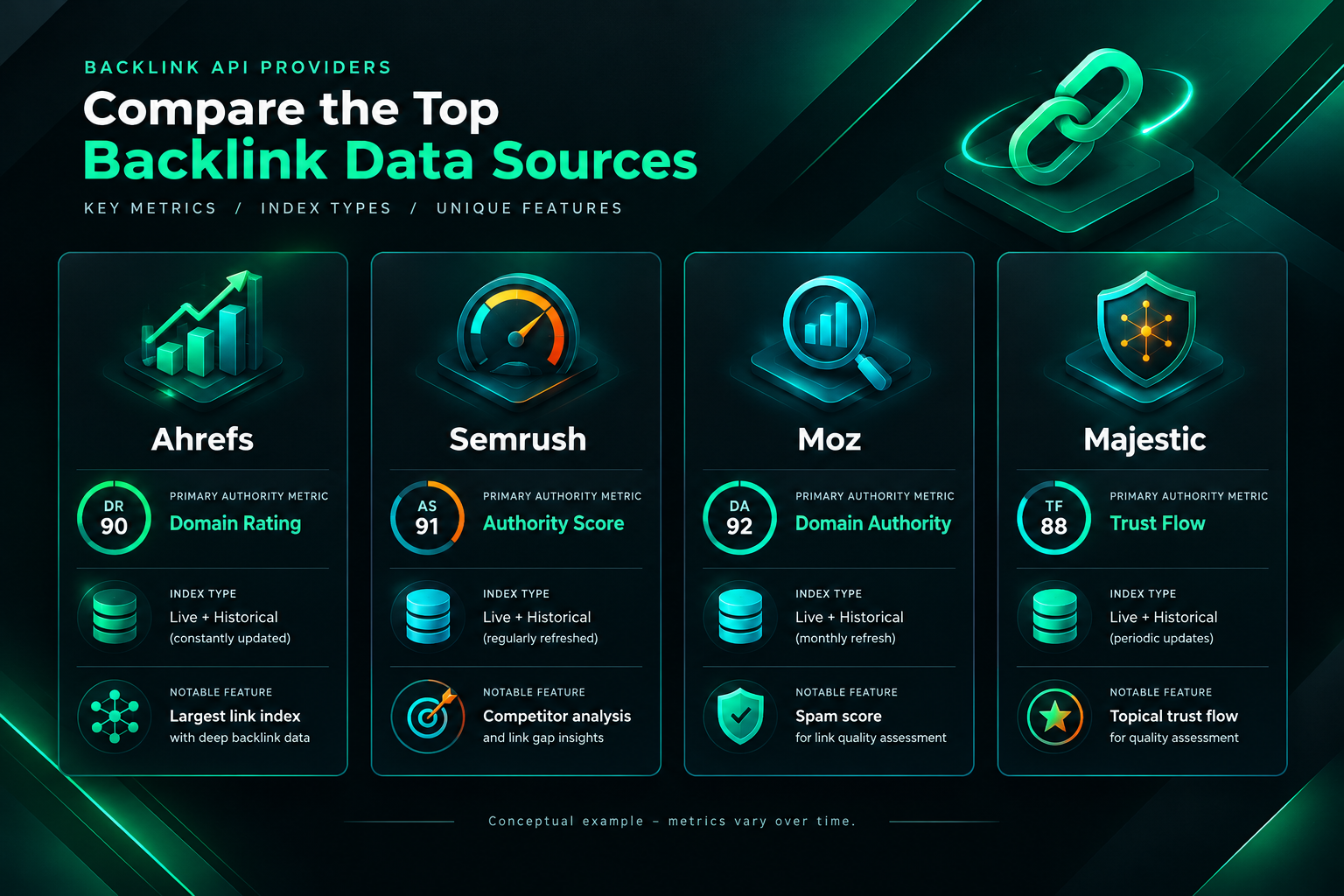
Semrush provides backlink data through its API, including referring domains, backlinks, anchor text, Authority Score, and toxic link indicators. Authority Score is Semrush’s proprietary composite metric and, like DR, reflects the tool’s own assessment rather than Google’s evaluation of a site’s authority.
Moz exposes link data through its Link Explorer API, including Domain Authority (DA), Page Authority (PA), spam score, and referring domain counts. DA is a Moz proprietary metric; it is widely referenced in the industry but is not produced or endorsed by Google.
Majestic offers Trust Flow and Citation Flow through its API, along with topical trust flow categories that can be useful for assessing the thematic relevance of a linking domain. Majestic maintains two indexes: a Fresh Index updated frequently and a Historic Index covering a longer time window, both accessible via API.
It is important to treat these proprietary metrics as directional indicators rather than definitive measures of SEO value. Two providers may assign very different scores to the same domain, and neither score reflects how Google actually evaluates a link’s contribution to rankings.
Practical Use Cases for Custom Backlink Analysis
Understanding the available endpoints is only the starting point. The real value of backlink APIs emerges when you apply them to specific analytical problems that manual tools handle poorly at scale.
Automated Link Monitoring for Campaign Management
Link building campaigns typically involve placements across dozens or hundreds of referring domains over time. Manually checking whether each placed link is still live, still followed, and still pointing to the correct target URL is time-consuming and error-prone. A custom script using a backlink API can query the link status for your entire placement list on a scheduled basis, flag any links that have been removed, changed to nofollow, or redirected, and feed that information into a reporting dashboard or alert system. This kind of automated link monitoring is particularly useful for agencies managing multiple client campaigns simultaneously, where manual checks would consume significant team time each month.
Referring Domain Profile Analysis at Scale
When assessing a competitor’s link building strategy or auditing a client’s existing backlink profile, pulling data through an API allows you to process far more records than a standard tool export permits. You can retrieve the full referring domain list, filter by link attribute, sort by a chosen authority metric, identify clusters of topically related linking domains, and cross-reference against your own database of known publisher quality signals. This kind of referring domain profile analysis at scale is difficult to replicate efficiently through a graphical interface alone.
Link Gap Analysis for Outreach Prioritization
Link gap analysis identifies referring domains that link to one or more competitors but not to your target site. Most backlink tools offer this as a built-in feature, but API access lets you automate the process across a larger competitor set, apply custom filtering logic, and integrate the output directly into your outreach prospecting workflow. For example, you might pull the referring domain lists for five competitors, deduplicate them, remove domains already linking to your target, apply a minimum authority threshold, and export a prioritized prospecting list ready for manual outreach review.
Anchor Text Distribution Reporting
Anchor text distribution is a useful diagnostic signal when reviewing a backlink profile. An unusually high proportion of exact-match commercial anchor text across referring domains can be a quality concern worth investigating, though it is not by itself proof of a problem or a guarantee of a penalty. Pulling anchor text data through an API allows you to calculate distribution percentages programmatically, track how the distribution changes over time as new links are acquired, and include this data in client reports without manual aggregation.
White-Label Reporting Pipelines
Agencies delivering white-label link building services often need to produce branded reports that combine link acquisition data with authority metrics, anchor text summaries, and placement context. A backlink API integrated into a reporting pipeline can pull the relevant data fields automatically each reporting period, populate a report template, and reduce the manual work involved in compiling client deliverables. The accuracy of these reports depends on the freshness and coverage of the underlying API index, so it is worth communicating to clients that the data reflects the provider’s crawl rather than a real-time view of Google’s index.
How to Structure a Basic Backlink API Workflow
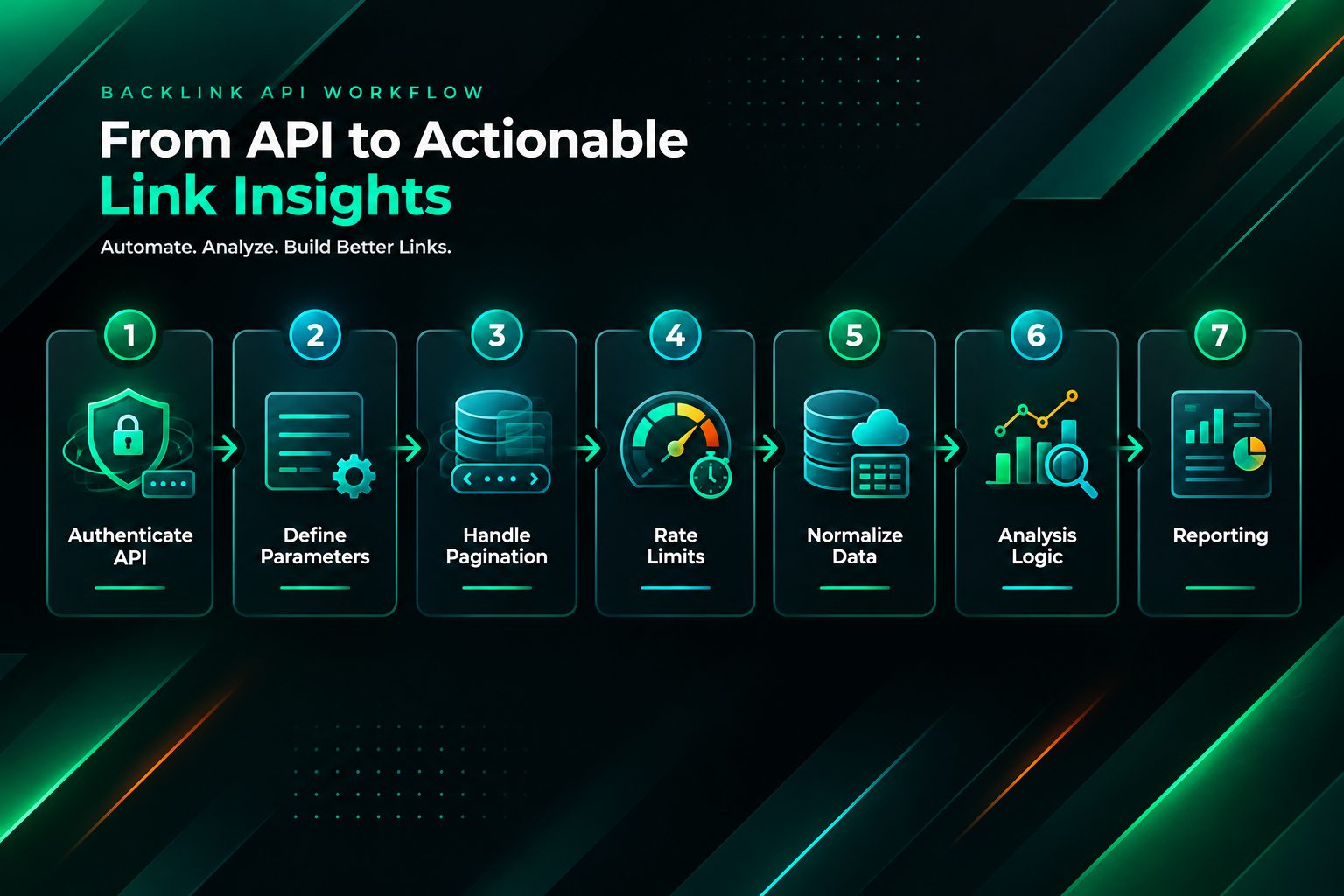
Building a functional backlink analysis workflow using an API involves several practical steps. The sequence below describes a general approach; the specific implementation will depend on your chosen provider, programming language, and the analysis goal.
- Authenticate your API access. Most providers use API key authentication passed as a header or query parameter. Store your key securely and never expose it in client-side code or public repositories.
- Define your target and parameters. Specify the domain or URL you want to analyze, the data fields you need, the date range if applicable, and any filters such as link attribute type, minimum authority score, or active versus lost links.
- Handle pagination. Backlink indexes can contain millions of records for a single domain. Most APIs return results in pages with a limit per request. Your code needs to loop through pages until all records are retrieved or until you reach a practical limit for your use case.
- Respect rate limits. API providers enforce request rate limits to protect their infrastructure. Exceeding these limits typically results in temporary blocks or additional charges. Build delays or retry logic into your requests and check the provider’s documentation for current limits.
- Normalize and store the data. Raw API responses need to be parsed, normalized into a consistent schema, and stored in a database or data warehouse if you intend to track changes over time. Consistent field naming and data types are important when combining data from multiple providers.
- Apply your analysis logic. Once the data is stored, you can apply filtering, aggregation, deduplication, and scoring logic relevant to your specific goal, whether that is monitoring placed links, identifying link gaps, or generating a distribution report.
- Output to your reporting layer. Results can be written to a spreadsheet, pushed to a dashboard tool such as Google Looker Studio or a custom interface, or formatted into a client report template.
Data Quality, Coverage, and Freshness Considerations
The usefulness of any custom backlink analysis depends heavily on the quality of the underlying data. Backlink API indexes are not identical to Google’s link graph, and no provider has complete coverage of the web. Each provider’s crawler has different priorities, crawl frequencies, and index sizes, which means the same domain may show different referring domain counts, different link attributes, and different authority scores depending on which API you query.
Data freshness is a particular consideration for link monitoring use cases. If a link was placed recently, it may not yet appear in a provider’s index. Conversely, a link that was removed weeks ago may still appear as active in an index that has not re-crawled the source page. Building a monitoring workflow that treats API data as a definitive real-time source without accounting for crawl lag can produce misleading results. Where link status accuracy is critical, supplementing API data with direct HTTP checks of the source page is a more reliable approach.
Proprietary authority metrics such as DR, DA, Authority Score, and Trust Flow are calculated from the provider’s own index and methodology. They are useful for relative comparisons within a single provider’s ecosystem but should not be treated as interchangeable across providers or as direct proxies for Google’s assessment of a domain’s authority. A domain with a high DR may still produce a low-quality or irrelevant link in practice, and a domain with a modest score may provide genuine topical relevance and referral value depending on the context.
Limitations and Risks of API-Based Backlink Analysis
Custom backlink analysis built on APIs offers genuine efficiency advantages, but it also carries limitations that are worth understanding before investing significant development time.
- Index coverage gaps: No provider indexes the entire web. Smaller or newer sites, non-English language domains, and pages behind authentication are often underrepresented. Analysis conclusions drawn from incomplete data should be treated as directional rather than definitive.
- Metric inconsistency across providers: Comparing authority metrics from different providers in the same analysis without normalization can produce misleading conclusions. If you use multiple data sources, document which metric comes from which provider and avoid treating them as equivalent.
- API pricing and usage costs: Most backlink API providers charge based on the number of rows returned, the number of requests made, or a combination of both. Large-scale analysis of many domains can consume significant API credits quickly. Estimating usage before building a workflow and monitoring consumption during operation helps avoid unexpected costs.
- Maintenance overhead: API endpoints, authentication methods, and data schemas change over time. A custom workflow built today may require updates when a provider releases a new API version or deprecates an endpoint. Factoring in ongoing maintenance is important when evaluating the total cost of a custom solution versus a managed tool.
- Interpretation requires SEO judgment: Raw API data does not interpret itself. Identifying whether an anchor text distribution is a concern, whether a referring domain is genuinely relevant, or whether a link gap represents a realistic outreach opportunity requires SEO expertise that sits outside the API layer. Automating data collection is straightforward; automating sound SEO judgment is not.
- No direct access to Google’s signals: Backlink APIs reflect third-party crawl data. Google Search Console provides some backlink data directly from Google’s index through its Links report, but this data is sampled and does not include the full range of metrics available from third-party providers. Neither source gives you a complete or authoritative view of how Google evaluates your backlink profile.
Combining API Data with Google Search Console
Google Search Console’s Links report provides a sample of links that Google has discovered pointing to your site, along with the most common anchor text and the top linking sites. While this data is limited in scope compared to third-party API indexes, it reflects Google’s own crawl rather than a third-party estimate. Combining Search Console link data with a more comprehensive third-party backlink API can provide a more complete picture: the API gives breadth and metric context, while Search Console confirms which links Google has actually discovered.
The Search Console API allows you to pull this data programmatically, making it possible to integrate Google’s link discovery data into the same pipeline as your third-party backlink API data. Discrepancies between the two sources are normal and expected; they reflect differences in crawl coverage and index methodology rather than errors in either system.
When Custom API Analysis Makes Sense and When It Does Not
Building a custom backlink analysis workflow using APIs is a meaningful investment of development time and ongoing maintenance effort. It is most likely to be worthwhile when you are managing link building campaigns across a large number of domains or clients, when you need to integrate backlink data with other proprietary data sources that standard tools do not support, when you require automated recurring reports at a frequency or scale that manual exports cannot efficiently support, or when you are building a white-label reporting product for agency clients.
For smaller-scale analysis, one-off audits, or teams without development resources, the graphical interfaces provided by Ahrefs, Semrush, Moz, or Majestic are likely to be more practical. These tools offer the same underlying data through a user interface that requires no code, handles pagination and rate limits automatically, and includes built-in visualization. The trade-off is less flexibility in how the data is filtered, combined, and presented.
If your primary goal is improving your backlink profile rather than analyzing it, the analytical infrastructure described in this article supports but does not replace the actual work of link acquisition. Identifying link gaps, monitoring placed links, and reporting on campaign progress are all valuable activities, but they depend on having a sound link building strategy and a reliable acquisition process in place. Custom analysis tools are most useful when they inform and support an active campaign rather than substituting for one.
Frequently Asked Questions
Do I need coding skills to use a backlink API?
Basic API usage requires the ability to make HTTP requests and parse JSON responses, which is achievable with minimal coding knowledge in languages such as Python or JavaScript. More complex workflows involving database storage, scheduled jobs, and report generation require more substantial development experience. Some providers also offer no-code integrations through platforms such as Zapier or Make, which can handle simpler use cases without custom code.
Which backlink API has the most accurate data?
No single provider has universally superior data across all domains, markets, and link types. Ahrefs and Semrush are frequently cited for large index sizes and regular crawl updates, while Majestic’s topical trust flow categories are valued for relevance assessment. The most reliable approach for critical analysis is to cross-reference data from more than one provider and treat discrepancies as a signal to investigate further rather than assuming either source is correct.
Can backlink API data tell me why my rankings dropped?
Backlink API data can show changes in your referring domain profile, such as lost links or shifts in anchor text distribution, that may be worth investigating after a ranking change. However, ranking changes have many potential causes including content quality issues, algorithm updates, technical SEO problems, and competitor activity. Backlink data alone is rarely sufficient to diagnose a ranking drop, and a thorough site-specific audit is usually needed before drawing conclusions.
How often should I pull backlink data for monitoring purposes?
For active link building campaigns, pulling referring domain and link status data weekly or bi-weekly is a common approach. Daily pulls are rarely necessary given typical crawl lag in provider indexes and can consume API credits quickly. For less active sites or periodic audits, monthly pulls are often sufficient. The right frequency depends on your campaign activity level and the reporting cadence your clients or stakeholders expect.
Is Google Search Console a substitute for a third-party backlink API?
Google Search Console’s Links report provides sampled data directly from Google’s crawl, which is valuable for understanding which links Google has discovered. However, it does not provide the full referring domain list, authority metrics, anchor text distribution at scale, or historical link data that third-party APIs offer. The two sources are complementary rather than interchangeable, and combining them typically produces more useful analysis than relying on either alone.
Can I use backlink API data to assess publisher quality before outreach?
Yes, pulling authority metrics, referring domain counts, and topical trust flow data for prospective publisher domains through an API can help prioritize outreach targets. However, API metrics should be one input among several in a publisher quality assessment. Factors such as content quality, editorial standards, topical relevance, traffic patterns, and the context of existing outbound links on the site are equally important and require human review that API data alone cannot provide.
Building Backlink Analysis That Actually Supports Your Link Building Goals
Backlink APIs are genuinely useful infrastructure for SEO teams and agencies that need to work with link data at scale, automate recurring reporting, or integrate backlink intelligence into broader data workflows. The practical value they deliver depends on how clearly you define the analytical problem you are trying to solve, how carefully you account for the limitations of the underlying index data, and how well the output connects to decisions that improve your actual link building campaigns.
The most effective use of backlink API data is not the analysis itself but what it enables: faster identification of link gaps worth pursuing, more reliable monitoring of placed links, and cleaner reporting that keeps campaigns accountable over time. If you are building or scaling a link building programme and want to understand how data-informed campaign management fits into a broader acquisition strategy, discussing your specific goals with an experienced link building team can help you identify where custom analysis adds genuine value and where simpler approaches may be more practical.