URL fragments — the portion of a web address that follows a hash symbol, such as example.com/page#section-name — are commonly used to link readers directly to a specific part of a page. Whether these fragment links pass SEO value, influence rankings, or deserve a place in a link building strategy is a question that comes up regularly among SEO practitioners and site owners. The honest answer is nuanced: fragment links behave differently from standard page-level links, and their SEO impact depends on how search engines process them and how they are used in practice.
Key Takeaways
- URL fragments (hash links) point to a specific section within a page rather than the page as a whole, and search engines generally treat the fragment portion as a client-side instruction rather than a separate URL.
- Google has indicated that links to URL fragments are treated similarly to links to the base page for the purpose of passing PageRank, though the evidence on ranking impact remains limited and context-dependent.
- Fragment links can improve user experience and referral traffic by directing visitors to the most relevant section of a long page, which may indirectly support engagement signals.
- For most link building campaigns, standard page-level links remain the clearer and more predictable choice; fragment links are best used where they genuinely serve the reader.
- The SEO value of any external link — fragment or otherwise — depends heavily on the quality, relevance, and authority of the linking page, not just the link format.
What Is a URL Fragment?
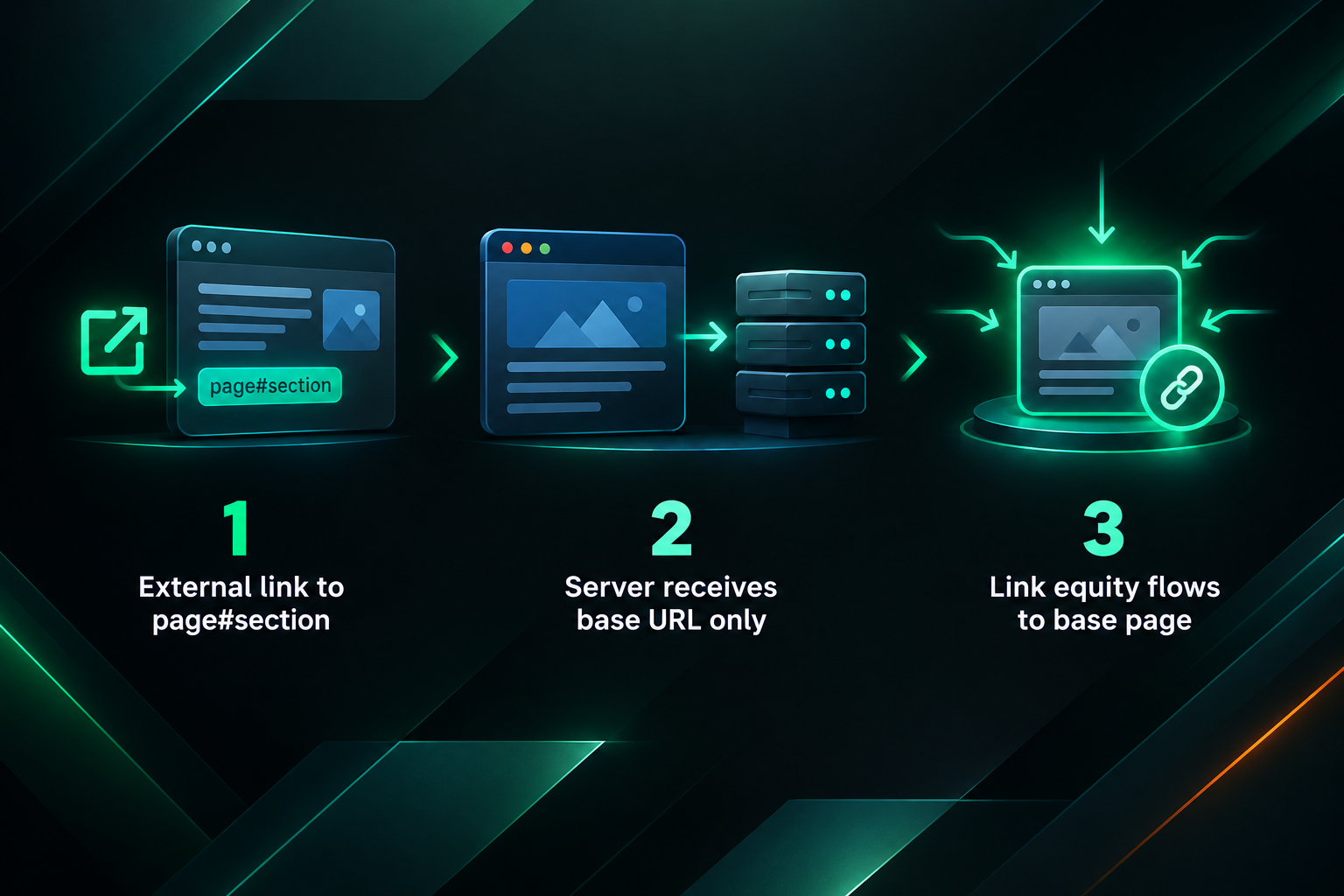
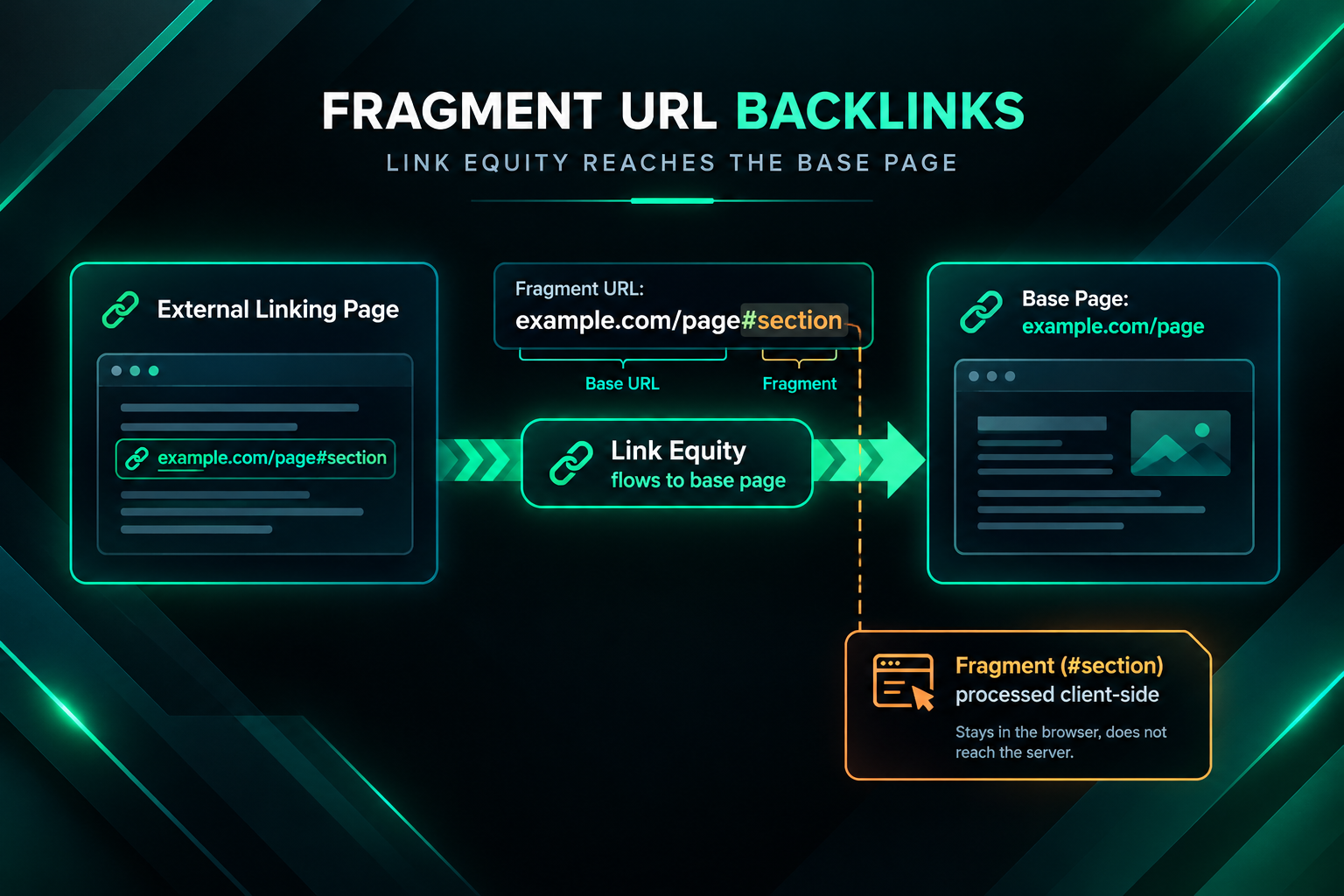
A URL fragment is the part of a web address that begins with a hash character (#) and identifies a specific location within a document. For example, in the URL https://example.com/guide-to-seo#on-page-factors, the fragment is #on-page-factors. When a user clicks this link, the browser loads the full page and then scrolls automatically to the element with the matching ID or anchor. The fragment itself is never sent to the web server as part of the HTTP request — it is processed entirely by the browser on the client side.
Fragments are widely used in long-form content, documentation pages, table-of-contents navigation, and single-page applications. They allow publishers to link readers directly to a relevant section without requiring a separate URL for each piece of content. From a user experience perspective, fragment links reduce friction by eliminating the need to scroll through a lengthy page to find the relevant information.
It is worth distinguishing URL fragments from URL parameters, which appear before the hash and are sent to the server. Parameters can create duplicate content issues and are handled differently by search engines. Fragments, by contrast, are invisible to the server and are not indexed as separate pages by Google under standard circumstances.
How Search Engines Handle Fragment Links
Because the fragment portion of a URL is not transmitted to the server, search engines like Google cannot retrieve a fragment-specific version of a page — they crawl and index the base URL. Google’s publicly available documentation and statements from its search representatives have indicated that when Googlebot encounters a link pointing to a URL with a fragment, it generally follows the link to the base page and processes it accordingly. The fragment identifier itself does not create a separate indexable entity in most cases.
From a PageRank perspective, Google has stated that links to URL fragments are treated similarly to links pointing to the base page URL. This means that a backlink to example.com/page#section from an external website would, in principle, pass link equity to example.com/page in the same way a link to example.com/page would. However, this is a general statement about how the system is designed to work, not a guarantee that every fragment link will be crawled, indexed, or weighted identically to a standard page-level link in every situation.
There are practical caveats. If a page uses JavaScript-rendered fragments or hash-based routing — common in single-page applications built with frameworks like React or Angular — the behavior can differ. In these cases, the fragment may represent genuinely different content that is rendered client-side, and Googlebot’s ability to process that content depends on its JavaScript rendering capabilities at the time of crawl. Google has improved its JavaScript rendering over time, but rendering is not instantaneous and can introduce indexing delays.
Do Fragment Links Pass Link Equity?
The question of whether links to URL fragments pass link equity — sometimes called link juice or PageRank — is one of the most practically relevant for SEO professionals. Based on available guidance, the answer is generally yes, with important qualifications.
When an external website links to a page using a fragment URL, the link equity is attributed to the base page rather than to a distinct fragment-level entity. This is because Google does not index fragments as separate pages under standard HTML anchor-based implementations. The referring domain’s link signal reaches the target page, and the page as a whole benefits from that association. In this sense, a fragment link from a high-quality, topically relevant external page may contribute to the target page’s authority in a similar way to a standard link.
However, several factors can affect whether a fragment link is crawled and processed at all. Googlebot must first discover the link, which depends on the linking page being crawled. The linking page must itself be indexable and carry sufficient authority for the link to be meaningful. If the fragment link appears in a noindexed page, a page blocked by robots.txt, or within a JavaScript element that Googlebot cannot render, the link may not be processed as expected. These are not risks unique to fragment links — they apply to all external links — but they are worth considering when evaluating the likely impact of any specific placement.
Third-party SEO tools such as Ahrefs, Semrush, and Majestic may handle fragment links differently in their own crawling and reporting. A tool may report a fragment link as pointing to the base URL, or it may display the full fragment URL as a separate referring page depending on how the tool normalizes URLs. These are proprietary tool behaviors and do not necessarily reflect how Google processes the same link. Domain Rating, Domain Authority, Authority Score, and Trust Flow are third-party metrics and should not be treated as direct measures of how Google values a specific link.
Practical SEO Implications of Fragment Links
Understanding the technical behavior of fragment links is useful, but the more important question for most site owners and SEO teams is whether acquiring or building links that use fragment URLs is a worthwhile strategy. The answer depends on the context and the goal.
User Experience and Referral Traffic
One genuine benefit of fragment links is improved user experience. When a linking article references a specific claim, statistic, or section of a long resource page, using a fragment link sends the reader directly to the relevant content rather than to the top of the page. This can reduce bounce rates for referral visitors, increase time on page, and improve the likelihood that the visitor finds the content useful. These engagement signals may have indirect SEO relevance, though the relationship between engagement metrics and rankings is not straightforward and should not be overstated.
For pages that serve as comprehensive resources — detailed guides, glossaries, FAQ pages, or long-form comparison content — fragment links from external sources can direct qualified referral traffic to the most relevant section. This is particularly useful when the linking context is specific, such as a blog post citing a particular statistic or definition from a longer reference page.
Internal Linking and On-Page Navigation
Fragment links are also widely used for internal linking, particularly in table-of-contents sections at the top of long articles. Internal fragment links help users navigate within a page and can help search engines understand the structure and depth of the content. Google has also used fragment-based anchor links in featured snippets and rich results, which suggests that well-structured in-page anchors may support content discoverability in certain contexts. This is an area where the evidence is observational rather than definitively established, and outcomes will vary by page type and query.
Link Building Campaign Considerations
For external link building campaigns — whether through manual outreach, guest posting, niche edits, or digital PR — the decision to use a fragment URL in a placement should be driven by editorial relevance rather than a belief that fragment links are inherently more or less valuable than standard links. If a guest post or editorial mention naturally references a specific section of a target page, using a fragment link is appropriate and may improve the reader’s experience. If the reference is to the page as a whole, a standard page-level link is the cleaner choice.
There is no strong evidence that deliberately targeting fragment URLs in outreach campaigns produces meaningfully different ranking outcomes compared to standard page-level links, assuming the base page is the same. The quality, topical relevance, and authority of the linking domain remain the primary factors that determine a link’s likely contribution to organic visibility.
When Fragment Links May and May Not Be Useful
Situations Where Fragment Links May Be Appropriate
- Linking to a specific definition, statistic, or section within a long resource page where the fragment genuinely improves the reader’s experience.
- Internal table-of-contents navigation on long-form content pages, helping both users and search engines understand page structure.
- Editorial citations in guest posts or digital PR placements where the referenced content is a specific section rather than the full page.
- Single-page application navigation where hash-based routing is the intended design, provided the content is accessible to search engine crawlers.
Situations Where Fragment Links May Be Less Useful or Problematic
- JavaScript-heavy single-page applications where fragment-based routing creates content that Googlebot may struggle to render or index reliably.
- Attempts to use fragment links as a workaround for duplicate content or to create the appearance of multiple distinct URLs from a single page — this is unlikely to produce the intended result and may create confusion in crawl data.
- Situations where the fragment identifier does not correspond to a real anchor element on the page, resulting in a link that loads the page but does not scroll to any specific section.
- Campaigns where the primary goal is to build measurable domain-level authority signals, in which case standard page-level links are more straightforward and easier to track across SEO tools.
Fragment Links, Anchor Text, and Relevance Signals
Anchor text — the visible, clickable text of a hyperlink — is one of the signals search engines use to understand the context and relevance of a linked page. This applies to fragment links in the same way it applies to standard links. The anchor text of a fragment link should accurately describe the content of the target page or section, and it should read naturally within the surrounding editorial context.
Over-optimized anchor text — using exact-match keyword phrases repeatedly across many external links — carries risks regardless of whether the link uses a fragment URL or a standard URL. Google’s link spam policies apply to the nature and pattern of link acquisition, not specifically to the URL format. A fragment link acquired through manipulative means is subject to the same policy considerations as any other link obtained in a similar fashion.
Topical relevance between the linking page and the target page remains important. A fragment link from a highly relevant, editorially independent page on a reputable website is likely to be more meaningful than a fragment link from an unrelated or low-quality page, regardless of the URL format. This is consistent with how link quality assessment works more broadly: the source, context, and editorial independence of the link matter more than the technical format of the URL.
Monitoring and Reporting Fragment Links
If you are tracking backlinks using tools such as Ahrefs, Semrush, or Google Search Console, it is worth understanding how each platform handles fragment URLs in its reporting. Some tools normalize fragment URLs to the base page URL, meaning a link to example.com/page#section may appear in reports as a link to example.com/page. Others may display the full fragment URL as a distinct referring URL. Neither approach is inherently wrong — they reflect different choices about URL normalization — but the difference can affect how you interpret your backlink data.
Google Search Console reports links at the page level and does not typically differentiate between links pointing to the base URL and links pointing to fragment variants of the same URL. This means that if you are trying to assess the link equity flowing to a specific page, Search Console data will generally aggregate fragment and non-fragment links together for that base URL. This is useful for understanding overall link acquisition to a page but does not allow granular fragment-level analysis within the tool.
For campaign reporting purposes, it is generally more practical to track links at the base page level and assess the quality and relevance of each placement individually, rather than attempting to distinguish the SEO impact of fragment versus non-fragment links to the same page. The variables that affect ranking outcomes — content quality, competition, crawl frequency, overall backlink profile, technical SEO health — are far more significant than the presence or absence of a fragment identifier in the link URL.
Fragment Links in the Context of a Broader Link Building Strategy
Fragment links are a small technical detail within a much larger set of factors that determine the effectiveness of a link building campaign. For businesses and SEO teams evaluating their link acquisition approach, the presence or absence of fragment identifiers in link URLs is unlikely to be a meaningful differentiator in campaign outcomes.
What matters more is the overall quality of the backlink profile: the topical relevance of linking domains, the editorial independence of placements, the diversity of referring domains, the authority signals of linking pages, and the alignment between the linked content and the target page’s purpose. A campaign that secures a modest number of genuinely relevant, editorially placed links from reputable websites is likely to be more beneficial than a high volume of links — fragment or otherwise — from low-quality or irrelevant sources.
For pages that are underperforming in organic search, it is also worth considering whether the issue is primarily a link-related one before investing in link acquisition. Low organic visibility can result from crawling or indexing problems, weak or outdated content, a mismatch between the page’s content and the search intent it is targeting, poor internal linking, or strong competition from well-established pages. A site-specific assessment is the appropriate starting point before attributing ranking gaps to backlink deficits alone.
When outsourcing link building or working with an agency, it is reasonable to ask how placements are evaluated for quality and relevance, how anchor text decisions are made, and how the campaign is reported. These questions apply regardless of whether the campaign involves fragment links or standard page-level links. The fundamentals of link quality assessment — editorial context, topical relevance, domain authority signals, link attribute transparency — remain consistent across link formats.
Frequently Asked Questions
Does Google treat a link to a URL fragment differently from a link to the base page?
Google has indicated that links to URL fragments are generally treated similarly to links to the base page for PageRank purposes, since the fragment is not transmitted to the server and does not create a separate indexable URL under standard HTML implementations. In practice, the link equity flows to the base page rather than to a distinct fragment-level entity.
Can a fragment link appear in Google Search Console as a separate URL?
Under standard HTML anchor-based fragments, Google Search Console typically reports links at the base page level and does not differentiate between fragment and non-fragment variants of the same URL. However, JavaScript-based hash routing in single-page applications can behave differently depending on how the application is structured and how Googlebot renders it.
Should I request fragment links in my link building outreach?
There is no strong evidence that specifically requesting fragment links produces better SEO outcomes than standard page-level links. The decision to use a fragment URL in a placement should be driven by editorial relevance — whether the link genuinely points the reader to the most useful section of the target page — rather than a belief that the URL format itself carries additional SEO value.
Do SEO tools like Ahrefs or Semrush count fragment links separately?
Different tools handle fragment URL normalization differently. Some report fragment links under the base page URL; others may display the full fragment URL as a distinct referring page. These are tool-specific behaviors and do not necessarily reflect how Google processes the same link. Always interpret backlink data in the context of the tool’s own methodology.
Are there any risks associated with fragment links?
Fragment links acquired through manipulative or low-quality link schemes carry the same risks as any other link obtained in a similar manner. The URL format does not change the policy considerations that apply to link acquisition. Additionally, broken fragment links — where the anchor element no longer exists on the target page — can create a poor user experience for referral visitors, though this is an editorial quality issue rather than a direct SEO penalty trigger.
Do internal fragment links help with SEO?
Internal fragment links, such as those used in table-of-contents navigation, can help users navigate long pages and may support search engine understanding of page structure and content depth. Google has used in-page anchor links in featured snippets and rich results in some cases, suggesting that well-structured internal anchors may have some discoverability benefit, though outcomes vary by page type and query.
What to Consider Before Optimizing for Fragment Links
Fragment links are a legitimate and useful part of web navigation, and understanding how search engines handle them is genuinely valuable for anyone involved in SEO or link building. The evidence suggests that external links using fragment URLs can pass link equity to the base page in a manner broadly comparable to standard page-level links, provided the linking page is crawlable, indexable, and editorially relevant. This makes fragment links a reasonable choice when they serve the reader’s experience — not a special tactic to pursue for its own sake.
For most link building campaigns, the practical priority should remain on acquiring links from high-quality, topically relevant sources through editorially sound placements. Whether those links use fragment URLs or standard page URLs is a secondary consideration. If you are working with an outsourced link building provider or an in-house SEO team, the more important questions concern publisher quality, topical alignment, anchor text diversity, and how placements are monitored over time.
If you are unsure whether your current link acquisition approach is well-matched to your target pages and business goals, a structured review of your existing backlink profile and on-page content quality is a sensible starting point. Fragment link optimization is unlikely to be the most impactful lever available — but understanding how these links work ensures that your campaign decisions are grounded in accurate expectations rather than assumptions about URL format.