Industry benchmark reports are one of the more reliable content formats for attracting editorial backlinks at scale. When a report contains original data that other writers, analysts, and journalists cannot find elsewhere, it becomes a citable resource — and citations in this context mean backlinks. This article explains how the strategy works in practice, what makes a benchmark report genuinely linkable, how to plan outreach around it, and what realistic results and limitations look like before you commit significant resources.
Key Takeaways
- Industry benchmark reports earn backlinks by providing original, citable data that other content creators need to reference — making the asset itself do much of the acquisition work.
- The quality of the underlying data and the relevance of the topic to your target audience determine whether a report attracts links or is ignored.
- Outreach is still necessary; even strong reports rarely earn significant links passively without a structured promotion campaign.
- Results depend on niche competitiveness, report quality, distribution reach, and how well the outreach is targeted — timelines of several months before measurable SEO impact are common.
- This strategy suits businesses with access to proprietary data or survey capacity, and it works best as part of a broader link acquisition plan rather than a standalone tactic.
What Is a Benchmark Report and Why Does It Attract Backlinks?
An industry benchmark report is a structured document that presents original data about performance standards, trends, or norms within a specific sector. Examples include conversion rate benchmarks by industry, average customer acquisition costs across SaaS tiers, email open rate comparisons by vertical, or salary surveys within a professional field. The defining characteristic is that the data is original — collected through surveys, proprietary platform analytics, aggregated customer data, or primary research — rather than republished from another source.
Backlinks accumulate around benchmark reports because writers and content teams regularly need statistics to support claims in their own articles. When a journalist writes about e-commerce performance or a marketer publishes a guide to paid search efficiency, they look for credible numbers to cite. If your report contains those numbers and is the primary source, the citation links back to your domain. This is sometimes described as the “statistics page” model of link earning, and it is one of the more durable approaches in white-hat link building because the links are genuinely editorial — they exist because another publisher found the data useful, not because a placement was arranged.
The mechanism also creates compounding value. A single benchmark report can attract links over months or years as new content referencing the same statistics is published. Some reports become evergreen reference points within their industry, continuing to earn backlinks long after the initial promotion campaign has ended, provided the data remains relevant or is updated periodically.
What Makes a Benchmark Report Genuinely Linkable
Not every report earns links. The difference between a report that attracts dozens of referring domains and one that earns almost none usually comes down to a small number of factors.
Original Data That Cannot Be Found Elsewhere
The most important characteristic of a linkable benchmark report is that the data is genuinely original. If your report aggregates publicly available statistics from other sources, there is no reason for another publisher to link to you rather than to the original sources. Original data means you collected it — through a survey of your customer base, through analysis of your platform’s aggregated usage data, through a commissioned research study, or through a structured data-collection process that produces findings no one else has published.
The bar for originality does not need to be academic-research quality, but the methodology should be transparent enough that a reader can assess how the data was gathered, how many respondents or data points were included, and what the scope and limitations are. Transparency increases credibility, and credibility increases the likelihood that a journalist or content team will feel comfortable citing the report.
Relevance to a Specific, Active Publishing Community
A benchmark report earns links when people are actively writing about the topic it covers. Before investing in research, it is worth assessing whether there is a community of publishers — industry blogs, trade publications, marketing newsletters, news sites — that regularly produces content in your niche. If that publishing ecosystem exists and is active, a well-positioned report has a realistic audience of potential linkers. If the niche is very narrow or the publishing community is small, the ceiling on link acquisition is lower regardless of report quality.
Specific, Quotable Statistics
Writers cite specific numbers, not general observations. A report that concludes “most companies struggle with customer retention” is not citable in the same way as one that states “42% of mid-market SaaS companies reported annual churn rates above 15% in the survey period.” Benchmark reports should be designed to produce precise, quotable findings — percentages, averages, medians, year-over-year changes, and segment-level breakdowns — because these are the elements that get embedded in other people’s content with a link back to the source.
Professional Presentation and Accessibility
A report that is difficult to read, poorly structured, or buried behind an aggressive lead-capture form will earn fewer links than one that is clearly presented and easy to access. Some degree of gating — asking for an email address — is common and acceptable, but requiring extensive form completion before a reader can see any data reduces the likelihood that journalists and bloggers will reference it. A common approach is to publish key findings and headline statistics openly on a landing page, with a more detailed downloadable version available behind a light gate.
Planning the Research Behind a Linkable Report
The research design phase determines whether the finished report will have the qualities that attract backlinks. Rushing this stage to produce content quickly usually results in a report that lacks the specificity or credibility needed to earn editorial citations.

Choosing a Topic with Link Potential
The most effective benchmark report topics sit at the intersection of what your business knows well and what your target linking audience writes about frequently. Use keyword research tools such as Ahrefs or Semrush to identify statistics-related queries in your niche — searches that include terms like “average,” “benchmark,” “statistics,” “survey,” or “industry data” alongside your core topic. These queries signal that writers are actively looking for citable data in that area. Reviewing which statistics pages in your niche already attract significant referring domains can also help identify the types of data that the publishing community values.
Survey Design and Data Collection
For businesses without access to large proprietary datasets, surveys are the most accessible route to original data. A well-designed survey of 200 to 500 respondents within a clearly defined professional audience can produce findings credible enough to attract links from industry publications. The survey should focus on questions that produce specific, measurable answers rather than opinion-based responses, and the respondent profile should be clearly documented in the report so readers can assess the relevance of the findings to their own context.
Businesses that operate platforms, marketplaces, or SaaS products may have access to aggregated usage data that can serve as the basis for a benchmark report without requiring a separate survey. This type of proprietary platform data can be particularly compelling because it reflects real-world behavior at scale, provided the sample size is sufficient and the data has been appropriately anonymized.
Segmentation and Depth
Reports that break findings down by company size, industry vertical, geography, or other relevant dimensions are more useful to a wider range of writers than reports that present only aggregate figures. A content marketer writing for a B2B software audience needs different benchmarks than one writing for a retail e-commerce audience. Segmented data allows more writers to find a relevant statistic within the same report, which increases the total number of potential citing contexts.
Publishing and Structuring the Report for Maximum Link Acquisition
How a benchmark report is published affects both its discoverability and its linkability. Several structural decisions made at the publishing stage have a meaningful impact on how many backlinks the report ultimately earns.
Dedicated Landing Page with Scannable Key Findings
Publishing the report on a dedicated, indexable landing page — rather than only as a PDF download — allows search engines to crawl and rank the content, and gives other publishers a stable URL to link to. The page should present the most important findings in a scannable format, with clear headings, specific statistics highlighted visually, and enough context for a reader to understand the significance of each finding without reading the entire document. This structure makes it easy for a journalist working quickly to find a citable statistic and copy the URL.
Shareable Data Visualizations
Charts, graphs, and infographics that visualize key findings increase the likelihood that other publishers will embed or reference the report. When a visualization is clearly attributed to your report and includes your domain name or brand, it can generate additional links even when the image itself is shared rather than the full report. Keeping visualizations simple and clearly labeled improves their usefulness as standalone assets.
Structured Data and On-Page SEO
Applying appropriate on-page SEO to the report landing page — including a descriptive title tag, a clear meta description, and structured headings that reflect the report’s key topics — helps the page rank for statistics-related queries in your niche. Organic search visibility means the report continues to attract new potential linkers over time without ongoing promotion effort. Internal linking from related content on your site also helps search engines understand the page’s relevance and can support its ranking potential.
Outreach Strategy for Benchmark Report Link Building
Even a high-quality benchmark report rarely earns significant backlinks without active outreach. The passive link earning that sometimes occurs with exceptional content is a secondary benefit, not a reliable primary strategy. A structured outreach campaign is necessary to reach the volume of potential linkers needed to build a meaningful number of referring domains.
Identifying Outreach Targets
Outreach targets for a benchmark report fall into several categories. The most direct targets are writers and editors who have previously published content citing statistics in your niche — they have already demonstrated a willingness to reference data, and your report gives them a new, potentially more relevant source. Tools like Ahrefs Content Explorer or Semrush’s backlink analysis features can help identify pages that have linked to similar statistics resources, which in turn reveals the publishers and authors most likely to be receptive.
A second category of targets includes journalists and newsletter writers who cover your industry regularly. These contacts may not have previously cited statistics in a specific article, but they are active in the publishing ecosystem and may reference your findings in future coverage. Building a media list of relevant industry journalists and bloggers before the report launches allows outreach to begin immediately on publication.
Personalizing Outreach at Scale
Benchmark report outreach works best when the email or message connects a specific finding from the report to content the recipient has already published. A generic “we published a report, please link to it” message is unlikely to generate a meaningful response rate. A message that references a specific article the recipient wrote, notes a relevant statistic from your report that would add value to that article, and explains why the data is credible is substantially more likely to result in a link placement.
Personalization at scale requires a structured process: researching each target’s recent content, identifying the most relevant finding from the report for each contact, and drafting a tailored message that makes the connection explicit. This is time-intensive, which is one reason many businesses choose to work with an experienced outreach team rather than managing the process entirely in-house.
Follow-Up and Relationship Building
A single outreach email rarely produces a high response rate. A structured follow-up sequence — typically one or two follow-up messages sent over a period of one to two weeks — can meaningfully increase the number of responses and placements. Beyond individual campaigns, benchmark report outreach can also be the starting point for longer-term relationships with industry journalists and bloggers, which may generate additional link opportunities in future campaigns.
Realistic Timelines and What to Expect
The timeline from research design to measurable SEO impact for a benchmark report campaign is typically longer than many businesses anticipate. Understanding the realistic sequence helps set appropriate expectations and avoid premature conclusions about whether the strategy is working.
Research design, data collection, and report production typically take four to twelve weeks depending on the complexity of the research and the resources available. Publishing and initial outreach can begin immediately after the report is live, but the first wave of link placements usually takes two to six weeks to materialize as publishers review the report, decide to reference it, and publish their content. Some placements take longer because they depend on the editorial calendar of the linking publication.
Once backlinks are acquired, search engines need to crawl and index both the linking pages and the updated link profile of your domain. The SEO impact of new referring domains — any improvement in rankings or organic visibility — typically becomes measurable over a period of weeks to months rather than days. The exact timeline depends on the authority and relevance of the linking domains, the competitiveness of the target keywords, the existing strength of the domain’s backlink profile, and other on-page and technical SEO factors. There is no reliable formula that converts a specific number of new referring domains into a predictable ranking change.
It is also worth noting that benchmark reports can continue earning links beyond the initial outreach campaign. If the report ranks for relevant statistics queries, new writers discovering it through search may link to it organically over time. Annual updates to the report — refreshing the data with new survey results or platform data — can extend this compounding effect and provide a reason to conduct additional outreach in subsequent years.
Limitations and Risks of This Strategy
Benchmark report link building is a legitimate and often effective strategy, but it has meaningful limitations that are worth understanding before committing resources.
- High upfront investment: Producing a credible benchmark report requires significant time and, in many cases, financial investment in research, design, and content production. The return on that investment is not guaranteed and depends heavily on execution quality and niche characteristics.
- Niche ceiling: In narrow or low-activity niches, the number of publishers who might cite the report is limited, which caps the number of backlinks the campaign can realistically generate regardless of report quality.
- Data credibility requirements: Reports based on small samples, unclear methodology, or data that appears commercially motivated may be ignored or actively criticized by the publishing community. Credibility is not automatic and must be earned through transparent research design.
- Outreach volume requirements: Earning a meaningful number of referring domains typically requires reaching a large number of potential linkers. Response rates for cold outreach are generally low, which means the outreach list needs to be substantial to produce a significant number of placements.
- No guaranteed SEO outcome: Acquiring backlinks from a benchmark report campaign may improve rankings and organic visibility, but this is not certain. Rankings depend on many factors beyond the backlink profile, including content quality, technical SEO, search intent alignment, and competition. Link building should be considered one component of a broader SEO strategy rather than a standalone solution.
- Link loss over time: Some links acquired through outreach may be removed if the linking page is updated, deleted, or restructured. Monitoring the backlink profile over time and identifying lost links is a standard part of ongoing link management.
Who This Strategy May Suit
Benchmark report link building is not equally suitable for every business or SEO campaign. It tends to work best in specific circumstances.
Businesses with access to proprietary data — SaaS platforms, marketplaces, agencies with aggregated client data, or companies with large customer bases — are well positioned to produce credible benchmark reports without the cost of commissioning external research. The data they already hold can be the foundation of a report that no competitor can replicate.
B2B companies in industries with active trade publishing ecosystems — technology, marketing, finance, HR, logistics, and similar sectors — typically have a larger pool of potential linking publishers than businesses in consumer niches with fewer industry-focused publications.
Businesses targeting informational or research-oriented keywords as part of their SEO strategy may find that a benchmark report serves a dual purpose: earning backlinks while also ranking for statistics-related queries that bring relevant organic traffic directly to the report page.
This strategy is less likely to be cost-effective for very early-stage websites with minimal domain authority, businesses in niches with little active publishing activity, or companies that cannot produce genuinely original data. In these cases, alternative link building approaches — such as guest posting on relevant industry publications, digital PR campaigns, or niche-specific resource link building — may offer a better return on the available budget and effort.
Integrating Benchmark Reports into a Broader Link Building Campaign
A benchmark report is most effective as one component of a diversified link acquisition strategy rather than the sole approach. Relying on a single content asset or tactic creates concentration risk — if the report underperforms or the outreach campaign produces fewer placements than expected, the entire link building effort stalls.
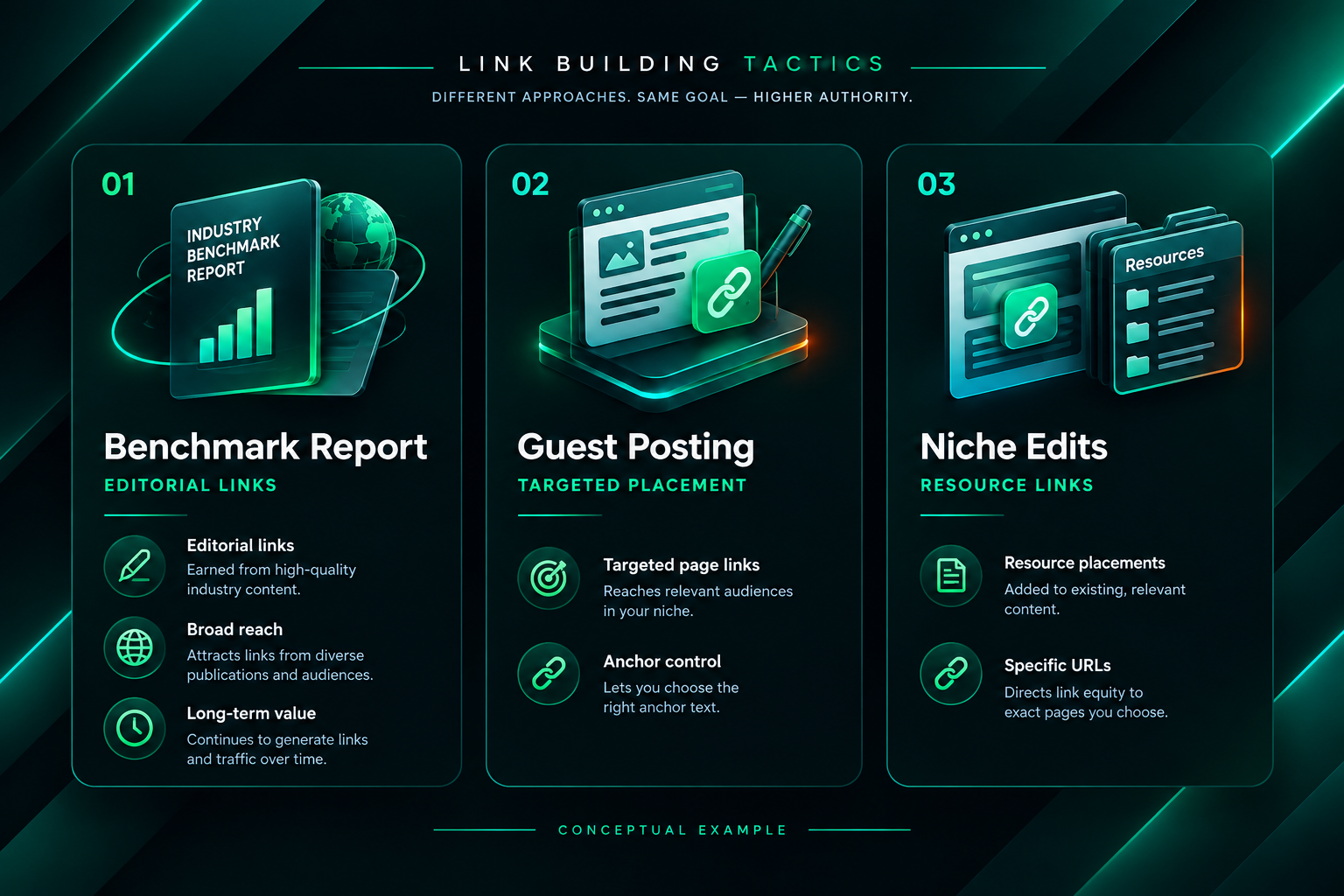
A well-structured campaign might use a benchmark report as a high-value linkable asset targeting editorial links from authoritative publications, while simultaneously running guest post outreach to build topically relevant links to key service or product pages, and pursuing niche edits or resource page placements to support specific target URLs. Each tactic serves a different purpose within the overall backlink profile, and the combination tends to produce more stable and diverse results than any single approach.
For agencies managing link building on behalf of clients, benchmark reports can also serve as a differentiating asset in white-label campaigns. A report produced in collaboration with a client — using their proprietary data — can generate links that reflect genuine industry authority rather than purely transactional placements, which may be particularly valuable for clients in competitive B2B markets where link quality and topical relevance are closely scrutinized.
Frequently Asked Questions
How many backlinks can a benchmark report realistically earn?
The number varies considerably depending on niche activity, report quality, outreach reach, and the size of the relevant publishing community. Some reports in active niches earn dozens of referring domains from a single campaign; others in narrower markets may earn ten to twenty. There is no reliable universal benchmark, and claims of guaranteed link counts should be treated with caution.
Does the report need to be updated every year?
Annual updates are not strictly required, but they extend the useful life of the asset and provide a reason to conduct additional outreach. A report with data that is several years old may be cited less frequently as newer sources become available. Updating the report annually and republishing it on the same URL preserves the accumulated backlink equity of the original page.
Can a small business without a large dataset produce a credible benchmark report?
Yes, though the approach may differ. A survey of 200 to 500 relevant professionals, conducted through a tool such as a survey platform and distributed through industry communities or social channels, can produce original data without requiring access to a large proprietary dataset. The key is transparent methodology and a clearly defined respondent profile.
How does this strategy compare to guest posting for link acquisition?
Guest posting places a link within content published on another site, typically targeting a specific page on your domain. Benchmark report outreach earns links to a content asset on your own site, which other publishers reference in their own content. Both approaches can produce high-quality editorial links, but they serve different purposes: guest posting is often more targeted to specific pages and anchor text, while benchmark reports tend to earn links more broadly and can continue attracting citations over time without ongoing content production.
What outreach response rates should I expect?
Cold outreach response rates for link building campaigns vary widely depending on the quality of the targeting, the personalization of the message, and the relevance of the report to the recipient’s content. Response rates in the range of 5% to 15% are commonly observed in well-targeted campaigns, though this figure can be higher or lower depending on the niche and the quality of the outreach list. These figures are observational and should not be treated as guarantees.
Should the report be gated or freely accessible?
For link acquisition purposes, freely accessible content generally earns more backlinks than gated content, because writers and journalists are less likely to reference a source they cannot easily verify. A common compromise is to publish key findings openly on a landing page while offering a more detailed downloadable version behind a light email gate. This approach balances lead generation goals with link acquisition potential.
How long before I see SEO results from benchmark report backlinks?
SEO impact from newly acquired backlinks typically becomes measurable over a period of weeks to several months, depending on how quickly search engines crawl and process the new links, the authority and relevance of the linking domains, and the competitive landscape for the target keywords. Expecting immediate ranking changes after a report launch is generally unrealistic; this strategy is better suited to businesses with a medium to long-term SEO horizon.
Is a Benchmark Report the Right Link Building Asset for Your Business?
Industry benchmark reports represent one of the more sustainable approaches to earning editorial backlinks, particularly for businesses operating in active publishing niches with access to original data. The links they attract tend to be genuinely editorial — placed because another publisher found the data useful — which aligns with the type of link profile that is generally considered durable and low-risk compared to purely transactional placements.
The strategy requires meaningful upfront investment in research, production, and outreach, and the results are not guaranteed. Niche characteristics, data quality, outreach execution, and the existing strength of your domain all influence how many links a report campaign generates and how much SEO impact those links produce. For businesses that cannot produce original data or operate in niches with limited publishing activity, alternative link building approaches may offer a more practical path to building a relevant backlink profile.
If you are considering benchmark report link building as part of a broader SEO and link acquisition strategy, it is worth discussing the approach with an experienced link building team who can assess whether the tactic is well matched to your niche, your existing backlink profile, and your SEO goals before committing significant resources to research and production.