UTM parameters are widely used to track marketing campaign performance in Google Analytics and similar platforms, but questions arise when they appear in backlinks pointing to your website. Do those tracking strings affect how search engines interpret the link? Can they dilute link equity, cause duplicate content issues, or interfere with crawling and indexing? This article explains how UTM parameters interact with backlinks, what the SEO implications actually are, and how to handle tracking in a way that protects both your analytics data and your link building results.
Key Takeaways
- UTM parameters in backlinks do not directly harm SEO, but they can create complications around duplicate content, crawl budget, and link equity consolidation if not managed carefully.
- Search engines, including Google, generally treat URLs with different UTM strings as separate URLs unless canonical tags or other signals instruct otherwise.
- UTM parameters serve an analytics purpose, not an SEO purpose; they help you measure referral traffic and campaign attribution, not improve rankings.
- Proper use of canonical tags and Google Search Console URL parameter settings can mitigate most technical risks associated with UTM-tagged backlinks.
- For link building campaigns focused on SEO outcomes, clean destination URLs without UTM strings are generally preferable; UTM tracking is better applied server-side or through other attribution methods.
What Are UTM Parameters and Why Do They Appear in Backlinks?
UTM parameters are short text strings appended to a URL that allow analytics platforms to identify the source, medium, campaign name, and other attributes of incoming traffic. A typical UTM-tagged URL might look like: https://example.com/page/?utm_source=newsletter&utm_medium=email&utm_campaign=spring_promo. When a visitor clicks that link, the analytics platform reads those parameters and records the session under the corresponding campaign data.
Backlinks with UTM parameters appear for several reasons. A content marketer may share a UTM-tagged link in a guest article to track how much referral traffic that placement generates. A digital PR team might append campaign identifiers to every outreach link to measure the performance of individual placements. In some cases, link building agencies or in-house teams add UTM strings to outbound links before pitching them to publishers, so that any resulting traffic can be attributed to a specific campaign or channel.
The intent behind UTM tagging is entirely legitimate from a measurement perspective. The complication arises because search engine crawlers also follow those links, and the parameters become part of the URL that the crawler sees, indexes, and potentially assigns link equity to.
How Search Engines Handle URLs with UTM Parameters
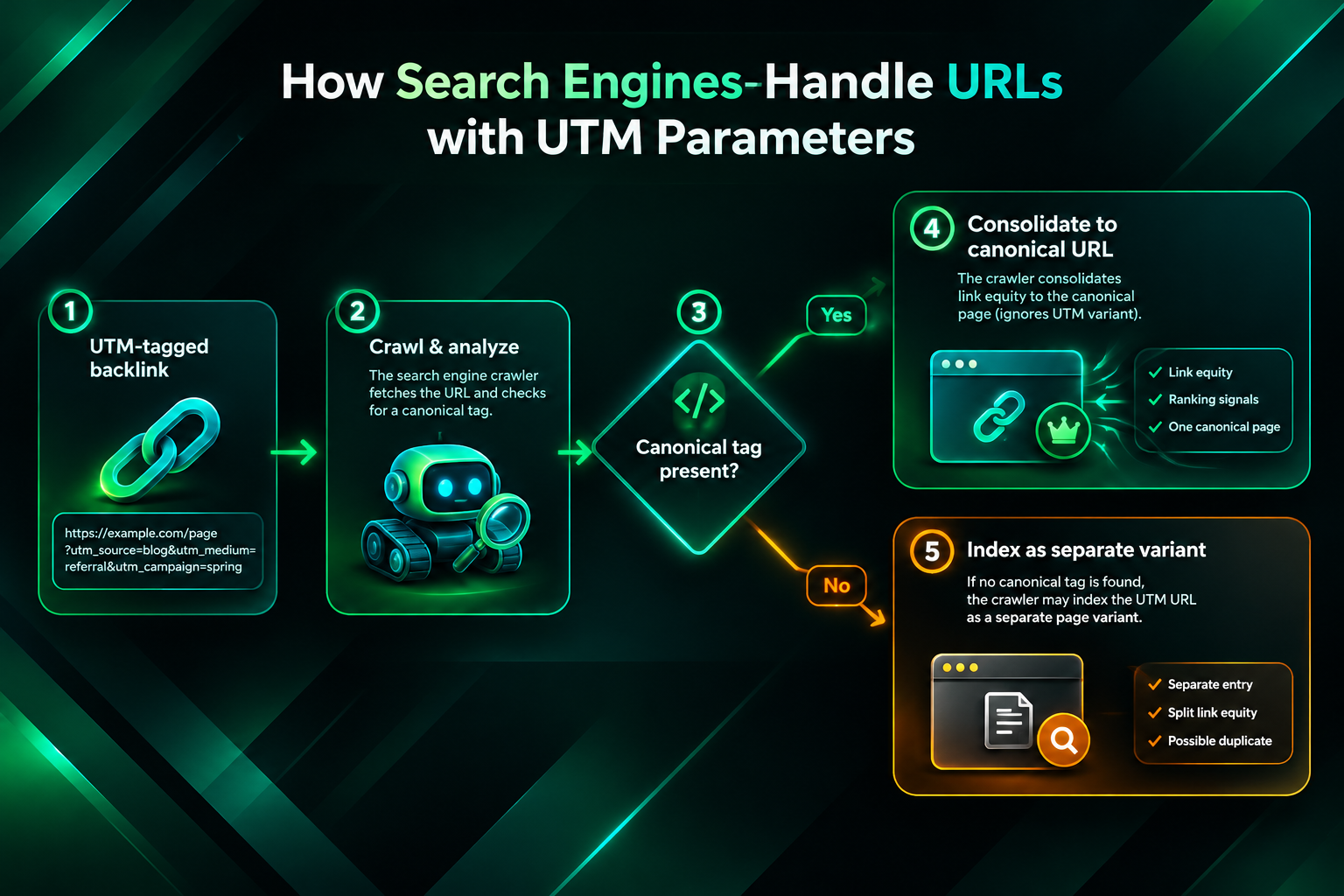
Search engines treat a URL as a unique address. When UTM parameters are present, the full URL including the parameter string is technically a different address from the clean version of the same page. Google’s crawlers will follow a UTM-tagged backlink and may attempt to crawl and index the destination URL with those parameters intact, unless signals are in place to indicate that the parameterised version is equivalent to the canonical page.
Google has stated publicly that it attempts to identify and consolidate parameter variants of the same page, and in many cases it will recognise that ?utm_source=guest_post does not change the page content and will treat the canonical URL as the preferred version. However, this consolidation is not guaranteed. It depends on how the site is configured, how many parameter variants exist, and how consistently canonical signals are implemented. Relying on Google to make the correct inference without explicit guidance introduces unnecessary uncertainty into a link building campaign.
Bing and other search engines have their own approaches to URL parameter handling, and their behaviour may differ from Google’s. If your target audience or organic traffic goals extend beyond Google, this is worth considering when deciding how to structure backlink URLs.
The SEO Risks Associated with UTM-Tagged Backlinks
The risks are not catastrophic, but they are real and worth understanding before deciding how to structure your link building campaigns.
Duplicate Content and Indexing Complications
If a search engine indexes both the clean URL and one or more UTM-tagged variants of the same page, it may treat them as separate pages with near-identical content. This is a form of duplicate content. While Google’s algorithms are generally capable of identifying and filtering these duplicates, the process is not instantaneous and is not always reliable across all page types and site configurations. Pages with thin content or weak internal linking may be more vulnerable to indexing confusion caused by parameter variants.
Link Equity Fragmentation
Link equity, sometimes called PageRank or link juice, is the value passed from one page to another through a hyperlink. When multiple backlinks point to different URL variants of the same destination page — for example, one link to the clean URL and another to the UTM-tagged version — there is a risk that the equity is not fully consolidated onto the canonical page. In practice, Google’s systems often consolidate this equity, but the consolidation depends on correct canonical implementation and consistent signals. Without those signals, some equity may be attributed to a URL variant that is not the intended ranking page.
Crawl Budget Considerations
For large websites with many pages, crawl budget — the number of URLs a search engine will crawl within a given period — is a practical concern. If a site has many UTM-tagged URL variants being discovered through backlinks and other sources, crawlers may spend time on those variants rather than on new or updated content pages. For most small to medium-sized websites this is unlikely to be a significant issue, but for e-commerce sites with large product catalogues or content-heavy platforms, unnecessary URL variants can contribute to crawl inefficiency.
Analytics Data Integrity
This is not strictly an SEO risk, but it is relevant to campaign measurement. If UTM parameters are applied inconsistently — different capitalisations, different campaign names for the same placement, or parameters added by publishers without your knowledge — your analytics data may become fragmented and difficult to interpret. Accurate attribution is essential for evaluating the real-world value of individual link placements, so inconsistent UTM usage undermines the very purpose the parameters were meant to serve.
Do UTM Parameters in Backlinks Pass Link Equity?
A backlink with UTM parameters does pass link equity, provided the link itself is a standard followed hyperlink. The presence of UTM parameters does not convert a followed link into a nofollowed one, and it does not inherently block equity from passing. The question is whether that equity is correctly attributed to the canonical version of the destination page.
When a canonical tag is correctly implemented on the destination page — pointing to the clean URL — search engines are instructed to consolidate signals, including link equity, onto the canonical version. In that scenario, a UTM-tagged backlink and a clean backlink pointing to the same page should ultimately contribute to the same canonical URL’s authority. The risk of fragmentation is reduced, though not entirely eliminated, because canonical tags are treated as strong hints rather than absolute directives by Google.
If no canonical tag is present, or if the canonical tag points to a different URL than expected, the equity consolidation becomes less predictable. This is why technical SEO hygiene on the destination site matters as much as the quality of the backlinks themselves.
How to Handle UTM Parameters in a Link Building Campaign
The practical question for anyone running or commissioning a link building campaign is how to balance campaign tracking with SEO best practices. Several approaches can help.
Use Clean URLs in Backlinks Where Possible
The simplest approach is to use clean, canonical URLs as the destination in all backlinks acquired through outreach, guest posting, niche edits, or digital PR. This eliminates the risk of equity fragmentation and indexing complications at the source. If you need to track the performance of individual placements, use alternative attribution methods rather than appending UTM strings to the linked URL itself.
Implement Canonical Tags Correctly
Every page that receives backlinks should have a self-referencing canonical tag pointing to the preferred clean URL. This instructs search engines to consolidate signals from any parameter variants onto the intended page. Canonical tags should be implemented consistently across the site, not just on pages that are actively receiving links in a current campaign.
Configure URL Parameters in Google Search Console
Google Search Console includes a URL Parameters tool that allows site owners to indicate how specific parameters should be handled during crawling. Configuring UTM parameters as parameters that do not change page content can help Google understand that these variants should not be crawled or indexed as separate pages. This is a useful supplementary measure, though it works alongside rather than as a replacement for correct canonical implementation.
Use Server-Side or GA4 Attribution Instead
If campaign attribution is the goal, consider using server-side tracking or referral source data already captured by your analytics platform. Google Analytics 4 and similar tools can identify referring domains and traffic sources from backlinks without requiring UTM parameters to be embedded in the linked URL. For placements where you control the link, you can also use a redirect through a tracking URL that strips the UTM parameters before the user reaches the destination page, preserving clean URLs in the backlink profile while still capturing campaign data.
Audit Existing Backlinks for UTM Variants
If you have an established backlink profile, it is worth auditing it for UTM-tagged links using tools such as Ahrefs, Semrush, or Majestic. Identify whether any significant referring domains are linking to UTM-tagged variants rather than clean URLs. In cases where the referring publisher is cooperative, you may be able to request an update to the linked URL. Where that is not practical, ensuring correct canonical implementation on the destination page is the next best step.
UTM Parameters vs. Other URL Parameters: Is There a Difference?
From a search engine perspective, UTM parameters are a subset of URL query parameters. They behave in the same way as other tracking or filtering parameters in terms of how crawlers encounter and process them. The distinction that matters is whether the parameter changes the content of the page or not. UTM parameters do not change page content — the same page is served regardless of which UTM values are present — which means they fall into the category of parameters that search engines should ideally ignore for indexing purposes.
Other types of URL parameters, such as those used for faceted navigation on e-commerce sites or session identifiers, may or may not change page content and require different handling strategies. UTM parameters are among the more straightforward cases because their purpose is purely analytical and they have no effect on what the user or crawler sees on the page itself.
What This Means for Outsourced Link Building Campaigns
When link building is managed by an external team or agency, the question of how destination URLs are structured in outreach and placements is worth raising explicitly. A well-run outsourced link building campaign should use clean canonical URLs as the default link destination, with campaign tracking handled through methods that do not introduce parameter variants into the backlink profile.
If you are working with a link building provider and want to track the performance of individual placements, discuss attribution methodology before the campaign begins. Ask whether the provider uses UTM-tagged URLs in outreach materials, whether those tags appear in the final published links, and how they recommend handling campaign measurement without compromising the SEO value of the placements. A provider with genuine technical SEO awareness will have a clear answer to these questions.
For agencies managing link building on behalf of clients under a white-label arrangement, the same considerations apply. Client-facing reporting should distinguish between referral traffic measured through UTM attribution and organic ranking improvements that may be influenced by the acquired backlinks over time. These are different metrics measuring different outcomes, and conflating them can lead to inaccurate campaign evaluation.
Realistic Expectations: What UTM Parameters Can and Cannot Tell You
UTM parameters in backlinks are a traffic measurement tool, not an SEO ranking tool. They can tell you how many sessions originated from a specific placement, which pages those visitors landed on, and how those visitors behaved on your site. They cannot tell you whether a backlink improved your rankings, increased your domain authority metrics, or contributed to long-term organic visibility.
Ranking improvements from backlinks, when they occur, typically take weeks to months to become measurable and depend on many factors beyond the backlinks themselves, including content quality, technical SEO condition, existing backlink profile, competition in the target market, and search intent alignment on the destination page. UTM-attributed referral traffic from a placement may be visible within days of publication, but this is a separate signal from any SEO benefit the link may eventually contribute.
It is also worth noting that high referral traffic from a backlink does not necessarily indicate high SEO value, and low referral traffic does not indicate low SEO value. A link from a highly relevant but low-traffic publication may contribute meaningfully to topical authority and ranking signals without generating significant direct referral visits. Evaluating link quality requires looking at multiple factors — topical relevance, publisher authority metrics, link attributes, placement context, and anchor text — not referral traffic alone.
Frequently Asked Questions
Will a backlink with UTM parameters hurt my rankings?
A single UTM-tagged backlink is unlikely to cause a measurable ranking problem on its own. The risk increases if many backlinks point to UTM-tagged URL variants without correct canonical implementation, potentially fragmenting link equity or creating indexing complications. Managing canonical tags correctly on your destination pages is the most effective way to mitigate this risk.
Does Google ignore UTM parameters when crawling backlinks?
Google attempts to identify parameters that do not change page content and may consolidate them with the canonical URL, but this is not guaranteed. Providing explicit signals through canonical tags and Google Search Console URL parameter configuration gives Google clearer guidance and reduces reliance on automatic inference.
Should I ask publishers to remove UTM parameters from links they have already published?
If a publisher has linked to a UTM-tagged version of your page and you have a cooperative relationship with them, requesting an update to a clean URL is reasonable. If that is not practical, ensuring your canonical tag is correctly implemented is the next best step. For most sites, a small number of UTM-tagged backlinks is unlikely to cause significant problems.
Can I use UTM parameters to track which guest posts send the most traffic?
Yes, but consider using a redirect-based tracking approach that strips the UTM parameters before the visitor reaches the destination page, so that the published backlink points to a clean URL. Alternatively, use referral source data already captured by your analytics platform to identify traffic from specific domains without embedding parameters in the linked URL.
Do UTM parameters affect anchor text or link attributes?
No. UTM parameters are part of the URL string, not the anchor text or link attributes such as rel=nofollow or rel=sponsored. The anchor text is determined by the clickable text in the hyperlink, and link attributes are set in the HTML of the linking page. UTM parameters have no effect on either.
Is there a difference between UTM parameters added by the linking site and those I add myself?
From a technical SEO perspective, the effect is the same regardless of who added the parameters. The URL that the search engine crawler follows is what matters. If a publisher adds their own UTM parameters to a link pointing to your site, the same considerations around canonical tags and parameter handling apply.
Should You Use UTM Parameters in Backlinks? A Practical Decision
The direct answer is that UTM parameters in backlinks do not help SEO and introduce a small but manageable set of technical risks. They serve a legitimate analytics purpose, but that purpose can usually be achieved through methods that do not affect the structure of the backlink URL itself. For link building campaigns where SEO outcomes are the primary goal, clean canonical URLs as link destinations are the better default choice.
If campaign attribution is important to your reporting — and for most businesses it should be — invest in a tracking methodology that separates measurement from link structure. Server-side attribution, referral domain analysis in GA4, or redirect-based tracking can all provide useful campaign data without introducing parameter variants into your backlink profile.
For websites that already have UTM-tagged backlinks in their profile, the priority should be ensuring correct canonical implementation across destination pages and reviewing Google Search Console for any indexing anomalies related to parameter variants. In most cases, this is sufficient to manage the risk without requiring outreach to publishers to update existing links.
If you are planning a link building campaign and want to ensure that both the SEO value and the measurement methodology are handled correctly from the outset, discussing these technical details with a qualified link building provider before the campaign begins is a worthwhile step. Getting the URL structure and tracking approach right at the start avoids complications that are more difficult to resolve after placements have been published.