Academic citations represent one of the most credible link types a website can earn, but they are also among the most difficult to acquire deliberately. Understanding how universities, research institutions, and scholarly publications decide to reference external sources is the starting point for any realistic strategy. This article explains what academic citation backlinks are, which content types tend to attract them, how to pursue them systematically, and where the approach has genuine limits.
Key Takeaways
- Academic and .edu backlinks carry strong perceived authority because they come from editorially controlled, non-commercial environments, but earning them requires genuinely citable content rather than outreach alone.
- The most effective content types for attracting academic citations include original research, publicly available datasets, detailed methodology guides, and well-sourced statistical resources.
- Timelines are long: academic publishing cycles, peer review, and institutional web updates mean measurable link acquisition from this strategy can take six to eighteen months or more.
- Not every website or niche is a realistic candidate; sectors with active academic research communities offer the best opportunities.
- Academic citation link building works best as a complement to a broader link acquisition strategy rather than a standalone approach.
What Are Academic Citation Backlinks?
An academic citation backlink is a hyperlink placed on a university website, research institution page, scholarly journal, or educational resource that points to an external source as a reference. These links appear in contexts such as reading lists, resource pages, research bibliographies, course materials, and published academic papers hosted online. Because academic institutions maintain strict editorial standards and rarely link to commercial content without a substantive reason, a link from a .edu domain or a recognised research body is generally treated as a strong editorial signal.
It is worth distinguishing between two types of academic-adjacent links that are sometimes conflated. The first is a genuine citation within academic or scholarly content, where a researcher or lecturer references your data, methodology, or findings because they are academically useful. The second is a resource page link, where a university department lists external websites relevant to a course or topic. Both can be valuable, but they require different approaches and carry different levels of editorial weight. A link embedded in a published research paper or a university library guide is typically harder to earn and more durable than a link on a student-facing resource list that may be updated each semester.
Why Academic Backlinks Are Considered Valuable
Third-party link evaluation tools such as Ahrefs, Semrush, and Moz assign high domain-level authority scores to most university and research institution domains. This reflects the large volume of inbound links these institutions receive from other credible sources over many years. A backlink from a high-authority .edu domain can therefore contribute positively to a website’s overall backlink profile, particularly when the linking page is topically relevant to the content being cited.
Beyond metric-based authority, academic links tend to be editorially earned rather than commercially arranged. Search engines have historically treated editorially placed links as stronger quality signals than links acquired through payment or reciprocal arrangements. Because academic institutions rarely sell link placements and their editorial processes are relatively transparent, links from these sources are generally considered low-risk from a search-engine policy perspective, provided the content being cited is genuinely relevant and useful.
Referral traffic from academic sources can also be meaningful in certain niches. Students, researchers, and academics who follow a citation link are often highly engaged readers, which may benefit brand awareness and content credibility even when the direct traffic volume is modest.
Content Types That Attract Academic Citations
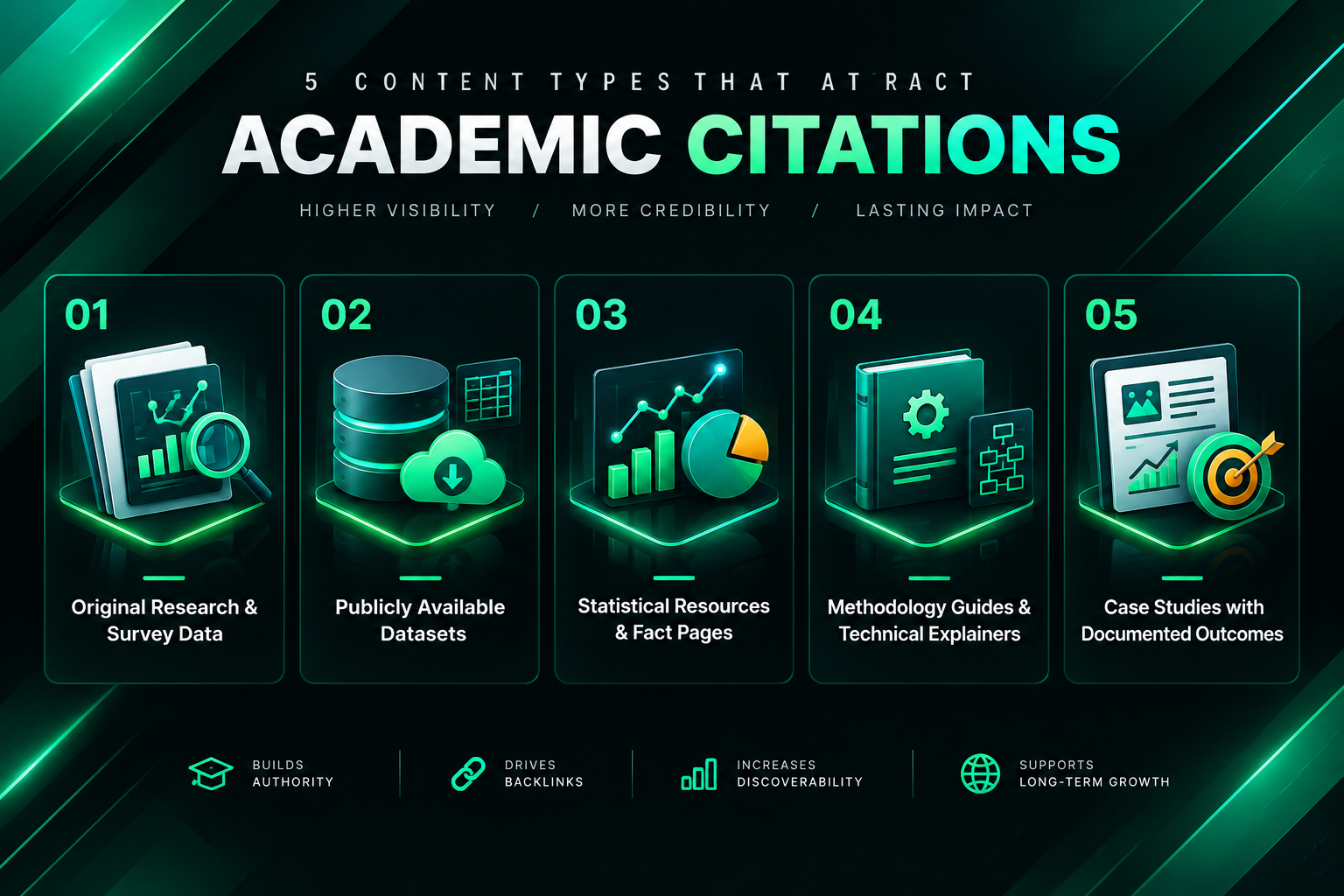
The single most important factor in earning academic backlinks is producing content that researchers, lecturers, and students would genuinely want to reference. This is not a matter of outreach tactics alone; it begins with content strategy. The following content types have the strongest track record of attracting citations from academic and educational sources.
Original Research and Survey Data
Academics cite primary sources wherever possible. If your organisation conducts and publishes original research — industry surveys, longitudinal studies, controlled experiments, or large-scale data analysis — you create a citable asset that researchers in your field may reference when writing papers, preparing lectures, or compiling literature reviews. The research does not need to meet the methodological standards of a peer-reviewed journal to be useful to academics, but it does need transparent methodology, clearly stated sample sizes, honest limitations, and reproducible findings. Vague or commercially motivated statistics are unlikely to be cited by credible institutions.
Publicly Available Datasets
Datasets that researchers can download, analyse, and build upon are among the most reliably cited external resources in academic contexts. If your business collects proprietary data — transaction records, usage patterns, environmental measurements, or industry benchmarks — making a cleaned and documented version publicly available can generate citations over an extended period as researchers discover and use the data in their own work.
Comprehensive Statistical Resources and Fact Pages
Many academic writers search for up-to-date statistics to support arguments in papers and reports. A well-maintained statistics page that aggregates and attributes data from multiple credible sources, clearly dates each figure, and links to original studies can become a reference point for academics who need a convenient, reliable summary. The key requirement is rigorous attribution: citing the original source for every statistic, not presenting aggregated data as your own findings.
Methodology Guides and Technical Explainers
Detailed, accurate explanations of technical processes, analytical methods, or professional practices can attract citations from course materials and reading lists, particularly in applied fields such as engineering, public health, environmental science, economics, and information technology. These guides need to be written to a standard that academics would consider credible, which typically means precise language, referenced claims, and acknowledgement of limitations or alternative approaches.
Case Studies with Documented Outcomes
Real-world case studies that document a process, intervention, or outcome with sufficient detail can be cited in academic work as examples of applied practice. The case study needs to be honest about methodology, context, and results, including what did not work, to be considered academically useful rather than promotional.
How to Pursue Academic Citation Backlinks Systematically
Earning academic backlinks involves two parallel workstreams: creating genuinely citable content and identifying the right people and pages to make aware of it. Neither workstream alone is sufficient.
Identify Relevant Academic Communities
Begin by mapping the academic disciplines and research communities that overlap with your industry or content area. Use Google Scholar, university department pages, and academic journal archives to identify researchers who publish in your topic area, courses that cover related subjects, and university library guides that list external resources. This research helps you understand what academics in your field actually cite and what gaps your content might fill.
Audit Existing Resource Pages and Reading Lists
Many university departments maintain publicly accessible resource pages, reading lists, and link directories for students and researchers. These pages are updated periodically and represent a realistic outreach target if your content is genuinely relevant. Use search operators such as site:.edu [topic] resources or site:.ac.uk [topic] reading list to locate relevant pages. Evaluate each page for topical alignment, the quality of existing linked resources, and whether your content would add meaningful value rather than duplicating what is already listed.
Conduct Targeted, Personalised Outreach
Cold outreach to academics requires a different tone and approach than standard link building outreach. Researchers and lecturers are not link building targets in the commercial sense; they are professionals who will only reference your content if it genuinely serves their academic or teaching needs. Outreach messages should be brief, specific about why the content is relevant to their work or course, and free from any suggestion of commercial exchange. Offering to share data, collaborate on research, or provide access to additional findings can make outreach more credible than a simple link request.
Leverage Broken Link Building on Academic Pages
Academic resource pages sometimes contain broken links to external sources that have moved or been removed. Identifying these broken links and suggesting your content as a replacement is a legitimate and often well-received outreach approach, provided your content is a genuine substitute for the original resource rather than a loosely related alternative. Tools such as Ahrefs or Screaming Frog can help identify broken outbound links on target pages.
Distribute Research Through Academic Channels
Publishing findings through channels that academics already use increases the likelihood of organic citation. Submitting research summaries to academic preprint servers, contributing to open-access repositories, presenting at industry-academic conferences, and engaging with academic communities on platforms such as ResearchGate or Academia.edu can all increase the visibility of your citable content among the people most likely to reference it.
Realistic Timelines and What to Expect
Academic citation link building operates on a fundamentally different timeline than most commercial link acquisition strategies. Academic publishing cycles are long: a researcher who discovers your data today may not publish the paper citing it for twelve to twenty-four months. University resource pages are updated infrequently, often at the start of an academic year or when a course is revised. Even successful outreach to a department librarian may take several months to result in a live link.
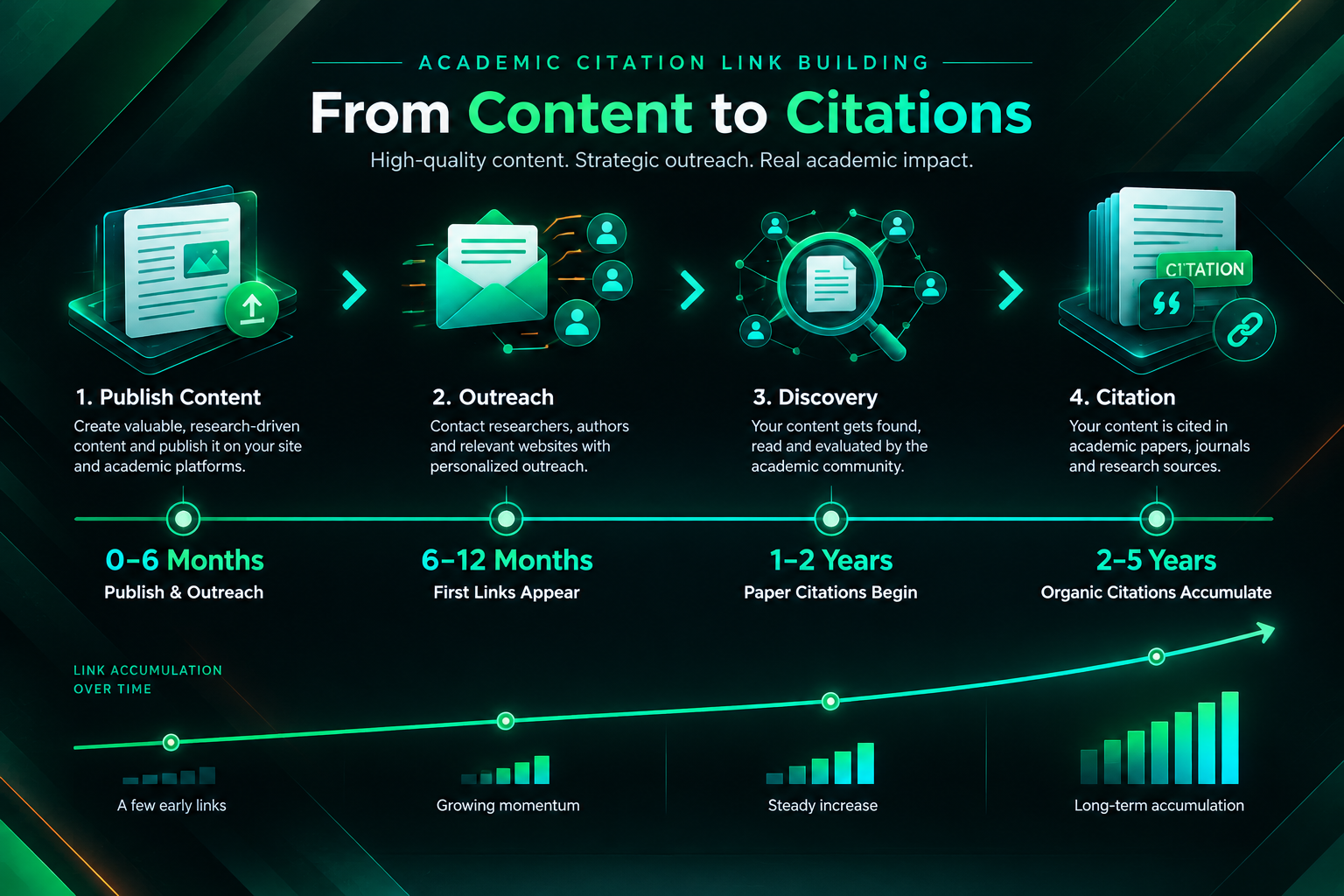
For most websites, a realistic expectation is that a well-executed academic citation strategy may begin generating measurable link acquisition within six to twelve months of publishing citable content, with the majority of organic citations accumulating over a two-to-five-year period as content is discovered and referenced. This makes the strategy poorly suited to short-term link building campaigns but potentially valuable as a long-term asset-building approach.
The volume of links generated is also typically lower than from guest posting or digital PR campaigns. A single piece of original research might earn five to twenty academic citations over several years, whereas a well-executed digital PR campaign can generate dozens of placements within weeks. The trade-off is link quality and durability: academic citations, once placed, tend to remain live for extended periods because academic content is rarely deleted or substantially revised.
Limitations and Honest Risks
Several limitations are worth understanding before committing resources to this strategy.
- Niche dependency: Academic citation opportunities are concentrated in industries with active research communities. Technology, healthcare, environmental science, economics, education, and social sciences offer genuine opportunities. Highly commercial niches such as e-commerce retail, local services, or entertainment have limited overlap with academic publishing and may find this strategy impractical.
- Content investment: Producing genuinely citable research requires significant investment in data collection, analysis, writing, and quality review. Content created primarily for link acquisition rather than genuine academic utility is unlikely to earn citations from credible institutions.
- No guaranteed outcomes: Even high-quality research may not attract academic citations if it does not reach the right audience, if the topic is already well-covered in existing literature, or if the methodology is considered insufficiently rigorous. There is no reliable way to guarantee a specific number of academic backlinks from a content investment.
- Metric variability: Not all .edu domains carry the same authority. A link from a well-established research university is meaningfully different from a link on a student club page or a low-traffic departmental subdomain. Domain-level authority metrics from tools like Ahrefs or Moz reflect aggregate link profiles and should not be used as the sole measure of a link’s value.
- Outreach friction: Academics receive large volumes of unsolicited email. Response rates to cold outreach are typically low, and poorly targeted or commercially framed messages may damage credibility rather than generate links.
- Policy considerations: Links that are paid for or arranged through commercial exchange, even on academic sites, would be subject to the same search-engine policies as paid links elsewhere. Genuine academic citations are editorially earned; any arrangement that involves payment or reciprocal benefit should be disclosed appropriately.
Which Websites May Benefit Most
Academic citation link building is most likely to be a productive investment for websites that meet several conditions. The business or organisation should operate in a sector with an active academic research community. The website should already have strong foundational content and technical SEO in place, since link building of any kind is unlikely to compensate for indexing problems, weak content, or significant on-page issues. The team should have the capacity to produce genuinely research-grade content, either in-house or through collaboration with subject-matter experts.
Organisations that may find this strategy particularly relevant include SaaS companies with proprietary usage data, healthcare and life sciences businesses, environmental and sustainability organisations, financial services firms with access to market data, and educational technology providers. In each case, the value of the strategy depends on whether the organisation can produce content that academics would independently choose to cite.
Websites in early-stage link building campaigns, highly commercial niches, or sectors with limited academic research activity are generally better served by other link acquisition methods as a primary strategy, with academic citation building considered as a supplementary long-term investment if resources allow.
How Academic Citation Building Fits Within a Broader Link Strategy
Academic citation link building is rarely sufficient as a standalone approach. Most websites benefit from a diversified backlink profile that includes links from industry publications, relevant blogs, digital PR placements, and editorially earned mentions across a range of domain types. Academic links contribute a specific quality signal — editorial credibility from non-commercial sources — that complements rather than replaces other link types.
A practical approach is to treat academic citation building as a content-led, long-term programme running alongside more immediate link acquisition activity. Original research assets created for academic citation purposes can often be repurposed for digital PR campaigns, guest post references, and social media distribution, improving the return on the content investment across multiple channels simultaneously.
For agencies managing link building campaigns on behalf of clients, academic citation building may be worth discussing as part of a longer-term content and authority strategy, particularly for clients in research-adjacent industries. The strategy requires honest expectation-setting about timelines and volume, and it works best when the client organisation has genuine data or expertise to contribute rather than relying solely on outreach.
Frequently Asked Questions
Do .edu backlinks automatically improve search rankings?
No. A link from a .edu domain does not automatically improve rankings. The value of any backlink depends on the topical relevance of the linking page, the editorial context of the link, the authority of the specific page rather than just the domain, and how the link fits within the broader backlink profile. A link from a highly relevant, well-trafficked university resource page is likely more valuable than a link from an obscure student subdomain with no inbound links of its own.
Can I pay for academic citations or .edu links?
Paying for links on academic websites, like paying for links anywhere, would be subject to search-engine link spam policies. Genuine academic citations are editorially earned based on the merit of the content being cited. Any arrangement involving payment, reciprocal links, or other commercial exchange would not constitute an editorial citation and should be disclosed appropriately. The value of academic links comes precisely from their non-commercial nature.
How long does it take to earn academic backlinks?
Timelines vary considerably depending on the content type, the academic community, and outreach effectiveness. Resource page links from university departments may be achievable within a few months of targeted outreach. Citations within published academic papers typically take twelve to twenty-four months or longer, reflecting academic publishing cycles. Organic citations from researchers who discover content independently may accumulate over several years.
What content is most likely to earn academic citations?
Original research with transparent methodology, publicly available datasets, well-sourced statistical resources, and detailed technical guides in fields with active academic communities are the content types most commonly cited by academic sources. Content that is promotional, lacks clear methodology, or does not add to existing knowledge is unlikely to be cited by credible institutions.
Is academic citation building suitable for small businesses?
It depends on the industry and available resources. Small businesses in research-adjacent sectors with access to proprietary data or genuine subject-matter expertise can pursue this strategy effectively. However, the content investment required is significant, and the timeline to measurable results is long. Small businesses with limited SEO budgets may find that other link acquisition methods deliver more immediate returns and should consider academic citation building only if they can sustain the investment alongside other activity.
How do I find academic resource pages relevant to my industry?
Search operators are the most practical starting point. Queries such as site:.edu [your topic] resources, site:.edu [your topic] links, or site:.ac.uk [your topic] reading list can surface relevant pages. Academic journal archives, Google Scholar author profiles, and university department pages are also useful for identifying researchers and courses that overlap with your content area.
Is Academic Citation Link Building Worth Pursuing for Your Website?
Academic citation backlinks offer a combination of editorial credibility, link durability, and authority signal that is difficult to replicate through other link acquisition methods. For websites in research-adjacent industries with the capacity to produce genuinely citable content, the strategy can be a valuable long-term component of a broader link building programme.
The honest limitations are equally important to understand. The strategy requires substantial content investment, operates on long timelines, produces relatively low link volumes, and is poorly suited to highly commercial niches or websites without genuine data or expertise to contribute. It is not a shortcut to rapid link acquisition and should not be positioned as one.
The most productive approach is to assess whether your organisation has the content assets, industry positioning, and patience to pursue academic citations alongside other link building activity, rather than treating it as a primary or standalone strategy. If you are considering how academic citation building might fit within a broader link acquisition campaign, discussing your specific content assets, industry, and goals with an experienced link building team can help clarify whether the investment is likely to be worthwhile for your website.