Scholarship link building was once considered a clever, low-risk way to earn .edu backlinks from universities and colleges. The premise was straightforward: a business offers a small scholarship, creates a dedicated page, and then reaches out to educational institutions asking them to link to it. For several years, many SEO practitioners treated this as a legitimate tactic. Google’s evolving guidance on link schemes, however, has made the risk profile of scholarship backlinks considerably less clear-cut than it once appeared, and the strategy deserves careful scrutiny before any business or agency commits resources to it.
Key Takeaways
- Google’s spam policies explicitly list links that are part of scholarship, grant, or contest programs as a potential link scheme when the primary purpose is manipulating PageRank rather than genuinely supporting students.
- The perceived authority of .edu domains does not automatically make scholarship links safe or valuable; link quality depends on relevance, editorial context, and the intent behind the placement.
- Scholarship link campaigns that lack genuine charitable intent and topical relevance carry a measurable policy risk, including the possibility of a manual action or algorithmic devaluation.
- Several alternative link acquisition strategies — including digital PR, manual guest post outreach, and resource page link building — can target high-authority placements without the same policy exposure.
- Any business considering scholarship link building should assess whether the program reflects a genuine commitment to education or is primarily a link acquisition mechanism, because that distinction matters both to Google and to the institutions being approached.
What Are Scholarship Backlinks?
A scholarship backlink is a link pointing to a business’s website from an educational institution’s page — typically a university, college, or school — that lists external scholarship opportunities for students. The business creates a scholarship program, usually offering a modest financial award, and then contacts .edu domains asking them to add the scholarship to their financial aid or opportunities pages. The link from the institution’s site back to the business’s scholarship page is the intended SEO outcome.
The appeal of this tactic historically rested on two assumptions. First, .edu domains were believed to carry inherently high authority because they are restricted to accredited educational institutions. Second, links from these domains were assumed to pass significant ranking signals to the linked page. Both assumptions contain partial truths but also meaningful caveats. Third-party metrics such as Domain Rating (Ahrefs), Domain Authority (Moz), and Authority Score (Semrush) do tend to be high for established universities, but these are proprietary tool metrics, not Google ranking signals. Google has stated clearly that it evaluates individual links rather than automatically rewarding all links from a particular domain type.
What Google’s Spam Policies Actually Say
Google’s link spam policies, documented in its Search Central guidance, describe a link scheme as any practice whose primary purpose is to manipulate PageRank or a site’s ranking in Google Search results. The policies include a specific example that is directly relevant here: links that are part of scholarship, grant, or contest programs with the requirement that participants link to your site are listed as a form of link scheme.
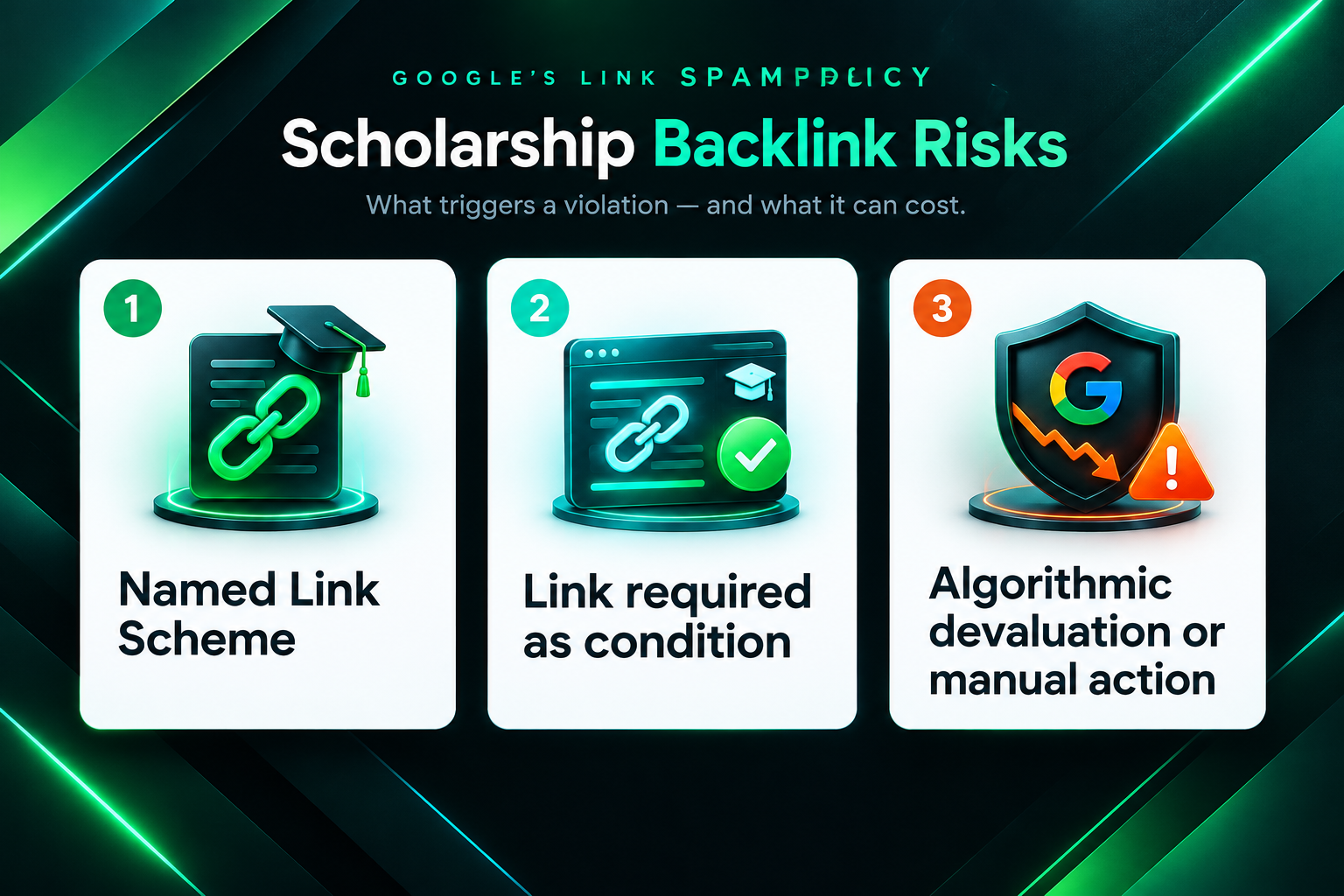
This is not an ambiguous or implied warning. Google has explicitly named scholarship-based link acquisition as a practice that may violate its spam policies. The key phrase in the policy is “with the requirement that participants link to your site” — meaning that when a link back to the sponsoring business is a condition of the scholarship listing, the arrangement resembles a paid or incentivised link rather than an editorially given one. Educational institutions that list scholarships are not independently choosing to endorse the business; they are responding to an outreach request that is fundamentally transactional in nature.
Google’s John Mueller has addressed scholarship link building in public Q&A sessions, indicating that these links are something Google tries to discount or ignore rather than reward. While a single public statement does not constitute formal policy, it aligns with the written guidance and suggests that Google’s systems are aware of this tactic and may already be treating many scholarship links as low-value or manipulative.
Why the .edu Halo Effect Is Misleading
A significant part of the scholarship link building pitch relies on the assumption that .edu backlinks are inherently more powerful than links from other domains. This assumption is worth examining carefully. Google has not confirmed that .edu or .gov top-level domains receive automatic ranking boosts. What tends to make links from universities valuable in practice is the combination of genuine topical relevance, editorial discretion, and the overall authority of the linking page — not the domain extension itself.
A scholarship listing page on a university’s financial aid section is typically a long list of external opportunities with minimal editorial context. The page may link to dozens or hundreds of external sites, many of which have no topical relationship to the university’s academic focus. From a link quality perspective, a contextually relevant link from a well-regarded industry publication or a topically authoritative blog may provide more meaningful SEO value than a listing on a generic scholarship aggregation page, even if the latter carries a .edu domain.
Additionally, as scholarship link building became widely practised, many universities began adding rel=”nofollow” or rel=”sponsored” attributes to external scholarship links, or stopped accepting scholarship submissions altogether. The tactic’s effectiveness has therefore diminished even for practitioners who consider the policy risk acceptable.
Assessing the Real Risk Level
Understanding the risk of scholarship backlinks requires distinguishing between two possible outcomes: a manual action (a human reviewer at Google applies a penalty to the site) and algorithmic devaluation (Google’s systems simply ignore or discount the links without issuing a formal penalty). Both outcomes reduce the SEO value of the links, but a manual action carries additional consequences, including a notification in Google Search Console and a potential drop in rankings that requires a reconsideration request to resolve.
The risk of a manual action from scholarship links alone is generally considered lower than the risk from more overtly manipulative schemes such as private blog networks (PBNs) or large-scale paid link placements. However, several factors can increase the risk profile of a scholarship campaign:
- Scale: Building dozens or hundreds of scholarship links in a short period creates an unnatural pattern that is more likely to attract algorithmic or manual review.
- Topical irrelevance: A software company acquiring scholarship links from nursing schools or art colleges creates a backlink profile that lacks the topical coherence that characterises natural link acquisition.
- Thin scholarship pages: A scholarship page created solely to attract links, with minimal information about the award criteria, application process, or genuine commitment to disbursing funds, is more likely to be treated as manipulative.
- Existing backlink profile issues: A site that already has a history of manipulative link building is at greater risk if scholarship links are added to an already questionable profile.
- Combination with other risky tactics: Scholarship links used alongside PBNs, link exchanges, or other policy-violating practices compound the overall risk.
For businesses that have received a manual action in the past or that operate in sensitive niches such as finance, health, or legal services — where Google applies heightened scrutiny — the risk calculus is less favourable than for a business with a clean backlink history in a lower-stakes industry.
When Scholarship Programs May Have Legitimate SEO Value
Not every scholarship program is automatically a link scheme. A genuine scholarship — one where the business has a real commitment to education, disburses actual funds to recipients, and promotes the program through authentic channels — can attract links that are editorially given rather than transactionally acquired. The distinction matters both in terms of Google’s policy and in terms of the quality of links that result.
A technology company that funds a scholarship for computer science students and is covered by university news departments, student publications, and industry press is engaging in a form of digital PR that happens to produce backlinks as a secondary outcome. The links in this scenario arise from genuine editorial decisions rather than from a templated outreach campaign asking institutions to add a listing in exchange for a link. This type of program is meaningfully different from a scholarship created primarily as a link acquisition vehicle.
The practical test is whether the scholarship would exist and be promoted even if it produced no backlinks. If the answer is no — if the program’s entire rationale is link acquisition — then it is difficult to argue that the resulting links are editorially given in the sense that Google’s policies intend.
Alternatives to Scholarship Link Building
For businesses and agencies seeking high-authority backlinks without the policy exposure associated with scholarship campaigns, several alternative strategies offer more sustainable and defensible link acquisition.
Digital PR and Newsjacking
Digital PR involves creating genuinely newsworthy content — original research, data studies, surveys, or compelling stories — and distributing it to journalists and editors who may choose to cover it. When a journalist links to the source of a study or quotes a business as an expert, the resulting link is editorially given and reflects a genuine editorial decision. Digital PR can produce links from high-authority news publications, industry media, and academic sources without requiring any transactional arrangement. The challenge is that effective digital PR requires investment in content creation and media relations, and results are not guaranteed.
Manual Guest Post Outreach
Manual outreach to relevant, editorially selective publications for guest posting opportunities remains one of the most widely used white-hat link acquisition methods. When executed with genuine topical relevance — matching the business’s expertise to the publication’s audience — guest posts can produce contextually placed links on authoritative sites. The quality of the placement depends heavily on the publisher’s editorial standards, the relevance of the content, and the link’s position within the article. Guest posting at scale on low-quality sites, or using templated outreach that ignores editorial fit, carries its own policy risks and should be distinguished from carefully managed manual outreach campaigns.
Resource Page Link Building
Resource page link building involves identifying pages on authoritative websites that curate useful links for a specific audience — such as a university’s list of recommended industry tools or a professional association’s resource directory — and requesting inclusion when the business’s content genuinely adds value. Unlike scholarship outreach, resource page link building targets pages where the editorial decision to include a link is based on the usefulness of the linked content rather than on a transactional arrangement. This approach requires identifying genuinely relevant resource pages and creating content that merits inclusion.
Niche Edits and Contextual Link Placements
Niche edits — also called link insertions — involve placing a link within existing published content on a relevant website. When acquired through genuine editorial relationships or outreach to site owners who agree that the link adds value to their existing content, niche edits can produce contextually relevant placements. The risk profile of niche edits varies significantly depending on whether the placement is genuinely editorial or whether it is a paid arrangement that violates Google’s link spam policies. Businesses and agencies should assess the acquisition method carefully rather than treating all niche edits as equivalent.
Unlinked Brand Mention Reclamation
When a business is mentioned in published content without a hyperlink, reaching out to the author or editor to request that the mention be converted to a link is a low-risk, editorially defensible approach. The link is justified by the existing mention, and the editorial decision to include the mention was made independently. This strategy works best for businesses with meaningful brand recognition and a track record of being referenced in industry or media content.
What to Consider Before Choosing a Link Acquisition Strategy
The right link acquisition approach for any business depends on factors that cannot be assessed without understanding the specific website, its existing backlink profile, its industry, and its SEO goals. A site with a history of manipulative link building faces different considerations than a site building its backlink profile from scratch. A business in a highly competitive niche may need a different mix of tactics than one targeting a less contested market.
Before committing to any link building strategy — including scholarship campaigns, guest posting, digital PR, or niche edits — it is worth considering the following:
- Does the strategy produce links that are editorially given, or does it rely on transactional arrangements that may violate search-engine policies?
- Is the topical relevance between the linking page and the target page strong enough to make the link credible to both search engines and human readers?
- Does the strategy scale in a way that creates an unnatural link acquisition pattern, or does it produce links at a pace consistent with organic growth?
- What is the likely longevity of the links? Scholarship listing pages are sometimes removed when institutions update their financial aid pages or stop accepting external submissions.
- Does the strategy align with the business’s broader content and brand goals, or is it purely a link acquisition mechanism with no other business value?
Frequently Asked Questions
Are all scholarship backlinks considered a link scheme by Google?
Not necessarily all, but Google’s spam policies specifically identify scholarship programs that require participants to link to the sponsoring site as a potential link scheme. The determining factor is whether the link is genuinely editorial or whether it is a condition of the scholarship listing. Programs with genuine charitable intent and authentic promotion may produce links that are treated differently, but the line is not always clear, and the risk exists regardless of intent.
Do .edu backlinks still carry special SEO value?
Google has not confirmed that .edu domains receive automatic ranking advantages. Third-party metrics such as Domain Rating and Domain Authority tend to be high for established universities, but these are tool-specific metrics rather than Google signals. The SEO value of any link depends on the relevance, editorial context, and authority of the specific linking page, not the domain extension alone.
Can a scholarship link campaign result in a Google manual action?
It is possible, particularly if the campaign is conducted at scale, lacks topical relevance, or is combined with other policy-violating tactics. The more common outcome for scholarship links may be algorithmic devaluation — where Google simply ignores the links — rather than a formal manual action, but neither outcome produces the intended SEO benefit.
What makes a scholarship program genuinely legitimate from an SEO perspective?
A scholarship program is more likely to produce defensible links when it reflects a genuine commitment to education, disburses real funds to recipients, attracts coverage from university news departments and industry media through authentic PR, and would exist even if it produced no backlinks. The links that result from genuine media coverage of a real scholarship are editorially given rather than transactionally acquired.
Are there safer alternatives that can still produce high-authority backlinks?
Yes. Digital PR, manual guest post outreach to editorially selective publications, resource page link building, and unlinked brand mention reclamation are all strategies that can produce high-authority backlinks without the policy exposure associated with scholarship campaigns. Each approach has its own requirements, timelines, and limitations, and the right mix depends on the specific website and its goals.
Should I disavow existing scholarship backlinks?
Disavowing links is a significant action that should not be taken without a thorough backlink audit and a clear understanding of which links may be contributing to a manual action or algorithmic issue. If scholarship links form a small part of an otherwise healthy backlink profile and the site has not received a manual action, disavowing them may not be necessary or beneficial. A qualified SEO professional should assess the backlink profile before any disavow action is taken.
Deciding Whether Scholarship Link Building Is Worth the Risk
The honest answer to whether scholarship backlinks constitute a link scheme is: they often do, at least as Google’s policies define the term. When a business creates a scholarship primarily to acquire .edu backlinks and conducts outreach asking institutions to list the scholarship in exchange for a link, the arrangement is transactional rather than editorial. Google’s spam policies name this practice explicitly, and Google’s public statements suggest that its systems are designed to discount or ignore links acquired this way.
This does not mean that every business that has ever run a scholarship program is at immediate risk of a penalty. The risk level depends on the scale of the campaign, the topical relevance of the links, the existing backlink profile, and whether the scholarship reflects genuine charitable intent. However, the combination of policy exposure, diminishing returns as institutions add nofollow attributes or stop accepting submissions, and the availability of alternative strategies that carry less policy risk makes scholarship link building a difficult tactic to recommend as a primary link acquisition method.
For businesses and agencies evaluating their link acquisition options, the more productive question is not how to make scholarship link building safer, but whether the resources required for a scholarship campaign would produce better, more durable SEO outcomes if directed toward digital PR, manual outreach, or resource page link building. These alternatives can target high-authority placements with editorial credibility and without the specific policy risk that Google has associated with scholarship-based link schemes.
If you are reassessing your link acquisition strategy and want to understand which approaches may be appropriate for your website’s specific situation, a qualified link building provider can help evaluate your existing backlink profile and identify tactics that align with both your SEO goals and current search-engine guidelines.