If you have ever compared your backlink profile across Ahrefs, Semrush, Moz, and Majestic at the same time, you have almost certainly seen four different numbers. This is not a sign that any of the tools is broken. It reflects fundamental differences in how each platform discovers, stores, and filters backlink data — and understanding those differences can meaningfully improve how you interpret link metrics, assess competitor profiles, and make decisions about link building campaigns.
Key Takeaways
- No backlink tool has a complete picture of the web. Each platform crawls a different portion of the internet, at different frequencies, using different crawler infrastructure.
- Discrepancies between tools are normal and expected. The same domain can show hundreds of referring domains in one tool and thousands in another, without either figure being wrong in absolute terms.
- Proprietary metrics such as Domain Rating (Ahrefs), Authority Score (Semrush), Domain Authority (Moz), and Trust Flow (Majestic) are not interchangeable and are not provided or endorsed by Google.
- Google Search Console is the only source that reflects links Google has actually discovered and chosen to report for your own site — though it does not show competitor data.
- For practical SEO and link building decisions, using two or three tools together and focusing on trends rather than absolute counts tends to produce more reliable insights than relying on a single number.
How Backlink Tools Discover Links
Every major backlink tool operates its own web crawler — a bot that systematically visits web pages, reads their HTML, and records the hyperlinks it finds. The scale, speed, prioritisation logic, and refresh rate of each crawler determine which links end up in that tool’s index. Ahrefs, Semrush, Moz, and Majestic each maintain separate crawler infrastructure, which means they are effectively taking different photographs of the web at different moments. The web itself is enormous and constantly changing, so no single crawler can visit every page on every domain at a frequency that keeps the index perfectly current.
Crawl prioritisation is one of the most significant sources of divergence. Tools tend to crawl high-authority, frequently updated domains more often than low-traffic or rarely updated sites. A link placed on a niche blog with infrequent crawl visits may appear in one tool’s index weeks or months before it appears in another’s — or it may never appear in some tools at all if the page falls below their crawl threshold. This means that freshly acquired backlinks are particularly likely to show inconsistent counts across platforms in the short term.
Index Size and Crawl Frequency
The size of a tool’s link index is a major factor in how many backlinks it reports. Ahrefs has historically marketed itself on the size and freshness of its index, while Majestic emphasises its long-running historical index alongside a fresher index. Semrush and Moz maintain their own indexes of varying depth. Because each index is built from a different crawl corpus, the raw number of backlinks and referring domains a tool reports for any given site will differ — sometimes substantially.
Crawl frequency also affects which links are still visible. A link that existed six months ago may have been removed from the live page, but if a tool has not re-crawled that page recently, the link may still appear in its index as active. Conversely, a newly published link may not yet have been discovered. This creates a situation where two tools can show different counts for the same site even when both are technically accurate relative to their own crawl data.
Index freshness matters most when you are monitoring a recently launched link building campaign. If you acquire a batch of placements and check your backlink count the following day, the numbers across tools will almost certainly not reflect the new links yet. Depending on the tool and the authority of the linking domain, indexation can take anywhere from a few days to several weeks.
Filtering Rules and Spam Detection
Beyond raw crawl data, each tool applies its own filtering logic before displaying backlink counts. Some platforms automatically exclude links they classify as spam, low-quality, or from link networks. Others include all discovered links by default and allow users to apply filters manually. This difference in default display settings is a significant and often overlooked reason why the numbers you see vary so much between platforms.
Semrush, for example, applies a toxicity scoring system and may suppress or flag links it considers potentially harmful. Ahrefs applies its own quality filters and has historically excluded certain link types from its default view. Moz uses its Spam Score metric to identify suspicious link patterns. Majestic uses Trust Flow and Citation Flow to signal link quality, but does not necessarily exclude low-quality links from its raw counts. Because these filtering methodologies differ, a site with a large volume of low-quality or spammy inbound links may show dramatically different counts depending on whether the tool you are using filters those links out by default.
This filtering behaviour has a practical implication for link building assessment. If you are evaluating a competitor’s backlink profile and one tool shows significantly fewer links than another, it is worth checking whether the lower-count tool is applying aggressive spam filtering rather than simply having a smaller index. Neither interpretation is automatically correct without further investigation.
How Each Tool Handles Redirects, Canonicals, and Link Attributes
The technical handling of redirects, canonical tags, and link attributes such as nofollow, sponsored, and ugc also contributes to count differences. Some tools count links through 301 redirects as separate backlinks; others consolidate them. Some tools include nofollow links in their default counts; others exclude them or display them separately. The introduction of the sponsored and ugc link attributes by Google in 2019 added further complexity, and tools have adopted different approaches to how they classify and display these link types.
Canonical tags present a related challenge. If a page has a canonical pointing to a different URL, some tools attribute the backlinks to the canonical destination while others record them against the URL where the link physically appears. This can create apparent discrepancies in per-page link counts even when both tools have crawled the same pages.
For link building practitioners, this means that comparing raw backlink counts between tools without understanding their attribute-handling rules can lead to misleading conclusions. A site that appears to have a strong backlink profile in one tool may have a large proportion of nofollow or sponsored links that another tool is excluding from its headline figure.
Proprietary Metrics Are Not Interchangeable
Domain Rating (DR) from Ahrefs, Authority Score from Semrush, Domain Authority (DA) from Moz, and Trust Flow from Majestic are all proprietary metrics. Each is calculated using a different algorithm, a different link index, and different weighting factors. They are not provided by Google, they are not endorsed by Google, and they do not directly measure how Google evaluates a domain or a specific backlink.
A domain with a DR of 60 in Ahrefs may have a DA of 35 in Moz and an Authority Score of 45 in Semrush. None of these figures is wrong — they are simply measuring different things using different methodologies. Treating them as equivalent or assuming that a high score in one tool guarantees strong performance in another is a common source of confusion, particularly when briefing link building campaigns or evaluating publisher quality.
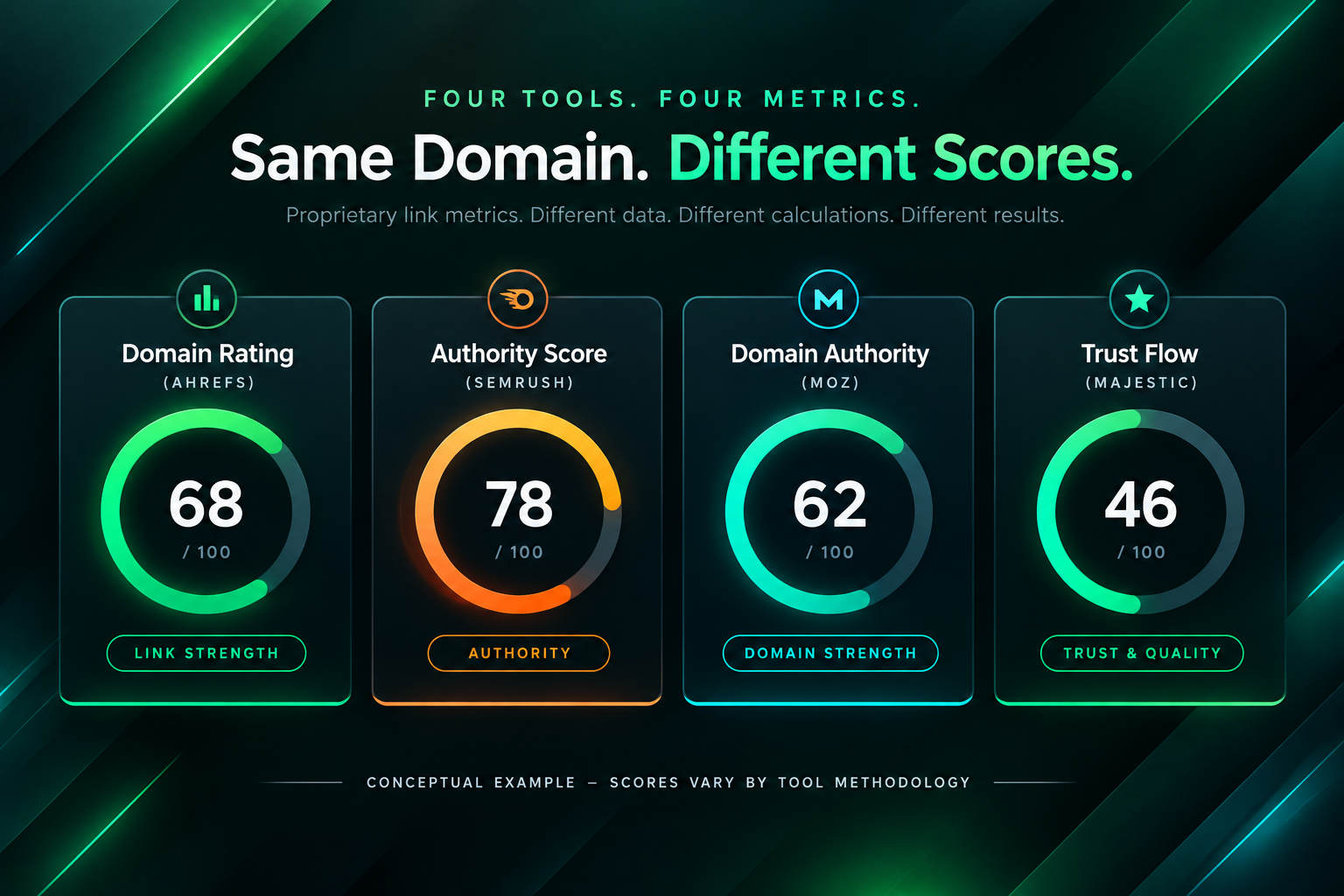
This distinction matters practically. When a link building provider quotes a minimum DR or DA threshold for placements, it is important to clarify which tool’s metric they are referencing and to understand that the same publisher may score quite differently across platforms. Relying on a single metric from a single tool as the sole quality indicator for a prospective linking domain can lead to either over-valuing or under-valuing a placement.
Google Search Console: A Different Kind of Data
Google Search Console (GSC) provides backlink data that is fundamentally different from what third-party tools report. GSC shows links that Google has discovered and chosen to report for your own verified property. It does not show competitor data, and it does not show every link Google has found — Google has stated that it reports a sample of links rather than a complete list.
Because GSC data comes directly from Google’s own crawl and reporting systems, it is often treated as the most authoritative source for understanding which links Google is aware of for your site. However, the sample nature of GSC reporting means that the number of links shown there will typically be lower than what third-party tools report, and it should not be used as a benchmark for total link count. GSC is most useful for identifying which domains are linking to you according to Google, spotting unexpected linking patterns, and monitoring for manual actions related to unnatural links.
Third-party tools, by contrast, are more useful for competitive research, prospecting, and tracking the discovery of newly acquired links — tasks that GSC cannot support because it only covers your own verified properties.
Why the Same Tool Can Show Different Numbers Over Time
Backlink counts within a single tool can also fluctuate significantly from one week to the next, even without any deliberate link building activity. These fluctuations have several causes. Tools periodically re-crawl their index and remove links from pages that no longer exist or have been updated. They also update their spam filtering algorithms, which can cause previously counted links to be reclassified and removed from the visible count. Index updates, algorithm changes within the tool itself, and changes to how the tool handles certain link attributes can all cause apparent drops or spikes in reported backlink counts.
This means that a sudden change in your reported backlink count is not necessarily a signal that links have been lost or that something has gone wrong with your site. Before drawing conclusions from a count change, it is worth checking whether the tool has announced an index update, whether the change is consistent across multiple tools, and whether Google Search Console shows any corresponding change in the links it reports for your property.
Practical Implications for Link Building Campaigns
Understanding why backlink tools show different numbers has direct practical value for anyone managing or commissioning a link building campaign. Several common situations become clearer once the underlying reasons for discrepancies are understood.
Evaluating Publisher Quality
When assessing a prospective linking domain, checking its metrics across two or three tools gives a more balanced picture than relying on a single platform. A domain that scores well in Ahrefs but poorly in Majestic’s Trust Flow metric may have a large volume of low-quality inbound links that Ahrefs is not filtering out in its DR calculation. Conversely, a domain with a modest DR may have a strong Trust Flow, suggesting a cleaner and more editorially selective link profile. Using multiple tools together, rather than treating any single metric as definitive, tends to produce more reliable publisher assessments.
Tracking Campaign Progress
When monitoring the impact of a link building campaign, it is more useful to track trends within a single tool over time than to compare absolute counts between tools at a single point in time. Choose one tool as your primary tracking platform for campaign reporting, and use a second tool for cross-referencing when a significant discrepancy appears. Expecting newly acquired links to appear immediately in all tools is unrealistic — allow several weeks for crawl discovery before drawing conclusions about whether a placement has been indexed.
Competitive Backlink Analysis
When analysing a competitor’s backlink profile to identify link building opportunities, the choice of tool can affect which opportunities you find. A tool with a larger or more frequently refreshed index may surface linking domains that a smaller-index tool misses entirely. Running a competitor analysis through two tools and comparing the referring domain lists can reveal opportunities that a single-tool approach would overlook. Focus on referring domains rather than raw backlink counts for competitive analysis, since a single domain linking multiple times inflates the backlink count without necessarily indicating broader editorial reach.
Which Tool Should You Trust?
There is no universally correct answer to which backlink tool is most accurate, because accuracy depends on what you are trying to measure and how you define completeness. Each major tool has documented strengths. Ahrefs is widely regarded for index size and crawl freshness. Majestic offers a long historical index that can surface older link patterns. Semrush integrates backlink data with broader SEO and competitive intelligence features. Moz provides the widely recognised Domain Authority metric, which remains a common benchmark despite its limitations.
For most practical SEO and link building purposes, the most reliable approach is to treat backlink tool data as directional rather than definitive. Use the data to identify patterns, compare relative link profiles, spot opportunities, and track trends — not to arrive at a precise count that you treat as ground truth. When a specific number matters for reporting or decision-making, state clearly which tool produced it and acknowledge that other tools may show different figures.
Frequently Asked Questions
Is it a problem if different tools show very different backlink counts for my site?
Not necessarily. Significant differences between tools are normal and reflect differences in index size, crawl frequency, and filtering methodology rather than errors. If you see a large discrepancy, it is worth investigating whether one tool is applying aggressive spam filtering or whether one has a significantly larger index. Checking Google Search Console alongside third-party tools can help you understand which links Google itself has reported for your property.
Why does Google Search Console show fewer backlinks than Ahrefs or Semrush?
Google Search Console reports a sample of links that Google has discovered and chosen to display for your verified property, not a complete list. Third-party tools crawl the web independently and may index links that Google has not yet crawled, has crawled but not reported, or has chosen to ignore. The GSC figure is not a ceiling on how many links exist — it is a partial view of what Google has reported.
Can I rely on Domain Rating or Domain Authority to assess link quality?
These metrics can be useful as one input among several, but they should not be treated as definitive quality indicators. DR, DA, Authority Score, and Trust Flow are proprietary metrics calculated by their respective tools using different methodologies. None of them is provided or endorsed by Google. A high score in one metric does not guarantee that a link from that domain will have a positive effect on your rankings. Assessing publisher quality should also consider topical relevance, editorial standards, organic traffic, and the context of the linking page.
Why did my backlink count drop suddenly in one tool?
Sudden drops within a single tool are often caused by index updates, changes to the tool’s spam filtering algorithm, or re-crawls that discovered removed or redirected pages. Before concluding that links have been lost, check whether the drop is consistent across multiple tools and whether Google Search Console shows any corresponding change. If the drop appears only in one tool, it is more likely a tool-side change than an actual loss of live links.
How long does it take for a new backlink to appear in backlink tools?
Discovery timelines vary by tool and by the authority and crawl frequency of the linking domain. Links on high-authority, frequently crawled domains may appear in major tools within a few days. Links on lower-traffic or infrequently updated sites may take several weeks or longer to appear, and some may never be indexed by tools with smaller crawl budgets. This is why it is advisable to allow at least two to four weeks after a placement goes live before assessing whether it has been discovered.
Should I use one tool or multiple tools for backlink analysis?
Using two or three tools together generally produces more reliable insights than relying on a single platform. Different tools surface different links, apply different quality filters, and calculate metrics differently. For campaign tracking, choose one tool as your primary reporting platform for consistency. For competitive research and publisher assessment, cross-referencing two tools can reveal opportunities and quality signals that a single-tool approach would miss.
Reading Backlink Data More Reliably
Backlink count discrepancies across tools are an inherent feature of how the web is crawled and indexed, not a flaw to be solved. Each major platform — Ahrefs, Semrush, Moz, Majestic, and Google Search Console — provides a partial and methodologically distinct view of the same underlying link landscape. Understanding why those views differ makes it possible to use each tool more appropriately and to avoid drawing misleading conclusions from a single number.
For link building campaigns specifically, the practical takeaway is to treat tool metrics as directional signals rather than precise measurements. Assess publisher quality using multiple data points, track campaign progress through consistent use of one primary tool, and cross-reference with a second tool when a significant discrepancy appears. If you are working with a link building provider, it is reasonable to ask which tools they use for quality assessment and how they account for metric differences when evaluating prospective placements. A provider that relies exclusively on a single proprietary metric without considering topical relevance, organic traffic, or editorial standards may be applying a narrower quality framework than the campaign warrants.