

Link velocity describes the rate at which a website acquires new backlinks over a given period. It is one of the signals that search engines may use to assess whether a backlink profile looks natural or artificially inflated. Understanding link velocity matters because acquiring links too quickly, too slowly, or in patterns that look manipulative can affect how search engines evaluate your site — even if the individual links are high quality. This article explains what link velocity means in practice, how it interacts with other SEO factors, what risks come with unnatural acquisition rates, and how to think about pacing when planning or outsourcing a link building campaign.
Key Takeaways
- Link velocity is the speed at which a website gains new backlinks over time, and an unnatural rate — whether too fast or too slow — can attract search engine scrutiny.
- There is no universally safe link acquisition rate; what looks natural depends on your site’s age, authority, content output, brand size, and industry context.
- Sudden spikes in referring domains, especially from low-quality or topically irrelevant sources, carry more risk than a steady, gradual increase from relevant publishers.
- Link velocity is one signal among many; it does not operate in isolation from content quality, anchor text distribution, link source relevance, and overall backlink profile health.
- Monitoring your link acquisition rate using tools such as Ahrefs, Semrush, or Google Search Console helps you identify anomalies before they become problems.
What Link Velocity Actually Means
Link velocity is most simply defined as the number of new backlinks or referring domains a website earns within a specific time window — typically measured weekly or monthly. A site that gains five new referring domains per month has a different velocity profile from one that gains two hundred in the same period. Neither number is inherently good or bad without context, but the pattern matters to search engines trying to distinguish organic editorial interest from coordinated link manipulation.
It is worth separating two related but distinct measurements. Backlink velocity counts every new link, including multiple links from the same domain. Referring domain velocity tracks how many unique websites are linking to you for the first time. Referring domain velocity is generally considered the more meaningful signal because earning links from many different independent sources is harder to fake than accumulating multiple links from a small number of sites. Most SEO tools, including Ahrefs and Semrush, allow you to track both metrics over time through their backlink history or referring domains graphs.
Link velocity is not a metric that Google has publicly confirmed as a direct ranking factor in precise terms. However, Google’s documented guidance on link spam and unnatural link patterns makes clear that sudden, coordinated, or artificial link acquisition is something its systems are designed to detect. The concept of velocity is therefore best understood as a proxy for naturalness rather than a standalone ranking signal with a defined threshold.
Why Link Velocity Matters for SEO
Search engines assess backlink profiles as part of evaluating a site’s authority and trustworthiness. A backlink profile that grows in a way consistent with genuine editorial interest — gradually, with occasional spikes tied to newsworthy content or brand events — tends to look credible. A profile that jumps from ten referring domains to five hundred in a single month, with no corresponding increase in content output or brand visibility, is more likely to trigger algorithmic scrutiny or a manual review.
The practical concern is not just about penalties. Even without a formal manual action, a sudden influx of low-quality or irrelevant links may dilute the positive signals from your existing backlink profile. Conversely, a very slow or stagnant link acquisition rate in a competitive niche may mean your site struggles to build the authority needed to rank for target keywords, particularly when competitors are actively earning links through content, digital PR, or outreach campaigns.
Link velocity also interacts with other backlink quality signals. A rapid increase in referring domains from topically relevant, editorially independent publishers looks very different from the same numerical increase coming from unrelated directories, low-traffic blogs, or sites with thin content. Search engines are likely to weigh the source quality, topical relevance, and anchor text distribution of new links alongside the rate at which they arrive. This means that velocity cannot be managed in isolation — it is one dimension of a broader backlink profile assessment.
What a Natural Link Acquisition Rate Looks Like
There is no single correct link velocity that applies to every website. What looks natural depends on several factors specific to your site and market. A well-funded SaaS company launching a major product update might legitimately earn hundreds of new referring domains in a short period through press coverage, product review sites, and community discussion. A local service business in a low-competition niche might naturally earn only a handful of new links per month. Applying the same acquisition rate to both would produce very different risk profiles.
Several factors influence what a plausible natural velocity looks like for a given site:
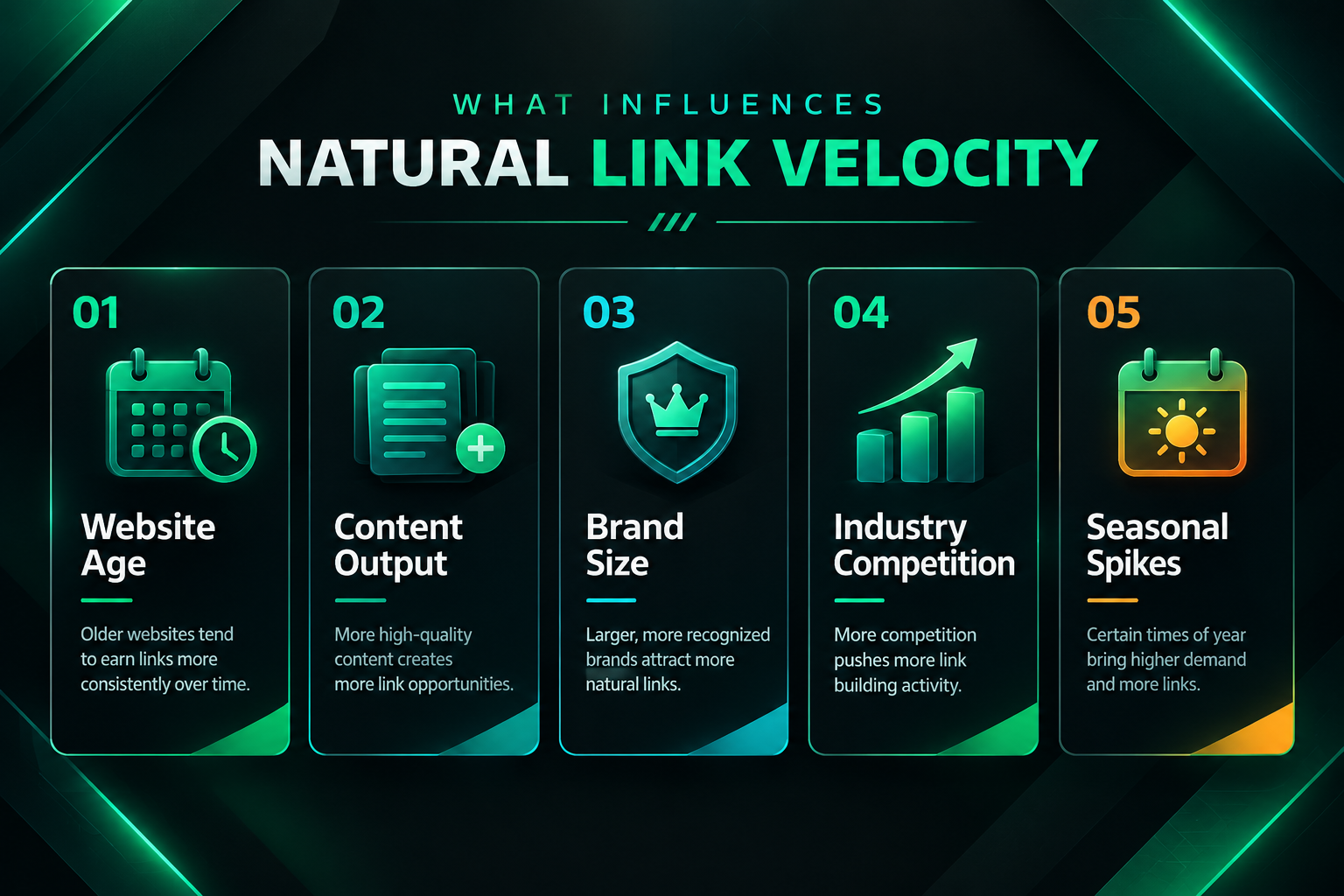
- Website age and history: Newer sites with few existing backlinks are expected to grow their profiles more slowly than established domains with hundreds of referring domains already in place.
- Content output and quality: Sites that publish research, data studies, tools, or widely shared content can justify faster link growth because there is a visible reason for editorial interest.
- Brand size and search demand: Brands with significant offline presence, PR activity, or social media reach may attract links at a faster rate without it appearing unusual.
- Industry and competitive landscape: In highly competitive niches such as finance, health, or legal services, active link building is common and expected. In quieter niches, the same pace might look anomalous.
- Seasonal or event-driven spikes: A spike in links following a product launch, a viral piece of content, or a news event is generally considered natural because there is a plausible external cause.
Benchmarking your link velocity against competitors in the same niche using tools like Ahrefs’ referring domains history or Semrush’s backlink analytics can help you understand what a credible growth rate looks like in your specific market. This kind of competitive analysis is a useful starting point before planning any link acquisition campaign.
Risks of Unnatural Link Velocity
Acquiring links too quickly — particularly through low-quality sources, link schemes, or bulk purchasing — carries meaningful risks. Google’s spam policies explicitly address unnatural link patterns, and a sudden, unexplained spike in referring domains is one of the patterns that may trigger algorithmic filtering or a manual review by Google’s spam team. The consequences can range from individual links being discounted to a broader reduction in the site’s ability to rank for target keywords.
The risk is not purely about speed. A rapid increase in high-quality, topically relevant editorial links from independent publishers is far less likely to cause problems than a slower but sustained campaign of links from private blog networks, link farms, or paid placements that violate Google’s guidelines. The combination of high velocity and low link quality is where the greatest risk lies.
It is also worth noting that negative SEO — where a competitor or bad actor points large volumes of low-quality links at your site — can create an artificial velocity spike that you did not initiate. Monitoring your backlink profile regularly through Google Search Console or a third-party tool allows you to identify and, if necessary, disavow such links before they cause lasting damage. Google has stated that its systems are generally good at ignoring low-quality links, but monitoring remains a sensible precaution for established sites in competitive niches.
Slow or stagnant link velocity carries its own risks in competitive markets. If your backlink profile is not growing while competitors are actively earning new referring domains, the relative authority gap may widen over time, making it harder to maintain or improve rankings for competitive keywords. This does not mean that link building is always the right priority — technical SEO issues, content gaps, or search intent mismatches may be more pressing — but it does mean that ignoring link acquisition entirely in a competitive niche is rarely a neutral decision.
Link Velocity and Anchor Text Distribution
Anchor text distribution is closely related to link velocity because the two signals interact when search engines assess a backlink profile. A site that acquires many new links quickly, with a high proportion of exact-match commercial anchor text, presents a pattern that is harder to explain as organic editorial behaviour. Naturally acquired links tend to use a mix of branded anchors, generic phrases, partial-match terms, and naked URLs, with exact-match commercial anchors appearing less frequently.
When planning a link building campaign, it is worth considering not just how many links you are acquiring and at what rate, but also what anchor text those links are using. A campaign that delivers a large volume of links in a short period, all using the same target keyword as anchor text, may look manipulative even if the individual publisher sites are of reasonable quality. Varying anchor text across placements and pacing the campaign to avoid sudden spikes in any single anchor type is a more defensible approach.
There are no universally correct anchor text ratios that guarantee a safe outcome. The appropriate distribution depends on your existing profile, your niche, and the competitive context. A site that already has a heavily branded anchor profile may benefit from more keyword-relevant anchors in new placements, while a site with an existing concentration of exact-match anchors may need to diversify. These decisions are best made after reviewing your current backlink profile rather than applying a fixed formula.
Managing Link Velocity During a Campaign
For businesses running active link building campaigns — whether in-house or through an outsourced provider — managing link velocity means thinking about pacing, source diversity, and monitoring throughout the campaign rather than just at the planning stage.
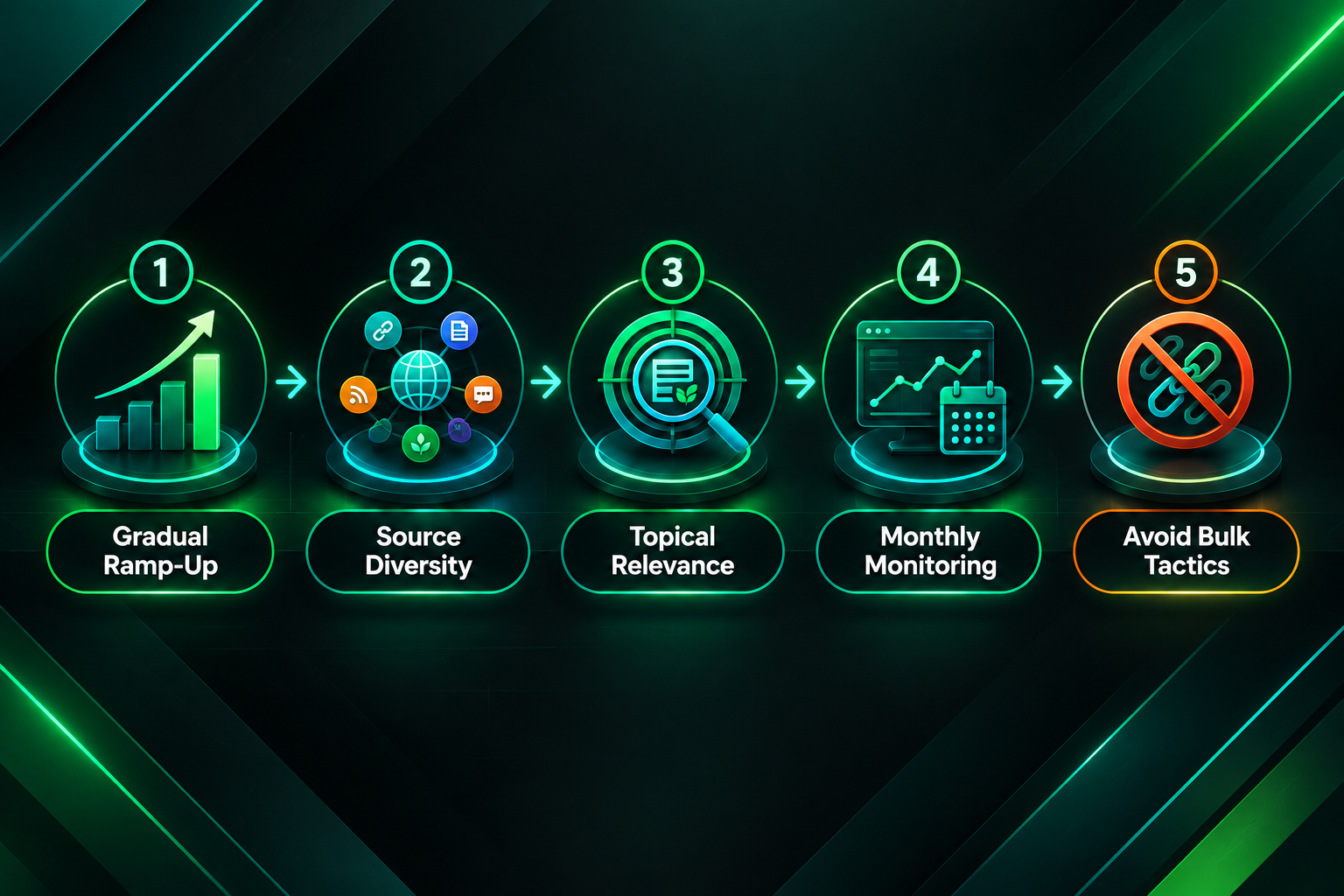
A few practical considerations for campaign management:
- Gradual ramp-up: Starting a campaign with a modest number of placements per month and increasing gradually tends to produce a more natural-looking velocity curve than launching with a large volume of links all at once.
- Source diversity: Acquiring links from a range of different publisher types — editorial blogs, industry publications, resource pages, digital PR placements — produces a more varied referring domain profile than concentrating all placements on a single link type.
- Topical relevance: Links from publishers whose content is relevant to your industry or target topic are more consistent with natural editorial interest than links from unrelated sites, regardless of the acquisition rate.
- Monitoring and adjustment: Tracking your referring domain growth monthly using Ahrefs, Semrush, or Google Search Console allows you to spot unexpected spikes — whether from your own campaign or from external sources — and adjust accordingly.
- Avoiding bulk or automated link building: Tactics that generate large numbers of links quickly through automation, link exchanges, or low-quality directories carry a higher risk of triggering spam filters, particularly when combined with a rapid velocity increase.
When working with an outsourced link building provider, it is reasonable to ask how they pace placements across a campaign, what publisher quality standards they apply, and how they handle reporting so you can monitor your referring domain growth over time. A provider that delivers all placements in a single batch at the start of a campaign may create a velocity spike that looks less natural than one that staggers placements across several weeks or months.
How to Monitor Your Link Velocity
Monitoring link velocity does not require specialist tools beyond what most SEO practitioners already use. The referring domains graph in Ahrefs or Semrush shows how your unique linking domain count has changed over time, making it straightforward to identify periods of rapid growth or decline. Google Search Console’s Links report provides a first-party view of which sites Google has recognised as linking to you, though it does not show the same level of historical detail as third-party tools.
When reviewing your link velocity data, look for:
- Sudden spikes in new referring domains that are not explained by a content campaign, PR event, or product launch.
- A high proportion of new links from sites with thin content, low traffic, or no topical relevance to your industry.
- Clusters of new links appearing at the same time from sites that share hosting, design, or ownership patterns — a potential indicator of a link network.
- A rapid increase in exact-match anchor text links alongside a velocity spike, which may amplify the risk of algorithmic scrutiny.
- A sustained decline in referring domains, which may indicate link rot — links being removed or the linking pages being taken down — and may warrant a link reclamation review.
Regular monitoring, ideally monthly for active campaigns and quarterly for sites not currently running link building activity, allows you to respond to anomalies before they become entrenched problems. If you identify a large volume of low-quality links that you did not acquire and cannot have removed, Google’s disavow tool is available as a last resort, though it should be used carefully and only when there is a genuine concern about harmful links.
Link Velocity in the Context of a Broader SEO Strategy
Link velocity is one signal within a much larger set of factors that influence organic search performance. A site with a healthy, growing backlink profile but significant technical SEO problems — such as crawling or indexing issues, slow page speed, or duplicate content — may not see the ranking improvements that link acquisition alone might otherwise support. Similarly, a site with strong technical foundations but content that does not match the search intent of its target keywords is unlikely to benefit fully from new backlinks.
Before prioritising link acquisition, it is worth confirming that the pages you want to rank are well-optimised for their target queries, that the site is being crawled and indexed correctly, and that there are no existing manual actions or spam-related issues in Google Search Console. Link building is most effective as part of a coordinated SEO strategy rather than as a standalone fix for underperforming pages.
For sites in early stages of development, earning links through genuinely useful content — original research, practical tools, detailed guides, or data-driven resources — tends to produce a more sustainable and natural-looking velocity profile than relying entirely on outreach or paid placements. As a site matures and its content library grows, a combination of earned links and strategic outreach-based acquisition is often a more balanced approach.
Frequently Asked Questions
Is there a safe number of links to build per month?
There is no universally safe number. The appropriate rate depends on your site’s age, existing backlink profile, content output, brand size, and competitive niche. A new site building ten referring domains per month may look natural, while an established brand in a competitive industry might reasonably acquire far more without concern. The quality and relevance of the sources matter as much as the quantity.
Can building links too slowly hurt my rankings?
In competitive niches, a stagnant backlink profile while competitors are actively earning new referring domains may contribute to a widening authority gap over time. However, slow link growth is rarely penalised by search engines — the greater risk is falling behind competitors rather than triggering a manual action. Whether link building is the right priority depends on a broader assessment of your site’s SEO condition.
Does Google penalise sites for a sudden spike in backlinks?
Google’s systems are designed to detect unnatural link patterns, and a sudden, unexplained spike in referring domains — particularly from low-quality or irrelevant sources — may result in those links being discounted or, in more serious cases, a manual review. A spike caused by a legitimate PR event, viral content, or product launch is less likely to cause problems because there is a plausible editorial explanation. The quality and relevance of the linking sites are important factors alongside the rate of acquisition.
How does link velocity relate to anchor text?
The two signals interact. A rapid increase in links combined with a high proportion of exact-match commercial anchor text presents a pattern that is harder to explain as natural editorial behaviour. Varying anchor text across placements and pacing the campaign to avoid sudden spikes in any single anchor type reduces the risk of the overall pattern appearing manipulative.
Should I be concerned about negative SEO affecting my link velocity?
Negative SEO — where a third party points large volumes of low-quality links at your site — can create an artificial velocity spike. Google has stated that its systems are generally effective at ignoring such links, but monitoring your backlink profile regularly allows you to identify unusual patterns. If you identify a sustained influx of clearly harmful links that you cannot have removed, Google’s disavow tool is available as a precautionary measure.
How often should I monitor my link velocity?
For sites running active link building campaigns, monthly monitoring of referring domain growth using a tool such as Ahrefs, Semrush, or Google Search Console is a reasonable practice. For sites not currently running campaigns, a quarterly review is generally sufficient to catch any unexpected changes in the backlink profile.
Managing Link Velocity as Part of a Long-Term Backlink Strategy
Link velocity is best understood as a dimension of backlink profile health rather than a metric to optimise in isolation. The goal is not to hit a specific number of new links per month but to build a profile that grows in a way consistent with genuine editorial interest in your content and brand — varied in source, relevant in topic, and paced in a way that reflects your site’s actual visibility and content output.
For businesses considering outsourced link building, discussing velocity and pacing with a prospective provider is a reasonable part of the evaluation process. A provider that understands the importance of gradual, diversified acquisition — and can explain how they monitor and adjust campaign pacing — is better positioned to support a sustainable backlink strategy than one focused purely on volume or speed of delivery.
If you are unsure whether your current link acquisition rate is appropriate for your site’s profile and competitive context, a backlink audit using a tool like Ahrefs or Semrush, combined with a review of your Google Search Console links data, is a practical starting point. For more complex situations — such as recovering from a previous link building campaign that may have created an unnatural profile — working with an experienced SEO professional to assess the situation before resuming acquisition is a sensible precaution.


