A private blog network, commonly abbreviated as PBN, is a collection of websites built or acquired specifically to create backlinks pointing to a target site. The practice has existed in SEO for well over a decade, and it remains one of the most debated link building tactics — not because it is effective in a straightforward sense, but because it sits in direct conflict with Google’s documented link spam policies and carries meaningful risks for any website that relies on it. This article explains what a private blog network is, how it operates, why search engines treat it as a manipulative practice, what the realistic risks look like, and which alternative link acquisition strategies may better serve long-term SEO goals.
Key Takeaways
- A private blog network is a group of websites controlled by one entity and used primarily to manufacture backlinks to a target site, rather than to serve a genuine audience.
- Google’s spam policies explicitly identify PBNs as a link scheme, meaning sites that use them risk manual actions, algorithmic penalties, or both.
- PBN links may produce short-term ranking movement in some competitive niches, but the gains are generally unstable and dependent on the network remaining undetected.
- Detection risk increases over time as Google’s spam detection systems improve and as footprints within the network become more visible to crawlers and human reviewers.
- White-hat alternatives such as manual outreach, guest posting on genuine editorial sites, digital PR, and niche edits on real publisher sites offer more durable link equity without the same policy exposure.
What Is a Private Blog Network?
A private blog network is a set of websites — sometimes numbering in the dozens or hundreds — that are owned or controlled by a single person or organisation and used to pass link equity to one or more money sites. The term “money site” refers to the website the operator actually wants to rank in search results. The PBN sites themselves are not the end goal; they exist solely as link sources.
PBN operators typically build their networks in one of two ways. The first is by registering expired domains that previously had genuine backlink profiles and some accumulated authority in third-party metrics such as Ahrefs Domain Rating or Moz Domain Authority. The logic is that an expired domain retains some of the link equity it earned when it was a legitimate website, and that equity can be redirected to the money site through a new backlink. The second approach is to build sites from scratch on fresh domains, though this is generally considered less effective because new domains carry no pre-existing link history.
Once the network domains are acquired, the operator populates them with content — often thin, AI-generated, or spun articles — and places links pointing to the target site within that content. The anchor text of those links is usually chosen to match the keywords the operator wants the money site to rank for. From a purely mechanical standpoint, the goal is to simulate the kind of editorial backlink profile that a well-regarded website would earn naturally over time.
How PBNs Differ from Legitimate Link Building
The fundamental difference between a private blog network and legitimate link building is editorial independence. When a genuine publisher links to a website, that decision is made independently, based on the quality or relevance of the content being linked to. The link reflects a real editorial judgement. PBN links carry no such independence: the same entity controls both the linking site and the site receiving the link, so the link does not reflect any third-party endorsement.
Google’s documentation on link spam is explicit on this point. Links intended to manipulate PageRank or a site’s ranking in search results — including links created primarily for SEO purposes rather than for users — are classified as link schemes. Private blog networks are listed as a specific example of this type of manipulation. The policy applies regardless of whether the linking sites contain real content, use varied anchor text, or are hosted on different servers.
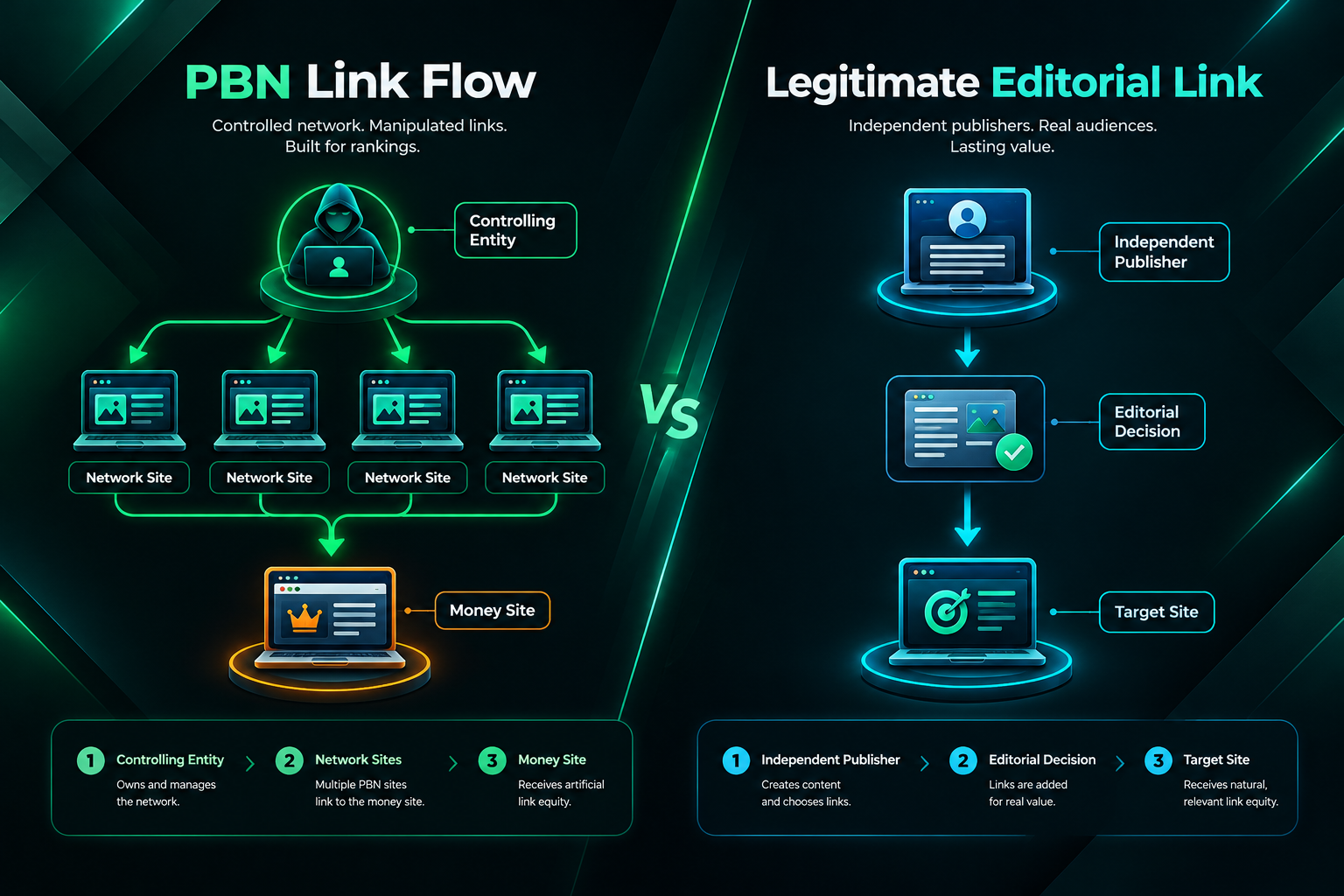
Legitimate link building methods — such as manual outreach to independent publishers, earning coverage through digital PR, or contributing genuine guest posts to established editorial sites — involve a third party making an independent decision to link. That editorial independence is what makes those links meaningful signals to search engines, and it is what PBNs attempt to replicate artificially.
Why Operators Still Use PBNs
Despite the policy risk, private blog networks continue to be used in certain SEO contexts, and understanding why helps clarify the trade-offs involved. In highly competitive niches — particularly those involving finance, gambling, health supplements, or affiliate marketing — the speed at which PBN links can be deployed is appealing. Manual outreach campaigns take time: identifying suitable publishers, pitching content, waiting for editorial review, and securing publication can take weeks or months per placement. A PBN operator can place dozens of links within days.
There is also a cost argument that some operators make. Building or buying a network of expired domains and maintaining them with minimal content can appear cheaper than paying for editorial placements on genuine high-authority sites. However, this calculation often ignores the ongoing maintenance costs of keeping a network functional, the cost of replacing domains that get deindexed, and the potential cost of recovering from a manual action applied to the money site.
Some SEO practitioners argue that PBNs work in the short term in less competitive markets or for local search queries where Google’s spam detection may be less aggressive. These claims are difficult to verify independently, and outcomes vary considerably depending on the quality of the network, the competitiveness of the niche, and the sophistication of the detection systems in place at any given time.
The Risks of Using a Private Blog Network
The risks associated with private blog networks are well-documented and fall into several distinct categories. Understanding each one is important before any business or SEO team considers this approach.
Manual Actions from Google
Google’s Search Quality team can apply a manual action to a website when a human reviewer determines that it violates Google’s spam policies. A manual action related to unnatural inbound links can result in the affected pages or the entire site being ranked significantly lower in search results, or removed from the index entirely. Manual actions are reported in Google Search Console, and recovering from one requires submitting a reconsideration request after demonstrating that the problematic links have been removed or disavowed — a process that can take months and is not guaranteed to succeed.
Algorithmic Penalties
Beyond manual actions, Google’s algorithmic systems — including updates historically associated with link quality assessment — are designed to identify and discount or penalise manipulative link patterns. A site that has benefited from PBN links may see ranking drops following a broad core update or a targeted spam update, even without a manual action being applied. These algorithmic adjustments can be harder to diagnose because they do not appear as explicit notifications in Search Console.
Network Footprints and Detection
Private blog networks leave footprints that make them identifiable to both automated systems and human reviewers. Common footprints include shared hosting IP addresses or IP blocks, similar site structures or themes across network properties, identical or overlapping WHOIS registration data, thin or templated content, and unnatural internal linking patterns. As Google’s crawling and machine learning capabilities have developed, the ability to identify these patterns at scale has improved. A network that evades detection today may not do so following the next algorithm update.
Third-Party Service Risks
Some SEO agencies and link marketplaces sell PBN links as a service, often without disclosing the nature of the network to the client. A business that purchases what appears to be a standard link building package may unknowingly receive PBN placements. If those links later trigger a penalty, the business bears the consequences even though it did not build the network itself. This makes due diligence on any link building provider an important step, particularly when pricing appears unusually low or when the provider cannot demonstrate that placements are on genuine, independently operated editorial sites.
Link Instability
PBN sites are inherently unstable as link sources. Network domains can be deindexed by Google, allowed to expire, or taken down by the operator. When a PBN site loses its index status or goes offline, any link equity it was passing to the money site disappears. A backlink profile that relies heavily on PBN links is therefore fragile in a way that a profile built on genuine editorial placements is not.
How Search Engines Identify PBN Links
Search engines use a combination of automated signals and human review to identify private blog networks. On the automated side, machine learning models can analyse patterns across large numbers of sites simultaneously — looking at link graph anomalies, content quality signals, hosting patterns, and registration data. A cluster of sites that all link to the same money site, use similar templates, and share infrastructure is a recognisable pattern even at scale.
Human quality raters and spam reviewers also play a role. Google’s Search Quality Evaluator Guidelines describe the characteristics of low-quality pages and sites, and PBN properties typically exhibit many of them: thin content, no clear audience, no genuine social presence, and no evidence of real editorial activity. When a reviewer identifies one site in a network, the connected properties can often be traced through the link graph or shared technical characteristics.
It is also worth noting that competitors, disgruntled former employees, or industry observers sometimes report suspected PBN activity to Google directly. The spam report mechanism provides an additional detection pathway that is entirely outside the operator’s control.
PBN Links vs Editorial Backlinks: A Practical Comparison
| Characteristic | PBN Links | Editorial Backlinks (Manual Outreach) |
|---|---|---|
| Editorial independence | None — same entity controls both sites | Yes — independent publisher decision |
| Google policy status | Explicitly classified as a link scheme | Compliant when genuinely editorial |
| Acquisition speed | Fast — days to weeks | Slower — weeks to months per placement |
| Link stability | Low — network sites can be deindexed or removed | Generally higher on established publishers |
| Detection risk | Significant and increasing over time | Low when acquired through genuine outreach |
| Penalty exposure | Manual action and algorithmic penalty risk | Low when links are genuinely editorial |
| Long-term value | Uncertain — dependent on network survival | More durable when publisher remains active |
| Content quality requirement | Often minimal on network sites | Typically requires quality content for placement |
| Scalability | Requires ongoing network maintenance | Scales with outreach capacity and content investment |

White-Hat Alternatives to Private Blog Networks
For businesses and SEO teams looking to build a backlink profile without the risks associated with private blog networks, several well-established approaches are available. Each has its own acquisition process, timeline, and suitability profile.
Manual Outreach and Guest Posting
Manual outreach involves identifying genuine, independently operated websites in a relevant niche and pitching original content for publication. When a placement is secured, the resulting backlink comes from a real editorial site with its own audience, content history, and independent link profile. The link reflects a genuine publisher decision, which is what makes it a meaningful signal. Guest posting at scale requires consistent content production and outreach effort, but the placements tend to be more stable and carry less policy risk than PBN links.
Niche Edits on Established Content
A niche edit — sometimes called a curated link or contextual link insertion — involves adding a link to an existing piece of content on a genuine publisher’s site. When done through legitimate outreach rather than through a link marketplace that sells placements indiscriminately, niche edits can provide contextually relevant backlinks within content that already has its own link equity and search visibility. The key distinction is whether the publisher is making an independent editorial decision or simply selling a placement without regard for relevance or quality.
Digital PR and Earned Media
Digital PR focuses on creating genuinely newsworthy content — original research, data studies, expert commentary, or compelling stories — and distributing it to journalists, editors, and online publications. When coverage is earned rather than paid for, the resulting links are editorially independent and often come from high-authority news and media sites. Digital PR campaigns typically require more upfront investment in content creation and media relations, but the links earned tend to be highly durable and come from domains that would be difficult to approach through standard outreach.
Resource Link Building
Resource link building involves creating genuinely useful content — tools, guides, datasets, or reference pages — that other sites in a niche naturally want to link to. This approach requires patience and content investment, but the links it generates are earned through genuine utility rather than through outreach persuasion or network manipulation. Resource links tend to accumulate over time and can continue generating new placements long after the initial content is published.
Broken Link Building
Broken link building involves identifying links on relevant websites that point to pages that no longer exist, then suggesting the linking site replace the broken link with a link to relevant content on the target site. This approach provides value to the publisher by helping them fix a user experience problem, which makes it a more natural outreach proposition than a cold guest post pitch. It requires systematic prospecting and outreach but can yield genuine editorial placements on established sites.
Who Might Consider PBNs and Why That Reasoning Often Fails
The businesses most likely to consider private blog networks are those operating in highly competitive niches where organic rankings have a direct and significant revenue impact, and where the timeline for building a legitimate backlink profile feels too slow relative to business needs. Affiliate marketers, lead generation site operators, and businesses in industries where paid advertising is restricted or expensive sometimes view PBNs as a faster path to ranking visibility.
The reasoning often fails for several reasons. First, the speed advantage is real but temporary. Rankings built on PBN links are contingent on the network remaining undetected, and that contingency becomes less reliable over time. Second, the cost of a manual action — in terms of lost traffic, recovery effort, and the time required to rebuild a clean backlink profile — can far exceed the cost of building a legitimate link profile from the outset. Third, businesses that invest in genuine editorial link building are building an asset that compounds over time, whereas businesses that rely on PBNs are maintaining a liability that requires ongoing management and carries escalating risk.
Frequently Asked Questions
Are PBN links always detectable by Google?
Not necessarily in every individual case, but Google’s ability to identify network patterns has improved substantially over time. A well-constructed network with varied hosting, unique content, and careful footprint management may evade detection for a period, but the risk of eventual detection increases as the network grows and as Google’s spam systems are updated. There is no reliable way to guarantee that a PBN will remain undetected indefinitely.
Can I use the disavow tool to recover from PBN-related penalties?
The Google Search Console disavow tool allows site owners to ask Google to ignore specific links when assessing their site. If a manual action has been applied for unnatural inbound links, submitting a disavow file alongside a reconsideration request is part of the recovery process. However, disavowal does not guarantee recovery, and the process can take considerable time. Prevention is significantly less costly than recovery.
Do PBN links ever work in the short term?
Some SEO practitioners report short-term ranking improvements from PBN links, particularly in less competitive niches or local search contexts. These outcomes are difficult to verify independently, vary considerably by niche and network quality, and are not stable over time. Short-term gains that disappear following an algorithm update or manual action do not represent a reliable SEO strategy for a business with long-term goals.
How can I tell if a link building provider is using PBNs?
Ask the provider to share examples of sites where placements have been made and verify those sites independently. Genuine editorial sites will have their own organic traffic, a real audience, social presence, and content history that predates your campaign. Sites with thin content, no clear audience, and backlink profiles that consist primarily of links to other money sites are likely PBN properties. Unusually low pricing for large numbers of placements is also a signal worth investigating.
Is buying links from a marketplace the same as using a PBN?
Not always, but the distinction depends on the marketplace and the sites it works with. Some link marketplaces connect buyers with genuine independent publishers who make editorial decisions about placements. Others operate more like PBN services, selling placements on sites that exist primarily to sell links. The key question is whether the linking site has genuine editorial independence and a real audience, or whether it exists primarily as a link source.
What should I do if my site has existing PBN links?
If your site has accumulated PBN links — whether through your own activity or through a previous provider — a backlink audit using tools such as Ahrefs, Semrush, or Google Search Console is a reasonable starting point. Links that appear to come from low-quality, thin-content sites with no genuine audience may warrant disavowal, particularly if there is evidence of a manual action or an unexplained ranking drop. A qualified SEO professional can help assess the profile and recommend proportionate next steps based on the specific situation.
Is a Private Blog Network Worth the Risk for Your Website?
For most businesses with long-term SEO goals, the risks associated with private blog networks outweigh the potential short-term benefits. The fundamental problem is structural: PBN links are built on a foundation that Google’s policies explicitly prohibit, and the value they provide is contingent on remaining undetected by systems that are specifically designed to find them. That is not a stable foundation for organic search visibility that a business can rely on.
The alternative — building a backlink profile through genuine editorial outreach, guest posting on real publisher sites, digital PR, and other white-hat link acquisition methods — requires more time and consistent investment. But the links earned through these methods reflect genuine editorial decisions, carry less policy risk, and tend to remain valuable as long as the linking sites remain active. They also contribute to a backlink profile that can withstand algorithm updates rather than being vulnerable to them.
If your business is considering link building as part of a broader SEO strategy, the most useful first step is a site-specific assessment that looks at your existing backlink profile, your content quality, your technical SEO condition, and the competitive landscape in your niche. Link building is rarely the only factor in organic search performance, and the right approach depends on your specific situation rather than on a universal formula. A qualified link building provider should be able to explain their acquisition methods clearly, show you examples of genuine placements, and help you understand realistic timelines and outcomes before any campaign begins.