

When a business runs a blog, help centre, or regional site on a subdomain, a natural question arises: do backlinks pointing to that subdomain contribute anything to the main domain’s authority and rankings? The short answer is that it depends on how search engines interpret the relationship between the subdomain and the root domain, and the evidence on this topic is more nuanced than many SEO guides suggest. This article explains what is currently understood about subdomain backlinks, how Google and other search engines appear to treat them, what practical implications this has for link building strategy, and when targeting a subdomain with links may or may not serve your broader SEO goals.
Key Takeaways
- Google has historically treated subdomains as separate entities for crawling and indexing purposes, but the relationship between a subdomain and its root domain is not entirely disconnected in practice.
- Backlinks pointing to a subdomain may contribute to the overall perceived authority of the root domain in some circumstances, but this is not guaranteed and the degree of transfer is not publicly documented by Google.
- The quality, topical relevance, and editorial context of backlinks matter regardless of whether they point to a subdomain or the main domain.
- For most link building campaigns, targeting the root domain or specific high-priority pages on the main domain is the more predictable and controllable approach.
- Subdomain link building may be appropriate in specific situations, but a site-specific assessment is needed before treating it as a primary strategy.
How Google Treats Subdomains vs. the Root Domain
A subdomain is a prefix added before the root domain, such as blog.example.com or support.example.com. From a technical standpoint, Google’s crawlers treat subdomains as distinct from the root domain. Google Search Console, for example, requires separate property verification for subdomains unless a domain-level property is configured. This separation reflects how Google indexes and evaluates content: a subdomain can have its own crawl budget, its own indexing status, and its own set of ranking signals.
However, technical separation for crawling does not necessarily mean complete isolation for authority purposes. Google has indicated in various public statements and documentation that it understands the relationship between a subdomain and its parent domain. In practice, a well-established subdomain that shares branding, content quality, and topical relevance with the root domain is unlikely to be treated as a completely unrelated website. The degree to which link equity flows between the two remains one of the less transparently documented aspects of how Google’s algorithms work.
It is worth noting that Google’s John Mueller and other representatives have addressed subdomain questions on multiple occasions, generally confirming that Google tries to understand the relationship between a subdomain and the main site. However, these statements stop short of confirming that backlinks to a subdomain automatically pass full link equity to the root domain. Treating any informal statement as a definitive policy would be an overreach.
Does Link Equity Transfer from a Subdomain to the Root Domain?
Link equity, sometimes called link juice, refers to the ranking value that a backlink may pass from one page or domain to another. When a high-quality external website links to blog.example.com, the question is whether any of that value reaches example.com and its core pages.
The most widely accepted view among SEO practitioners is that some degree of association exists between a subdomain and its root domain, particularly when the subdomain is clearly part of the same brand and shares a consistent topical focus. Third-party tools such as Ahrefs and Semrush aggregate referring domain data at the root domain level in some of their reporting views, which reflects an assumption that subdomain backlinks contribute to the broader domain’s link profile. However, these are proprietary metrics and do not represent how Google’s algorithm actually weights the relationship.
A more cautious interpretation is that backlinks to a subdomain primarily benefit the subdomain’s own pages and rankings, with any benefit to the root domain being indirect and uncertain. If the subdomain ranks well and attracts organic traffic, it may generate internal links or brand signals that benefit the main domain. But this is a secondary effect, not a direct transfer of link equity in the way that a backlink to the root domain itself would work.
For link building campaigns where the goal is to improve the rankings of specific pages on the main domain, building links directly to those pages or to the root domain is the more reliable approach. Relying on subdomain backlinks to lift main domain rankings introduces an additional layer of uncertainty that is difficult to measure or control.
When Subdomain Backlinks May Provide Indirect Benefits
There are circumstances where acquiring backlinks to a subdomain can contribute meaningfully to a broader SEO strategy, even if the direct equity transfer to the root domain is uncertain.
Brand Authority and Trust Signals
When a subdomain hosts genuinely useful content, such as a knowledge base, a research hub, or an industry blog, high-quality backlinks to that content can strengthen the overall brand’s perceived authority. Search engines assess brand signals across a domain’s entire presence, and a subdomain that earns editorial links from reputable, topically relevant sources contributes to the brand’s overall footprint. This may indirectly support the root domain’s authority over time, though the mechanism is not linear or guaranteed.
Referral Traffic and Conversion Pathways
Backlinks to a subdomain can drive referral traffic that eventually reaches the main domain through internal navigation, calls to action, or linked product pages. For businesses where the subdomain serves as a content marketing hub or lead generation resource, this referral pathway can have measurable commercial value independent of any direct SEO equity transfer. Referral traffic and organic traffic are distinct metrics, and both can contribute to business outcomes.
Topical Relevance Across the Domain
If a subdomain is closely related in topic to the main domain’s core pages, backlinks to the subdomain from authoritative sources in the same niche may reinforce the overall topical relevance of the brand. Topical authority is increasingly recognised as a factor in how Google evaluates a site’s expertise on a given subject. A subdomain that earns links from respected industry publications on a specific topic may contribute to the root domain’s perceived expertise in that area, though this effect is difficult to isolate from other ranking factors.
Situations Where Subdomain Backlinks Are Less Likely to Help the Main Domain
Not every subdomain configuration creates a meaningful connection to the root domain. Several situations reduce the likelihood that subdomain backlinks will benefit the main domain’s rankings or authority.
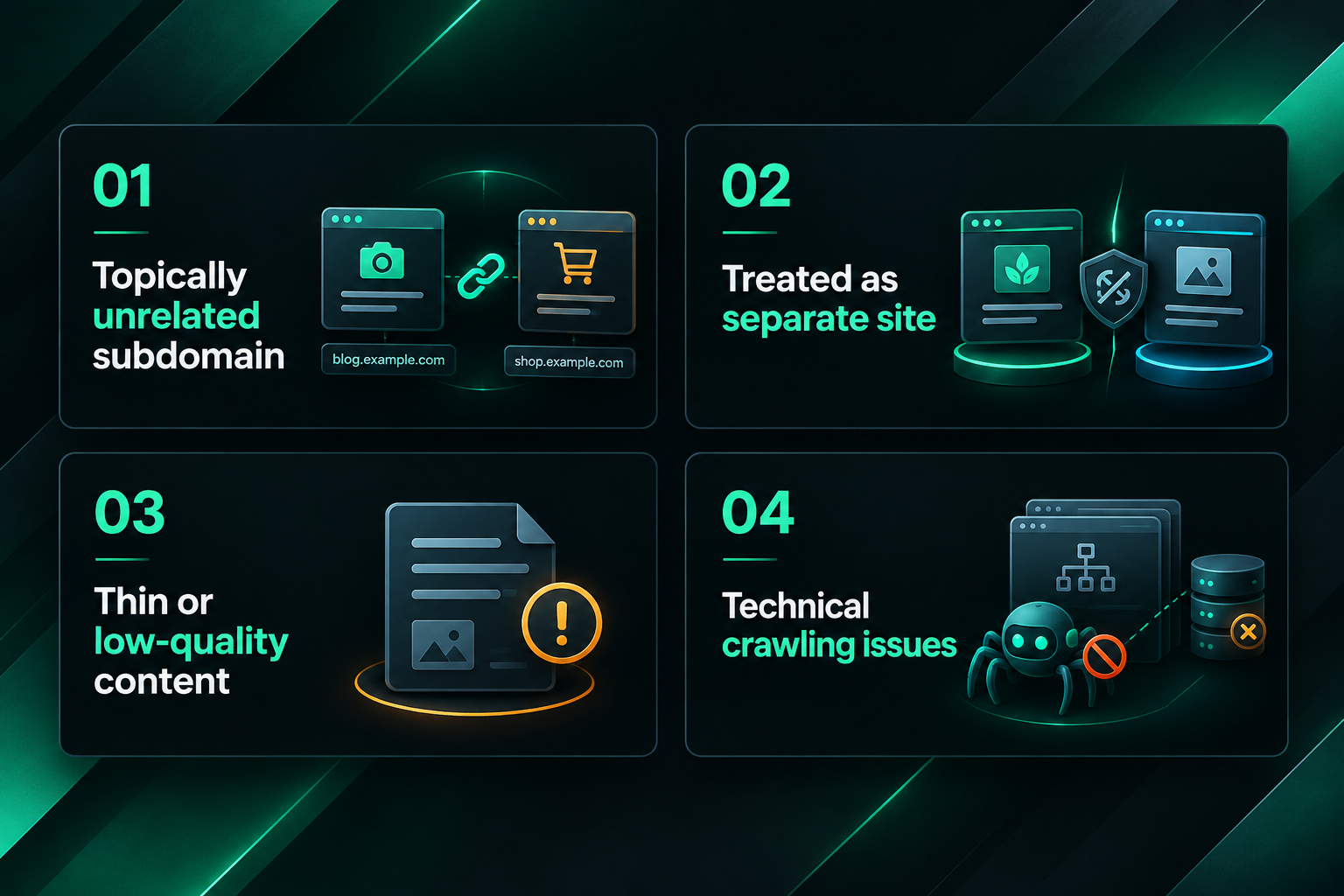
- Topically unrelated subdomains: If the subdomain covers a subject that has little connection to the main domain’s content or business focus, backlinks to it are unlikely to reinforce the root domain’s topical relevance. A software company running a cooking blog on a subdomain, for example, would not expect links to that blog to strengthen the main domain’s authority in software-related searches.
- Subdomains treated as separate sites: Some businesses deliberately configure subdomains to function as independent websites with separate branding, navigation, and content strategies. In these cases, Google is more likely to treat the subdomain as a distinct entity, reducing any association with the root domain.
- Low-quality or thin subdomain content: If the subdomain hosts weak, duplicated, or poorly maintained content, backlinks to it are unlikely to generate meaningful authority signals regardless of where they point. Link quality and content quality are interdependent; a strong backlink to a low-quality page produces limited benefit.
- Subdomains with technical issues: Crawling problems, indexing errors, or canonical tag misconfigurations on a subdomain can prevent search engines from properly associating it with the root domain, further limiting any potential equity transfer.
Subdomain vs. Subfolder: Does the Structure Affect Link Building Strategy?
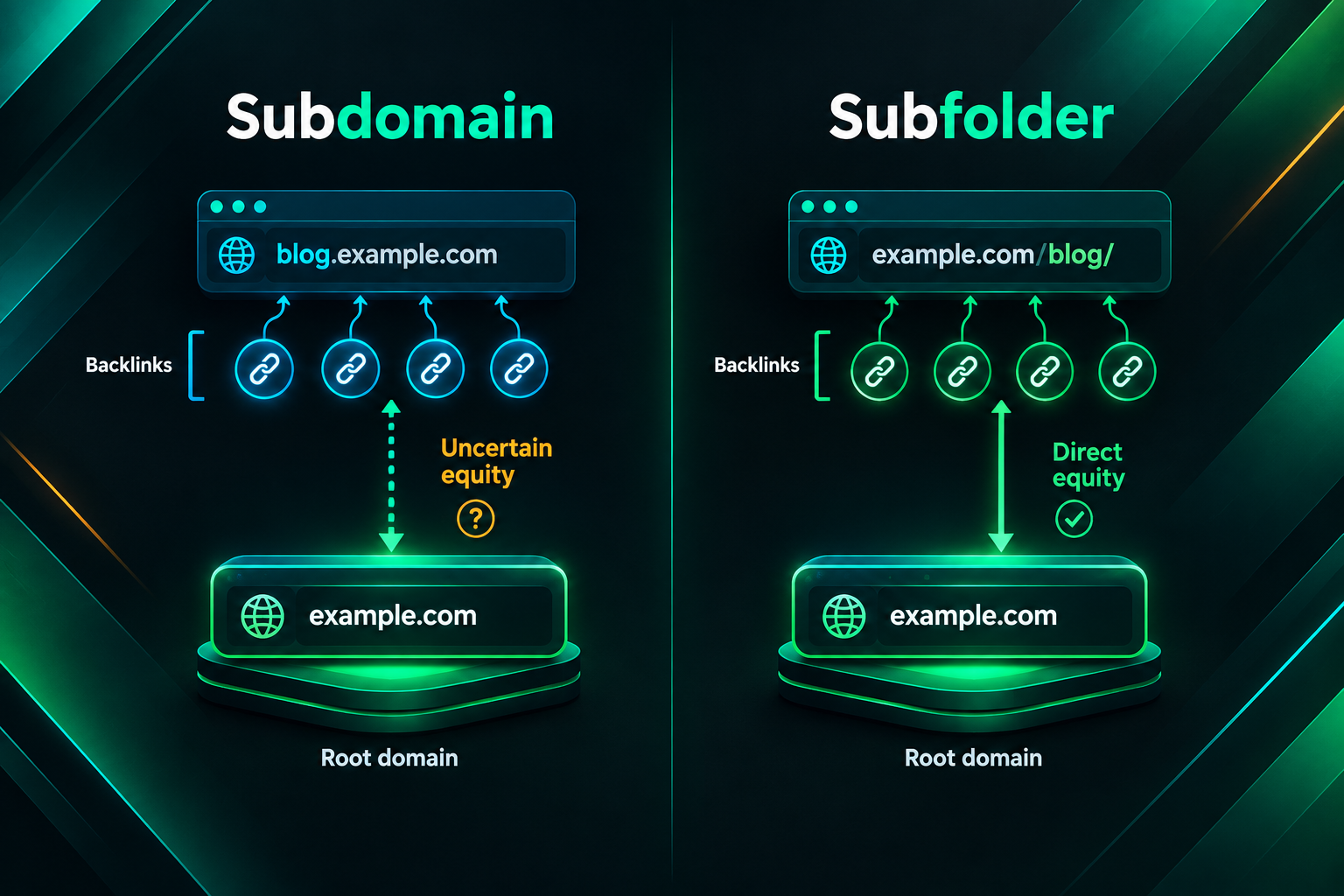
A related question that frequently arises alongside subdomain backlinks is whether content should be hosted on a subdomain (blog.example.com) or a subfolder (example.com/blog). This structural decision has implications for how backlinks are attributed and how link equity flows within the site.
When content is hosted in a subfolder, backlinks to that content point directly to a URL within the root domain. Any link equity those backlinks carry is unambiguously associated with the root domain and can flow through internal links to other pages on the site. This is one reason why many SEO practitioners recommend subfolder structures for content that is intended to support the main domain’s authority.
When content is hosted on a subdomain, the link equity attribution is less clear, as discussed above. This does not mean subdomains are always the wrong choice; there are legitimate technical, organisational, and user experience reasons to use subdomains. But from a pure link building perspective, a subfolder structure generally provides a more direct and predictable path for backlink value to reach the pages you most want to rank.
If your business is currently using a subdomain for content and considering a migration to a subfolder, this is a significant technical SEO decision that requires careful planning, proper redirect implementation, and monitoring. A poorly executed migration can cause temporary or lasting ranking disruptions. This decision should be made with input from an experienced SEO professional who can assess the specific site’s circumstances.
Backlink Quality Considerations for Subdomain Link Building
Whether a link building campaign targets the main domain or a subdomain, the quality of the backlinks acquired remains the most important factor. A high volume of low-quality links pointing to a subdomain is unlikely to benefit the root domain and may create risks for the subdomain itself.
When assessing the quality of a potential backlink, relevant factors include the topical relevance of the linking page and domain, the editorial context of the placement, the organic traffic and indexing status of the linking site, the diversity of the linking site’s own backlink profile, and whether the link is placed naturally within content rather than in a footer, sidebar, or link list. Third-party metrics such as Domain Rating from Ahrefs, Domain Authority from Moz, or Authority Score from Semrush can provide a rough indication of a site’s link profile strength, but these are proprietary estimates and should not be treated as direct measures of how Google values a link.
For campaigns targeting a subdomain with the intention of supporting the main domain, the quality bar should be at least as high as it would be for links pointing directly to the root domain. Acquiring links from editorially relevant, well-maintained websites with genuine organic audiences is the approach most likely to produce durable results and least likely to create compliance risks.
Practical Link Building Approaches for Subdomain and Root Domain Goals
Understanding the theory is useful, but the practical question for most businesses and SEO teams is how to allocate link building effort across a site that includes subdomains.
Prioritise the Root Domain for Core Commercial Pages
If the primary goal is to improve rankings for product pages, service pages, or other commercially important URLs on the main domain, link building campaigns should target those pages directly or target the root domain to build overall domain-level authority. Manual outreach campaigns, guest posting on topically relevant publications, and digital PR efforts that earn editorial coverage are all methods that can be directed toward specific target pages on the main domain.
Use Subdomain Content as a Link Magnet
A well-resourced subdomain hosting original research, comprehensive guides, or useful tools can attract editorial backlinks naturally. If this content is closely connected to the main domain’s topics and the subdomain is clearly part of the same brand, these earned links may contribute to the brand’s overall authority. This approach works best when the subdomain content is genuinely valuable and when the site architecture creates clear pathways between the subdomain and the main domain’s key pages.
Internal Linking Between Subdomain and Root Domain
One practical way to help link equity flow from a subdomain to the main domain is through deliberate internal linking. If the subdomain earns strong backlinks and its pages link internally to relevant pages on the root domain, some of the equity those backlinks carry may reach the main domain through this internal link pathway. This is not a substitute for building links directly to the root domain, but it can be a useful supplementary approach when the subdomain already has a strong backlink profile.
Monitor Both Properties Separately
Because Google Search Console treats subdomains as separate properties, monitoring backlink acquisition, indexing, and ranking performance for the subdomain and the root domain independently is important. This allows you to assess whether subdomain link building is producing measurable effects on the subdomain’s own rankings and whether any correlation with root domain performance is observable over time. Correlation is not causation, and attributing root domain ranking changes specifically to subdomain backlinks requires careful analysis of all concurrent SEO activities.
Risks and Limitations to Consider
Any link building activity carries potential risks, and subdomain-focused campaigns are no exception. Acquiring links from low-quality, irrelevant, or manipulative sources can harm the subdomain’s own rankings and may create negative associations for the root domain if Google identifies a pattern of unnatural link acquisition across the brand’s web presence.
Google’s spam policies apply to link schemes regardless of whether they target a subdomain or the root domain. Paid links that are not properly disclosed, links from private blog networks, and links acquired through schemes designed to manipulate PageRank are all practices that carry penalty risk. A manual action applied to a subdomain may not automatically affect the root domain, but the reputational and operational disruption of a manual action on any part of a brand’s web presence is a meaningful risk.
It is also worth acknowledging that the SEO community’s understanding of how subdomain authority interacts with root domain authority is based largely on observational data, practitioner experience, and limited public statements from search engine representatives. There is no publicly available, peer-reviewed research that definitively quantifies the degree of equity transfer between a subdomain and its root domain. Strategies built on this assumption should be treated as informed hypotheses rather than established facts.
Frequently Asked Questions
Do backlinks to a subdomain count toward the root domain’s backlink profile?
Some third-party SEO tools aggregate backlink data at the root domain level and include subdomain backlinks in domain-wide metrics. However, this reflects the tool’s methodology, not a confirmed Google policy. Whether Google attributes subdomain backlinks to the root domain’s authority in its ranking algorithms is not publicly documented in precise terms. The safest assumption is that subdomain backlinks primarily benefit the subdomain itself, with any root domain benefit being indirect and uncertain.
Is it better to build links to a subdomain or the main domain?
For most link building goals, targeting the main domain or specific pages on it is the more predictable approach. Links pointing directly to root domain pages have a clearer and more direct path to influencing those pages’ rankings. Subdomain link building may be appropriate when the subdomain hosts valuable content that is genuinely worth linking to, but it should not be used as a substitute for building links to the pages you most want to rank.
Can a subdomain hurt the main domain’s SEO if it has a poor backlink profile?
A subdomain with a heavily spammy or manipulative backlink profile could potentially create negative associations for the broader domain, particularly if Google identifies the subdomain as part of the same entity as the root domain. While a manual action on a subdomain does not automatically extend to the root domain, maintaining good link hygiene across all subdomains is a reasonable precaution. Regular backlink audits and disavow file management for subdomains with problematic link profiles are worth considering.
Does moving content from a subdomain to a subfolder improve link equity?
Migrating content from a subdomain to a subfolder can, in principle, make backlinks to that content more directly attributable to the root domain. However, a migration must be executed carefully with proper 301 redirects and monitoring to avoid ranking disruptions. The SEO benefit of the migration depends on the quality of the existing backlinks, the content’s relevance, and how well the technical migration is handled. This decision requires a site-specific assessment.
How long does it take to see SEO results from subdomain backlinks?
The timeline for any backlink to influence rankings varies considerably depending on how quickly search engines crawl and index the linking page, the authority of the linking site, the competitiveness of the target keywords, and the overall state of the site’s backlink profile. For subdomain backlinks specifically, any measurable effect on root domain rankings may take longer to observe, if it occurs at all, because the relationship between the subdomain and root domain introduces additional uncertainty. Results timelines of several months are common for link building campaigns generally, and outcomes are never guaranteed.
Should I use a subdomain or subfolder for my blog if link building is a priority?
From a link building perspective, a subfolder structure is generally considered more straightforward because backlinks to subfolder URLs are unambiguously part of the root domain’s link profile. If link building to support root domain rankings is a significant part of your SEO strategy, a subfolder is typically the lower-risk structural choice. However, this decision involves technical, organisational, and content strategy factors beyond link building alone, and a qualified SEO professional should be consulted before making structural changes to an established site.
Making an Informed Decision About Subdomain Link Building
The question of whether backlinks to a subdomain help the main domain does not have a single definitive answer that applies to every website and every campaign. What the available evidence and practitioner experience suggest is that subdomain backlinks can contribute to a brand’s overall authority and may provide indirect benefits to the root domain, particularly when the subdomain is topically aligned, well-maintained, and clearly associated with the main brand. However, this contribution is less direct, less measurable, and less certain than building links to the root domain itself.
For businesses and SEO teams deciding where to focus link acquisition efforts, the most practical guidance is to prioritise the pages and domain properties that most directly support your ranking goals. If your core commercial pages are on the main domain, building links to those pages or to the root domain is the more reliable path. Subdomain content can play a valuable supporting role as a link magnet and brand authority asset, but it works best as part of a broader strategy rather than as the primary vehicle for link building.
If you are managing a site with multiple subdomains, or considering a structural change to consolidate content under the root domain, a thorough SEO audit is the appropriate starting point. Understanding your current backlink profile, indexing status, and ranking performance across all properties will inform a more effective and lower-risk strategy than applying a general rule without site-specific context. A qualified link building partner can help assess which pages and properties are worth targeting and how to structure a campaign that aligns with your actual business goals.


