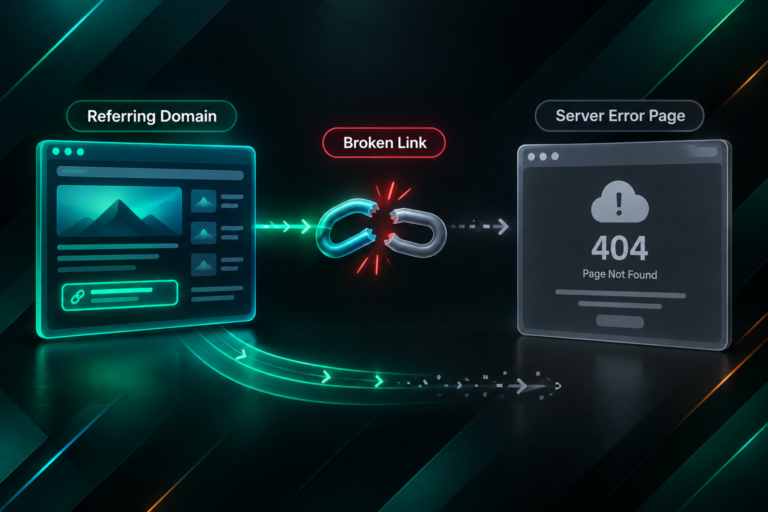
JavaScript powers much of the modern web, but it also introduces genuine uncertainty for SEO teams trying to ensure their links are discovered, crawled, and counted. Whether you are building internal links, earning editorial backlinks, or managing a link acquisition campaign, understanding how Google handles JavaScript links can help you avoid wasted effort and make better technical decisions.
Key Takeaways
- Google can crawl and index many JavaScript-rendered links, but the process is slower and less reliable than crawling standard HTML links.
- JavaScript links that depend on user interaction, authentication, or complex rendering conditions are at higher risk of being missed by Googlebot.
- For link building purposes, HTML anchor links remain the most dependable format for passing link equity to target pages.
- Technical SEO issues on either the linking or receiving domain can reduce the value of otherwise well-placed backlinks.
- Verifying that earned or acquired links are actually crawled and indexed is a practical step that is often overlooked in link building campaigns.
How Google Crawls and Renders JavaScript
Googlebot, the crawler Google uses to discover and index web content, operates in two broad stages when it encounters a page. In the first stage, it fetches the raw HTML of the page. In the second stage, it renders the page using a component called the Web Rendering Service, which processes JavaScript similarly to how a modern browser would. This two-stage process means that links embedded in JavaScript can, in principle, be discovered and followed by Google.
However, rendering is not instantaneous. Google has publicly acknowledged that JavaScript rendering is deferred, meaning pages may be crawled in their raw HTML state first and rendered later, sometimes days or weeks after initial discovery. During that gap, any links that only exist after JavaScript executes may not be visible to Googlebot. For pages that are crawled infrequently, this delay can be significant.
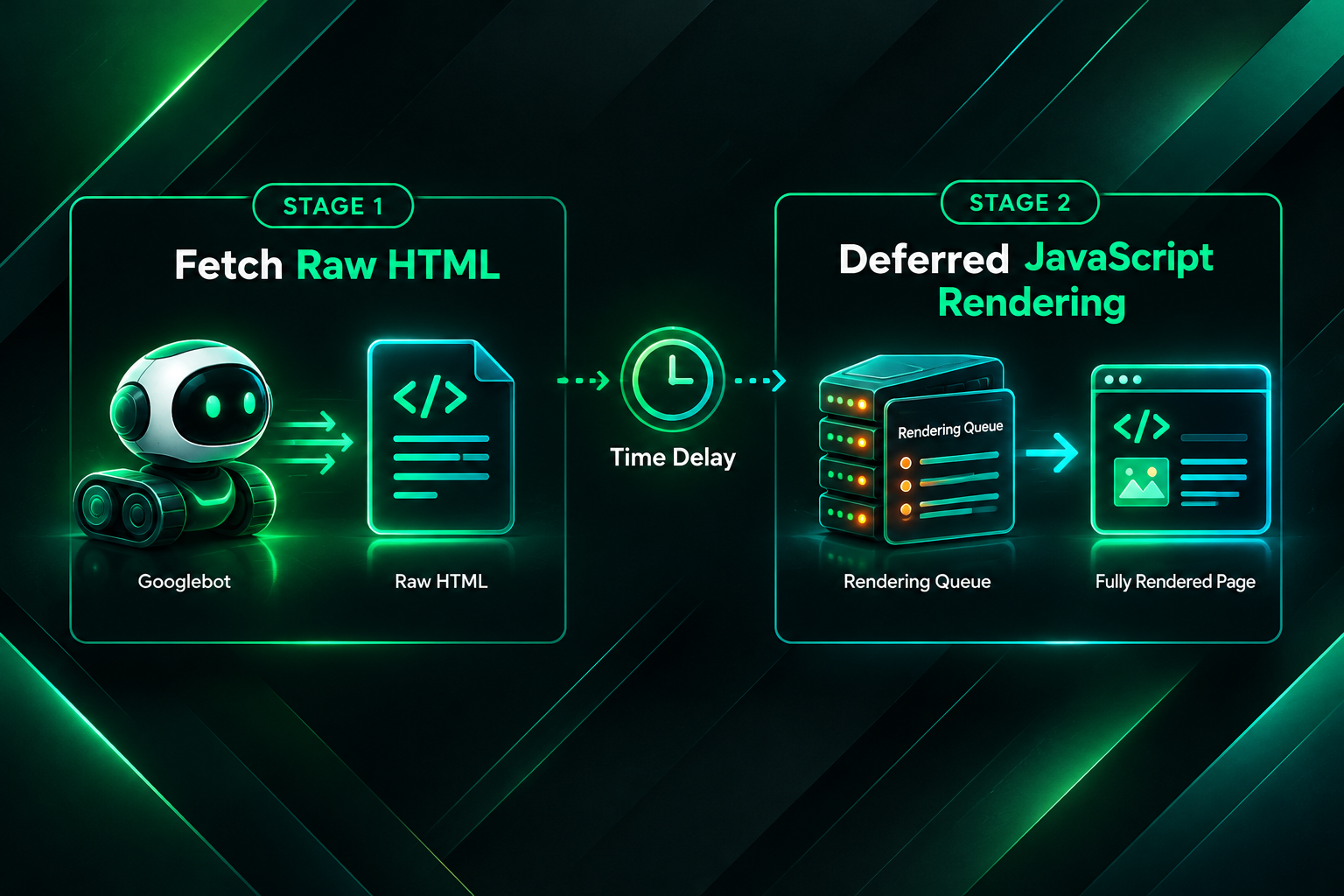
Google’s own documentation describes this rendering queue as a resource-constrained process. Not every page receives the same rendering priority, and pages with lower crawl budget allocation may wait longer before JavaScript is processed. This is particularly relevant for large websites, newly published pages, and domains with limited crawl authority.
Types of JavaScript Links and Their Crawlability
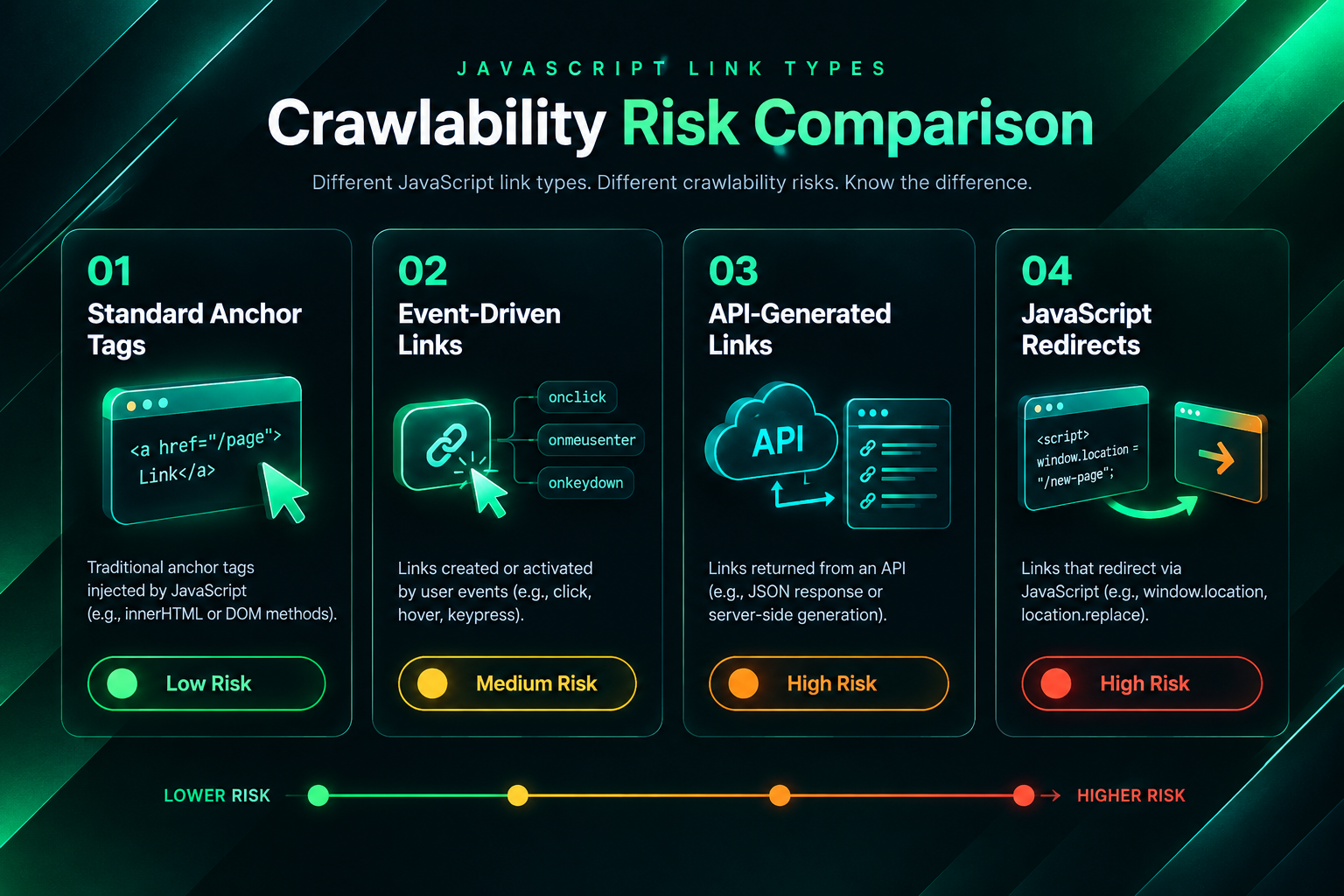
Not all JavaScript links carry the same crawlability risk. Understanding the differences helps SEO teams and developers prioritize which link implementations need attention.
Standard Anchor Tags Injected by JavaScript
A common pattern is a standard HTML anchor tag that is inserted into the page’s DOM by a JavaScript framework such as React, Vue, or Angular. Once rendered, these links look identical to a static HTML link. Google’s rendering engine can generally discover and follow these links, provided the page is rendered successfully. The main risk is the rendering delay described above, not a fundamental inability to process the link.
Event-Driven and Interaction-Dependent Links
Some links only appear or become functional after a user action, such as clicking a button, scrolling to a section, or hovering over an element. Googlebot does not simulate complex user interactions in the same way a human visitor would. Links that require a click event to be triggered, a dropdown to be expanded, or a modal to be opened are at meaningful risk of being missed entirely. Google has stated that it does not execute all JavaScript interactions, and links hidden behind these conditions should not be relied upon for SEO purposes.
Links Generated from API Calls or Dynamic Data
Some pages fetch link data from an external API after the initial page load. If Googlebot renders the page but the API call fails, times out, or returns no data during the rendering window, the resulting links will not be discovered. This is a less predictable failure mode because it depends on server response times and rendering conditions at the moment Googlebot visits.
JavaScript Redirects
Links that use JavaScript to redirect users to another URL, rather than a standard HTTP redirect or an HTML anchor with an href attribute, are handled differently by Googlebot. Google can follow some JavaScript redirects, but they are generally less reliable than server-side 301 redirects for passing link signals. Using JavaScript redirects as a substitute for proper redirect implementation is a technical SEO risk that can affect both crawlability and link equity transfer.
What This Means for Link Equity and Backlink Value
Link equity, sometimes called link juice, refers to the ranking-related value that one page passes to another through a hyperlink. For a backlink to contribute to a target page’s authority and potential rankings, Googlebot must be able to crawl the linking page, discover the link, render it if necessary, and then crawl the destination URL. A failure at any of these stages reduces or eliminates the practical SEO value of the placement.
When a link building campaign places a backlink on a publisher’s website, the link’s value depends partly on factors outside the campaign’s direct control, including how the publisher’s site is built and whether its JavaScript renders reliably for Googlebot. A link placed on a high-authority domain that uses a JavaScript framework may still pass significant value if the rendering succeeds, but there is less certainty compared to a link in a static HTML page.
Third-party SEO tools such as Ahrefs, Semrush, and Majestic crawl the web using their own bots, which may handle JavaScript differently from Googlebot. A link that appears in one of these tools’ indexes does not guarantee that Google has crawled and processed it. Conversely, a link that does not appear in a third-party tool’s index may still have been discovered by Google. These tools provide useful signals but should not be treated as a definitive record of what Google has or has not crawled.
Diagnosing JavaScript Link Crawlability Problems
Several practical methods can help identify whether JavaScript links on a given page are being discovered and processed by Google.
Google Search Console URL Inspection
The URL Inspection tool in Google Search Console allows you to fetch and render a specific page as Googlebot sees it. The rendered HTML output shows which links are visible after JavaScript execution. If a link appears in the rendered output, there is a reasonable basis to expect Google can discover it. If it does not appear, the link is likely being missed. This is one of the most direct diagnostic methods available without requiring developer tools.
Checking the Rendered DOM
Developers and technical SEO practitioners can use browser developer tools to inspect the rendered DOM of a page and compare it to the raw HTML source. Links that appear in the DOM but not in the source are JavaScript-rendered. This comparison helps identify which links depend on JavaScript execution and therefore carry additional crawlability uncertainty.
Log File Analysis
Server log files record every request made to a website, including requests from Googlebot. Analyzing log files can reveal whether Googlebot is visiting pages that contain JavaScript links, how frequently it returns, and whether it is following the links to destination URLs. Log file analysis requires access to server logs and some technical capability to interpret them, but it provides direct evidence of crawler behavior rather than inferred signals.
Monitoring Backlink Indexation
For acquired backlinks specifically, checking whether the linking page has been indexed by Google is a useful baseline step. A page that is not indexed cannot pass link value regardless of how the link is implemented. Google Search Console’s index coverage report and a simple site: search can help verify indexation status, though neither method is perfectly comprehensive.
JavaScript Links and Link Building Campaigns
For businesses and agencies running link acquisition campaigns, JavaScript crawlability is a practical quality consideration rather than a purely theoretical concern. When evaluating publisher sites for guest post placements, niche edits, or other editorial link opportunities, the technical implementation of the linking page matters alongside more commonly assessed factors such as domain authority metrics, topical relevance, and traffic estimates.
A publisher site built on a JavaScript-heavy framework is not automatically a poor choice for link placement. Many such sites render reliably for Googlebot and produce links that are crawled and indexed without issue. The concern arises when the specific link placement is embedded in a component that depends on user interaction, is loaded asynchronously after the main page render, or sits within a section of the page that Googlebot may not fully process.
Practically, this means that link building quality assessment should include a basic check of how the target placement will be implemented, not just the domain-level metrics of the publisher. Asking a publisher whether a guest post will be published as standard HTML content, or whether it will be embedded in a JavaScript-rendered component, is a reasonable due diligence question. Most editorial guest posts on content-focused websites are published as static or server-rendered HTML, which reduces this risk considerably.
Niche edits, which involve inserting links into existing published content, carry a similar consideration. If the existing content is rendered as standard HTML, the inserted link will generally be in the same format. If the page uses a JavaScript-based content management system that renders body content dynamically, the link may face the same rendering uncertainty as other JavaScript links on that site.
How Site Architecture Affects JavaScript Link Crawlability
The crawlability of JavaScript links is not determined solely by the link implementation itself. The broader technical architecture of a website influences how reliably Googlebot can render its pages and discover its links.
Crawl budget is a relevant factor for larger websites. Google allocates a finite amount of crawling and rendering resources to each domain based on signals including the site’s authority, update frequency, and server performance. Websites with large page counts, slow server response times, or significant JavaScript complexity may find that Googlebot renders only a portion of their pages within a given crawl cycle. Pages that are rendered less frequently are more likely to have JavaScript links missed or delayed.
Server-side rendering and static site generation are two architectural approaches that reduce JavaScript crawlability risk. With server-side rendering, the server processes JavaScript and delivers fully rendered HTML to the crawler, eliminating the need for Googlebot to execute JavaScript itself. Static site generation produces pre-built HTML files that contain all links in their final form. Both approaches improve the reliability of link discovery compared to client-side rendering, where JavaScript execution is left entirely to the crawler.
Progressive enhancement is another relevant concept. Websites designed with progressive enhancement ensure that core content and links are available in the raw HTML, with JavaScript adding functionality on top rather than being required for basic content delivery. This approach provides a reliable fallback for crawlers that cannot or do not execute JavaScript fully.
Practical Recommendations for SEO Teams
The following considerations may help SEO teams and link building practitioners reduce JavaScript-related crawlability risk without requiring a complete technical overhaul.
- Prefer HTML anchor tags with href attributes for any link that needs to be reliably crawled. Where JavaScript is used to enhance navigation or functionality, ensure that the underlying link structure is present in the HTML.
- Avoid relying on JavaScript-only navigation for internal linking between important pages. If key pages are only reachable through JavaScript-triggered events, they may receive fewer crawls and less link equity from internal links.
- Use the URL Inspection tool in Google Search Console to verify that important pages render correctly and that their links are visible in the rendered output.
- Check publisher site architecture when evaluating link placement opportunities. A quick inspection of the page source and rendered DOM can indicate whether a placement will be in static HTML or a JavaScript-rendered component.
- Monitor acquired backlinks for indexation after placement. If a linking page is not indexed, or if the link does not appear in the rendered version of the page, follow up with the publisher or consider alternative placements.
- Consider server-side rendering or static generation for pages that carry significant internal linking responsibility, such as category pages, hub pages, or cornerstone content.
When JavaScript Link Issues Overlap with Broader SEO Problems
JavaScript crawlability is one of several technical factors that can limit the effectiveness of a link building campaign or reduce organic visibility. It is worth noting that low rankings or limited organic traffic may have multiple contributing causes, and JavaScript link issues are rarely the sole explanation.
Pages that are difficult for Googlebot to crawl may also have problems with indexation, content quality, search intent alignment, or internal linking structure. A backlink profile that appears strong in third-party tools may not translate into ranking improvements if the target pages have technical issues that prevent Google from fully understanding or indexing their content. Similarly, a technically sound website with well-implemented HTML links may still underperform in search if the content does not satisfy user intent or if competition in the target market is strong.
This means that JavaScript link crawlability should be assessed as part of a broader technical SEO review rather than in isolation. Identifying and resolving JavaScript rendering issues may improve the efficiency of link acquisition efforts, but it is unlikely to be sufficient on its own if other significant SEO factors are unaddressed.
Frequently Asked Questions
Does Google treat JavaScript links the same as HTML links?
Not exactly. Google can process many JavaScript-rendered links, but the rendering process introduces delays and uncertainty that do not apply to standard HTML anchor tags. HTML links with href attributes are discovered during the initial crawl without requiring a separate rendering step, making them more reliably and quickly processed.
Will a backlink on a JavaScript-heavy site still pass link equity?
It may, provided the page is rendered successfully by Googlebot and the link is visible in the rendered output. The risk is that rendering delays or failures reduce the reliability of link equity transfer compared to a placement on a site using static or server-rendered HTML. Checking the rendered version of the linking page using Google Search Console’s URL Inspection tool can provide useful evidence.
Can Googlebot follow links inside single-page applications?
Googlebot can follow links in single-page applications if those links use standard anchor tags with href attributes and if the application renders correctly during Googlebot’s rendering window. However, single-page applications that rely heavily on client-side routing and dynamic content loading present a higher crawlability risk than traditional multi-page websites with server-rendered HTML.
How long does it take Google to render JavaScript pages?
Google has not published a fixed timeline for JavaScript rendering. The delay between initial crawl and rendering can range from hours to several weeks depending on the page’s crawl priority, the website’s crawl budget, and the complexity of the JavaScript involved. Newly published pages and lower-authority domains may experience longer rendering delays.
Do third-party SEO tools accurately reflect JavaScript link crawlability?
Third-party tools such as Ahrefs, Semrush, and Majestic use their own crawlers, which handle JavaScript differently from Googlebot. A link appearing in these tools’ indexes does not confirm that Google has crawled and processed it. These tools are useful for identifying link placements and assessing domain-level signals, but they should not be used as a definitive measure of whether Google has discovered a specific JavaScript link.
Should I avoid publishers that use JavaScript frameworks entirely?
Not necessarily. Many websites built on JavaScript frameworks publish content as server-rendered or statically generated HTML, which Googlebot can crawl reliably. The relevant question is whether the specific page and link placement will be in a format that Googlebot can discover without depending on complex client-side rendering. A basic technical check of the publisher’s page implementation is more informative than avoiding JavaScript frameworks as a category.
What to Consider Before Assuming Your Links Are Being Crawled
The practical takeaway from Google’s approach to JavaScript rendering is that link discovery is not guaranteed simply because a link exists on a published page. For businesses investing in link acquisition, whether through in-house outreach or an outsourced link building service, verifying that placed links are actually crawled and indexed is a worthwhile step that is often skipped.
A link building campaign that places backlinks on well-chosen, topically relevant publishers with strong domain signals can still underdeliver if the linking pages are not rendered reliably by Googlebot, if the target pages have technical issues that limit crawlability, or if the link implementation depends on JavaScript conditions that Googlebot does not replicate. None of these issues are unique to any particular link building method, but they are more likely to go unnoticed when campaign reporting focuses exclusively on placement counts and domain authority metrics.
For SEO teams and agency decision-makers, building a basic technical verification step into campaign workflows, such as checking rendered page output for key placements and monitoring indexation of linking pages, can improve confidence that acquired links are contributing as intended. Where JavaScript crawlability issues are identified on a target website, addressing them through server-side rendering, progressive enhancement, or HTML link fallbacks may improve the efficiency of both internal linking and external link acquisition efforts. A qualified SEO professional can help assess whether technical link crawlability issues are a meaningful factor for a specific website and campaign context.