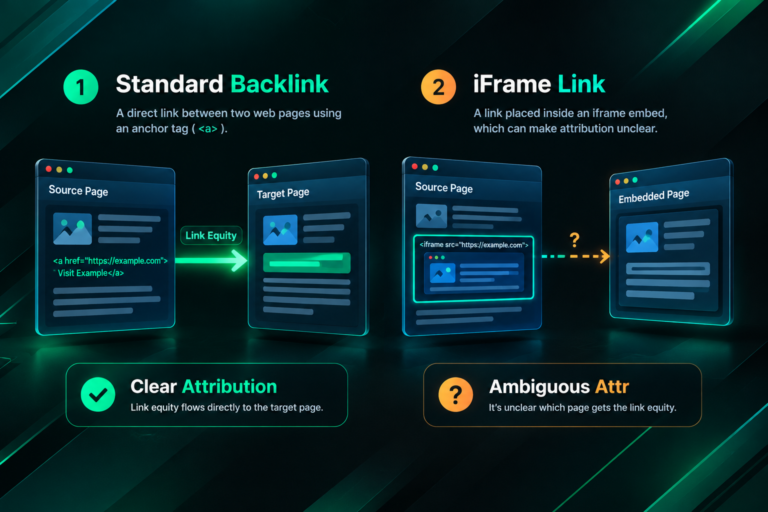
A link farm is a network of websites created primarily to generate large volumes of backlinks rather than to serve genuine readers. Search engines including Google have treated link farms as a form of manipulation for many years, and sites associated with them risk ranking penalties or manual actions. Understanding what distinguishes a link farm from legitimate link building helps business owners and SEO teams make better decisions about their backlink strategy.
Key Takeaways
- Link farms are networks of low-quality sites built to manufacture backlinks artificially, not to provide value to readers.
- Google’s spam policies explicitly target link schemes, including link farms, and sites involved may face ranking demotions or manual actions.
- Third-party authority metrics such as Domain Rating (Ahrefs), Domain Authority (Moz), or Trust Flow (Majestic) do not guarantee that a linking site is safe or editorially legitimate.
- Identifying link farm characteristics before acquiring or accepting a link reduces the risk of associating your site with low-quality or manipulative networks.
- White-hat alternatives such as manual outreach, guest posting on genuine editorial sites, and digital PR can build a backlink profile that is more durable and less likely to attract search-engine scrutiny.
What Is a Link Farm?
A link farm is a group of websites — sometimes hundreds or thousands — that exist primarily to link to one another or to third-party sites in exchange for payment or reciprocal links. The sites in a link farm typically carry little or no original content of value. Their purpose is to pass link equity, sometimes called PageRank or link juice in SEO discussions, to target pages in order to inflate those pages’ perceived authority in search-engine algorithms.
Link farms emerged as a direct response to the way early search engines used hyperlinks as a signal of credibility. If more links pointed to a page, the page ranked higher. Link farms exploited this by manufacturing links at scale. Search engines, particularly Google, have invested heavily in detecting and discounting or penalising these networks over many years, beginning with the Penguin algorithm update in 2012 and continuing through ongoing spam-detection improvements.
It is worth distinguishing a link farm from a private blog network (PBN). A PBN is a set of sites under common ownership, often built on expired domains with existing authority, used to pass links to a money site. A link farm may be more loosely organised — sometimes involving unrelated site owners who participate in link exchange schemes — but both share the same fundamental characteristic: links are created for algorithmic manipulation rather than genuine editorial endorsement.
How Search Engines Detect Link Farms
Google’s spam policies describe link schemes as any behaviour intended to manipulate PageRank or a site’s ranking in search results. The policies specifically mention buying or selling links that pass PageRank, excessive link exchanges, and large-scale article campaigns with keyword-rich anchor text as examples of practices that violate their guidelines. While Google does not publish a precise technical description of every detection method, several observable patterns are associated with link farm identification.
Unnatural anchor text distribution is one signal. When a large proportion of backlinks to a page use identical or closely matched commercial keyword phrases as anchor text, this pattern can appear manipulative compared to the varied, natural anchor text that genuine editorial links tend to produce. Link farms often sell placements with exact-match anchor text, which creates an unnatural footprint across the backlink profile.
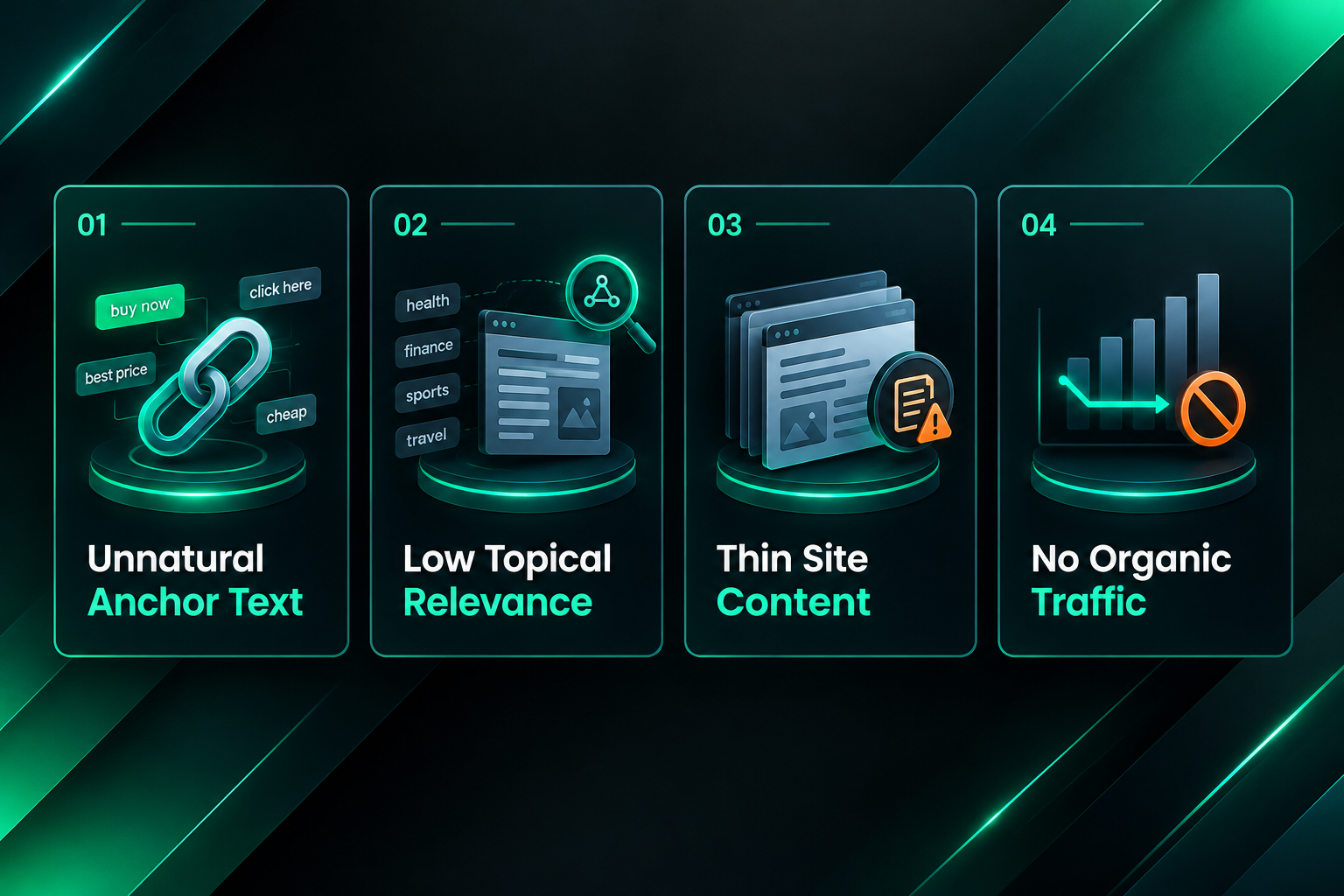
Low topical relevance between the linking site and the linked page is another indicator. A genuine editorial link typically appears because the linking site’s content is related to the topic of the linked page. Link farms frequently place links on sites with no meaningful subject-matter connection to the target page, which can appear anomalous to algorithmic analysis.
Site quality signals also matter. Link farm sites often have thin or duplicated content, high numbers of outbound links relative to content volume, no clear editorial identity, minimal organic traffic, and poor engagement metrics. Tools such as Ahrefs, Semrush, and Majestic can surface some of these characteristics through metrics like referring domain counts, traffic estimates, and link velocity, though no third-party tool replicates Google’s internal assessment.
Google also uses human reviewers as part of its quality assessment process. A manual action — a formal notification delivered through Google Search Console — can be issued when a reviewer determines that a site’s link profile violates spam policies. Manual actions related to unnatural inbound links can result in partial or full ranking demotions that are not automatically reversed when the algorithm updates.
Recognising Link Farm Characteristics
Not every low-quality website is a link farm, and not every paid link placement comes from one. However, several characteristics, when present together, suggest that a site may be part of a link scheme rather than a legitimate publisher.
- Disproportionate outbound link counts: A page with dozens or hundreds of outbound links to unrelated sites, particularly in a footer, sidebar, or dedicated links page, is a common link farm pattern.
- No identifiable editorial team or authorship: Legitimate publishers typically have named authors, editorial policies, or about pages. Link farm sites often lack these entirely or use generic placeholder content.
- Thin or templated content: Pages with very short, low-effort, or clearly auto-generated text exist to host links rather than to inform readers.
- Irrelevant topic mix: A site that publishes content across completely unrelated industries — finance, health, travel, and technology all on the same domain with no clear focus — may be a link farm accepting placements from any paying client.
- No organic search visibility: A site with a high third-party authority metric but negligible estimated organic traffic may have acquired its metric artificially, which is itself a warning sign.
- Rapid link velocity: A domain that accumulated thousands of referring domains in a very short period, particularly if those domains also show link farm characteristics, may be part of a network.
Assessing these factors manually takes time, but it is a reasonable step before accepting a link placement or evaluating a provider’s proposed publisher list. No single characteristic is definitive; the combination of several signals is more meaningful than any one factor in isolation.
Risks of Link Farm Association
The primary risk of acquiring links from link farms is a negative impact on organic search rankings. This can occur through two mechanisms: algorithmic demotion and manual action.
Algorithmic demotion happens when Google’s systems identify and discount or penalise links that appear manipulative. In practice, this may mean that links from link farm sites pass little or no ranking benefit, or that the presence of a large volume of such links contributes to a broader assessment of the site’s link profile quality. The Penguin algorithm, which became part of Google’s core algorithm in 2016, processes link quality signals in real time as pages are recrawled, meaning that the impact of low-quality links can change as Google’s understanding of a backlink profile evolves.
A manual action is more serious. If a Google reviewer determines that a site has engaged in link schemes, a manual action can be applied to the site’s inbound links or to the site itself. Recovering from a manual action requires identifying and removing or disavowing the problematic links, submitting a reconsideration request, and waiting for Google to review the request — a process that can take weeks or months and does not guarantee full recovery.
Beyond search-engine risk, link farms offer limited referral traffic value. Because link farm sites typically have no genuine audience, a link placed on one is unlikely to send qualified visitors to the target page. Legitimate link building, by contrast, can generate both ranking improvements and direct referral traffic from relevant audiences, though the degree of either outcome depends on many factors including the target page’s content quality, competition, and existing authority.
There is also a reputational consideration. If a business’s backlink profile is audited by a prospective partner, investor, or acquirer, a large proportion of links from low-quality or manipulative sources may raise concerns about the site’s SEO practices and the sustainability of its organic visibility.
Link Farms vs Legitimate Link Building
The distinction between a link farm placement and a legitimate editorial link is not always immediately obvious, particularly when link farms are designed to mimic real publishers. The key difference lies in editorial intent and genuine audience value.
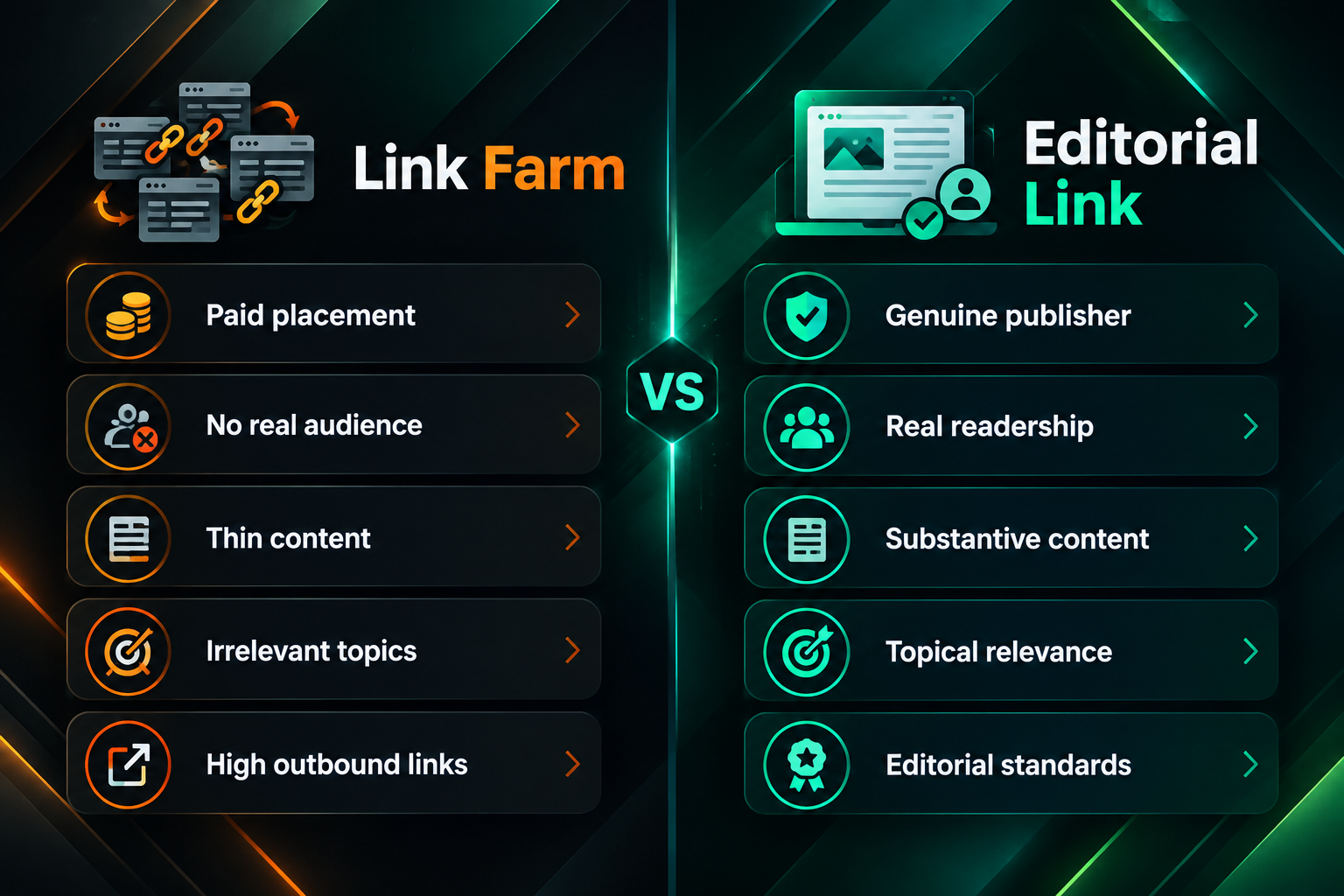
A legitimate editorial link appears because a real editor or author decided that the linked resource adds value for their readers. The linking site has a genuine audience, publishes content with a clear purpose, and would exist regardless of whether it was being paid to host links. The link is contextually relevant, appears within substantive content, and reflects a genuine recommendation or reference.
A link farm placement exists because someone paid for it or participated in a reciprocal scheme. The site may look superficially similar to a real publisher, but it has no genuine audience, no editorial standards, and no reason to exist other than to host links. The content surrounding the link is often thin, generic, or irrelevant to the linked page’s topic.
Manual outreach-based guest posting, when conducted properly, targets real publishers with genuine readerships and editorial standards. The process involves identifying relevant sites, pitching original content ideas, writing substantive articles that serve the publisher’s audience, and earning a link within that content. This approach takes more time and effort than purchasing a link farm placement, but the resulting links are more likely to pass genuine ranking signals and less likely to attract search-engine scrutiny.
Evaluating a Backlink Profile for Link Farm Signals
If you are assessing an existing backlink profile — whether for a site you manage or one you are considering acquiring — several practical steps can help identify potential link farm associations.
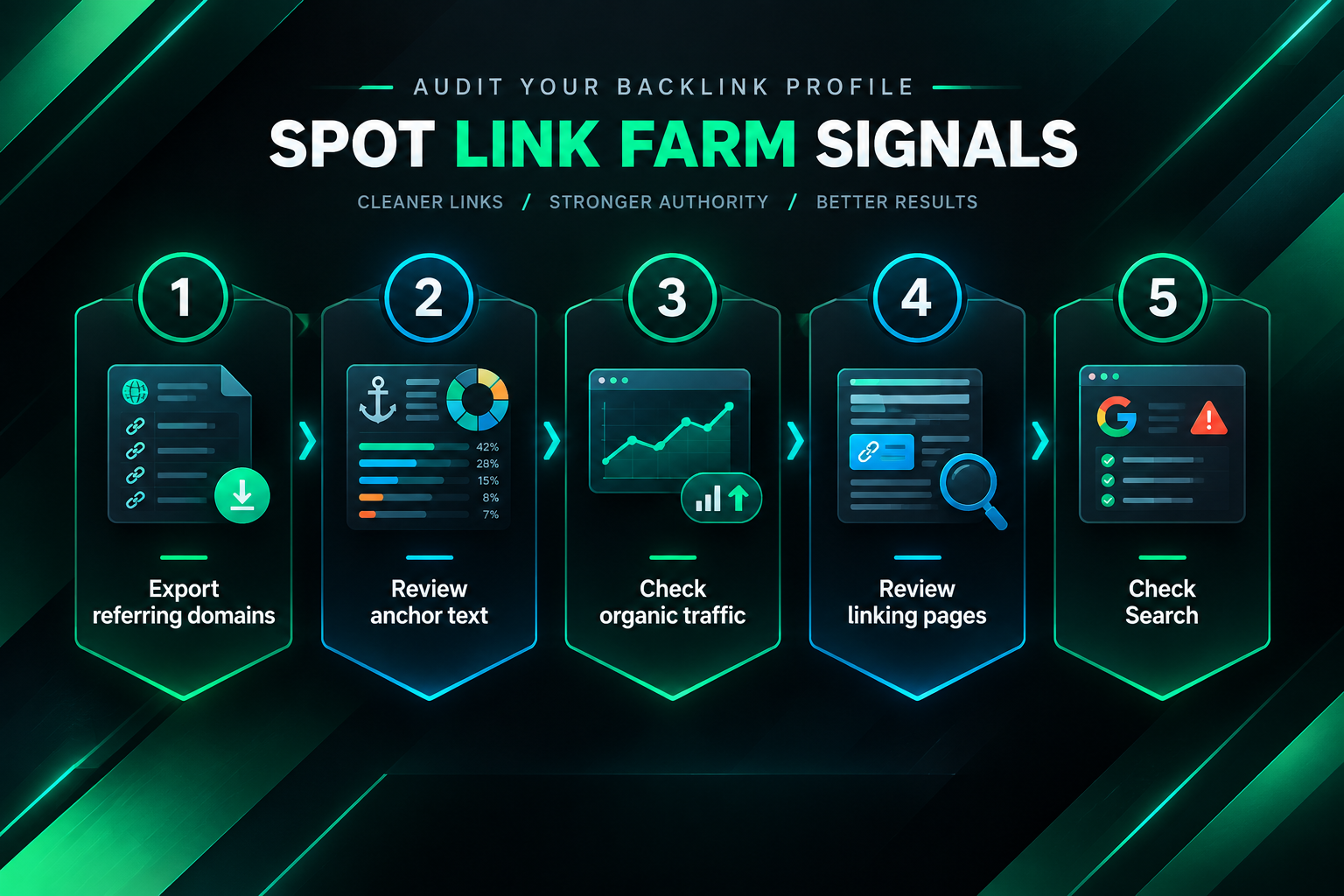
- Export referring domains from a tool such as Ahrefs, Semrush, or Majestic. Sort by the number of outbound links from each domain. Sites with very high outbound link counts relative to their content volume warrant closer inspection.
- Review anchor text distribution. A heavily commercial, exact-match anchor text profile — where a large proportion of links use the same target keyword phrase — is a common indicator of manipulative link building, including link farm use.
- Check estimated organic traffic for top referring domains. Legitimate publishers typically have some organic search visibility. Referring domains with high authority metrics but near-zero estimated traffic may have acquired their metrics artificially.
- Visit a sample of linking pages manually. Assess content quality, topical relevance, outbound link density, and whether the site has a genuine editorial identity. This manual review is time-consuming but provides context that automated tools cannot fully replicate.
- Check Google Search Console for manual actions. If a manual action related to unnatural links has been applied, it will appear in the Manual Actions report. The absence of a manual action does not confirm that a backlink profile is clean, but its presence confirms a problem that requires attention.
If a significant proportion of a site’s backlinks appear to come from link farm or link scheme sources, a disavow file submitted through Google Search Console may be appropriate. However, disavowing links should be approached carefully and ideally with input from an experienced SEO professional, as incorrectly disavowing legitimate links can remove genuine ranking signals.
Safer Alternatives to Link Farms
For businesses and SEO teams looking to build a backlink profile that is more durable and less likely to attract search-engine scrutiny, several white-hat link acquisition approaches are worth considering. Each has its own requirements, timelines, and suitability factors.
Manual Outreach and Guest Posting
Manual outreach involves identifying relevant, editorially independent websites and pitching original content contributions. When a pitch is accepted and an article is published, the resulting link appears within genuine editorial content on a real publisher’s site. This approach requires research, writing, and relationship-building effort, and placements typically take several weeks from initial outreach to publication. The links acquired through this process tend to be more topically relevant and contextually placed than link farm placements, and the sites involved have genuine audiences. Results vary depending on the target niche, the quality of the outreach, and the competitiveness of the target pages.
Niche Edits and Link Insertions
Niche edits involve adding a link to an existing published article on a relevant site, rather than creating new content. When conducted through genuine outreach to real publishers — rather than through link farm networks — this approach can place links within established, indexed content that already has some authority. The quality of the outcome depends heavily on the publisher’s legitimacy, the relevance of the existing article, and the context of the insertion. As with guest posting, the distinction between a legitimate niche edit and a link farm placement lies in whether the linking site has genuine editorial standards and a real audience.
Digital PR and Earned Links
Digital PR focuses on creating content, data, or stories that journalists, bloggers, and publishers want to reference independently. When successful, this approach can generate links from high-authority news and media sites that would be very difficult to acquire through direct outreach. Digital PR campaigns typically require more upfront investment in content creation and media relations, and results are less predictable than outreach-based methods. However, the links earned through genuine media coverage are among the most credible signals a backlink profile can contain.
Resource and Broken Link Building
Resource link building involves creating genuinely useful content — tools, guides, datasets, or reference pages — that other sites in a niche have reason to link to. Broken link building involves identifying broken outbound links on relevant sites and suggesting your content as a replacement. Both approaches require content investment and outreach effort, but the links acquired reflect genuine editorial decisions rather than paid placements.
Frequently Asked Questions
Can a link farm hurt my website even if I didn’t know about it?
Links pointing to your site from link farms can potentially affect your backlink profile’s perceived quality. In most cases, Google’s systems attempt to ignore or discount low-quality links rather than automatically penalising the target site, particularly when those links appear to be unsolicited. However, if a large volume of manipulative links is detected, a manual review may follow. Monitoring your backlink profile periodically and disavowing clearly manipulative links when appropriate is a reasonable precaution, particularly for sites in competitive niches.
Are all paid links the same as link farm links?
No. Paid links exist on a spectrum. A link farm placement is paid for on a site with no genuine audience or editorial standards. A sponsored placement on a legitimate publisher, disclosed with a rel=”sponsored” or rel=”nofollow” attribute as Google’s guidelines recommend, is a different arrangement. The risk profile differs significantly. Google’s spam policies are primarily concerned with paid links that pass PageRank without disclosure, not with all commercial relationships between publishers and advertisers.
Do high Domain Rating or Domain Authority scores mean a site is not a link farm?
Not necessarily. Domain Rating (Ahrefs), Domain Authority (Moz), and similar metrics are calculated by third-party tools based on their own link data and algorithms. They are not provided by Google and do not reflect Google’s internal quality assessment. A site can accumulate a high third-party metric through its own participation in link schemes while still being a low-quality or manipulative publisher. Always assess a site’s actual content quality, organic traffic, and editorial standards alongside any metric score.
How long does it take to recover from a link farm penalty?
Recovery timelines vary considerably depending on whether the issue is algorithmic or a formal manual action, the volume of problematic links, and how thoroughly the disavow or removal process is completed. Algorithmic recoveries may occur as Google recrawls and reassesses the backlink profile, which can take weeks to months. Manual action recoveries require a reconsideration request and a Google review, which can also take several weeks. There is no guaranteed timeline, and outcomes depend on the specific circumstances of each site.
Is it possible to accidentally acquire link farm links through an SEO agency?
Yes. Some link building providers use networks that share characteristics with link farms — sites with thin content, no genuine audience, and links sold to multiple clients across unrelated industries. Before engaging a link building provider, it is reasonable to ask for sample publisher sites, to review their quality assessment criteria, and to understand how they distinguish legitimate editorial placements from network-based placements. Reviewing a sample of proposed or delivered links against the characteristics described in this article can help identify potential concerns.
What should I do if I find link farm links in my backlink profile?
Start by documenting the links and assessing their volume relative to your overall backlink profile. For a small number of low-quality links among a predominantly healthy profile, no immediate action may be necessary. For a large volume of clearly manipulative links, particularly if accompanied by a manual action or unexplained ranking decline, preparing a disavow file and submitting it through Google Search Console may be appropriate. A site-specific assessment by an experienced SEO professional is advisable before taking action, as disavowing links incorrectly can remove genuine ranking signals.
Assessing Your Link Building Approach Before It Becomes a Problem
Link farms represent one of the clearest examples of a link building shortcut that carries meaningful long-term risk. The appeal is understandable: links at scale, quickly, and at low cost. The problem is that the links produced offer little genuine ranking value and create a backlink profile that may attract algorithmic demotion or manual review over time.
The more durable path involves building links through methods that reflect genuine editorial decisions — manual outreach, guest posting on real publishers, digital PR, and content-led link acquisition. These approaches require more time and investment, and results are not guaranteed, but they are less likely to create the kind of backlink profile that search engines are designed to discount or penalise.
If you are unsure whether your current backlink profile contains link farm associations, or if you are evaluating a link building provider’s methods, a backlink audit conducted against the quality signals described in this article is a practical starting point. For businesses considering outsourcing link acquisition, working with a provider that can demonstrate transparent publisher selection criteria and genuine editorial placements is worth prioritising over volume-based promises at low cost.