Backlinks from .edu and .gov domains have long been treated as a kind of SEO gold standard, with many practitioners assuming these links carry automatic ranking power simply because of their domain extension. The reality is more nuanced. Whether an edu or gov backlink meaningfully benefits a website depends on the quality and relevance of the linking page, how the link was acquired, and how Google’s systems evaluate it — not on the domain suffix alone. This article examines what the evidence actually supports, how these links can be earned legitimately, and what realistic expectations look like for businesses and SEO teams considering this approach.
Key Takeaways
- Google has stated that .edu and .gov domain extensions do not receive automatic ranking boosts; link quality is determined by the same signals applied to any other domain.
- Edu and gov sites often carry strong topical authority and high trust signals because of their editorial standards, which can make a genuine contextual link from them valuable.
- Legitimate acquisition methods — such as scholarships, resource contributions, research partnerships, and broken-link outreach — are time-intensive and not guaranteed to succeed.
- Paid or manipulative schemes targeting .edu and .gov domains carry the same policy risks as any other link scheme and should be evaluated accordingly.
- For most businesses, a diverse backlink profile built on relevance and editorial quality will likely deliver more consistent results than chasing a specific domain extension.
What Google Actually Says About Edu and Gov Backlinks
The belief that .edu and .gov links are inherently more powerful than links from other domains is widespread in SEO communities, but it is not supported by official Google documentation. Google’s former head of web spam, Matt Cutts, addressed this directly in a video response, stating that Google does not give special treatment to links based on their top-level domain or domain extension. The PageRank algorithm and its successors evaluate links based on signals such as the authority of the linking page, the relevance of the surrounding content, the link’s placement context, and whether the link appears to be editorially placed rather than artificially inserted.
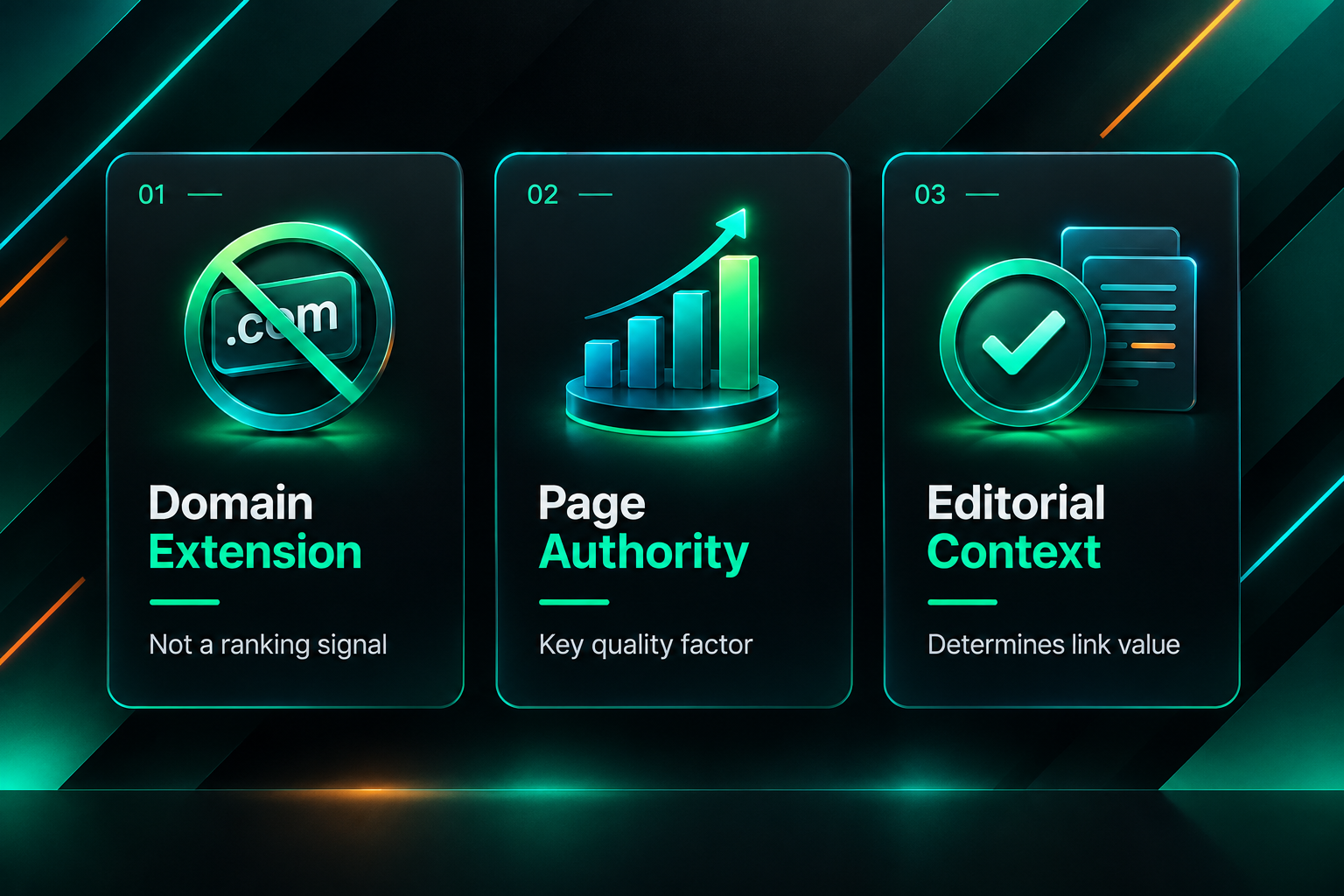
What makes many .edu and .gov pages genuinely valuable as link sources is not the extension itself but the characteristics that tend to accompany it. Educational institutions and government agencies typically maintain strict editorial standards, attract large volumes of legitimate inbound links themselves, and publish content that is cited widely across the web. A contextual link from a well-maintained university resource page or a government health agency’s reference list may carry meaningful trust signals — but those signals come from the page’s authority and relevance, not from the letters after the dot.
This distinction matters practically. A link buried in a low-traffic, rarely updated .edu subdomain with no inbound links of its own is unlikely to deliver the same value as a link from a highly cited departmental resource page. Evaluating an edu or gov link opportunity requires the same quality assessment applied to any other potential placement: examining the linking page’s authority metrics, its topical relevance to your content, the placement context, and whether the link is likely to be crawled and indexed.
Why Edu and Gov Links Are Often Considered High-Quality
Even though the domain extension itself is not a ranking signal, there are legitimate reasons why links from educational and government domains are frequently worth pursuing. These sites tend to accumulate strong backlink profiles over many years, which means their individual pages often carry high PageRank-equivalent authority. When a well-linked university department page or a government agency’s resource section links to an external site, that link passes a meaningful portion of the page’s accumulated authority.
Topical trust is another relevant factor. Search engines assess the trustworthiness of a linking domain partly through the quality and consistency of its content and its inbound link profile. Government health agencies, university research departments, and public libraries are among the most consistently cited sources on the web. A link from a page within one of these ecosystems can contribute positively to a site’s perceived trustworthiness in a given topic area, particularly in sectors such as healthcare, finance, education, legal services, and public policy where expertise and authority signals carry additional weight.
Referral traffic is a secondary but real benefit. Government resource pages and university library guides can attract sustained, targeted traffic from students, researchers, professionals, and members of the public. A link from a relevant .gov or .edu page can deliver qualified visitors over an extended period, independent of any direct ranking effect.
How Edu and Gov Backlinks Are Legitimately Acquired
Earning a genuine editorial link from an educational institution or government body requires a different approach from standard guest post outreach. These organizations rarely accept unsolicited content contributions in the way that commercial publishers do, and many have explicit policies against linking to commercial websites for payment. The most reliable acquisition methods are those that offer genuine value to the institution’s audience.

Scholarship and Grant Programs
One of the most documented methods for earning .edu backlinks is creating a legitimate scholarship or grant program and notifying university financial aid offices, scholarship aggregator pages, and student services departments. Many universities maintain publicly accessible scholarship listing pages and will add a link to a verified external scholarship. This method requires a real financial commitment — the scholarship must be genuine and funded — and results are not guaranteed, as each institution decides independently whether to list external opportunities. The links earned through this method are typically placed on scholarship or financial aid resource pages, which may or may not carry strong individual page authority depending on the institution.
Resource Page and Broken Link Outreach
University library guides, departmental resource pages, and government agency reference lists frequently link to external websites that provide useful information for their audiences. Identifying relevant resource pages and offering a genuinely useful, well-researched piece of content as a replacement for a broken link or as an addition to an existing list is a legitimate outreach method. This approach requires careful prospecting to find pages where your content is a natural fit, and it demands that the content itself meets the editorial standards of the institution. Response rates from .edu and .gov webmasters tend to be lower than from commercial publishers, and the process can take considerably longer.
Research Collaboration and Data Contributions
Businesses that produce original research, industry data, or tools that are genuinely useful to academic or government audiences may earn citations naturally. Publishing original survey data, commissioning independent research, or creating publicly accessible tools that researchers and policy professionals find useful can lead to organic citations from .edu and .gov domains over time. This is a longer-term strategy that depends heavily on the quality and relevance of the asset being created, and it is not suitable for every business or niche.
Community Partnerships and Local Government Listings
Local government websites, public library systems, and community college resource pages sometimes maintain directories of local businesses, nonprofits, or service providers. Businesses with a genuine local presence may be eligible for inclusion in these listings. The links from local government directories are typically lower in individual page authority than links from major federal agencies or research universities, but they can contribute to a locally relevant backlink profile and may carry trust signals appropriate to local SEO goals.
Guest Contributions to University Publications
Some university departments, student newspapers, and academic extension programs accept expert contributions from industry professionals. Where a genuine subject-matter fit exists — for example, a cybersecurity firm contributing to a university computer science department’s blog, or a financial services company contributing to a business school’s resource section — this can be a legitimate path to an editorial .edu link. These opportunities are relatively rare and require a credible expert contributor rather than generic content.
Assessing the Quality of an Edu or Gov Link Opportunity
Not all .edu and .gov link opportunities are equal, and treating them as automatically valuable because of their domain extension is a mistake that can lead to wasted outreach effort or, in some cases, association with low-quality pages. A structured quality assessment should be applied to any prospective placement.
Key factors to evaluate include the authority of the specific linking page rather than just the root domain, the topical relevance of the page’s content to your target page, whether the page is actively maintained and indexed, the number and quality of other external links on the page, and whether the link placement would appear contextually natural to a human reader. Third-party metrics from tools such as Ahrefs, Semrush, or Moz can provide useful reference points for page-level authority, but these are proprietary estimates rather than Google-provided signals and should be treated as directional indicators rather than definitive quality scores.
It is also worth noting that some .edu domains host student blogs, personal faculty pages, or subdomain microsites that may have little connection to the institution’s main editorial standards. A link from a student’s personal project page on a university subdomain is unlikely to carry the same authority signals as a link from the institution’s main library resource guide. Careful prospecting and page-level assessment are essential.
Risks and Policy Considerations
The same Google Search Essentials guidelines that govern link schemes across the web apply equally to .edu and .gov link acquisition. Paying for placements on educational or government websites, using link brokers who claim to have relationships with these institutions, or participating in reciprocal link arrangements that violate the linking site’s own policies all carry the risk of a manual action or algorithmic devaluation. The domain extension does not provide immunity from Google’s spam policies.
Some link vendors market .edu and .gov backlinks as premium products, sometimes at significantly higher prices than standard guest post placements. Buyers should exercise caution and verify that any claimed placement is genuinely editorial, that the linking page is indexed and active, and that the acquisition method complies with both Google’s guidelines and the linking institution’s own policies. A link that appears to have been placed through a scheme rather than earned editorially may be discounted by Google’s systems or, in cases of clear manipulation, may contribute to a negative assessment of the linking site’s overall backlink profile.
It is also worth considering that government and educational institutions occasionally audit their outbound links and remove placements that no longer meet their standards or that were added without proper authorization. Link retention on .edu and .gov pages is not guaranteed, and a link building strategy that relies heavily on a small number of high-profile placements carries concentration risk if those links are later removed.
Realistic Expectations and Campaign Suitability
Edu and gov link acquisition is not a strategy that suits every business or every campaign stage. The effort required to earn genuine placements from these sources is substantially higher than for standard editorial outreach, and the timelines are typically longer. For businesses in competitive niches where topical authority and trust signals are particularly important — such as healthcare, legal services, financial advice, education technology, or public policy — a well-executed strategy to earn relevant .edu or .gov citations may contribute meaningfully to a broader link building campaign. For businesses in unrelated niches, the effort-to-return ratio may not justify prioritizing these placements over other link acquisition methods.
Businesses considering this approach should assess their existing backlink profile, the authority and relevance of their current referring domains, and whether their content assets are genuinely suited to the audiences of educational and government websites. A site that lacks strong foundational content, has technical SEO issues, or is in an early stage of building domain authority may find that other link building priorities deliver more measurable results in the near term.
When working with an outsourced link building provider on campaigns that include .edu or .gov outreach, it is reasonable to ask about the specific acquisition methods used, how placement quality is assessed, what the expected timeline for results looks like, and what happens if a placed link is removed. Transparent providers will be able to explain their prospecting and outreach process clearly and will not make guarantees about placement volumes or ranking outcomes.
Alternatives and Complementary Strategies
For businesses that find .edu and .gov link acquisition impractical or unsuitable for their niche, several complementary strategies can build a strong, diverse backlink profile without relying on a specific domain extension.
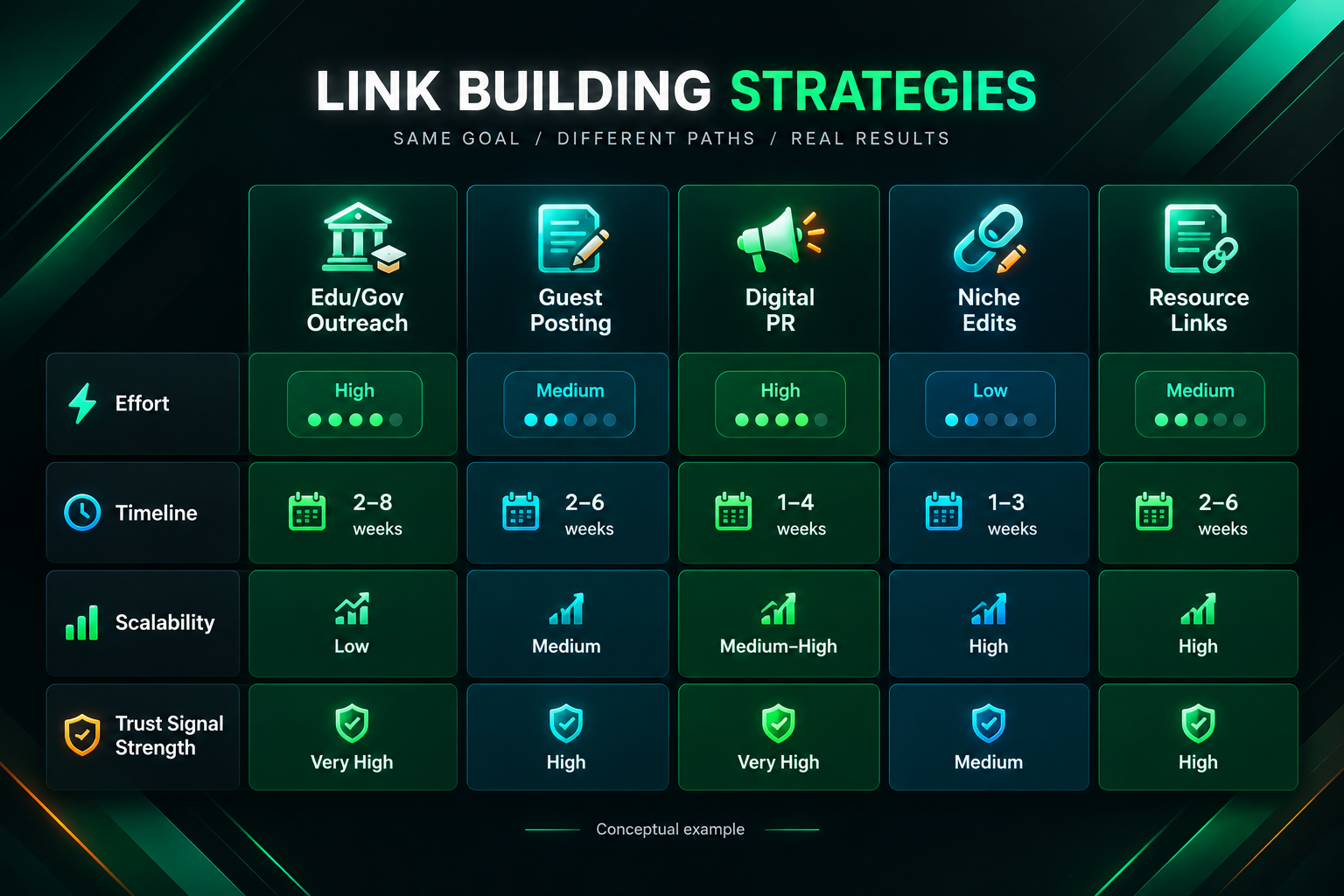
- Manual guest post outreach to topically relevant, editorially selective publishers can build authority and referral traffic in a more scalable way than .edu or .gov outreach, with shorter timelines and more predictable placement rates.
- Digital PR and original research can earn citations from high-authority news publications, industry media, and trade associations, which may carry comparable trust signals to .edu or .gov placements in many niches.
- Niche edits and contextual link placements within existing, well-indexed content on relevant authority sites can deliver strong topical relevance signals without the extended timelines associated with institutional outreach.
- Resource link building targeting commercial publishers, industry associations, and professional bodies can build a diverse referring domain profile with strong topical alignment.
- Unlinked brand mention outreach converts existing citations into followed links, building authority from sources that have already demonstrated interest in the brand.
A well-structured link building campaign typically combines several of these methods rather than concentrating effort on a single link type. Topical diversity, referring domain diversity, and placement context are generally more important to long-term backlink profile health than the presence or absence of links from any particular domain extension.
Frequently Asked Questions
Does Google give .edu and .gov links more PageRank than other links?
Google has not confirmed that .edu or .gov domain extensions receive preferential PageRank treatment. The value of a link from these domains comes from the same factors that determine any link’s value: the authority of the linking page, its topical relevance, the placement context, and whether the link appears to be editorially placed. A high-authority, relevant .edu or .gov page can pass significant link equity, but this is a function of the page’s characteristics, not the domain extension itself.
Is it possible to buy .edu or .gov backlinks safely?
Paying for placements on educational or government websites is generally considered a link scheme under Google’s Search Essentials guidelines, regardless of the domain extension. Some vendors claim to offer paid .edu or .gov placements, but buyers should be aware that these arrangements may violate both Google’s policies and the linking institution’s own rules. Links acquired through schemes rather than genuine editorial processes risk being discounted or, in more serious cases, contributing to a manual action. Legitimate .edu and .gov links are earned through genuine value exchange, not purchased.
How long does it take to earn a .edu or .gov backlink?
Timelines vary considerably depending on the acquisition method and the responsiveness of the target institution. Scholarship-based outreach may take several months from program launch to link placement. Resource page and broken link outreach campaigns targeting .edu or .gov pages typically have lower response rates than commercial outreach, and multiple follow-up contacts may be needed. Research-based link earning through original data or tools can take considerably longer, as it depends on organic discovery and citation by academic or government audiences. Businesses should plan for timelines measured in months rather than weeks for this type of outreach.
Are .edu links from student blogs or personal faculty pages valuable?
Links from student blogs, personal faculty pages, or low-traffic subdomain microsites on .edu domains are unlikely to carry the same authority signals as links from the institution’s main resource pages or departmental sites. The value of any link depends on the authority and relevance of the specific linking page, not the root domain. Prospecting should focus on well-maintained, actively indexed pages with genuine topical relevance rather than any .edu URL.
Can a small business realistically earn .edu or .gov backlinks?
Small businesses can earn legitimate .edu or .gov links, but the most accessible methods — such as scholarship programs or research contributions — require either financial investment or significant content resources. Local government directory listings and community college resource pages may be more accessible for businesses with a genuine local presence. For many small businesses, the effort required to pursue .edu or .gov placements may be better directed toward building a strong foundation of topically relevant links from commercial publishers and industry sources first.
How should I evaluate a vendor offering .edu or .gov link building services?
Ask the vendor to explain their specific acquisition methods in detail. Legitimate providers will describe genuine outreach processes such as scholarship programs, resource page prospecting, or research-based link earning. Be cautious of vendors who cannot explain their methods clearly, who guarantee specific placement volumes, or who offer .edu and .gov links at unusually low prices. Request examples of previous placements and verify that the linking pages are genuinely indexed, editorially relevant, and maintained by the institution rather than hosted on abandoned or low-quality subdomains.
Deciding Whether Edu and Gov Link Building Fits Your Strategy
Edu and gov backlinks can be a genuinely valuable component of a link building strategy when they are earned through legitimate methods, placed on relevant and authoritative pages, and assessed with the same quality standards applied to any other link type. The domain extension alone is not a shortcut to ranking improvement, and treating it as one can lead to wasted resources or, in the case of paid schemes, meaningful policy risk.
For businesses in sectors where topical authority and trust signals carry particular weight, a targeted effort to earn relevant .edu or .gov citations — as part of a broader, diverse link building campaign — may be worth the additional time and resource investment. For businesses at an earlier stage of building their backlink profile, or in niches where these institutions are unlikely to link to commercial content, other link acquisition methods will typically deliver more consistent and measurable results in a shorter timeframe.
If you are considering whether edu and gov link outreach is appropriate for your current campaign, a qualified link building provider can assess your existing backlink profile, your content assets, and your competitive landscape to help determine where this type of outreach fits relative to other priorities. The goal is always a backlink profile that reflects genuine editorial endorsement across relevant, authoritative sources — and that standard applies regardless of which domain extension those sources happen to use.