If you have ever embedded content from another website or had your content embedded elsewhere, you may have wondered whether the links inside those iframes pass any SEO value. The short answer is that Google can crawl links inside iframes, but whether those links function as meaningful backlinks in the traditional sense is more complicated than a simple yes or no. Understanding how search engines treat iframe content helps you avoid misplaced assumptions about link equity and make better decisions about your link acquisition strategy.
Key Takeaways
- Google can crawl and index content inside iframes, but iframe links are generally not treated the same as standard editorial backlinks for ranking purposes.
- The SEO value of an iframe link depends on how the search engine attributes the content — whether it is associated with the embedding page or the original source.
- Deliberately using iframes to manufacture backlinks carries meaningful risk under Google’s spam policies and is unlikely to produce reliable ranking improvements.
- For sustainable link acquisition, manual outreach, guest posting, and editorial placements on relevant, quality publishers remain more dependable approaches.
- If you are auditing your backlink profile, iframe-sourced links may appear in tools like Ahrefs or Semrush but should be evaluated carefully before being counted as genuine link equity.
What Is an iFrame and How Does It Work?
An iframe, short for inline frame, is an HTML element that embeds one web page inside another. When a publisher places an iframe on their page, the embedded content is loaded from a separate URL — it is not part of the host page’s own HTML source in the conventional sense. Common uses include embedding YouTube videos, Google Maps, third-party widgets, social media posts, and syndicated content blocks. From a visitor’s perspective, the embedded content appears seamlessly within the host page, but technically it originates from a different domain or URL.
The distinction matters for SEO because search engine crawlers do not always treat embedded iframe content the same way they treat native HTML on a page. When Googlebot encounters an iframe, it can follow the src attribute to the embedded URL and crawl that content separately. However, the relationship between the embedding page and the embedded content is not automatically equivalent to a standard hyperlink pointing from one page to another.
How Google Handles Links Inside iFrames
Google has confirmed through its documentation and public statements from its search representatives that Googlebot is capable of rendering JavaScript and crawling iframe content. This means that a link sitting inside an iframe is not invisible to Google — the crawler can discover and follow it. However, the question of whether that link passes PageRank or functions as a genuine backlink is a separate matter.
When Google crawls an iframe, it typically associates the content with the original source URL specified in the src attribute, not necessarily with the embedding page. This means a link inside an iframe may be credited to the page being embedded rather than appearing as a link from the host domain to a third-party destination. In practical terms, the embedding page may not be passing link equity to the linked destination in the way a standard anchor tag in the page’s own HTML would.
Google’s John Mueller has addressed iframe-related questions in various public forums over the years, generally indicating that iframe content is treated as belonging to the embedded document rather than the host page. While Google’s exact handling can vary depending on how the iframe is implemented, the consensus among SEO practitioners is that iframe links are not a reliable mechanism for passing link authority between domains.
It is also worth noting that Google’s ability to crawl iframe content depends on whether the embedded URL is accessible to Googlebot, whether JavaScript rendering is required, and whether the content is blocked by robots.txt or other access restrictions. These variables mean that iframe links are inconsistent even as a discovery mechanism, let alone as a source of link equity.
Do iFrame Links Appear in Backlink Tools?
Third-party SEO tools such as Ahrefs, Semrush, and Majestic crawl the web independently and may detect links found within iframes. Whether a given tool reports an iframe link as a backlink depends on how that tool’s crawler handles iframe elements and whether it attributes the link to the embedding page or the embedded source. Some tools may list iframe-sourced links in a site’s backlink profile, which can create the impression that these links carry the same weight as editorial placements.
This is an important distinction for anyone auditing a backlink profile. A link appearing in Ahrefs or Semrush does not automatically mean it is passing meaningful PageRank or contributing to rankings. Metrics such as Domain Rating (Ahrefs), Authority Score (Semrush), or Trust Flow (Majestic) are proprietary calculations and are not direct measures of Google’s assessment of a link’s value. An iframe link that appears in a backlink report should be evaluated in context rather than assumed to be a high-value placement.
The Risk of Using iFrames Deliberately for Link Building
Some link building approaches have historically attempted to exploit iframe embedding as a way to generate backlinks at scale — for example, by creating embeddable widgets, infographics, or content blocks that include a link back to the originating site, then encouraging other websites to embed them. When done transparently and with genuine editorial value, this type of strategy can be a legitimate form of link acquisition. The embedded content provides real utility to the host site, and the attribution link is a natural part of the arrangement.
However, when iframe embedding is used primarily as a mechanism to manufacture links rather than to provide genuine value, it enters territory that conflicts with Google’s link spam policies. Google’s spam policies explicitly address links that are intended to manipulate PageRank, and this includes schemes that use technical workarounds to create the appearance of editorial endorsement without genuine editorial intent. A site that embeds low-quality widgets across thousands of unrelated pages purely to generate links is unlikely to see lasting ranking benefits and may attract a manual action or algorithmic demotion.
The risk is compounded by the fact that, as discussed above, iframe links may not reliably pass link equity in the first place. This means a strategy built around iframe-based link acquisition carries meaningful downside risk with uncertain upside benefit — a poor trade-off compared to approaches that generate genuine editorial placements.
When iFrame Embedding Can Be a Legitimate Part of a Content Strategy
Not all iframe-related link acquisition is manipulative. There are legitimate scenarios where embedding content creates natural attribution links that may contribute to a site’s visibility and referral traffic, even if the direct PageRank benefit is uncertain.
Embeddable infographics and data visualizations are a well-established example. A publisher creates a genuinely useful visual resource and provides an embed code that includes a link back to the original source. When other websites embed the infographic because it adds value to their content, the attribution link is editorially motivated. Whether that link passes significant PageRank through the iframe mechanism is debatable, but the strategy can still generate brand visibility, referral traffic, and in some cases direct editorial links when publishers choose to link to the source separately in their own HTML.
Similarly, embeddable tools, calculators, and interactive widgets can attract genuine placements from relevant publishers. The SEO value of these placements is likely to be stronger when the embedding site also includes a standard HTML link to the source alongside the iframe, rather than relying solely on a link embedded within the iframe element itself.
If you are considering an embeddable content strategy, the practical recommendation is to design the embed code so that the attribution link appears as a standard anchor tag outside the iframe where possible, or to encourage publishers to add their own editorial link to your site. This approach is more likely to generate link equity that search engines recognize reliably.
iFrame Links vs. Standard Editorial Backlinks
To understand why iframe links are generally considered less valuable than standard editorial backlinks, it helps to consider what Google’s link evaluation is designed to reward. The underlying principle of PageRank is that a link from one page to another represents an editorial endorsement — a signal that the linking page’s author or publisher considers the linked destination relevant and trustworthy. The value of that signal depends on the quality, relevance, and authority of the linking page, as well as the context in which the link appears.
A standard editorial backlink — for example, a link placed within the body of a well-written article on a relevant, authoritative website — carries this signal clearly. The link is part of the host page’s own HTML, it is contextually relevant, and it represents a deliberate editorial choice by the publisher. Search engines are designed to recognize and reward this type of link.
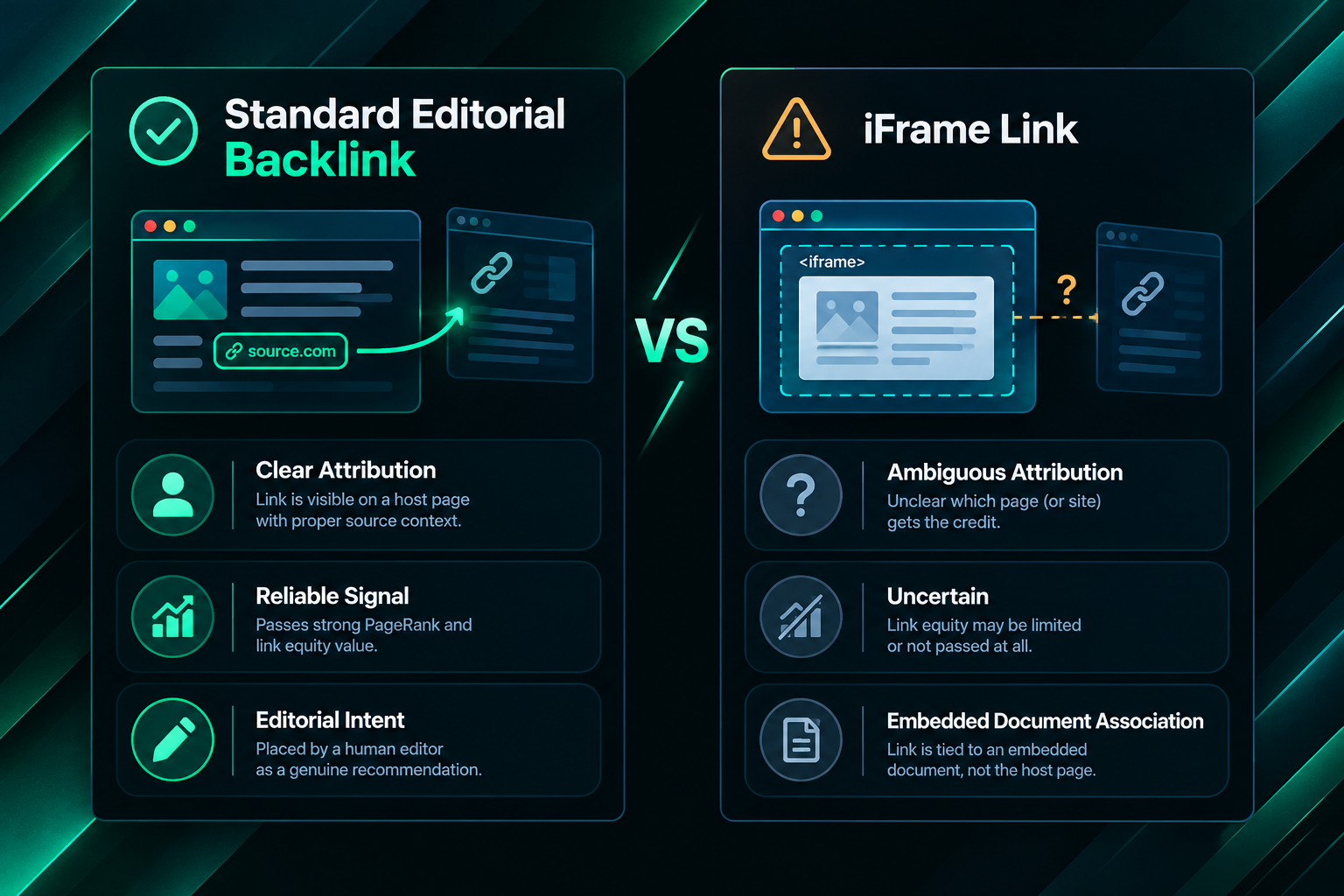
An iframe link, by contrast, is embedded content from a separate document. Even when Google crawls it, the attribution of that content to the host page is ambiguous. The host page’s publisher may not have made a deliberate editorial decision to endorse the linked destination — they may simply have embedded a widget or video player. This ambiguity reduces the reliability of iframe links as editorial signals, which is why most SEO practitioners do not treat them as equivalent to genuine editorial placements.
Practical Implications for Backlink Audits
If you are conducting a backlink audit and encounter links that appear to originate from iframes, a few practical considerations apply. First, assess whether the linking page is a genuine, quality publisher or a low-quality site that has embedded your content as part of a widget scheme. Second, consider whether the link appears in the iframe’s embedded content or as a standard anchor tag on the host page. Third, evaluate whether the link is likely to be crawled and indexed by Google given the technical implementation.
Links that appear in backlink tools but originate from iframe embeds on low-quality or irrelevant pages are unlikely to be contributing meaningfully to your rankings. They are also unlikely to require disavowal unless they are part of a pattern that could be interpreted as a manipulative link scheme. If you are uncertain, consulting an SEO professional with access to your Google Search Console data and full backlink profile is a more reliable approach than making disavowal decisions based on tool data alone.
For sites that have used embeddable widget strategies in the past, it is worth reviewing whether those placements are on relevant, quality publishers and whether the embed code generates links that are accessible to Googlebot. If the strategy was implemented primarily for link building rather than genuine content value, a reassessment may be appropriate given the risk profile.
Alternatives That May Deliver More Reliable Link Equity
For businesses and SEO teams looking to build a backlink profile that reliably contributes to organic visibility, several approaches are generally considered more dependable than iframe-based strategies.
Manual outreach and guest posting involve identifying relevant, quality publishers in your industry and pitching original content that earns a standard editorial link within the article body. This approach generates links that are clearly attributed to the host page, contextually relevant, and editorially motivated. The process requires time and relationship-building, but the resulting placements are more likely to be recognized as genuine endorsements by search engines.
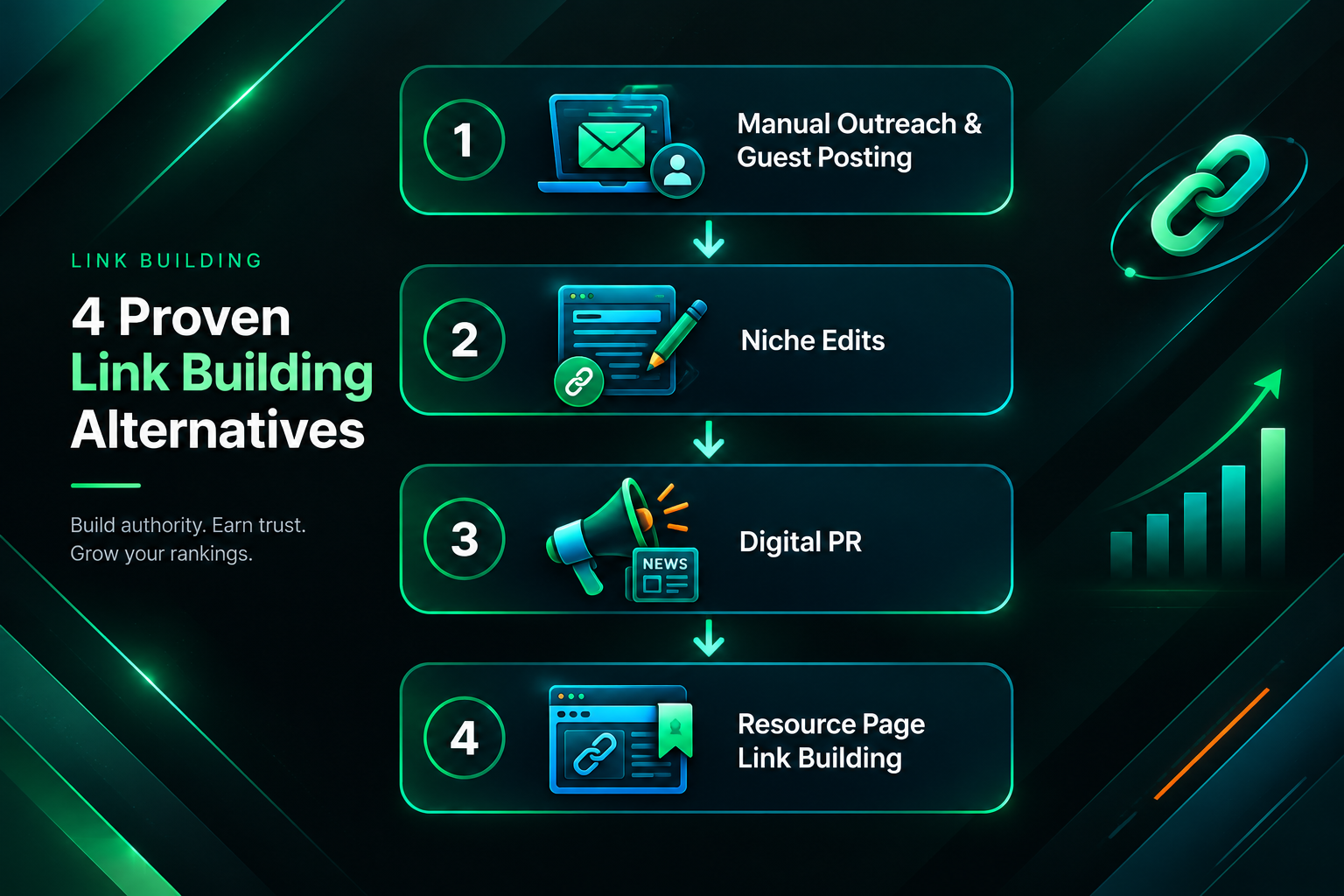
Niche edits, sometimes called link insertions, involve placing a link within existing published content on a relevant website. When done through genuine editorial relationships rather than paid link schemes, niche edits can generate contextually strong placements on pages that already have established authority and traffic.
Digital PR focuses on creating newsworthy content, data studies, or resources that attract coverage and links from journalists, bloggers, and industry publications. This approach can generate high-authority placements that are difficult to replicate through outreach alone, though it requires investment in content creation and media relationship development.
Resource page link building involves identifying pages on relevant websites that curate useful resources for their audience and requesting inclusion. When the resource is genuinely useful and relevant, this can generate editorial placements with clear topical context.
Each of these approaches generates standard HTML backlinks with clear editorial attribution, which are more reliably processed by search engines as genuine link signals. The trade-off is that they require more effort, time, and often budget compared to automated or widget-based approaches — but the link equity they generate is more likely to be durable and meaningful.
What This Means for Outsourced Link Building Campaigns
If you are working with an external link building provider or considering outsourcing your link acquisition, understanding how iframe links work is relevant to evaluating the quality of what you receive. A reputable provider will focus on generating standard editorial placements on genuine, relevant publishers — not on widget schemes, iframe embeds, or other technical workarounds that may appear in backlink reports without delivering reliable link equity.
When reviewing a provider’s approach, it is reasonable to ask how placements are acquired, what types of links are generated, and how the provider assesses publisher quality. Placements should appear as standard anchor tags within editorial content on real websites with genuine audiences. If a provider’s reporting shows a high volume of links from embedded widgets or iframe-based placements, it is worth investigating whether those links are likely to be recognized by Google as genuine editorial signals.
Quality link building campaigns typically involve publisher vetting, topical relevance assessment, and editorial content creation — processes that take time but generate placements with clearer SEO value. The volume of links matters less than the quality and relevance of the publishers, the context of the placement, and whether the links are accessible and attributable in the way search engines expect.
Frequently Asked Questions
Can Google see links inside iframes?
Yes, Googlebot can crawl iframe content by following the src attribute to the embedded URL. However, Google typically associates that content with the embedded document rather than the host page, which affects how any links within the iframe are attributed and whether they pass link equity to the host page’s outbound destinations.
Will an iframe link show up in my backlink profile in Ahrefs or Semrush?
It may, depending on how the tool’s crawler handles iframe elements. Third-party tools crawl independently and may report iframe-sourced links as backlinks. However, a link appearing in a backlink tool does not confirm that Google is treating it as a meaningful editorial signal or that it is contributing to your rankings.
Is it against Google’s guidelines to use iframes for link building?
Using iframes to deliberately manufacture backlinks at scale — for example, through widget schemes designed primarily to generate links rather than provide genuine value — is likely to conflict with Google’s link spam policies. Legitimate embeddable content strategies that provide real utility to publishers are a different matter, though the direct PageRank benefit of iframe links remains uncertain regardless of intent.
Should I disavow iframe links in my backlink profile?
Not necessarily. Disavowal is generally appropriate for links that are clearly manipulative and that you believe may be contributing to a manual action or algorithmic penalty. Iframe links from low-quality sources are unlikely to be passing significant positive value, but disavowal decisions should be made carefully and ideally with the guidance of an SEO professional who can review your full backlink profile and Search Console data.
If I create an embeddable widget, how can I make the attribution link more effective?
Design the embed code so that the attribution link appears as a standard anchor tag outside the iframe element where possible. You can also encourage publishers who embed your content to add their own editorial link to your site in their page’s HTML. This approach is more likely to generate link equity that search engines recognize reliably than relying solely on a link embedded within the iframe itself.
Do iframe links count the same as editorial backlinks for ranking purposes?
Based on available evidence and Google’s documented approach to iframe content, iframe links are generally not treated as equivalent to standard editorial backlinks. The attribution of iframe content to the host page is ambiguous, which reduces the reliability of these links as editorial signals. For ranking purposes, standard editorial placements in the host page’s own HTML are considered more dependable.
What to Consider Before Relying on iFrame Links in Your SEO Strategy
The evidence available from Google’s documentation, public statements from its search representatives, and the broader SEO community consistently points in the same direction: iframe links are not a reliable substitute for genuine editorial backlinks. They may be crawled, they may appear in backlink tools, and in some implementations they may contribute marginally to a site’s link profile — but they are not a dependable mechanism for building the kind of authoritative, contextually relevant backlink profile that supports sustainable organic visibility.
For businesses and SEO teams evaluating their link acquisition strategy, the practical implication is straightforward. If your current approach relies heavily on widget embeds, iframe-based placements, or similar technical mechanisms, it is worth assessing whether those placements are generating genuine editorial value or simply adding noise to your backlink report. The effort and budget invested in those approaches may deliver better returns when redirected toward manual outreach, guest posting on relevant publishers, or digital PR campaigns that generate standard editorial links with clear topical context.
If you are unsure how your existing backlink profile is performing or whether your current link acquisition approach is aligned with your organic visibility goals, a professional link building audit can provide a clearer picture. Understanding what is in your profile, what is likely to be contributing to rankings, and where the gaps are is a more reliable starting point than assuming that link volume in a third-party tool translates directly to SEO value.