Backlinks are one of the most discussed concepts in search engine optimisation, yet they are frequently misunderstood. A backlink is simply a hyperlink on one website that points to a page on another website. Search engines such as Google have used these links as signals of credibility and relevance for decades, and they remain a meaningful part of how pages are evaluated for organic search rankings. Understanding what backlinks are, how they differ in quality, and where they fit within a broader SEO strategy helps business owners and marketers make better decisions about where to invest their time and budget.
Key Takeaways
- A backlink is a hyperlink from one website pointing to a page on another website, and search engines treat these links as signals of authority and relevance.
- Not all backlinks carry equal weight — the quality, topical relevance, and context of a link matter more than the total number of links pointing to a page.
- Backlinks are one ranking factor among many; technical SEO, content quality, and search intent alignment all influence organic visibility alongside link acquisition.
- Acquiring backlinks through manipulative or low-quality methods carries documented risks under Google’s spam policies, and the impact of any link building campaign depends on the specific website, market, and competition.
- A site-specific assessment is advisable before prioritising link building, as low organic visibility can have multiple causes that links alone may not resolve.
What Is a Backlink?
A backlink — also called an inbound link, incoming link, or external link — is a hyperlink that originates on one domain and directs a user to a page on a different domain. From the perspective of the destination page, that link is a backlink. From the perspective of the linking page, it is an outbound link. The distinction matters because search engines analyse both the source and the destination when assessing what a link signals about a page’s credibility and subject matter.
When a website links to another, it is effectively making a reference. Early search engine research, including the foundational work behind Google’s PageRank algorithm, treated these references as votes of confidence — the more credible sites that linked to a page, the more likely that page was to be authoritative on its topic. While the modern ranking system is considerably more sophisticated than a simple vote count, the underlying principle that links carry informational value about a page’s relevance and trustworthiness has remained consistent in Google’s publicly available documentation.
Backlinks are distinct from internal links, which connect pages within the same domain, and from paid advertisements, which are typically labelled and treated differently by search engines. A backlink from an editorially placed, contextually relevant source on a reputable website is generally considered more valuable than a link placed in a directory, a comment section, or a low-quality article with no genuine audience.
How Search Engines Use Backlinks
Search engines use backlinks as one of many signals when deciding how to rank pages in organic search results. Google’s publicly available guidance describes links as a way for crawlers to discover new pages and as a signal that other sites find a page useful or credible. However, Google has also been clear that not all links are treated equally, and that attempts to manipulate rankings through artificial link schemes can result in manual actions or algorithmic demotions under its spam policies.
When a search engine crawler follows a backlink, it can discover the destination page and assess the relationship between the two pages. The anchor text — the visible, clickable words that form the hyperlink — provides context about what the destination page covers. A link with descriptive anchor text such as “content marketing strategy for B2B companies” tells a search engine something different about the destination page than a link with generic anchor text such as “click here”. This is why anchor text diversity and relevance are discussed in link building planning, though prescribing exact anchor text ratios as a guaranteed formula is not supported by documented evidence.

Search engines also assess link attributes. A standard followed link passes what is commonly called link equity or link value to the destination page. A link marked with the rel=”nofollow” attribute signals to search engines that the linking site does not wish to endorse the destination, and Google has stated it treats nofollow as a hint rather than a directive. Links marked rel=”sponsored” or rel=”ugc” indicate paid placements or user-generated content respectively. These distinctions affect how a link may be interpreted, though the precise weighting applied to different link attributes is not publicly disclosed by search engines.
What Makes a Backlink Valuable?
The value of a backlink is not determined by a single factor. Several characteristics influence how much weight a link may carry in practice, and these characteristics interact with one another rather than operating independently.
Topical Relevance
A backlink from a website that covers closely related subject matter is generally considered more relevant than a link from an unrelated domain. A software company receiving a backlink from a technology publication is a more natural and contextually coherent reference than the same company receiving a link from a gardening blog. Topical relevance applies both at the domain level and at the individual page level — a link embedded within an article that discusses the same subject as the destination page tends to carry clearer contextual meaning.
Authority and Trustworthiness of the Linking Domain
Links from websites that are themselves well-regarded and widely referenced tend to carry more weight than links from newly registered or thinly populated domains. Third-party SEO tools such as Ahrefs, Semrush, Moz, and Majestic each calculate their own proprietary metrics — Domain Rating, Authority Score, Domain Authority, and Trust Flow respectively — as proxies for a domain’s link profile strength. These metrics are useful for comparative assessment during link prospecting, but they are tool-specific estimates rather than Google-provided scores, and an improvement in any of these metrics does not guarantee a corresponding improvement in search rankings or organic traffic.
Placement and Editorial Context
A link placed within the body of a substantive, well-written article on a genuine publisher website is typically considered more editorially meaningful than a link in a footer, sidebar, or boilerplate section. Editorial context signals that a human writer or editor made a deliberate decision to reference the destination page, which aligns more closely with the kind of organic endorsement that search engines aim to reward. Links that appear to have been placed purely for SEO purposes, without genuine editorial intent, carry a higher risk of being discounted or flagged under search engine spam policies.
Link Attributes and Indexing Status
For a backlink to potentially contribute to search rankings, the linking page generally needs to be crawlable and indexed by the relevant search engine. A link on a page that is blocked by robots.txt, marked noindex, or not yet discovered by crawlers may not pass the signals that a fully indexed, followed link would. Monitoring whether linking pages are indexed is a practical step in any link building campaign, though the timing of crawling and indexing is controlled by the search engine and cannot be guaranteed by a link building provider.
Types of Backlinks and How They Are Acquired
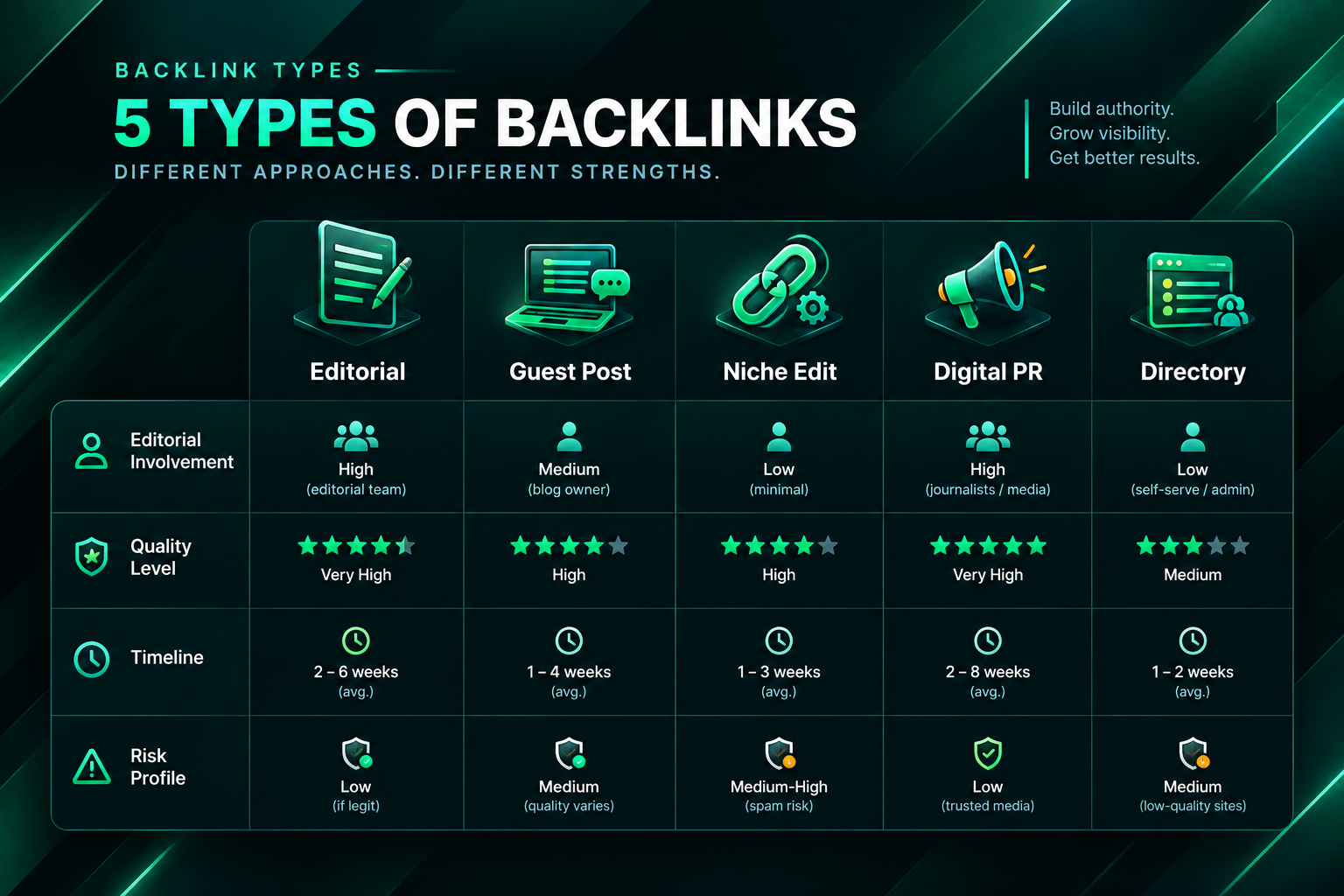
Backlinks can be acquired through a range of methods, each with different characteristics in terms of editorial involvement, topical targeting, delivery timelines, and risk profile. Understanding these differences helps businesses and SEO teams choose approaches that align with their goals and risk tolerance.
Editorial Backlinks
Editorial backlinks are links that a publisher or writer includes voluntarily because they find the destination page genuinely useful or relevant to their audience. These links are widely considered the most valuable type because they reflect authentic third-party endorsement. Earning editorial backlinks typically requires producing content, tools, research, or resources that other websites want to reference. This approach can be slow and unpredictable, but the links it produces tend to be durable and contextually strong.
Guest Post Backlinks
Guest posting involves writing an article for a third-party website in exchange for a backlink within the content or author bio. When executed on genuine, topically relevant publications with real audiences, guest posting can be an effective way to build contextual backlinks while also reaching new readers. The quality of guest post placements varies considerably — links on high-traffic, editorially selective publications carry different weight than links on low-quality sites that accept any submission. Google’s spam policies specifically address large-scale guest posting conducted primarily for link acquisition, so the editorial quality and genuine relevance of each placement matter.
Niche Edit Backlinks
A niche edit — sometimes called a curated link or link insertion — involves adding a backlink to an existing published article on a third-party website, rather than creating new content. The link is inserted into content that is already indexed and may already have its own backlink profile. Niche edits can be acquired through outreach to publishers who are willing to update their existing content, though the same quality considerations that apply to guest posts apply here: the relevance of the host page, the editorial standards of the publisher, and the naturalness of the placement all affect the likely value of the link.
Digital PR and Resource-Based Links
Digital PR involves creating newsworthy content, original research, data studies, or compelling resources and distributing them to journalists, bloggers, and online publications. When successful, this approach can generate backlinks from high-authority news and media domains that would be difficult to reach through direct outreach alone. The process requires investment in content creation and media relations, and results are not guaranteed, but the links produced tend to come from domains with strong independent credibility.
Directory and Profile Links
Listings in reputable industry directories, professional associations, and business profiles can produce backlinks with modest but legitimate value, particularly for local SEO. These links are generally straightforward to acquire but are unlikely to move the needle significantly on their own for competitive search terms. Low-quality directory submissions at scale are associated with manipulative link schemes and carry policy risk.
Backlinks as One Factor Among Many
Backlinks are a meaningful SEO signal, but they are not the only factor that determines where a page ranks in organic search results. Google’s publicly available documentation describes a ranking system that considers hundreds of signals, including the relevance and quality of a page’s content, its technical accessibility, its alignment with the search intent behind a query, and the overall experience it provides to users.
A page with a strong backlink profile but weak, outdated, or poorly structured content may still underperform in search results. Conversely, a page with excellent content that addresses a clear search intent may rank competitively in less contested niches without an extensive backlink profile. For highly competitive search terms, a combination of strong content, sound technical SEO, and a credible backlink profile is typically required to achieve and sustain visibility.
Low organic visibility can have several causes that backlinks alone cannot address. Crawling or indexing problems, search intent mismatches, thin or duplicate content, weak internal linking, recent website migrations, or existing manual actions from search engines may all contribute to poor rankings. Before investing in link acquisition, a site-specific SEO audit can help identify whether backlinks are genuinely the limiting factor or whether other issues should be addressed first.
Risks Associated with Backlink Acquisition
Not all approaches to acquiring backlinks carry the same level of risk. Google’s spam policies explicitly address link schemes, which include buying or selling links that pass PageRank, participating in excessive link exchanges, using automated programmes to create links, and large-scale article campaigns with keyword-rich anchor text. Websites found to be in violation of these policies may receive manual actions that suppress their search visibility, or may be affected by algorithmic updates designed to identify and discount manipulative links.
Private blog networks (PBNs) — networks of websites created or controlled primarily to generate backlinks — are a well-documented example of a higher-risk tactic. While some practitioners report short-term ranking gains from PBN links, the approach conflicts with Google’s documented policies, and sites relying on PBN links have historically been affected by algorithm updates targeting link manipulation.
Even manual outreach campaigns that use legitimate methods carry some degree of risk if the placements are on low-quality sites, if anchor text patterns appear unnatural, or if the volume of link acquisition is disproportionate to the website’s content and history. A measured, quality-focused approach to link building — prioritising relevance, editorial standards, and genuine publisher credibility — is more consistent with documented search engine guidance than volume-focused tactics.
It is also worth noting that links can be lost over time. Publishers may remove or update content, websites may close, or pages may be restructured. Monitoring the backlink profile of a website over time, using tools such as Google Search Console, Ahrefs, or Semrush, helps identify lost links and assess whether the overall profile remains healthy.
How Backlinks Fit Into a Link Building Campaign
For businesses that decide link acquisition is a priority, a structured campaign typically involves several stages before any links are placed. Understanding this process helps set realistic expectations about timelines and workload.
Campaign planning usually begins with an audit of the existing backlink profile to understand the current state of the website’s link equity, identify any potentially harmful links, and establish a baseline for measuring progress. This is followed by identifying target pages — the specific URLs that would benefit most from additional link equity — and defining the types of publishers and placements that would be most relevant and credible for those pages.
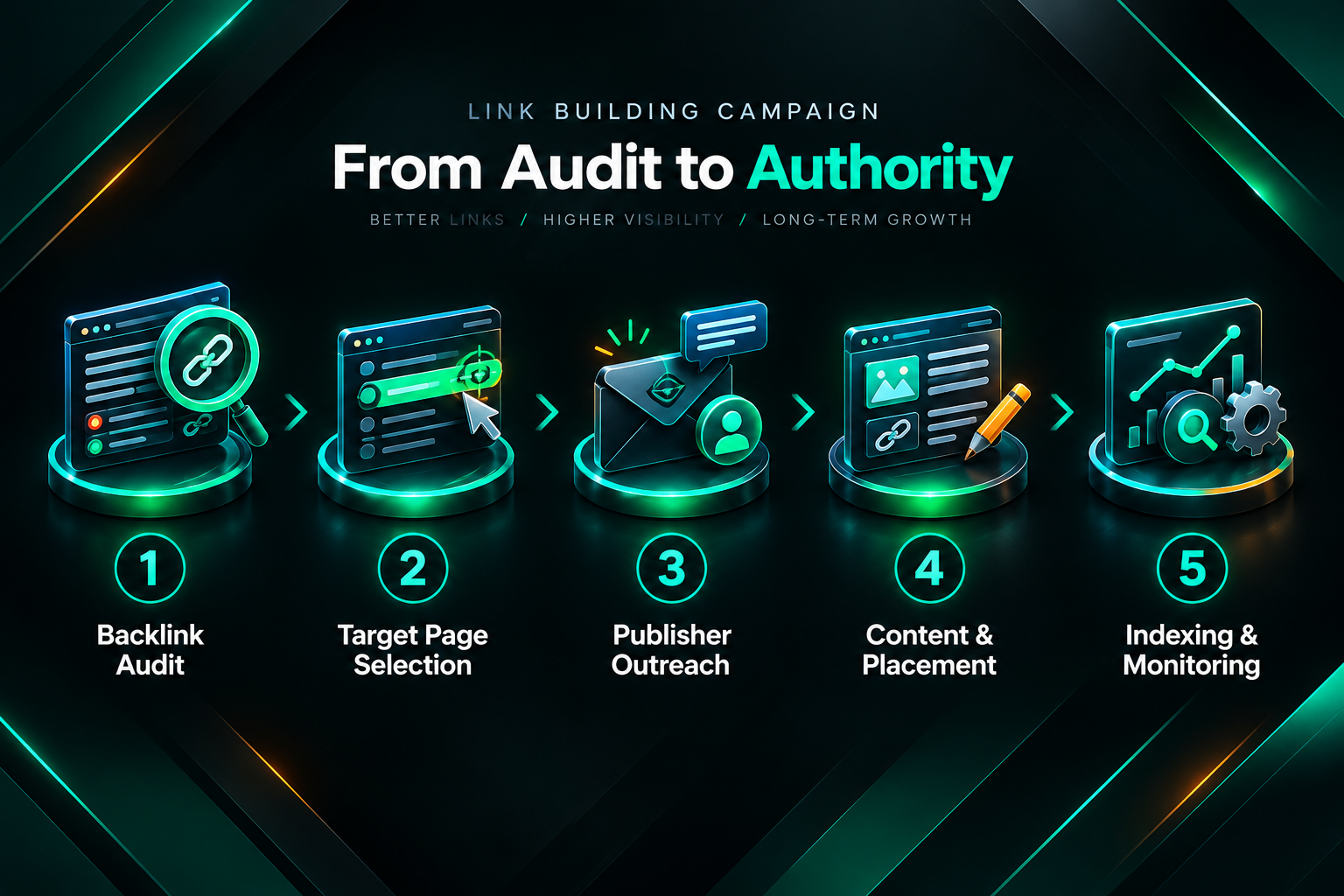
Outreach to publishers, whether for guest posts, niche edits, or resource-based placements, takes time. Publishers may take days or weeks to respond, and editorial review processes vary. Once a placement is agreed, the content creation, editing, and publication process adds further time before a link goes live. After publication, search engine crawlers need to discover and index the linking page before any potential ranking effect can begin. The time between a link going live and any measurable change in rankings or organic traffic can range from weeks to several months, and the magnitude of any change depends on the competitiveness of the target keywords, the quality of the placements, and the overall SEO condition of the website.
Ongoing campaigns typically require continued investment because the competitive landscape changes, links can be lost, and maintaining or improving search visibility in competitive markets is rarely a one-time effort. Reporting should track not just the number of links acquired but also the indexing status of linking pages, the relevance and authority of publishers, and — over a longer time horizon — any observable changes in organic rankings and traffic to target pages.
Assessing Backlink Quality: Practical Considerations
When evaluating the quality of a backlink — whether assessing an existing profile or reviewing a proposed placement — several practical questions are worth considering.
- Is the linking domain a genuine, active website with real content and an identifiable audience? Sites created primarily to sell links, with thin or duplicated content and no organic traffic, are unlikely to provide meaningful value and may carry policy risk.
- Is the linking page topically relevant to the destination page? A link from a page covering a closely related subject is more contextually coherent than a link from an unrelated article.
- Is the link placed editorially within the body of the content? In-content links within substantive articles are generally more meaningful than links in footers, sidebars, or author bios on low-quality sites.
- Is the anchor text natural and descriptive without being over-optimised? Anchor text that reads naturally within the surrounding sentence is preferable to exact-match keyword phrases inserted awkwardly into content.
- Is the linking page indexed by the relevant search engine? A link on an unindexed page is unlikely to contribute to rankings until the page is crawled and indexed.
- Does the publisher have editorial standards? Publications that review and edit submitted content, maintain consistent publishing standards, and have a genuine readership are more credible link sources than sites that publish any submission without review.
Frequently Asked Questions
Do backlinks still matter for SEO in 2024 and beyond?
Google has confirmed in its public documentation that links remain a significant ranking signal. However, the emphasis has shifted toward link quality and relevance rather than quantity. A small number of contextually relevant, editorially placed links from credible publishers is generally more useful than a large volume of low-quality links. The relative importance of links compared to other ranking factors continues to evolve as search engines refine their algorithms.
How many backlinks does a website need to rank?
There is no universal number of backlinks that guarantees a ranking position. The number of links needed to compete depends on the specific keyword, the strength of competing pages, the quality of the links, and many other factors including content quality and technical SEO. A site-specific competitive analysis is more useful than any fixed target.
What is the difference between a dofollow and a nofollow backlink?
A dofollow link (the default link type) is one that search engines are instructed to follow and may use to pass link equity to the destination page. A nofollow link carries the rel=”nofollow” attribute, which signals to search engines that the linking site does not wish to endorse the destination. Google has stated it treats nofollow as a hint rather than a strict directive. Sponsored and user-generated content links use separate attributes (rel=”sponsored” and rel=”ugc”) to indicate their nature.
Can bad backlinks harm a website’s rankings?
Google’s algorithms are designed to discount low-quality or manipulative links rather than automatically penalise the destination site for links it did not request. However, a pattern of unnatural links — particularly if they appear to be part of a deliberate link scheme — can result in a manual action. Google Search Console provides a disavow tool that allows website owners to request that certain links be ignored, though this should be used cautiously and typically only when there is clear evidence of harmful link patterns.
How long does it take for a new backlink to affect rankings?
The timeline varies. After a link goes live, the linking page must be crawled and indexed by the search engine before any potential effect can begin. Depending on the crawl frequency of the linking domain and the search engine’s indexing queue, this can take anywhere from a few days to several weeks. Any observable change in rankings or organic traffic may take additional weeks or months, and the effect depends on the competitiveness of the target keywords and the overall quality of the campaign.
Is it possible to build backlinks without creating new content?
Yes. Niche edits involve inserting links into existing published content on third-party websites, which does not require creating new articles. Digital PR can also generate links to existing pages if the outreach is based on data or resources already published on the website. However, content creation often strengthens link building efforts by giving publishers a reason to link and by providing material for guest post placements.
Should link building be the first SEO priority for a new website?
Not necessarily. For a new website, ensuring that pages are crawlable, indexed, and technically sound, and that content clearly addresses the search intent of target queries, is typically a prerequisite for link building to have meaningful impact. Investing in link acquisition before addressing fundamental technical or content issues may produce limited results. A site-specific assessment helps determine the appropriate sequencing of SEO activities.
Making Informed Decisions About Backlinks and Link Building
Backlinks remain a documented and meaningful part of how search engines assess the credibility and relevance of web pages. Understanding what they are, how they differ in quality, and how they interact with other SEO factors gives businesses and marketing teams a more realistic foundation for planning their organic search strategy.
The most important practical takeaway is that backlink quality consistently matters more than quantity. A measured approach focused on topically relevant, editorially placed links from genuine publishers is more consistent with search engine guidance and more likely to produce durable results than volume-focused or manipulative tactics. At the same time, backlinks are one input into a complex ranking system, and their impact depends on the condition of the website, the competitiveness of the target market, and the quality of the content on the pages being linked to.
For businesses considering a link building campaign, a site-specific audit and a clear understanding of target pages and goals are useful starting points before committing to any particular approach. If you are evaluating whether outsourced link acquisition may be appropriate for your website, discussing your current backlink profile, content, and competitive landscape with an experienced SEO provider can help clarify whether link building is the right priority and which methods may be most suitable for your situation.