

Link equity is one of the foundational concepts in search engine optimisation, yet it is frequently misunderstood or oversimplified. At its core, link equity refers to the value or authority that one webpage passes to another through a hyperlink. Understanding how link equity works, what affects its strength, and how it moves through a website can help you make better decisions about content structure, internal linking, and backlink acquisition — without chasing metrics that may not reflect real ranking potential.
Key Takeaways
- Link equity is the ranking value passed from one page to another through a hyperlink, and it influences how search engines assess the authority and relevance of a page.
- Not all links pass equal equity — factors including the linking page’s authority, topical relevance, link placement, anchor text, and link attributes all affect how much value is transferred.
- Internal links distribute link equity across your own site, making internal linking strategy an important and often underused lever for improving page-level visibility.
- Acquiring backlinks from authoritative, topically relevant sources may help a page accumulate equity over time, but results depend on many other SEO and competitive factors.
- Link equity is not a fixed or permanent asset — it can diminish if linking pages lose authority, if links are removed, or if site structure changes disrupt how equity flows.
What Is Link Equity and Where Does the Concept Come From?
Link equity — sometimes called link juice, though that informal term is less precise — describes the authority or ranking signal that a hyperlink transfers from one page to another. The concept originates from the PageRank algorithm developed by Google’s founders, which treated each link on the web as a kind of vote. Pages with more links pointing to them, particularly from pages that themselves had many inbound links, were considered more authoritative and were ranked more prominently in search results.
Google’s original PageRank model has evolved considerably since its public introduction, and the company no longer publishes PageRank scores. However, the underlying principle — that links carry signals of trust and relevance between pages — remains a documented part of how Google evaluates content. Google’s own documentation acknowledges that links help its systems understand which pages are considered valuable by other sites on the web. The concept of link equity is therefore grounded in documented search engine behaviour, not speculation, even though the precise mechanics of modern link evaluation are not fully disclosed.
It is important to distinguish link equity from third-party metrics such as Domain Rating (Ahrefs), Domain Authority (Moz), Authority Score (Semrush), or Trust Flow (Majestic). These proprietary scores attempt to model link-based authority, but they are not Google metrics and do not directly determine rankings. They can be useful as relative indicators when assessing a backlink profile, but a high score on any one of these tools does not guarantee that a page will rank well or that a link from that page will meaningfully improve your own rankings.
How Link Equity Flows Between Pages
Link equity flows from a linking page to a linked page through the hyperlink itself. When a page with a strong backlink profile links to another page, it passes a portion of its accumulated authority to the destination. This flow is not unlimited — a page distributes its equity across all the links it contains, so a page with many outbound links passes less equity through each individual link than a page with very few outbound links.
Several factors influence how much equity a given link actually transfers:
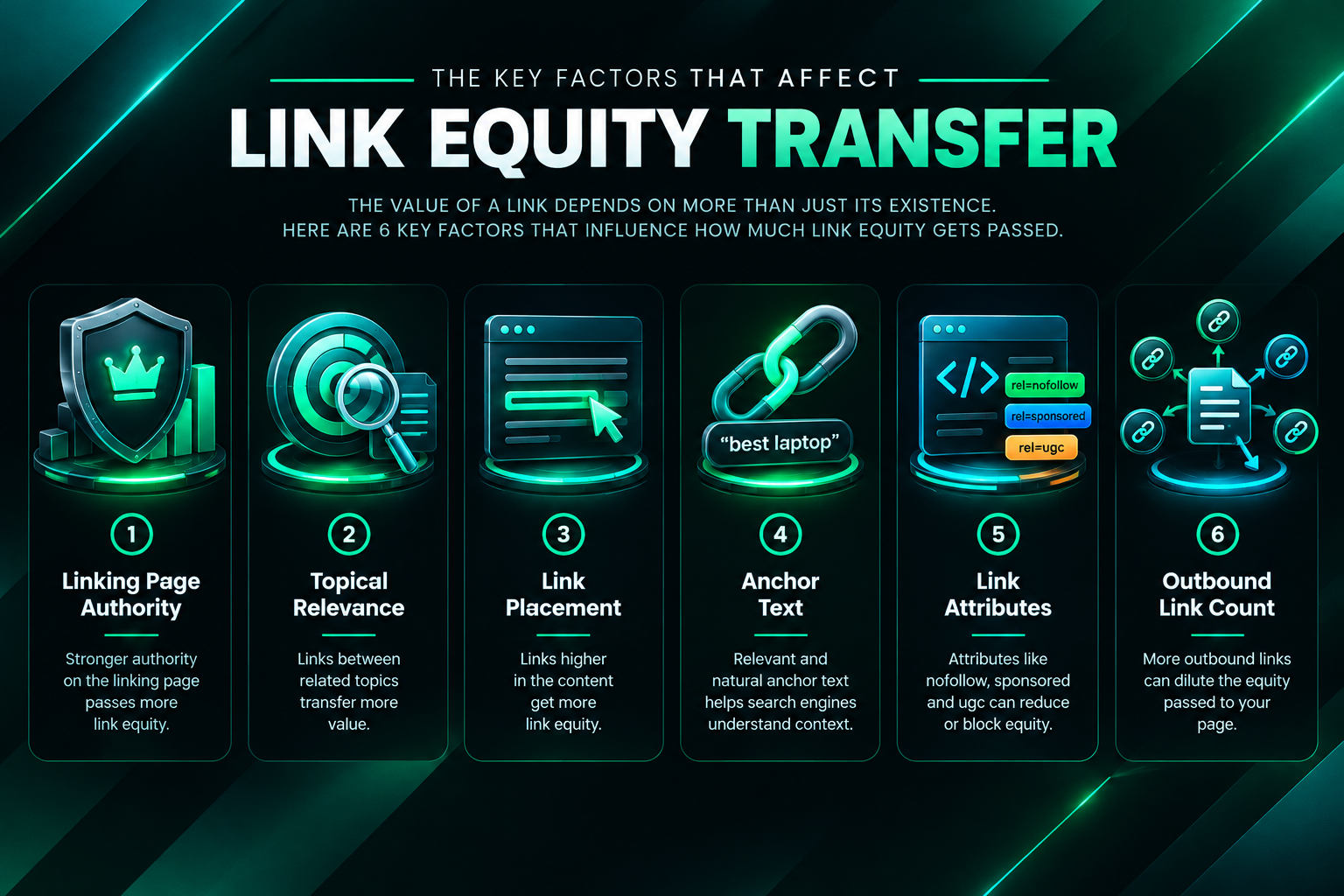
- Authority of the linking page: A link from a page that has itself accumulated significant equity from credible sources is generally considered more valuable than a link from a page with little or no inbound authority.
- Topical relevance: Links from pages and websites that are thematically related to the destination page may carry stronger relevance signals. A link to a cybersecurity product page from a technology publication is likely to carry more contextual weight than the same link from an unrelated lifestyle blog.
- Link placement: Links embedded within the main editorial body of a page are generally considered more meaningful than links in footers, sidebars, or boilerplate navigation. Placement within relevant, contextual content suggests editorial intent.
- Anchor text: The visible, clickable text of a link provides context about the destination page’s topic. Descriptive, relevant anchor text may help search engines understand what the linked page is about, though over-optimised or manipulative anchor text patterns can attract scrutiny under Google’s spam policies.
- Link attributes: A standard followed link passes equity. A link marked with the rel=”nofollow” attribute signals to search engines that the linking site does not wish to pass equity, though Google has stated it treats nofollow as a hint rather than a directive. Links marked rel=”sponsored” or rel=”ugc” indicate paid placements or user-generated content respectively, and are generally not expected to pass equity in the same way as editorial followed links.
- Number of outbound links on the page: As noted above, equity is distributed across all links on a page. A link on a page with two outbound links may pass more equity than a link on a page with two hundred.
Understanding these factors helps explain why acquiring a single link from a highly relevant, authoritative page with few outbound links can be more valuable than acquiring dozens of links from low-authority or irrelevant sources.
Internal Links and Link Equity Distribution
Link equity does not only flow from external websites into your own. It also moves between pages within your own site through internal links. This makes internal linking one of the most controllable and often underused tools for improving how equity is distributed across a website.
When a high-authority page on your site — perhaps a well-linked resource or a popular blog post — links internally to a product page, a service page, or a conversion-focused landing page, it passes a portion of its accumulated equity to that destination. This can help pages that have few or no direct external backlinks benefit from the authority that other pages on the site have earned.
Practical implications of internal link equity distribution include:
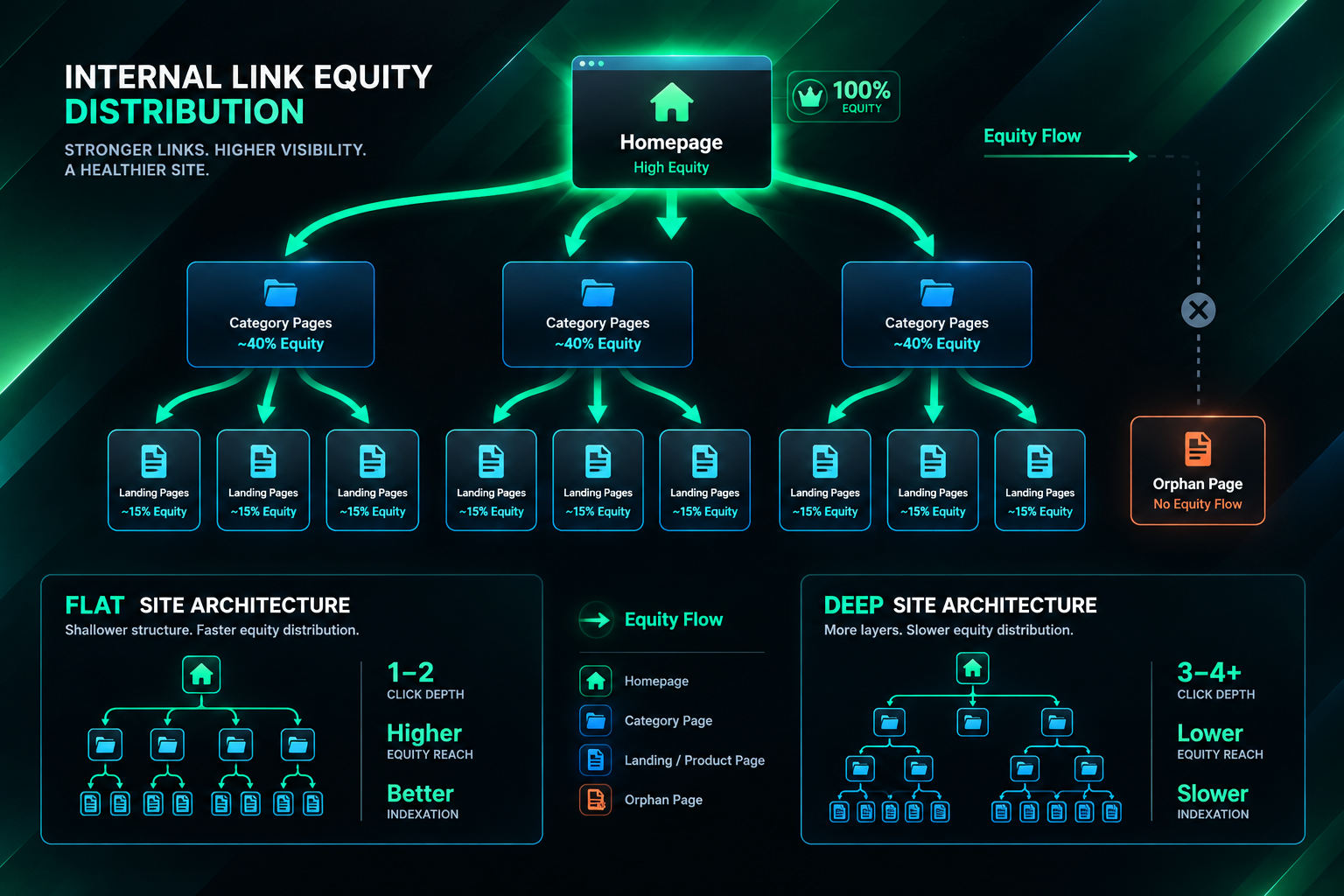
- Prioritising links to important pages: Pages that are central to your business goals — such as category pages, key service pages, or high-value landing pages — may benefit from receiving internal links from multiple authoritative pages on the same site.
- Avoiding equity dilution: Excessive internal links on a single page, particularly links to low-priority pages, can dilute the equity passed to each destination. Keeping internal link counts purposeful helps concentrate equity where it matters most.
- Addressing orphan pages: Pages with no internal links pointing to them receive no internal equity and may also be harder for search engine crawlers to discover and index. Identifying and linking to orphan pages is a straightforward way to improve their visibility.
- Site architecture and crawl depth: Pages buried deep in a site’s architecture — requiring many clicks to reach from the homepage — tend to accumulate less equity than pages closer to the root. Flattening site structure where practical can help important pages receive more equity.
Internal linking improvements are often a cost-effective first step before investing in external link acquisition, particularly for websites where important pages are poorly connected to the rest of the site.
External Backlinks and Link Equity Acquisition
External backlinks — links from other websites pointing to your pages — are the primary way a site accumulates link equity from outside its own domain. Acquiring these links is the focus of link building as a discipline, and the quality, relevance, and diversity of a site’s external backlink profile can influence how search engines assess its authority on a given topic.
Not all backlink acquisition methods carry the same risk profile or produce the same type of equity signal. Common approaches include:
- Manual outreach and guest posting: Reaching out to relevant publishers and contributing original content in exchange for a contextual link. When done on genuinely relevant, editorially selective websites, this approach can produce links with meaningful equity and topical relevance. The quality of the placement — the publisher’s own authority, the editorial standards of the site, and the relevance of the surrounding content — matters considerably.
- Niche edits (link insertions): Adding a link to an existing published article on a relevant website. This can be a legitimate editorial arrangement when the link genuinely improves the existing content, but the practice varies widely in quality and policy compliance depending on how it is executed.
- Digital PR and content-led link acquisition: Creating original research, data, tools, or resources that other websites naturally reference and link to. Links acquired this way tend to be editorially motivated and may carry strong equity signals, though this approach typically requires significant content investment and is not guaranteed to produce links.
- Paid or sponsored placements: Paying for link placement on another website. Google’s spam policies require that paid links be marked with appropriate attributes such as rel=”sponsored” or rel=”nofollow”. Unmarked paid links that pass equity are considered a violation of Google’s guidelines and carry a risk of manual action or algorithmic devaluation, regardless of how they were acquired.
The distinction between an editorially earned link and a paid or manipulated placement matters not only for policy compliance but also for the type of equity signal the link may carry. Search engines have become increasingly sophisticated at identifying patterns associated with link schemes, and a backlink profile that appears artificially constructed may be discounted or penalised rather than rewarded.
What Reduces or Blocks Link Equity
Link equity can be reduced, blocked, or lost in several ways. Understanding these scenarios helps avoid common mistakes that undermine the value of links a site has worked to acquire.
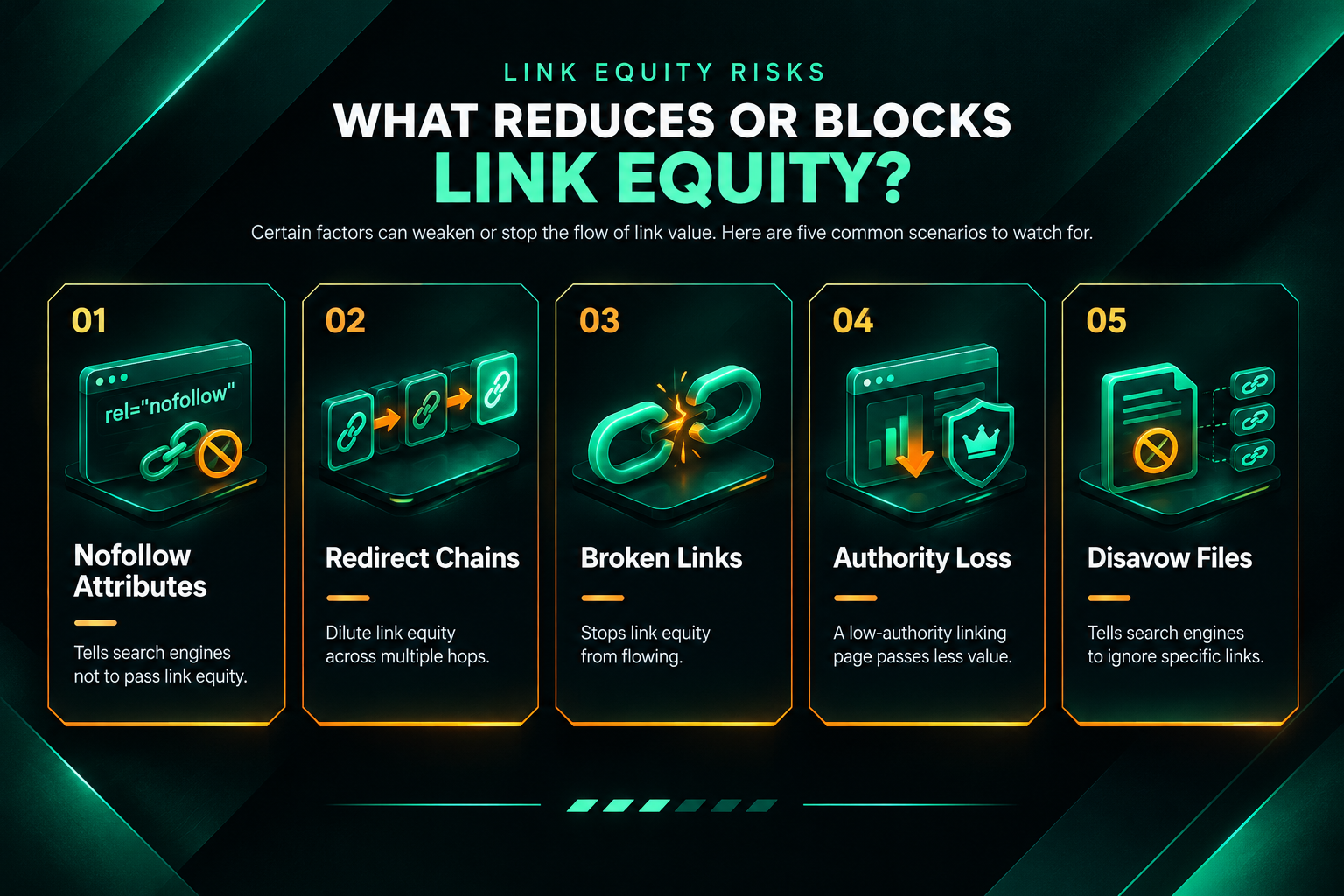
Nofollow and sponsored attributes: As noted earlier, links marked with rel=”nofollow”, rel=”sponsored”, or rel=”ugc” are not expected to pass equity in the same way as standard followed links. Google treats nofollow as a hint, meaning some equity may still flow in certain cases, but this cannot be relied upon.
Redirects: A 301 permanent redirect generally passes most of the equity from the original URL to the destination, though some signal loss may occur. Redirect chains — where a URL redirects to another URL that itself redirects — can result in more significant equity loss. Temporary 302 redirects may not pass equity at all in some interpretations of search engine behaviour.
Canonicalisation: A canonical tag on a page signals to search engines that another URL is the preferred version of that content. Equity from links pointing to a non-canonical URL may be consolidated to the canonical version, but this is not always guaranteed and depends on how the canonical is implemented.
Broken links: If a page that previously linked to your site is deleted or its URL changes without a redirect, the link is broken and no longer passes equity. Monitoring your backlink profile for lost or broken links is a useful ongoing practice.
Linking page authority loss: If a page that links to you loses its own authority — because it loses its own backlinks, is penalised, or is removed — the equity it passes to your site diminishes accordingly. Link equity is not a one-time transfer; it reflects the ongoing authority of the linking page.
Disavow files: If you have submitted a disavow file to Google Search Console to distance your site from low-quality or spammy links, those disavowed links will not pass equity. This is intentional when managing a problematic backlink profile, but it is worth reviewing disavow files periodically to ensure legitimate links have not been included by mistake.
Link Equity, Rankings, and Organic Traffic
Link equity is one input into how search engines assess a page’s authority and relevance, but it is not the only factor that determines rankings or organic traffic. A page may accumulate significant link equity and still underperform in search results if other important factors are not in order.
Low organic visibility can have multiple causes that link equity alone cannot address, including:
- Crawling or indexing problems that prevent search engines from accessing or processing the page
- Content that does not adequately match the search intent behind the target query
- Thin, outdated, or low-quality content that does not satisfy user needs
- Strong competition from pages with both high equity and superior content
- Technical SEO issues such as slow page speed, poor mobile usability, or structured data errors
- Internal linking gaps that leave important pages poorly connected to the rest of the site
- An existing manual action or algorithmic penalty affecting the domain
This means that investing in link equity acquisition — whether through outreach, guest posting, or other methods — is most likely to produce measurable results when the target pages are technically sound, contain content that genuinely serves the search intent, and are not already affected by unresolved technical or quality issues. A site-specific assessment is generally needed before concluding that link building is the most appropriate next step.
It is also important to distinguish between domain-level authority metrics, page-level link equity, search rankings, organic traffic, and business outcomes such as leads or revenue. An improvement in a third-party authority metric does not automatically translate into higher rankings, and higher rankings do not automatically translate into qualified traffic or conversions. Each of these is a separate measurement, and treating them as interchangeable can lead to misallocated effort and budget.
How Long Does Link Equity Last?
Link equity is not permanent. It reflects the current state of the linking page’s authority and the continued existence of the link itself. Several scenarios can reduce or eliminate the equity a link provides over time:
- The linking page loses its own backlinks and its authority diminishes
- The linking page is removed, restructured, or redirected without preserving the link
- The publisher changes their linking policy and adds nofollow attributes to previously followed links
- The linking domain is penalised or deindexed
- Your own page’s URL changes without a proper redirect, breaking the link
This is one reason why link building is generally treated as an ongoing investment rather than a one-time activity. A backlink profile built over time from diverse, authoritative, and relevant sources is more resilient than one that depends on a small number of links from a single source or type of publisher. Monitoring your backlink profile periodically — using tools such as Google Search Console, Ahrefs, or Semrush — can help you identify lost links and assess whether replacements or additional acquisition may be warranted.
Assessing Link Equity Quality Before Acquisition
When evaluating whether a potential backlink is likely to contribute meaningful equity, several practical factors are worth considering beyond a single third-party metric score:
- Does the linking page have its own backlinks from credible sources? A page with no inbound links of its own has little equity to pass, regardless of its domain-level metric score.
- Is the website topically relevant to your industry or niche? Relevance between the linking site and the destination page may strengthen the contextual signal the link provides.
- Does the website have genuine organic traffic? A site with real, consistent organic traffic is more likely to be a credible publisher than one with inflated metrics but no visible audience.
- Is the link editorially placed within relevant content? A link embedded naturally within a well-written article on a relevant topic is more likely to carry equity than a link in a footer, a widget, or a low-quality directory listing.
- Does the site have a history of selling links or participating in link schemes? Publishers with a pattern of selling followed links at scale may be more likely to be devalued by search engine algorithms over time.
- Is the link attribute appropriate? Confirming that a link will be followed — rather than nofollowed or sponsored — is a basic step before investing in outreach or placement.
No single factor is definitive, and assessing link quality requires judgement across multiple dimensions rather than reliance on any one metric or tool.
Frequently Asked Questions
Is link equity the same as PageRank?
Link equity is the broader concept of value passed between pages through links. PageRank was Google’s original algorithm for quantifying this value. Google no longer publishes PageRank scores, but the underlying principle of links transferring authority between pages remains part of how Google evaluates content. The terms are related but not identical.
Does a nofollow link pass any link equity?
Google has stated that it treats the nofollow attribute as a hint rather than a directive, meaning some equity may flow through nofollow links in certain circumstances. However, this cannot be relied upon as a consistent outcome. For practical link building purposes, followed links from relevant, authoritative pages are generally the primary target.
Can I improve my rankings just by building more links?
Not necessarily. Link equity is one of several factors that influence rankings. If a page has technical issues, content that does not match search intent, or is competing in a highly competitive niche, acquiring more links may not produce the expected improvement. A site-specific assessment of all relevant factors is advisable before prioritising link acquisition.
How many links do I need to rank for a competitive keyword?
There is no fixed number. The links needed to compete for a given keyword depend on the authority and link profiles of the pages currently ranking, the quality and relevance of your own content, your site’s existing authority, and many other factors. Prescribing a specific link count without analysing the competitive landscape is not reliable guidance.
Does link equity flow through redirects?
A 301 permanent redirect generally passes most of the equity from the original URL to the destination, though some signal loss may occur. Redirect chains and temporary 302 redirects may result in more significant equity loss. Keeping redirects direct and minimising chains is a practical technical SEO consideration.
What is the difference between link equity and referring domains?
Referring domains is a count of how many unique websites link to a page or domain. Link equity describes the quality and authority value of those links. A page can have many referring domains but low link equity if those domains are low-authority or irrelevant, and conversely a page can have few referring domains but strong link equity if those domains are highly authoritative and relevant.
Should I disavow low-quality links to protect my link equity?
Disavowing links is generally recommended only when there is evidence of a manual action related to unnatural links, or when a site has a clearly problematic backlink profile from previous link scheme participation. Disavowing links indiscriminately can remove equity from legitimate links. If you are uncertain, consulting an SEO professional before submitting or modifying a disavow file is advisable.
Using Link Equity as a Practical Decision Framework
Understanding link equity moves the conversation about backlinks away from chasing metric scores and toward a more considered assessment of where authority actually comes from, how it flows, and what it can realistically achieve. A page that earns links from genuinely relevant, authoritative sources — and that distributes its own accumulated equity thoughtfully through internal linking — is better positioned to compete in organic search than one that accumulates links without regard for quality or context.
For businesses and SEO teams evaluating whether to invest in link acquisition, the most useful starting point is usually an honest audit of the current state: which pages have meaningful equity, which important pages are poorly linked internally, whether technical or content issues are limiting the impact of existing links, and what the competitive backlink landscape looks like for target keywords. Link building is most likely to contribute to measurable outcomes when it addresses a genuine gap in a site’s authority profile and when the pages receiving links are otherwise well-positioned to rank.
If you are considering working with a link building provider, look for one that can explain how they assess publisher quality, what link attributes their placements carry, how they approach topical relevance, and how they report on placements over time. A provider that focuses on these factors is more likely to deliver links that contribute lasting equity than one that prioritises volume or metric scores alone.


