Key Takeaways
- PR link building earns high-quality backlinks by placing newsworthy content in front of journalists and authoritative websites, rather than buying or exchanging links.
- Links earned through digital PR strengthen domain authority, improve E-E-A-T signals, and can drive meaningful referral traffic alongside ranking improvements.
- Reactive PR platforms such as Qwoted and Featured.com are practical low-cost entry points for beginners before investing in full outreach campaigns.
- In regulated niches such as healthcare and finance, the credentials of the expert or spokesperson matter more than in most other industries.
- PR link building results typically take weeks to months to materialise; realistic expectations and a measurement framework matter from day one.
What Is PR Link Building?
PR link building is the process of earning backlinks from authoritative websites by using public relations tactics rather than direct link exchanges or paid placements. The core idea is straightforward: create content or commentary that journalists, editors, and publishers genuinely want to reference, and those publications will naturally link back to your website when they cover the story.
The term sits at the intersection of two disciplines that were once treated as separate. Traditional public relations focused on brand reputation, media relationships, and press coverage — without necessarily caring whether a journalist’s article contained a clickable link. Traditional link building, by contrast, focused on acquiring hyperlinks for SEO purposes, often through outreach, directories, or guest posts. PR link building merges both objectives: coverage that also carries a do-follow backlink from a high-authority publication delivers SEO value alongside the brand visibility that PR has always provided.
What distinguishes PR link building from other link acquisition methods is that the links are earned on merit. A publication links to your research, your expert quote, or your data because it adds value to their readers — not because money changed hands. Google’s link quality signals reward this distinction. Earned links from editorially placed, contextually relevant sources carry considerably more weight than links acquired through schemes, directories, or paid placements, which Google actively discounts or penalises.
PR Link Building vs. Traditional Link Building
Understanding how these two approaches differ helps clarify where PR link building fits within a broader SEO strategy and why the two methods tend to produce different results over time.
| Factor | Traditional Link Building | PR Link Building |
|---|---|---|
| Primary goal | Acquire backlinks for ranking signals | Earn coverage and backlinks through editorial merit |
| Link type | Often paid, exchanged, or guest-post placements | Editorially placed, earned media links |
| Domain authority of linking sites | Variable; can include low-DA directories | Typically high-DA news and media outlets |
| Topical relevance | Can be forced regardless of relevance | Naturally tied to newsworthy content and beat |
| Scalability | Easier to scale with outreach tools | Requires content investment; harder to mass-produce |
| Risk of Google penalty | Higher if link schemes are used | Low when genuinely earned |
| Brand visibility benefit | Minimal; links are usually buried | Significant; often accompanied by media mentions |
| Typical timeline to results | Weeks (once links index) | Weeks to months from ideation to live placement |
Neither approach is entirely self-sufficient. Most effective SEO strategies combine both: PR link building builds the high-authority referring domains that lift domain rating, while targeted traditional outreach fills gaps in a site’s link profile at scale.

Why PR Link Building Matters for SEO in 2025 and Beyond
High-quality backlinks from authoritative websites remain one of the strongest ranking signals Google uses. When a nationally recognised publication links to your site within a relevant article, Google interprets that as a vote of editorial confidence — a signal that your content, brand, or expertise is worth surfacing. Accumulating links from a diverse range of reputable referring domains tends to correlate with improved organic visibility over time, though the relationship is not always linear and other factors such as content quality and site structure also play significant roles.
Beyond raw rankings, PR link building reinforces E-E-A-T — Google’s framework for evaluating Experience, Expertise, Authoritativeness, and Trustworthiness. For websites operating in YMYL (Your Money or Your Life) categories — healthcare, finance, legal, and similar sectors — E-E-A-T signals are scrutinised more heavily. A consistent pattern of media coverage, expert commentary in reputable outlets, and citations from authoritative sources can meaningfully strengthen how Google perceives a brand’s trustworthiness.
There is also an emerging dimension that most introductory guides overlook: AI search. Platforms such as Google AI Overviews, ChatGPT, and Perplexity increasingly cite sources when generating responses. Publications that already appear in those AI Overviews and AI-generated answers tend to be the same high-authority outlets that link-building campaigns target. Earning a placement in a respected media outlet therefore now carries a dual benefit — a backlink for traditional search rankings and a greater likelihood of being cited as a source within AI-generated answers. This makes brand authority built through earned media increasingly valuable as AI-driven search grows.
Referral traffic is a practical, often underappreciated benefit. A link embedded within a high-traffic article can send targeted visitors directly to your site for months or years after publication. Unlike paid advertising, that referral traffic continues without ongoing spend.
Core PR Link Building Tactics
Original Research and Data Studies
Publishing original research — a survey, a proprietary data analysis, or a sector-specific report — creates what SEO practitioners call a linkable asset. Journalists and content teams frequently search for data to support a story. If your brand publishes that data first, other outlets naturally cite and link to the source. The key is ensuring the research addresses a topic that is genuinely newsworthy and relevant to publications in your niche. A well-executed study can generate dozens of referring domains from a single campaign, and the asset continues attracting links passively after the initial outreach window closes.
Expert Commentary and Spokesperson Strategy
Many PR link building campaigns underutilise the expert commentary approach. Identify one or two credible spokespeople within your organisation — ideally professionals with verifiable credentials, particularly in regulated sectors — and develop a clear set of topic themes they can speak to. Pre-write short, quotable statements on predictable news hooks relevant to your industry. When a journalist covers that topic, your spokesperson can respond rapidly with a useful, attributed quote that the journalist incorporates into the article alongside a link to your site. Speed matters here: journalists working to deadlines reward sources that respond within hours.
Reactive PR via Journalist Query Platforms
Reactive PR is the most accessible entry point for teams new to PR link building. Platforms including Qwoted and Featured.com (successors to the widely used but discontinued HARO service) connect journalists seeking expert sources with professionals who can provide commentary. A journalist publishes a query requesting a specialist viewpoint; you respond with a concise, credible answer; if selected, you earn a media mention and typically a high-quality backlink from the publication. The barrier to entry is low, the volume of opportunities is consistent, and the domain authority of placing publications can be significant.
Press Releases for Genuine News
A well-crafted press release remains a useful PR link building tool when there is genuine news to announce — a product launch, a study result, a significant business development, or a regulatory milestone. The critical distinction is that press releases distributed purely for SEO purposes and containing thin or irrelevant content rarely earn organic editorial links. Journalists receive hundreds of press releases; only those with a clear news angle and a credible source merit attention. Press releases distributed through wire services can generate syndicated placements, though the SEO value of those placements varies depending on whether the linking sites are indexed authoritative sources or low-quality aggregators.
Infographics and Visual Linkable Assets
Data visualised as an infographic, interactive tool, or structured resource provides a format that publishers can embed or reference with attribution. Visual assets work particularly well for complex data or step-by-step processes that are difficult to convey in plain text. For this tactic to generate earned media links consistently, the asset needs to be genuinely useful, visually clear, and distributed with an embed code that automatically includes a link back to the source.
How to Get Started with PR Link Building: A Step-by-Step Approach
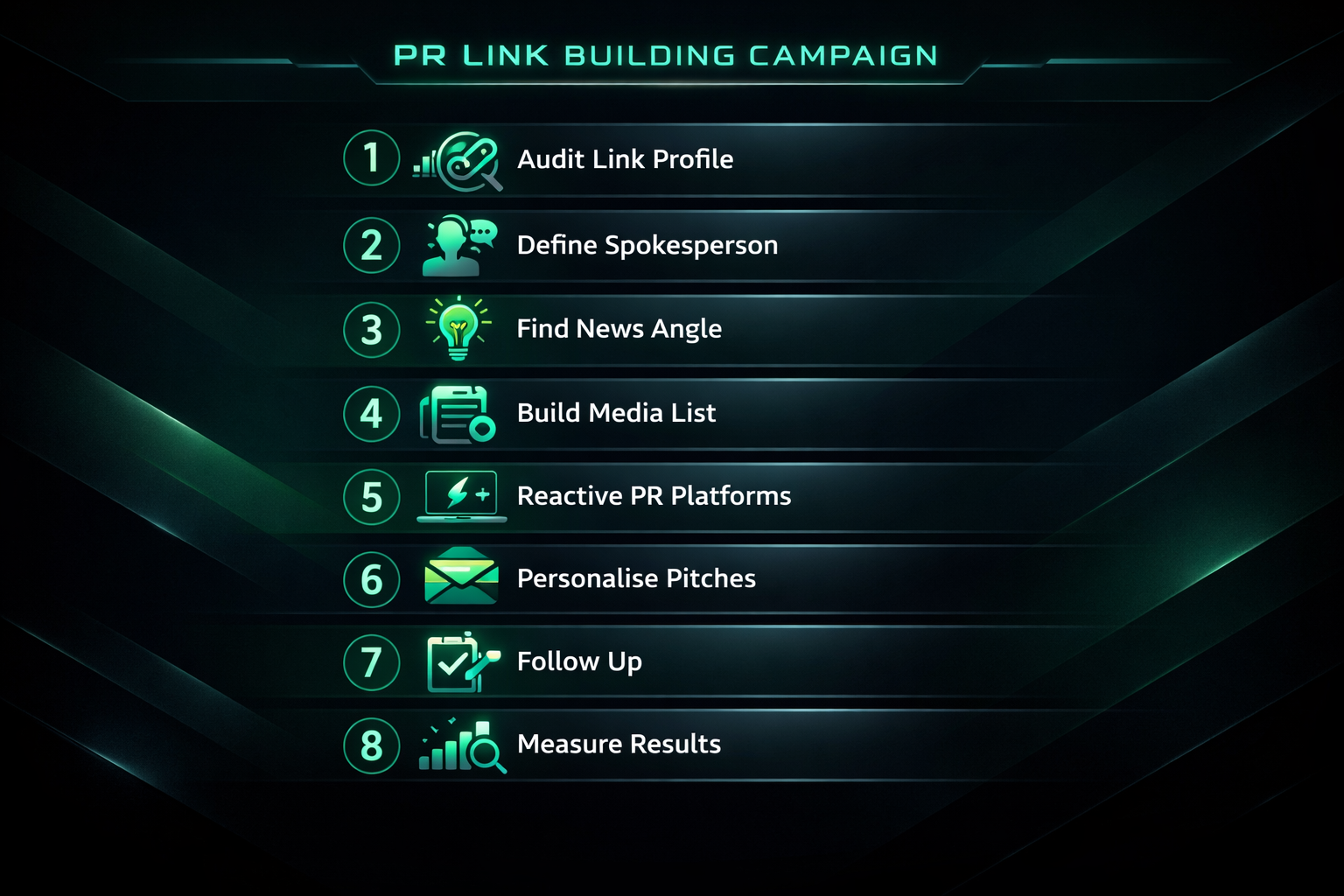
- Audit your existing link profile. Before building new links, understand where your backlink profile currently stands. Tools such as Ahrefs or Semrush can show your domain rating, existing referring domains, and the authority of sites already linking to you. This baseline tells you which types of placements will move the needle and highlights any gaps compared with competitors.
- Define your spokesperson or expert asset. Identify who within your organisation has the credentials and availability to comment publicly. In healthcare and finance niches, verifiable qualifications are non-negotiable — a journalist covering a medical topic needs a credible, named professional. Build a concise bio, a list of topic themes, and a small bank of pre-written quotes that can be adapted quickly.
- Identify your most newsworthy content angle. Consider what your organisation knows, measures, or observes that others do not. Could you survey a customer base, analyse publicly available data in a novel way, or produce a sector-specific report? Newsworthy content does not need to be expensive to produce, but it does need a genuine story hook that a journalist covering your industry would find worth covering.
- Build a targeted media list. Rather than mass-distributing a pitch to thousands of journalists, identify twenty to fifty journalists and editors who cover topics directly relevant to your story. Tools such as Muck Rack or Cision provide journalist contact databases with beat information. Topical relevance matters: a backlink from a publication that covers your sector carries more weight than a high-DA link from a completely unrelated outlet.
- Sign up for reactive PR platforms. Register on Qwoted and Featured.com and set up alerts for queries relevant to your expertise. Respond to journalist queries quickly and concisely. A one-to-three paragraph expert answer with a clear attributed source is typically what journalists need. This tactic can generate your first media mentions and high-authority backlinks within weeks, before a full outreach campaign is operational.
- Craft personalised pitches, not generic press releases. When reaching out to journalists proactively, personalise each pitch to the journalist’s specific beat and recent coverage. Explain the story angle in two to three sentences, make the news hook immediately clear, and offer the expert, data, or asset as a resource. Generic mass pitches are almost universally ignored.
- Follow up once, professionally. A single polite follow-up email three to five business days after the initial pitch is standard practice. Beyond that, continued follow-up damages journalist relationships. If a pitch does not land, assess whether the story angle needs refining or whether the target publication was a poor fit.
- Set up measurement before the campaign launches. Configure Google Analytics to track referral traffic from media placements. Use Ahrefs or Semrush to monitor new referring domains as they are acquired. Record the domain authority or domain rating of each linking site and track keyword ranking changes for target pages over a rolling three-month window.
Link Quality Factors That Affect How Much Value a PR Placement Delivers
Not all PR placements deliver equal SEO value, even when the linking publication has a strong domain authority. Several additional factors influence how much ranking benefit a specific link provides.
Topical relevance between the linking publication and your website is an important signal. A healthcare brand earning a link from a recognised medical news outlet benefits more than the same brand earning a link from a general lifestyle aggregator with a similar domain rating. Relevance tells search engines that the link reflects a genuine editorial relationship between two related entities.
Link position on the page matters. A backlink embedded naturally within the body copy of an article — particularly in the first half of the piece — tends to carry more weight than a link buried in a footnote, author credit, or sidebar. Editorial links that appear as natural citations within the narrative are the strongest form.
Anchor text should be natural and contextually appropriate. Over-optimised anchor text — where every link to your site uses the same exact-match keyword phrase — is a flag that Google’s algorithms may interpret negatively. Varied, descriptive anchor text that reflects how a journalist would naturally reference your brand or content is the healthiest pattern for a growing link profile.
Do-follow versus no-follow status remains relevant. Many major publications apply no-follow or sponsored attributes to external links as a policy. A no-follow link from a high-authority publication still delivers brand visibility and referral traffic, but its direct contribution to domain authority is reduced compared with a do-follow placement. Understanding the typical linking policy of your target publications helps set realistic expectations.
Common Mistakes to Avoid
- Pitching products instead of stories. Journalists write stories, not advertisements. A pitch that focuses on why a product is great gives a journalist no reason to cover it. A pitch that offers data, an expert perspective, or a novel angle they can build a story around is far more likely to result in coverage.
- Prioritising domain authority over topical relevance. Chasing the highest possible DA without considering whether the publication is relevant to your niche can result in links that provide limited SEO value. A mid-authority specialist publication in your sector often outperforms a high-DA general outlet for improving your link profile’s relevance signals.
- Sending generic mass pitches. Blasting a single press release to hundreds of journalists with no personalisation almost never works and can damage future journalist relationships. A smaller list of genuinely relevant, personalised pitches consistently outperforms volume.
- Ignoring credentials in regulated niches. In healthcare, finance, legal, and similar YMYL sectors, the expert spokesperson’s credentials are non-negotiable. Journalists covering these topics will not use an unnamed or uncredentialled source, and Google’s E-E-A-T framework places additional weight on verifiable expertise in these categories.
- No follow-up measurement. Launching a campaign without tracking referring domains, referral traffic, and keyword ranking changes makes it impossible to assess return on investment or improve future campaigns. Measurement should be set up before the first pitch is sent.
- Expecting results too quickly. A PR link building campaign from ideation to live placement typically spans several weeks to several months. Journalist review cycles, editorial schedules, and content publication timelines all introduce delays. Campaigns abandoned prematurely based on short-term results miss the compounding benefits that accrue as placements index and referring domains accumulate.
DIY, Agency, or Tool: Choosing the Right Approach
The right way to run PR link building depends on available budget, team capacity, and the competitiveness of the target niche. Each pathway has genuine trade-offs worth understanding before committing resources.
DIY with reactive PR platforms is the most practical starting point for small teams or businesses testing the approach. Signing up for Qwoted and Featured.com costs little or nothing, and consistent engagement with relevant journalist queries can generate meaningful placements over three to six months. The constraint is time: someone must monitor queries daily and respond quickly and credibly.
Outreach tools such as Respona can semi-automate journalist prospecting, email personalisation, and follow-up sequences, reducing the manual workload of running proactive campaigns. These tools are most valuable when a team already has a strong content angle and spokesperson in place; the tool handles the outreach logistics rather than the strategic or creative elements.
Agency partnerships provide access to established journalist relationships, experienced pitch writers, and dedicated campaign management. The investment is higher, but agencies with sector-specific experience can accelerate results significantly — particularly in competitive niches where media relationships are already cultivated. For healthcare and medical brands, working with an agency that understands YMYL compliance and E-E-A-T requirements reduces the risk of credibility missteps.
How to Measure PR Link Building Success
A practical measurement framework for PR link building covers four core areas. First, track the number of new referring domains acquired each month and the domain rating or domain authority of each linking publication. This tells you whether the campaign is building the kind of link profile that translates to meaningful ranking improvements. Second, monitor referral traffic from each placement using Google Analytics — segment by source to identify which publications are sending engaged visitors. Third, track keyword ranking changes for the pages most likely to benefit from the new backlinks, using a rank-tracking tool with a rolling three-month view to account for the lag between link acquisition and ranking response. Fourth, count media mentions separately from backlinks, since brand mentions without links still contribute to brand authority and can influence AI Overviews citations even when no hyperlink is present.

Review these metrics monthly rather than weekly. PR link building operates on longer timescales than paid campaigns, and meaningful trends in domain rating and keyword rankings typically emerge over a three-to-six-month window rather than immediately after each placement.
Frequently Asked Questions
Is PR link building the same as digital PR?
The terms are closely related and often used interchangeably, but there is a subtle distinction. Digital PR is a broader discipline that encompasses all online public relations activity — including social media, online reputation management, and content marketing — whether or not it generates backlinks. PR link building is a more specific application of digital PR tactics with the explicit goal of earning high-quality backlinks from authoritative websites. In practice, most digital PR campaigns are designed with link acquisition as a primary objective, so the terms frequently overlap.
How long does PR link building take to produce results?
From initial campaign planning to a live placement with an indexed backlink, a realistic timeline is four to twelve weeks depending on the complexity of the content angle, the journalist’s publication schedule, and the editorial review process. Ranking improvements that result from new referring domains typically become visible over a three-to-six-month window after links begin indexing. Reactive PR through journalist query platforms can produce placements faster — sometimes within days of a query response being accepted.
Can small businesses or new websites do PR link building?
Yes, though the starting point matters. Reactive PR through Qwoted or Featured.com is accessible to small teams because it requires expertise and responsiveness rather than a large budget or an existing media network. Original research campaigns require more investment but can be designed at modest scale — a survey of a few hundred respondents, for example, can generate newsworthy data without significant cost. The key constraint for new websites is that some journalists prefer to link to established domains; building a credible online presence and a verifiable expert spokesperson accelerates acceptance.
Do PR links need to be do-follow to have value?
Do-follow backlinks pass direct link equity and contribute more directly to domain authority improvements. However, no-follow links from high-authority publications still deliver referral traffic, brand visibility, and media mention signals that can indirectly support E-E-A-T. Many major news outlets apply no-follow attributes as standard policy, so a realistic link building campaign will include a mix of both. A link profile consisting entirely of do-follow links from a narrow set of sources can itself appear unnatural; editorial diversity is a healthy characteristic.
How does PR link building differ from buying links?
Purchased links — where payment directly secures a backlink rather than editorial merit — violate Google’s Webmaster Guidelines and carry the risk of a manual penalty or algorithmic devaluation. PR link building earns links through the genuine interest of journalists and editors in covering a story or citing a source. The distinction is editorial independence: in PR link building, the publication decides whether to link based on the value of the content or commentary, not because a fee was paid.
Does PR link building help with AI search visibility?
Evidence suggests that AI search platforms including Google AI Overviews, Perplexity, and ChatGPT tend to draw on and cite sources that already hold editorial credibility — which correlates strongly with the types of high-authority publications that PR link building campaigns target. While no public documentation confirms an exact mechanism, earning consistent coverage in trusted media outlets appears to improve the likelihood that a brand or its content is cited within AI-generated answers. This is an emerging area where the relationship between earned media and AI citation is still developing.
Is PR Link Building the Right Investment for Your Brand?
PR link building is not the fastest route to a larger link count, and it requires meaningful investment in content, expertise, and outreach — whether that investment is time, money, or both. However, the links it produces are among the most durable and valuable a brand can earn. A single placement in a nationally recognised publication can deliver referral traffic, brand authority, and E-E-A-T reinforcement that persists for years, and the backlink continues contributing to domain authority long after the campaign that generated it has ended.
For brands in regulated or trust-sensitive sectors — healthcare, financial services, legal — PR link building is particularly well suited because it is built around verified expertise and credible sourcing, which aligns naturally with the E-E-A-T requirements those niches demand. The spokesperson-driven approach, the original research model, and the reactive PR platforms all reward genuine knowledge rather than marketing spend alone.
The practical starting point for most organisations is a combination of reactive PR engagement through Qwoted or Featured.com, a clearly defined expert spokesperson with verifiable credentials, and a measurement framework that tracks referring domains and referral traffic from the first placement. From that foundation, more ambitious data-driven campaigns and proactive media outreach can be layered in as the approach matures and relationships with relevant journalists develop.