

Key Takeaways
- Skyscraper link building is a white hat link building strategy created by Brian Dean of Backlinko that follows three core steps: find link-worthy content, create a superior version, and conduct personalized outreach to earn backlinks.
- The technique can still generate high-quality dofollow links and improve organic search traffic, but results depend heavily on content quality, domain authority, outreach personalization, and niche competition.
- Modern execution — sometimes called Skyscraper Technique 2.0 — goes beyond making content longer; it requires original data, genuine E-E-A-T signals, and differentiated value that AI-generated content cannot replicate.
- Realistic response rates from outreach campaigns are low, typically in the single digits, so volume, targeting quality, and email personalization all significantly affect outcomes.
- Understanding when to use skyscraper link building versus alternatives such as digital PR, broken link building, or niche edits can save considerable time and resources.
What Is the Skyscraper Technique?
Skyscraper link building is a content marketing strategy designed to earn high-quality backlinks by systematically improving on content that already attracts links. The name comes from a simple analogy: if someone builds a 40-storey skyscraper in your city, you attract attention by building a 50-storey version — not by constructing something entirely unrelated.
Brian Dean of Backlinko introduced the skyscraper technique in 2015, and it quickly became one of the most widely referenced approaches in white hat link building. The core premise is that links already exist pointing to popular content in your niche, and those links demonstrate real demand. By identifying that existing linkable asset, creating a meaningfully better version, and contacting the sites already linking to the original, you give webmasters a practical reason to update or replace their link.
Unlike tactics that rely on paid link placement or low-quality directory submissions, skyscraper link building earns links editorially. When executed well, the backlinks acquired are genuine endorsements from relevant websites, which positively influences a site’s backlink profile and its standing in organic search rankings.
How the Three-Step Process Works
The skyscraper method follows a structured sequence. Each step builds on the previous one, and weaknesses at any stage reduce the likelihood of earning links.
Step 1: Find Link-Worthy Content Worth Improving
The starting point is competitor backlink analysis — identifying existing content in your niche that has already attracted a meaningful number of referring domains. Tools such as Ahrefs Site Explorer, Semrush Backlink Analytics, and BuzzSumo are commonly used for this step. In Ahrefs, the “Best by Links” report within Site Explorer shows which pages on a competitor’s domain have the most backlinks, making it straightforward to identify strong candidates.
Not every linked page makes a viable target. The most useful targets share common traits: they cover a topic relevant to your site, they have accumulated links from a range of domains rather than just one or two, the content is genuinely improvable (outdated, shallow, visually poor, or missing key subtopics), and the topic remains actively searched. Prioritise pages where you can credibly add something that does not already exist — original data, a missing perspective, substantially better usability, or more current information.
When filtering link prospects for outreach later, many practitioners recommend targeting pages with a Domain Rating between 30 and 70 with meaningful organic traffic, as very high-authority sites are less likely to swap links while very low-authority sites offer limited SEO value from dofollow links.
Step 2: Create a Demonstrably Superior Version
This is where most skyscraper campaigns succeed or fail. Early iterations of the technique encouraged simply making content longer, but length alone is no longer a meaningful differentiator. Modern search algorithms and webmaster expectations require genuine Information Gain — content that teaches something the existing resource does not, or does so in a meaningfully clearer, more accurate, or more useful way.
Superior content in the current landscape typically includes one or more of the following: original research or proprietary data that other sites will want to cite, up-to-date statistics replacing outdated figures, expert commentary that adds credibility and E-E-A-T signals, custom visuals such as original diagrams or embeddable assets that other sites can reference, substantially better user experience on mobile, and more comprehensive coverage of related subtopics the original article ignores.
E-E-A-T — Experience, Expertise, Authoritativeness, and Trustworthiness — matters here in a practical sense. A piece signed by a recognized expert, backed by first-hand experience, or citing verifiable original data is more likely to attract organic links beyond the initial outreach campaign. Content that could have been generated by a basic AI prompt, even if technically accurate, tends not to earn editorial links because it offers nothing webmasters cannot already find elsewhere.
Step 3: Conduct Personalized Outreach
The final step is contacting the websites that link to the original piece and letting them know your improved version exists. This is where many campaigns underperform. Brian Dean’s original outreach template became so widely distributed that webmasters now recognize it immediately, and templated emails are frequently ignored or marked as spam.
Effective personalized outreach identifies a specific reason the recipient’s site would benefit from linking to your content rather than the original. This might be an outdated statistic on the linked page, a broken resource, or a clear gap that your article fills. Each email should reference the recipient’s site specifically, name the exact page, and explain concisely why the replacement offers their readers more value. Keeping the email brief, avoiding attachments, and following up once after a week without a response tends to improve reply rates.
Realistic outreach response rates for skyscraper campaigns typically fall between 5% and 15%, with actual link acquisition rates lower still. Campaigns that generate meaningful results usually involve a well-built prospect list of several hundred relevant contacts rather than a handful of targets. Limiting outreach only to sites that link to the single original article is a common mistake that constrains campaign scale; broadening to other pages that link to similar content on the same topic increases the prospect pool considerably.
Does Skyscraper Link Building Still Work in 2025?
The honest answer is: it depends on how it is executed. The technique does still generate high-quality backlinks for practitioners who invest in genuinely differentiated content and thoughtful outreach. However, the landscape has changed substantially since 2015.
Skyscraper fatigue is a real phenomenon. Webmasters in competitive niches receive large volumes of outreach emails from people claiming to have created a “better resource.” Many delete these emails without reading further. A 2024 industry report found that only a small minority of SEO professionals considered the classic skyscraper approach highly effective, reflecting this saturation effect.
The proliferation of AI-generated content has compounded this problem. Many sites now publish content that is comprehensive in length but undifferentiated in insight, making “better” increasingly difficult to demonstrate convincingly. This raises the bar: skyscraper link building works when the content genuinely stands apart, and struggles when it merely repackages what already exists.
Google’s evolving algorithms, including AI Overviews and increased emphasis on E-E-A-T, also affect which content earns links organically over time. Content built around original data, named expert contributions, and real first-hand experience is more likely to attract sustained editorial attention than polished rewrites of existing material.
Skyscraper Technique 2.0: The Modern Approach
Skyscraper Technique 2.0 refers to an updated execution framework that addresses the limitations of the original approach. Rather than seeking to improve any popular piece of content, it focuses on targeting only topics where your site can add something genuinely new — proprietary statistics, original research findings, interactive tools, embeddable data visualizations, or expert-led insights that competing content cannot easily replicate.
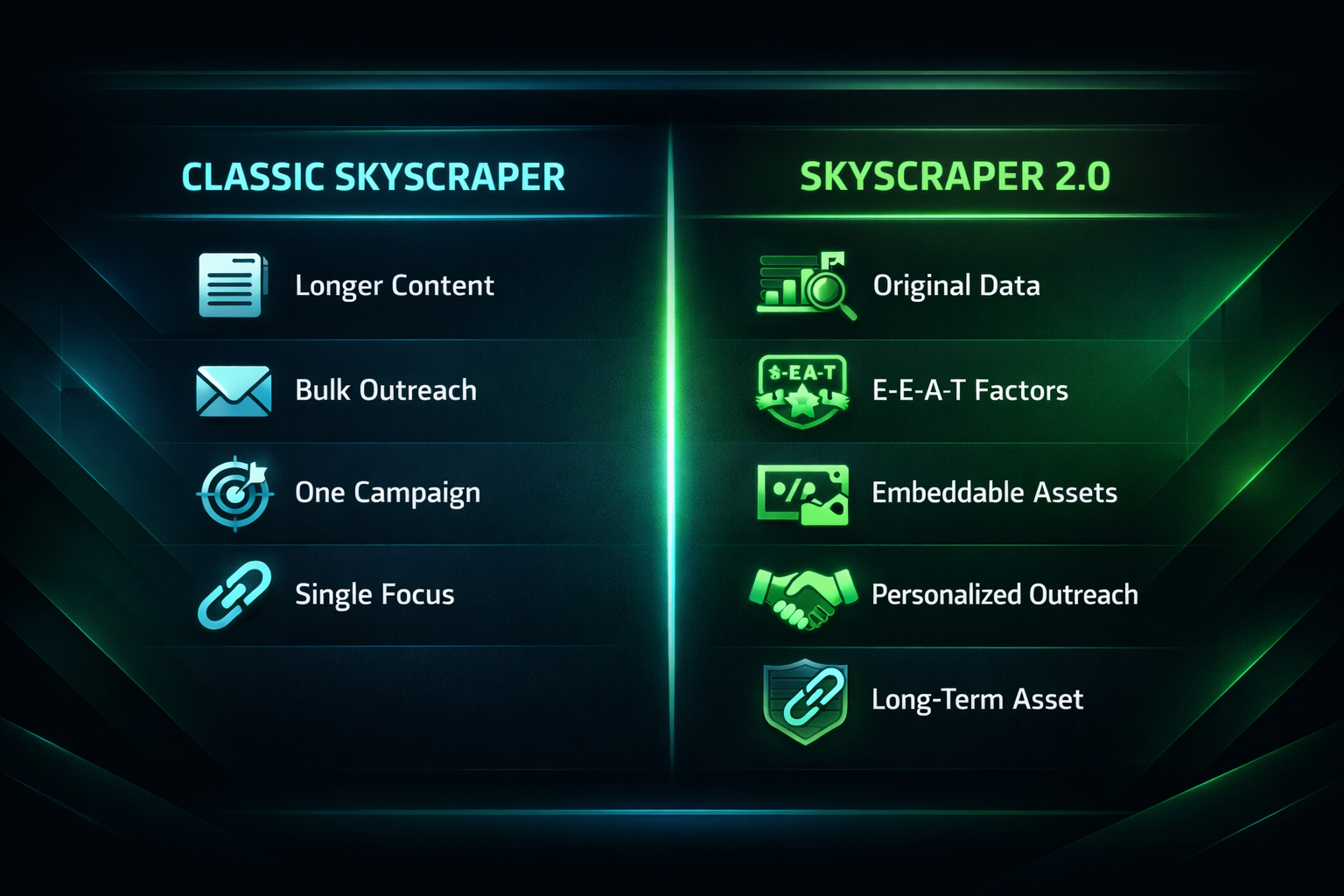
The 2.0 approach also broadens the outreach strategy beyond sites that link to the specific original article. It treats each piece of superior content as a long-term linkable asset that attracts inbound links through digital PR, syndication, and relationship-based outreach over months rather than a single campaign. This reduces reliance on cold email response rates and creates compound SEO benefits as the content accumulates links naturally over time.
Optimizing skyscraper content for answer engines and AI search tools has also become relevant. Structuring content so that specific sections directly answer discrete questions — with named entities, clear definitions, and concise factual passages — improves the likelihood that AI Overviews and other answer engine optimization (AEO) surfaces will reference or cite the content, which itself builds topical authority.
The Reverse Skyscraper Technique
The reverse skyscraper technique inverts the classic process. Rather than creating content first and then finding link prospects, it starts by identifying where your existing content already ranks or receives mentions, then seeks to place links from high-authority pages that cover related topics but do not yet link to your resource.
This approach can be more efficient for sites that already have strong linkable assets, because it avoids the significant time investment of creating new content. It also sidesteps some of the skyscraper fatigue problem, since the outreach is positioned as a natural addition rather than a replacement request. The reverse skyscraper technique is particularly useful for evergreen content that covers a topic comprehensively and has demonstrated organic search value but has not yet been linked to from relevant high-authority pages in the niche.
Skyscraper Link Building vs. Common Alternatives
| Method | How It Works | Main Advantage | Main Limitation | Best Suited For |
|---|---|---|---|---|
| Skyscraper Link Building | Improve popular linked content, outreach to existing linkers | Targets pages with proven link demand | High content investment; skyscraper fatigue | Sites able to produce original, expert-led content |
| Digital PR | Publish newsworthy data or stories for journalist coverage | Can earn high-authority press links at scale | Unpredictable; requires strong story or data angle | Brands with original research or PR resources |
| Broken Link Building | Find dead links on relevant sites; offer your content as a replacement | Gives webmasters a clear reason to act | Finding relevant broken links is time-consuming | Any site with relevant existing content |
| Guest Posting | Write original articles for other sites in exchange for a link | Direct placement control; builds relationships | Google scrutiny of low-quality guest post networks | Sites building topical authority and relationships |
| Niche Edits / Link Insertions | Add a link to an existing published article on another site | Fast placement; contextual relevance | Quality control risk; sometimes paid, which carries policy risk | Sites targeting specific contextual placements |
Common Skyscraper Mistakes to Avoid
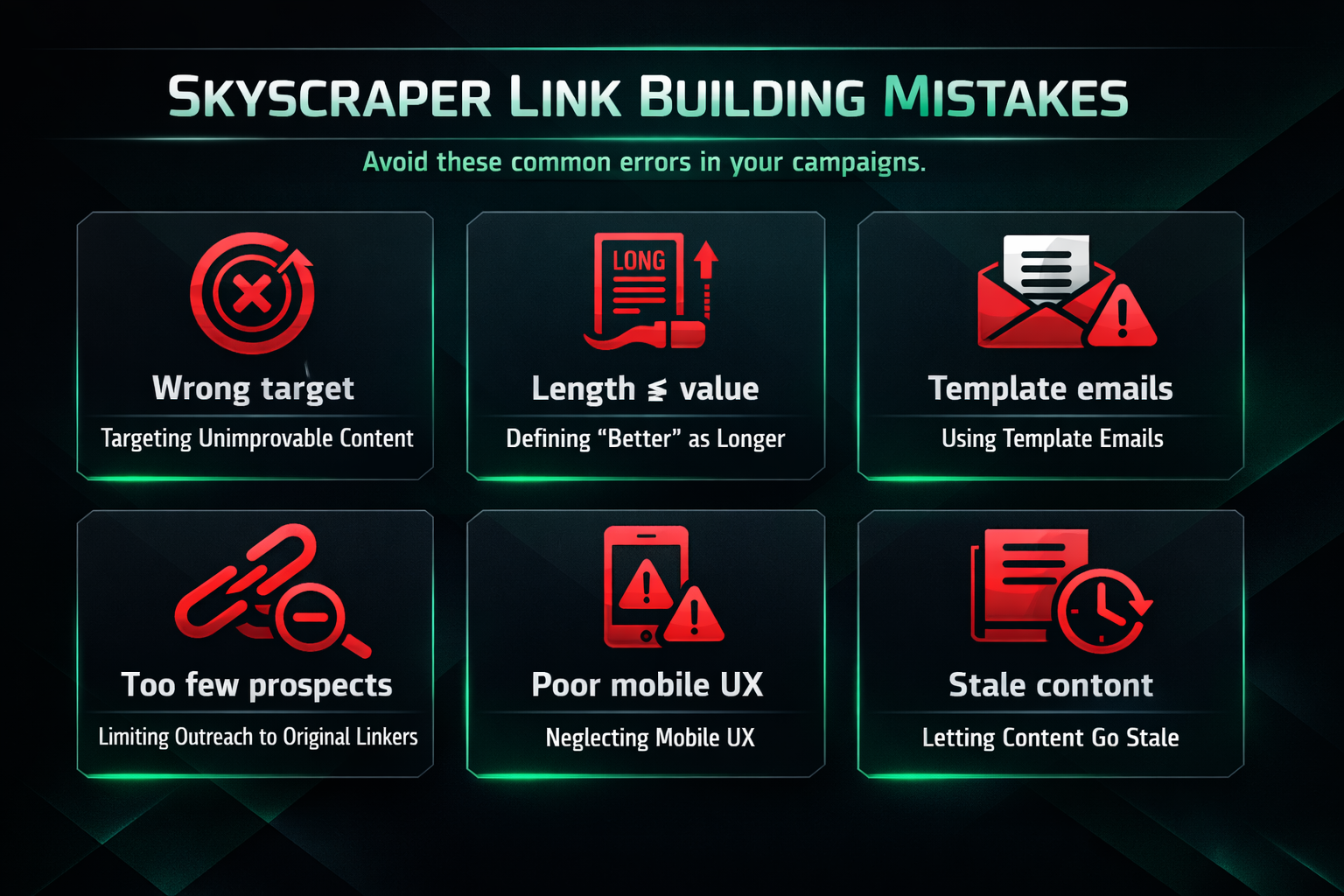
- Targeting content without genuine improvement potential. If the original article is already comprehensive, current, and well-designed, creating a longer version of the same information will not persuade webmasters to swap links.
- Defining “better” as “longer.” Word count is not a proxy for value. A 3,000-word article that adds no new insight is not superior to a focused 1,500-word piece that directly answers user questions.
- Using a recognizable outreach template. Templated cold emails, especially those closely resembling Brian Dean’s original format, are widely recognized by webmasters and often filtered or ignored.
- Restricting outreach to the original article’s linkers only. This limits the prospect list unnecessarily. Reaching out to sites that cover related subtopics and might find the content relevant significantly expands campaign potential.
- Neglecting mobile UX and page speed. A piece of content may be substantially more informative than a competitor’s but still lose links if it loads slowly or renders poorly on mobile devices.
- Letting content go stale after publication. Skyscraper content that contained current data at launch but is not updated loses its comparative advantage over time, reducing its value as a long-term linkable asset.
- Ignoring domain authority gaps. Outreaching to sites with significantly higher authority than your own for direct link replacement is rarely successful in the early stages of building a backlink profile.
Tools Used in Skyscraper Campaigns
Several tools support different stages of skyscraper link building, each with distinct strengths for this workflow.
Ahrefs is the most commonly cited tool for competitor backlink analysis in skyscraper campaigns. Its Site Explorer and “Best by Links” report make it straightforward to identify top-linked content in any niche, while the Backlink report allows filtering by dofollow links, domain rating range, and organic traffic — useful for building a qualified outreach prospect list.
Semrush offers comparable backlink analytics through its Backlink Analytics and Backlink Audit tools, and its Keyword Gap and Content Gap features can help identify subtopics the original article misses — directly informing what “superior content” should cover.
BuzzSumo is particularly useful in the content discovery phase, showing which articles have earned the most social shares and engagement in a niche. While social shares do not directly correlate with backlinks, highly shared content often overlaps with highly linked content, and BuzzSumo can surface relevant angles that backlink-focused tools may not highlight.
Email verification tools such as NeverBounce help ensure outreach emails reach valid addresses, reducing bounce rates that can affect domain sending reputation. For managing large outreach campaigns, platforms such as Pitchbox or Respona allow personalization at scale while tracking reply rates and follow-up sequences.
Should You Use Skyscraper Link Building? A Decision Framework
Skyscraper link building is not the right tactic for every situation. Before committing significant resources, consider the following questions:
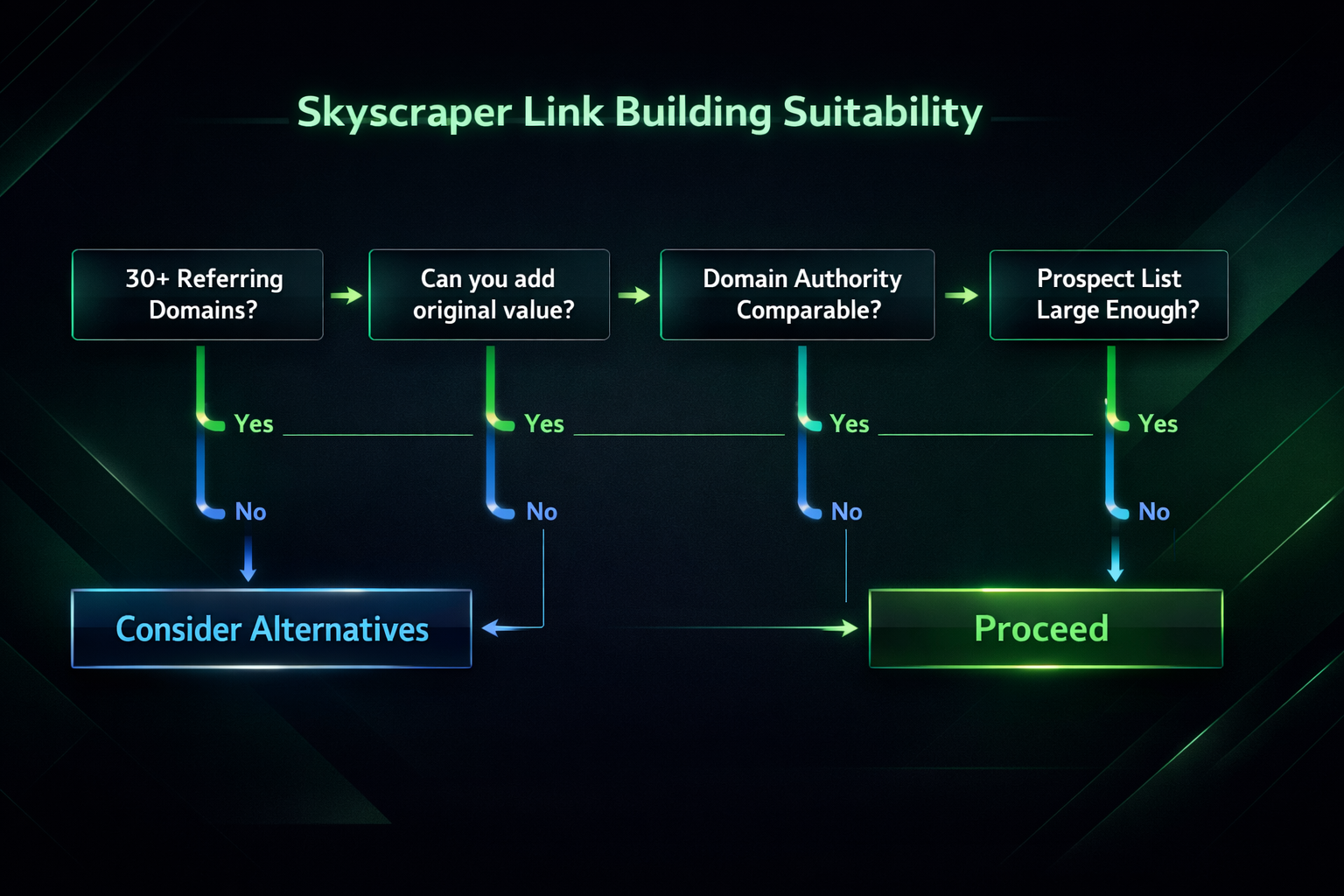
- Does the target content have at least 30–50 referring domains from relevant, non-spammy sites? Fewer than this suggests limited link demand in the niche and a weak foundation for an outreach campaign.
- Can you credibly add something the original lacks? Original data, a named expert, a missing subtopic, substantially better visuals, or more current information are all genuine improvements. A longer version of the same information is not.
- Is your domain authority within a reasonable range of the sites you plan to contact? A new domain with minimal backlink profile will struggle to persuade established sites to swap links regardless of content quality.
- Do you have the resources for personalized outreach at meaningful scale? A prospect list of fewer than 50 contacts is unlikely to yield enough responses to justify the content investment.
- Is the topic relevant to your content marketing strategy? The content you create should attract the right organic search traffic and support your broader topical authority, not just earn any backlink regardless of niche relevance.
If the answer to most of these questions is yes, skyscraper link building may be worth the investment. If your domain is new, your niche has low link demand, or you cannot genuinely improve on the target content, alternatives such as broken link building or targeted digital PR may deliver better results for the effort involved.
Frequently Asked Questions
How long does a skyscraper link building campaign typically take?
A complete campaign — from identifying targets to publishing improved content and completing outreach — typically takes between four and twelve weeks depending on content complexity and outreach volume. Links are rarely acquired immediately after outreach; many arrive over several weeks as recipients review emails and update their pages. Content continues to attract organic links beyond the initial campaign if it genuinely serves its topic well.
What response rate should I expect from skyscraper outreach?
Honest expectations place response rates between 5% and 15% for well-personalized outreach, with actual link acquisition rates lower than response rates. Campaigns with templated or semi-personalized emails in saturated niches often see responses below 5%. Higher domain authority, stronger content differentiation, and genuine personalization all improve these figures.
Is the skyscraper technique suitable for local or small business websites?
It can be, but the approach requires adjustment. Local niches often have fewer referring domains pointing to any single piece of content, which limits the prospect pool. Small businesses may find that investing in local digital PR, structured citation building, or niche-specific guest content delivers more efficient results at their scale than a full skyscraper campaign.
Does creating AI-generated skyscraper content work?
AI-generated content that simply aggregates and reformats existing information is unlikely to succeed as skyscraper content. Webmasters and algorithms are increasingly able to identify content that adds no genuine insight. Skyscraper content that earns links credibly in the current environment requires original data, expert input, or first-hand experience that AI tools alone cannot produce.
Can skyscraper link building negatively affect my site?
The technique itself is a white hat link building approach and does not carry the penalty risks associated with paid link schemes or private blog networks. However, aggressive outreach using misleading claims, contacting the same sites repeatedly, or misrepresenting your content can damage sender reputation and relationships with relevant webmasters. Maintaining honest, transparent outreach practices protects both your site’s reputation and its long-term ability to build genuine editorial links.
How does skyscraper link building affect organic search traffic over time?
Quality backlinks earned through successful skyscraper campaigns contribute to a stronger backlink profile, which can improve rankings for target keywords and increase organic search traffic over time. The relationship between link acquisition and ranking improvement is rarely immediate; benefits typically accumulate over months as search engines process new backlinks and reassess topical authority.
Is Skyscraper Link Building Worth the Investment for Your Site?
Skyscraper link building remains a legitimate and potentially effective content marketing strategy when applied thoughtfully. Its core logic — that content demonstrably better than what already earns links has a reasonable chance of attracting those links — holds up, even as execution has grown more demanding.
The technique works best for sites that can invest in genuinely differentiated content: original research, expert-led insights, or resources that fill a clear gap in existing coverage. For these sites, a well-executed campaign can earn high-quality dofollow links from topically relevant referring domains, strengthen their backlink profile, and support sustained improvements in organic search traffic.
Where skyscraper link building underperforms is in contexts where the content investment cannot be justified, where domain authority is too low to earn replacement links from established sites, or where the niche is too saturated for cold outreach to cut through. In these situations, alternatives such as broken link building, digital PR, or the reverse skyscraper technique may offer a better return on effort.
The clearest signal for whether to proceed is whether you can honestly answer yes to this question: does the content you plan to create offer something — original data, a missing expert perspective, meaningfully better usability — that the existing linked resource does not? If the answer is yes, skyscraper link building is worth serious consideration as part of a broader content marketing strategy. If the answer is no, the resources are likely better directed elsewhere.


