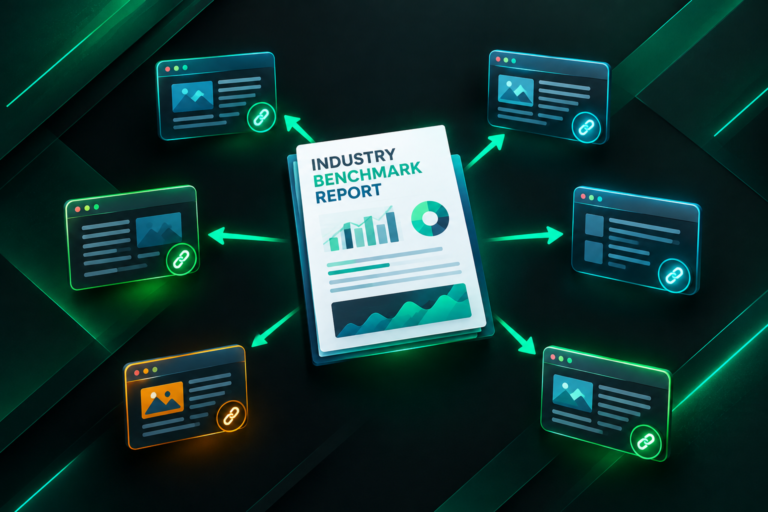
PDF files are indexed by major search engines, and links embedded within them can be followed by crawlers — but whether those links meaningfully contribute to a website’s search performance is a more nuanced question than a simple yes or no. This article explains how search engines treat links in PDF documents, what factors influence whether those links carry any SEO value, the practical limitations of relying on PDF-based backlinks, and when other link acquisition approaches may be more appropriate for your goals.
Key Takeaways
- Google can crawl and index PDF files, and links within PDFs can be followed — but the SEO value they pass is uncertain and likely lower than equivalent links in standard HTML pages.
- PDF links may contribute to a backlink profile, but they are generally not a reliable primary link building strategy for improving organic search rankings.
- The authority and relevance of the domain hosting the PDF matters more than the file format itself.
- For most link building campaigns, editorial links placed within HTML content on relevant, authoritative websites are likely to deliver more measurable SEO benefit.
- PDF documents can serve legitimate SEO purposes — particularly for content distribution, referral traffic, and brand visibility — without being the cornerstone of a link acquisition strategy.
How Search Engines Treat PDF Files
Google has confirmed that its crawlers can read and index PDF documents. When Googlebot encounters a PDF hosted on a publicly accessible URL, it can extract text content, follow hyperlinks embedded in the document, and include the file in its index. Bing similarly supports PDF indexing. This means a PDF is not invisible to search engines — it can appear in search results and its outbound links can, in principle, be discovered and evaluated.
However, the way search engines process PDF content differs from how they handle standard HTML pages. PDFs lack many of the structural signals that search engines use to assess context and relevance: there are no semantic HTML elements such as header tags, structured data markup, or internal linking architecture in the conventional sense. The anchor text of a hyperlink in a PDF may be rendered differently depending on how the document was created — a URL typed as plain text is not the same as a properly formatted hyperlink, and some PDF creation tools do not produce clickable, crawlable links even when a URL is visible on the page.
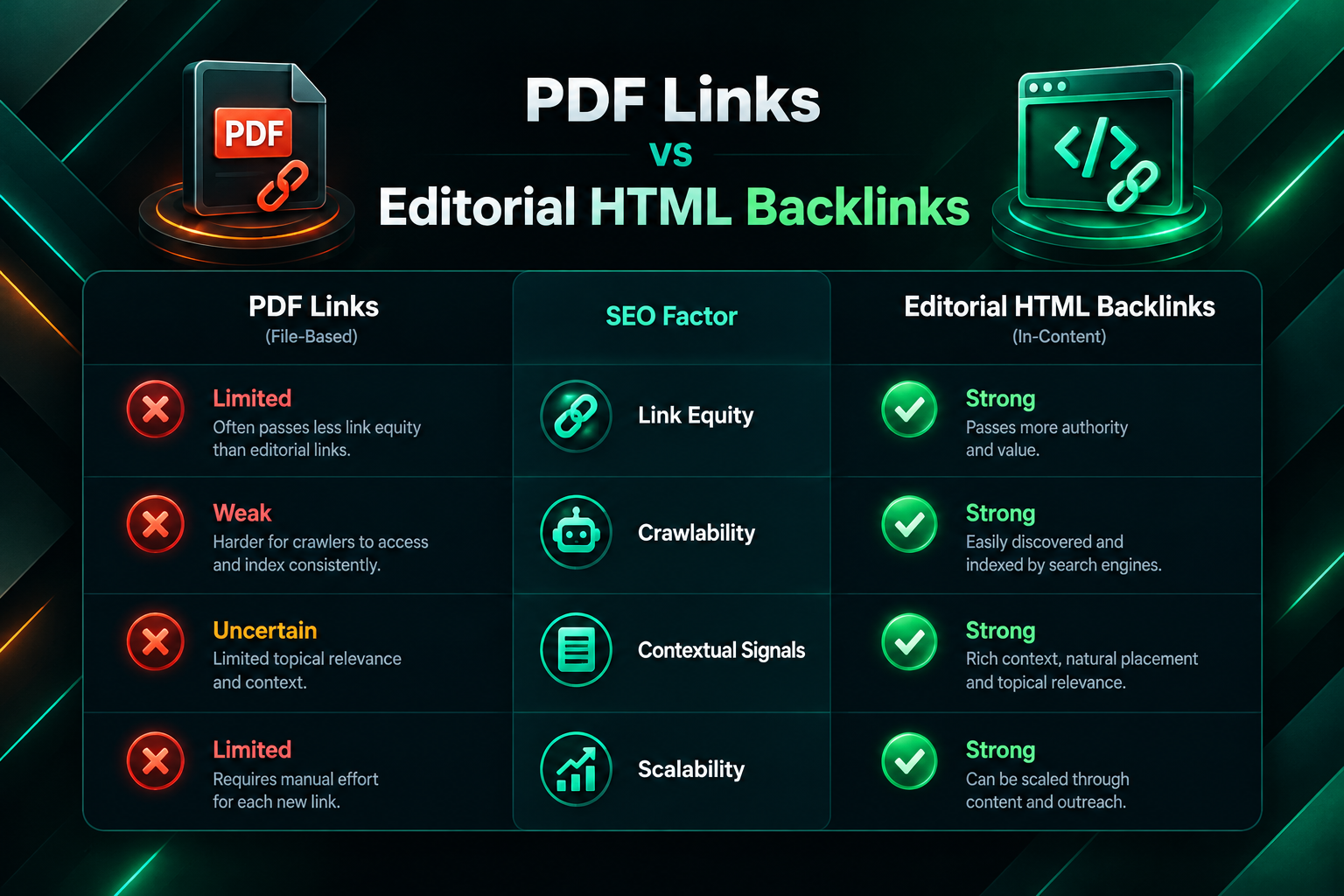
Google’s John Mueller has addressed PDF links in public Q&A sessions, indicating that links in PDFs can be followed but that the search engine may treat them differently from links in HTML documents. The precise weighting applied is not publicly documented, and Google does not publish a definitive statement confirming that PDF links pass PageRank at the same rate as HTML links. SEO practitioners generally treat PDF backlinks as carrying reduced or uncertain link equity compared to contextual links placed within the body of an HTML page on a relevant, authoritative website.
What Determines Whether a PDF Link Has Any SEO Value
The format of the document is only one variable. Several other factors influence whether a link embedded in a PDF is likely to contribute anything meaningful to a target page’s authority or search visibility.
The Authority and Relevance of the Hosting Domain
A PDF hosted on a high-authority, topically relevant domain — such as a government website, a university research repository, or a well-regarded industry publication — is more likely to carry link equity than the same PDF hosted on a low-quality or unrelated website. Domain-level authority, as approximated by third-party metrics such as Ahrefs’ Domain Rating or Moz’s Domain Authority, reflects the overall strength of a site’s backlink profile. A link from a strong domain in a PDF may still contribute some value; a link from a weak or spammy domain in a PDF is unlikely to help and could, in certain circumstances, be a negative signal.
Whether the Link Is Properly Formatted and Crawlable
Not all links in PDF files are equal from a technical standpoint. A hyperlink that is correctly embedded as a clickable anchor within the PDF is more likely to be followed by a crawler than a URL that appears as plain text without a proper link structure. PDFs created from word processors, design tools, or older software may not always produce crawlable hyperlinks even when a URL is visible. Before assuming a PDF link is being crawled, it is worth verifying the document’s technical structure.
The Link Attribute Applied
Links in PDFs can carry nofollow or other link attributes, depending on how the document was created and where it is hosted. A nofollow attribute instructs search engines not to pass link equity through that link. Many document-sharing platforms and academic repositories automatically apply nofollow to outbound links, which would significantly reduce or eliminate any direct SEO benefit from a link placed in a PDF hosted on those platforms. Checking the link attributes on any PDF placement is an important step before treating it as a source of followed backlinks.
Topical Relevance and Placement Context
Search engines assess the context surrounding a link to determine its relevance. A link to a cybersecurity software product placed within a PDF white paper about network security is contextually relevant. The same link placed in an unrelated PDF — a recipe book, a travel guide, or a generic directory listing — provides little contextual signal. Topical relevance between the PDF content and the target page is a meaningful factor in how much weight, if any, the link may carry.
Can PDF Links Appear in a Backlink Profile?
Yes. Backlink analysis tools such as Ahrefs, Semrush, and Majestic can detect and report links originating from PDF files. These tools crawl the web similarly to search engine bots and can identify hyperlinks within indexed PDFs. If a PDF hosted on an external domain links to your website, that link may appear in your backlink profile within these tools, attributed to the domain hosting the PDF.
Seeing a PDF link in a backlink report does not confirm that the link is passing PageRank or contributing to rankings. It confirms that the link exists and has been discovered by the tool’s crawler. The actual SEO impact depends on the factors discussed above — domain authority, link attributes, crawlability, and topical relevance — none of which are guaranteed simply because the link appears in a report.
For link building campaign reporting purposes, it is worth distinguishing between PDF-sourced links and editorial HTML links when reviewing referring domain data. Treating all discovered backlinks as equivalent can lead to an inaccurate picture of a campaign’s actual contribution to search authority.
Legitimate Uses of PDF Documents in an SEO Context
While PDF backlinks are not a reliable primary link building tactic, PDF documents can serve several legitimate purposes within a broader SEO and content marketing strategy.
Content Distribution and Brand Visibility
Publishing high-quality PDF resources — research reports, white papers, technical guides, or industry data — on authoritative platforms can generate referral traffic and brand exposure. If the PDF is genuinely useful and widely shared, it may attract organic links from other websites that reference or embed the document, generating HTML backlinks as a secondary effect. The PDF itself is the content asset; the link building benefit comes from the attention the content earns, not from the PDF format.
Supporting Owned PDF Pages in Search Results
A PDF hosted on your own domain can rank in search results for relevant queries. If a PDF page on your website ranks and attracts visitors, it contributes to organic traffic. Internal links within that PDF pointing to other pages on your site may help with crawl discovery, though the structural limitations of PDFs mean that HTML-based internal linking is generally more effective for site architecture purposes.
Academic and Research Citation Contexts
In industries where academic papers, technical specifications, or regulatory documents are commonly distributed as PDFs, earning a citation link within such a document from a credible institution can carry meaningful authority. Government and educational domain links (.gov, .edu) are generally considered high-value by SEO practitioners, and if those links happen to be within a PDF, the domain authority may still contribute positively to the target site’s backlink profile.
Risks and Limitations of Pursuing PDF Links Deliberately
Deliberately building a link acquisition strategy around PDF placements carries several practical limitations that are worth understanding before committing resources to this approach.
- Uncertain link equity: The SEO value passed by PDF links is not confirmed by search engine documentation and is generally considered lower than equivalent HTML links by most SEO practitioners. Campaigns built primarily around PDF links may not deliver measurable ranking improvements.
- Technical crawlability issues: Not all PDF links are crawlable. Poorly formatted documents, platform-level nofollow attributes, or PDF creation tools that do not produce proper hyperlinks can result in links that are never followed by search engine bots.
- Limited contextual signals: PDFs lack the semantic HTML structure that helps search engines understand the context and relevance of a link. This may reduce the weight assigned to the link compared to a contextually placed editorial link in an HTML article.
- Platform restrictions: Many document-sharing platforms that host PDFs apply nofollow attributes to all outbound links, making them ineffective as sources of followed backlinks regardless of the document’s content quality.
- Scalability challenges: Building a meaningful number of high-quality, followed PDF links from authoritative, relevant domains is difficult to scale. The effort required often exceeds what would be needed to acquire equivalent or superior HTML editorial links through manual outreach.
- Spam risk: Low-quality PDF submission to document-sharing directories as a link building tactic has been associated with manipulative link schemes. Pursuing this approach at scale, particularly through automated submission, carries a risk of being treated as a link scheme under Google’s spam policies.
How PDF Links Compare to Editorial HTML Backlinks
For most link building goals, editorial links placed within the body content of HTML pages on relevant, authoritative websites are considered more valuable than links embedded in PDF files. The reasons relate to both technical factors and the way search engines assess link quality.
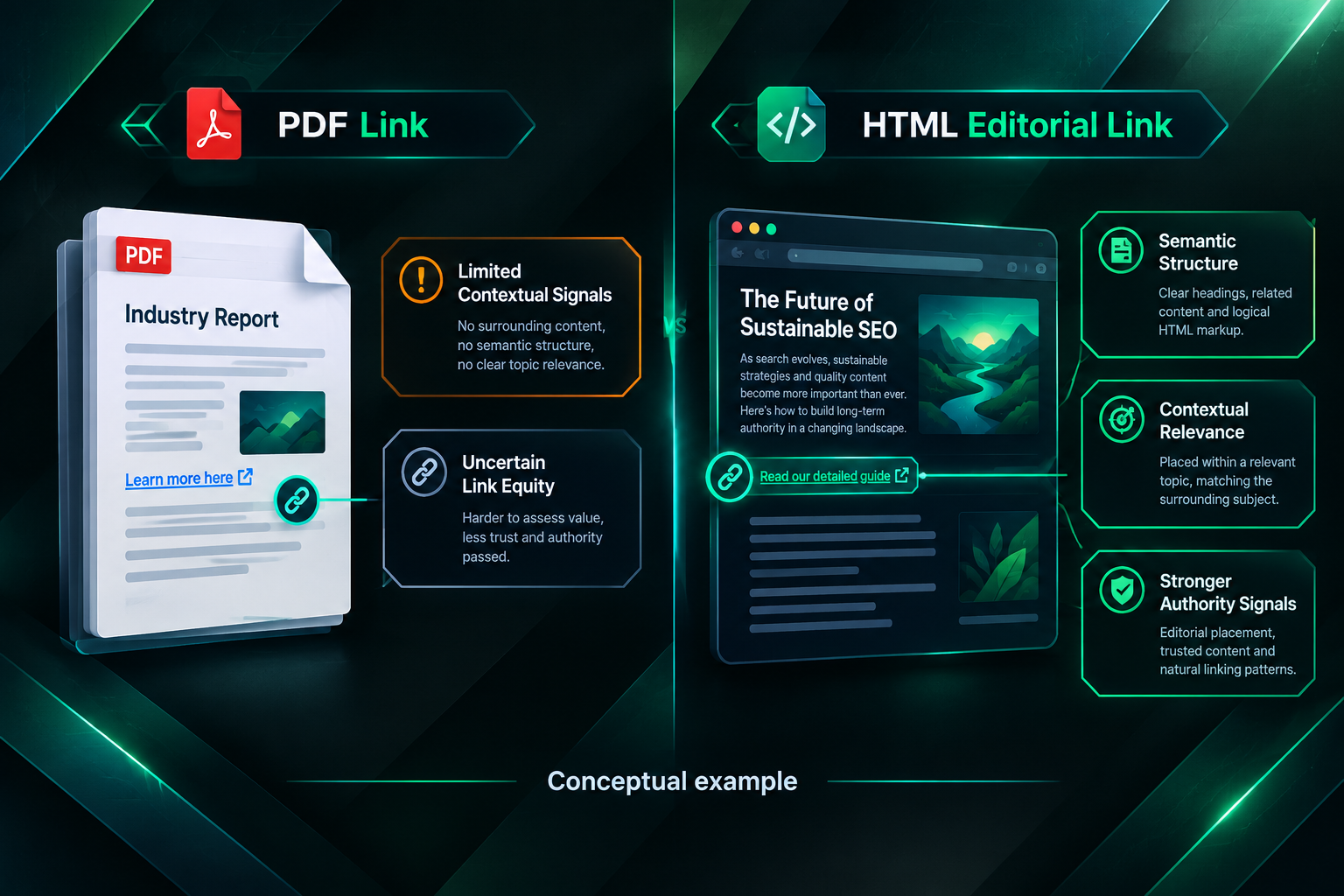
An editorial HTML backlink placed within a well-written article on a topically relevant website provides clear contextual signals: the surrounding text, the page’s topic, the anchor text of the link, and the structural position within the content all contribute to how the link is interpreted. HTML pages also benefit from the full range of on-page SEO signals — heading structure, internal linking, schema markup — that help search engines understand the page’s authority and relevance.
PDF documents, by contrast, are processed differently. Even when a PDF link is crawled and followed, the absence of semantic HTML structure means fewer contextual signals are available. The result is that PDF links are generally treated as lower-confidence signals of relevance and authority, even when they originate from strong domains.
Manual outreach campaigns targeting editorial placements in HTML content — whether through guest posting, niche edits, or digital PR — are typically better suited to improving organic search rankings than campaigns focused on PDF link acquisition. This does not mean PDF links are worthless in every context, but it does mean they should not be the primary mechanism for building a site’s backlink profile.
When PDF Links May Be Worth Considering
There are specific scenarios where PDF links may be a reasonable supplementary element of a broader link building or content strategy, rather than a standalone tactic.
- Academic or research-heavy industries: If your target audience regularly consumes PDF-format research, white papers, or technical documentation, producing high-quality PDF content can earn genuine citations from credible sources, including links from institutional domains.
- Government and regulatory contexts: Businesses that work with government agencies or regulatory bodies may find that their materials are referenced in official PDF documents. These links, while in PDF format, originate from high-authority domains and may carry meaningful value.
- Content assets that naturally attract links: A PDF that contains original research, proprietary data, or genuinely useful reference material may attract organic links from other websites that cite it in HTML content. The PDF is the content asset; the HTML links it earns are the SEO benefit.
- Diversifying a backlink profile: A backlink profile that includes a variety of link types — including some PDF citations alongside editorial HTML links — may appear more natural than one composed entirely of a single link type. However, this should be a minor consideration, not a primary campaign objective.
Alternatives to PDF Link Building for Sustainable SEO Results
For businesses and SEO teams looking to build a strong, sustainable backlink profile, several link acquisition approaches are generally considered more effective than PDF-focused strategies.
Manual Outreach and Guest Posting
Manual outreach involves identifying relevant, authoritative websites in your industry and pitching editorial content — typically guest articles — that include a contextual link to your target page. Guest posting, when executed with genuine editorial quality and topical relevance, can produce followed editorial backlinks from real websites with established audiences. The acquisition process requires research, personalised outreach, and content creation, but the resulting links are placed within HTML content and carry clearer contextual signals than PDF links.
Niche Edits and Link Insertions
Niche edits involve placing a link within existing published content on a relevant website, rather than creating new content. When the existing article is topically relevant and the link adds genuine value for readers, this approach can produce contextually strong backlinks. As with guest posting, the quality of the hosting domain and the relevance of the surrounding content are the primary factors determining the link’s likely SEO contribution.
Digital PR and Earned Media
Digital PR campaigns aim to earn editorial coverage and backlinks from news publications, industry media, and authoritative online platforms. This approach typically involves creating newsworthy content — original research, data studies, expert commentary, or notable announcements — and distributing it to relevant journalists and editors. The resulting links are editorial, HTML-based, and often originate from high-authority domains. Digital PR can be resource-intensive but may produce links that are difficult to replicate through other methods.
Resource Link Building
Resource link building involves creating genuinely useful content — tools, guides, datasets, or reference pages — and earning links from websites that curate or recommend resources in your niche. This approach relies on content quality and relevance rather than outreach volume, and the links earned are typically placed within HTML pages on relevant websites.
Frequently Asked Questions
Does Google follow links in PDF files?
Google has confirmed that its crawler can follow links in PDF files. However, whether those links pass link equity at the same rate as HTML links is not confirmed by Google’s public documentation. Most SEO practitioners treat PDF links as carrying reduced or uncertain value compared to editorial links in HTML content.
Will a PDF link from a high-authority domain help my rankings?
A followed link from a high-authority, topically relevant domain may contribute some value to your backlink profile regardless of whether it is in a PDF or an HTML page. However, the structural limitations of PDFs mean the contextual signals are weaker, and the impact on rankings is uncertain. Domain authority and topical relevance remain the most important factors.
Are PDF links on document-sharing platforms worth pursuing?
Most major document-sharing platforms apply nofollow attributes to outbound links, which means links in PDFs hosted on those platforms are unlikely to pass link equity. Submitting PDFs to these platforms for SEO link building purposes is generally not an effective strategy and, at scale, may be treated as a manipulative link scheme.
Can a PDF hosted on my own website help with SEO?
A PDF on your own domain can rank in search results and attract organic traffic. Internal links within the PDF may assist with crawl discovery, though HTML-based internal linking is more effective for site architecture. If your PDF earns external links from other websites, those links point to your domain and may contribute to your overall backlink profile.
Should I disavow PDF links pointing to my site?
Not automatically. PDF links from authoritative, relevant domains are unlikely to cause harm. PDF links from spammy, irrelevant, or low-quality domains may be worth reviewing as part of a broader backlink audit. Disavow decisions should be based on a careful assessment of the linking domain’s quality and the overall pattern of your backlink profile, not on the file format alone.
How do I check whether a PDF link is being crawled?
You can use Google Search Console to check whether a PDF URL is indexed and to review which pages link to your site. Third-party tools such as Ahrefs, Semrush, or Majestic can identify PDF-sourced links in your backlink profile. To verify whether a specific link within a PDF is properly formatted and crawlable, you may need to inspect the PDF’s technical structure or use a link checker tool.
Should PDF Links Be Part of Your Link Building Strategy?
PDF links occupy a narrow and uncertain role in SEO. They are not invisible to search engines, and in the right context — a well-formatted, followed link from a high-authority, topically relevant domain — they may contribute something to a backlink profile. But the evidence for PDF links as a reliable driver of ranking improvements is limited, and the practical limitations around crawlability, link attributes, and contextual signals mean they are unlikely to deliver the same return as equivalent editorial HTML backlinks.
For most businesses and SEO campaigns, the effort required to acquire high-quality PDF links from genuinely authoritative sources is comparable to or greater than the effort needed to earn stronger editorial links through manual outreach, guest posting, or digital PR. Allocating link building resources toward those approaches is generally more likely to produce measurable improvements in organic search visibility.
PDF documents can still serve a useful role in a content strategy — particularly for distributing original research, supporting brand authority, and earning organic citations in academic or research-heavy industries. But treating PDF link acquisition as a primary link building tactic is unlikely to be the most efficient use of a campaign budget.
If you are assessing your current backlink profile or planning a link acquisition campaign, a site-specific review of your existing links, target pages, and competitive landscape will provide a more reliable basis for strategy decisions than any general guidance about file formats. A qualified link building provider can help evaluate which acquisition methods are most appropriate for your website’s goals, industry, and current SEO position.