Original research is one of the most effective content assets a business or agency can publish — but without a clear citation policy, that research can be misused, misattributed, or stripped of the backlinks it was designed to earn. A citation policy defines how others may reference, quote, and link to your research, and it gives your team a consistent framework for managing attribution across outreach, partnerships, and syndication. This guide explains what a citation policy covers, why it matters for link acquisition, and how to build one that works in practice.
Key Takeaways
- A citation policy sets clear rules for how external publishers, journalists, and content creators may reference your original research, protecting both attribution and backlink integrity.
- Well-structured citation requirements make it easier to earn editorially placed, contextually relevant backlinks from authoritative sources.
- A policy should cover attribution format, acceptable use, data integrity, and the process for requesting permission or corrections.
- Citation policies are most effective when paired with a proactive outreach and digital PR strategy that actively promotes the research to relevant publishers.
- Enforcement and monitoring are as important as the policy itself — unlinked mentions and misattributed data can erode the SEO value of your research investment.
What Is a Citation Policy for Original Research?
A citation policy for original research is a documented set of guidelines that specifies how third parties — journalists, bloggers, researchers, and content marketers — should attribute and link to data or findings you have produced. It is distinct from a general content usage policy because it focuses specifically on research assets: surveys, proprietary datasets, industry reports, benchmark studies, and similar original work. The policy typically covers the required attribution format, acceptable quotation limits, linking requirements, and the process for requesting extended use or corrections.
For businesses that invest in original research as part of a content-led link building strategy, a citation policy serves two practical purposes. First, it protects the integrity of the data by reducing the risk of findings being taken out of context or republished without accurate sourcing. Second, it creates a clear expectation that any publication referencing the research should include a followed or attributed link back to the original source. This expectation, when communicated clearly and enforced consistently, can meaningfully improve the volume and quality of backlinks the research generates over time.
Citation policies are common in academic publishing, but they are increasingly relevant for commercial content teams and SEO agencies that use data-driven content as a link acquisition channel. A policy does not need to be legally complex to be effective — clarity and accessibility matter more than length.
Why Citation Policies Matter for Link Building
Original research earns backlinks because it provides something other content cannot easily replicate: a primary source. When a journalist writes about industry trends, a blogger supports an argument with statistics, or a content marketer cites a benchmark figure, they need a credible source to reference. If your business has produced that data, you become the natural citation target. The challenge is ensuring that citation translates into an actual backlink rather than an unlinked mention or, worse, a reference to a secondary source that aggregated your findings without attribution.
A citation policy addresses this challenge directly. By stating clearly that any use of your research data requires a link to the original publication, you set a professional standard that most reputable publishers will respect. Many journalists and content teams already follow citation norms similar to academic referencing; a formal policy simply makes your expectations explicit and gives your outreach team a document to reference when following up on unlinked mentions.
From an SEO perspective, the backlinks generated by well-cited original research tend to have characteristics that are difficult to replicate through other link acquisition methods. They are typically editorially placed, contextually relevant, and hosted on sites that have a genuine reason to reference the content. These qualities are generally associated with higher-value backlinks, though the actual impact on rankings depends on many other factors including the authority of the linking domain, the topical relevance of the placement, and the overall backlink profile of the target page.
It is worth noting that a citation policy alone does not guarantee backlinks. Research that is not actively promoted, not distributed to relevant journalists and publishers, or not structured in a way that makes data easy to extract and cite will generate fewer references regardless of how clearly the policy is written. The policy works best as part of a broader digital PR and outreach strategy.
Core Elements of an Effective Citation Policy
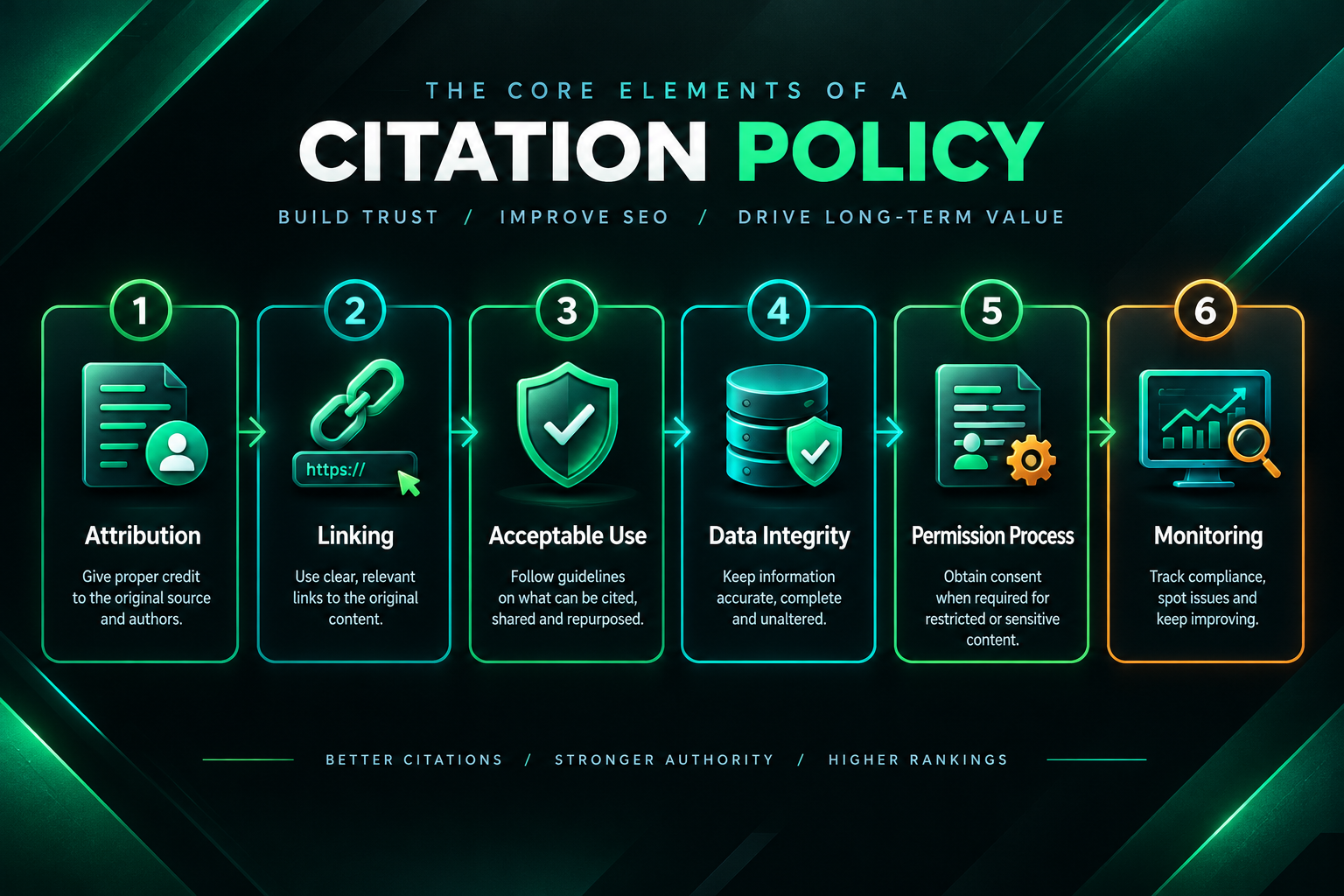
A practical citation policy for original research does not need to be lengthy, but it should address several specific areas to be useful both internally and for external publishers.
Attribution Requirements
The policy should specify exactly how the research should be attributed. This typically includes the name of the publishing organisation, the title of the research report or study, the publication date, and a direct link to the original source page. Providing a preferred citation format — similar to how academic journals specify APA or Chicago style — reduces the likelihood of inconsistent attribution across different publications. For example, you might specify: “[Organisation Name], [Report Title], [Year], available at [URL].” Making this format easy to copy from the research page itself, such as through a dedicated citation box or downloadable reference file, reduces friction for publishers who want to cite correctly.
Linking Requirements
The policy should state that any online publication referencing the research data must include a hyperlink to the original source. Where possible, specify that the link should point to the specific report or data page rather than the homepage. You may also wish to address link attributes: while you cannot control whether a publisher applies a nofollow or sponsored attribute, you can state your preference for a standard editorial link and note that this is consistent with the nature of the citation — a genuine reference to a primary source rather than a paid placement.
Acceptable Use and Quotation Limits
Define how much of the research may be reproduced without additional permission. A common approach is to allow quotation of specific statistics or short excerpts — typically a few sentences or a single data point — while requiring permission for reproduction of full tables, charts, methodology sections, or substantial portions of the report. This protects the commercial value of the research while remaining permissive enough that journalists and bloggers can easily reference individual findings without a lengthy approval process.
Data Integrity and Context Requirements
One of the most important but often overlooked elements of a citation policy is a requirement that data be presented in context. Statistics taken out of context can misrepresent findings and damage the credibility of the original research. The policy should ask publishers to include relevant qualifications — such as sample size, geographic scope, or the time period covered — when citing specific figures. It should also request that publishers do not alter the data or present findings in a way that contradicts the original conclusions. Including a contact address for corrections or clarifications makes this easier to enforce in practice.
Permission and Licensing Process
For uses that go beyond the standard quotation allowance — such as reproducing a full dataset, including charts in a commercial publication, or translating the research into another language — the policy should outline a simple permission request process. This does not need to be bureaucratic; a contact email address and a stated response time is usually sufficient. Having a clear process prevents publishers from either reproducing content without permission or abandoning the citation entirely because they cannot determine what is allowed.
Enforcement and Monitoring
A citation policy is only as effective as the monitoring and follow-up process behind it. The policy itself should acknowledge that you actively monitor for references to your research and that you may contact publishers to request corrections or the addition of a missing link. This signals professionalism and sets an expectation without being adversarial. Internally, the team responsible for the research should have a process for tracking mentions using tools such as Google Alerts, Ahrefs Content Explorer, or Semrush’s brand monitoring features, and for following up on unlinked mentions through polite outreach.
How to Structure the Policy Document
The citation policy itself should be published on your website, ideally on a dedicated page linked from each research report. A page that is easy to find and clearly written will be used; a policy buried in a terms-and-conditions document will be ignored. The structure does not need to be complex. A short introduction explaining the purpose of the policy, followed by clearly labelled sections covering attribution, linking, acceptable use, data integrity, and the permission process, is sufficient for most commercial research publishers.
Consider including a ready-to-use citation example at the top of the page. Publishers who arrive looking for the correct way to cite your research should be able to find it within seconds. A copyable text block with the preferred citation format, including the URL, removes a common point of friction and increases the likelihood that the citation will be formatted correctly and include the link.
If your organisation publishes multiple research reports, the policy can be written to apply to all of them, with individual reports linking back to the central policy page. This approach is more scalable than creating a separate policy for each piece of research and makes it easier to update the policy as your practices evolve.
Integrating the Citation Policy with Your Outreach Strategy
Publishing a citation policy is a necessary step, but it is not sufficient on its own. The policy needs to be actively communicated as part of the research promotion process. When your outreach team contacts journalists, bloggers, or industry publications to share new research findings, the outreach email or press release should reference the citation policy and include a direct link to it. This positions the policy as a helpful resource rather than a legal restriction and makes it easier for the recipient to understand how to use the data correctly.
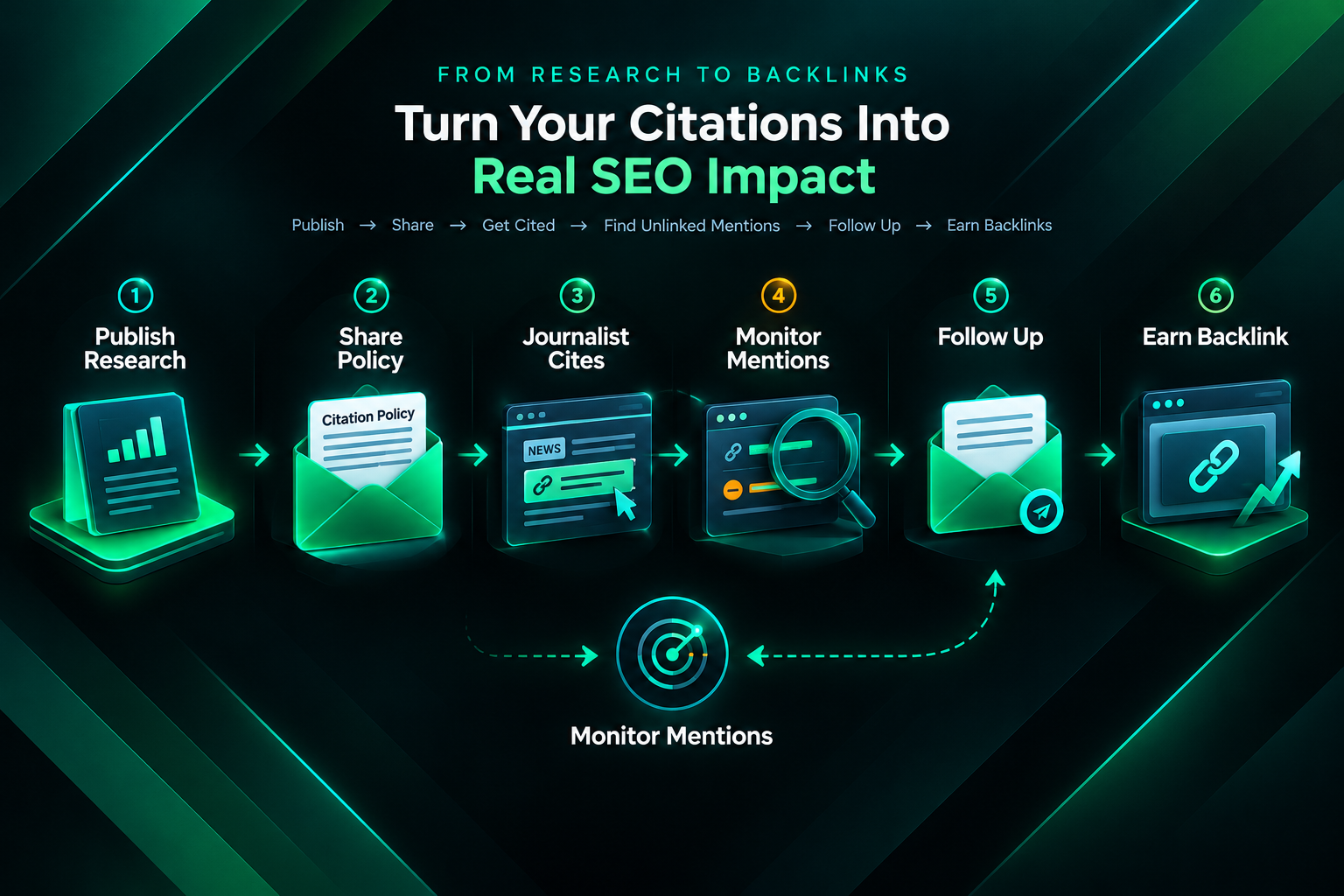
For agencies managing link building campaigns on behalf of clients, the citation policy is also a useful tool during digital PR outreach. When pitching data to journalists or content editors, being able to point to a clear, professional citation policy can increase confidence in the research and reduce the back-and-forth that sometimes delays publication. It signals that the organisation behind the research takes attribution seriously, which is reassuring for publishers who are concerned about sourcing credibility.
Outreach follow-up is where the policy becomes most practically valuable. When monitoring tools identify an unlinked mention of your research — a publication that has cited your data without including a hyperlink — the citation policy gives your outreach team a clear, non-confrontational basis for requesting the addition of a link. Rather than asking for a link as a favour, the team can point out that the publication’s reference does not currently meet the attribution requirements set out in the policy and politely request that a link be added. This approach tends to be more effective than a generic link request because it frames the ask as a correction rather than a solicitation.
Common Mistakes to Avoid
Several avoidable errors can reduce the effectiveness of a citation policy. Making the policy difficult to find is the most common: if publishers cannot locate it easily, they will not follow it. Overly restrictive quotation limits are another problem — if the policy requires permission for every individual statistic, most journalists will simply find a different source rather than go through an approval process for a single data point. The policy should be permissive enough to encourage citation while protecting the research from wholesale reproduction.
Failing to monitor for mentions is a significant missed opportunity. Research that generates unlinked mentions but no followed backlinks delivers less SEO value than research that is actively tracked and followed up. The investment in producing original research is only fully realised when the citation policy is paired with consistent monitoring and outreach. Similarly, neglecting to update the policy when research methodology or publication practices change can create confusion for publishers who reference older reports under different terms.
Finally, some organisations create citation policies that are written primarily as legal documents rather than practical guides for publishers. While legal accuracy matters, the primary audience for a citation policy is a journalist or content editor working under deadline pressure. Plain language, a clear structure, and a ready-to-use citation example will serve that audience far better than dense legal terminology.
Citation Policies and Backlink Quality
From a link building perspective, the backlinks generated through a well-managed citation policy tend to differ from those acquired through traditional outreach or guest posting in several meaningful ways. Research citations are typically placed within the body of an article at the point where the data is referenced, which means the link appears in a contextually relevant position rather than in an author bio or footer. The anchor text is usually descriptive — referencing the research title or the organisation — rather than keyword-optimised, which reflects natural editorial practice.
These characteristics are generally considered positive signals by SEO practitioners, though it is important to note that third-party metrics such as Domain Rating from Ahrefs, Domain Authority from Moz, or Authority Score from Semrush are proprietary estimates rather than direct measures of how Google evaluates a linking domain. A backlink from a high-traffic, topically relevant publication that genuinely references your research is likely to be more valuable than a link from a low-traffic site that has been approached purely for link building purposes, but the actual impact on rankings depends on many factors that vary by website, market, and competitive landscape.
It is also worth distinguishing between the link building value of original research and the broader content marketing value. Research that is widely cited builds brand authority and topical credibility in ways that extend beyond the direct SEO impact of individual backlinks. For businesses operating in competitive niches, being recognised as a primary data source can support long-term visibility in ways that are difficult to attribute to any single link or campaign.
Frequently Asked Questions
Does a citation policy need to be legally binding?
A citation policy does not need to be a formal legal document to be effective. Most publishers will follow clear, reasonable guidelines voluntarily, particularly when the policy is framed as a professional standard rather than a legal restriction. For organisations with significant research assets or concerns about commercial misuse, consulting a legal professional about copyright and licensing terms may be worthwhile, but for most content marketing purposes a plain-language policy is sufficient.
How do I handle publishers who cite my research without a link?
Monitor for unlinked mentions using tools such as Google Alerts, Ahrefs Content Explorer, or Semrush brand monitoring. When you identify an unlinked mention, send a polite outreach email pointing out that the reference does not currently include a link as required by your citation policy, and request that one be added. Frame the request as a correction rather than a favour. Most reputable publishers will respond positively to a professional, non-confrontational request.
Should the citation policy apply to social media references?
Social media references are generally difficult to enforce and typically do not carry the same link building value as editorial placements on websites. Most citation policies focus on online publications, blogs, and news sites. You may choose to include a brief note about social media attribution — asking that posts tag your organisation’s account or include a link to the research — but this is usually a secondary consideration rather than a core policy requirement.
How often should a citation policy be updated?
Review the policy whenever you publish a significant new research report, change your publication practices, or identify recurring issues with how publishers are citing your work. An annual review is a reasonable baseline for organisations that publish research regularly. When the policy is updated, consider adding a version date so that publishers can confirm they are referencing the current version.
Can a citation policy help with digital PR outreach?
Yes. A clear citation policy can support digital PR outreach by demonstrating that your organisation takes research attribution seriously and has a professional framework for managing data use. Including a link to the policy in press releases and outreach emails gives journalists a quick reference for how to cite the research correctly, which can reduce back-and-forth and speed up publication. It also positions your research as a credible primary source rather than a secondary aggregation of data from elsewhere.
What if a competitor reproduces my research data without attribution?
If a competitor reproduces substantial portions of your research without attribution or permission, this may constitute a copyright infringement depending on the jurisdiction and the extent of reproduction. In the first instance, a polite but firm outreach email referencing your citation policy and requesting attribution or removal is usually the appropriate first step. For serious or repeated infringement, seeking legal advice may be appropriate. For minor cases — such as a competitor citing a single statistic without a link — a standard unlinked mention outreach approach is usually sufficient.
Building a Citation Policy That Works Over Time
A citation policy for original research is most valuable when it is treated as a living document rather than a one-time task. As your research programme grows and your content earns more references across different types of publications, the policy will need to evolve to address new situations — syndication requests, translation inquiries, academic references, and data licensing opportunities that may not have been anticipated when the policy was first written.
The practical test of an effective citation policy is whether it makes it easier for publishers to cite your research correctly and easier for your team to follow up when they do not. If the policy is clear, accessible, and backed by consistent monitoring and outreach, it can meaningfully improve the return on investment from original research as a link acquisition strategy. If it is buried, overly restrictive, or never enforced, it adds little value beyond a formal document that few people read.
For businesses and agencies considering original research as part of a broader link building programme, a citation policy is one component of a larger system that includes research design, content production, targeted outreach, publisher relationship management, and ongoing monitoring. Each of these elements contributes to whether the research generates the backlinks, brand authority, and topical relevance it was intended to produce. A qualified SEO or digital PR team can help assess whether original research is a suitable strategy for a given website and competitive context, and how a citation policy fits within the overall campaign structure.