Deciding whether to invest in link building or technical SEO first is one of the most common prioritization questions facing business owners, in-house SEO teams, and agency decision-makers. The honest answer is that neither discipline is universally more important than the other — the right starting point depends on your website’s current condition, competitive landscape, and business goals. This article explains what each discipline involves, how they interact, and what factors should guide your sequencing decision.
Quick Comparison
| Factor | Technical SEO | Link Building |
|---|---|---|
| Primary goal | Ensure the site can be crawled, indexed, and understood by search engines | Increase the site’s authority and relevance signals through external links |
| Typical focus areas | Crawlability, indexing, site speed, structured data, internal linking, Core Web Vitals | Acquiring editorially relevant backlinks from authoritative referring domains |
| Who does the work | Developers, technical SEO specialists, or in-house teams | Outreach specialists, content teams, or outsourced link building providers |
| When results may appear | Crawl fixes can take effect within days to weeks after re-indexing; broader ranking impact varies | Typically 2–6 months before measurable ranking or traffic changes become visible |
| Ongoing investment | Periodic audits and maintenance; more intensive during site migrations or redesigns | Continuous outreach and placement activity to build and maintain a healthy backlink profile |
| Risk if neglected | Pages may not be indexed; link equity may not flow correctly; rankings may stagnate regardless of backlinks | Competitors with stronger backlink profiles may outrank pages with comparable content and technical health |
| Dependency | Can deliver ranking improvements independently when crawling or indexing issues are the root cause | Delivers limited value if critical technical issues prevent pages from being indexed or understood |
| Suitability | All websites, especially new sites, recently migrated sites, or those with known crawl issues | Sites with solid technical foundations competing in markets where backlink profiles influence rankings |
What Technical SEO Involves
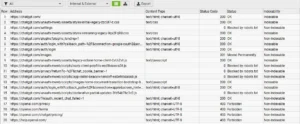
Technical SEO refers to the work done to ensure that search engines can efficiently crawl, render, and index a website’s pages. It covers a broad range of factors including site architecture, crawl budget management, canonical tags, XML sitemaps, robots.txt configuration, HTTPS implementation, page speed, Core Web Vitals, structured data markup, and internal linking structure. When technical SEO issues are present, they can prevent pages from appearing in search results entirely — meaning that any investment in content or link acquisition may deliver little measurable return until those issues are resolved.
Technical SEO problems vary considerably in severity. A missing canonical tag on a handful of product pages is a different priority than a robots.txt file that accidentally blocks Googlebot from crawling the entire site. A thorough technical audit — using tools such as Google Search Console, Screaming Frog, or Semrush’s site audit — helps identify which issues are likely to have the greatest impact on crawling and indexing before other SEO investments are made. Not every technical finding requires immediate action, and prioritization within technical SEO itself is a meaningful exercise.
What Link Building Involves
Link building is the process of acquiring hyperlinks from external websites that point to pages on your own site. Search engines, including Google, have historically treated backlinks as signals of a page’s relevance and authority — though the weight and interpretation of those signals continues to evolve. The quality, topical relevance, and editorial context of linking pages matter considerably more than raw link volume. A small number of contextually relevant links from authoritative referring domains in your industry may contribute more to ranking potential than a large number of low-quality or unrelated placements.
Link acquisition methods include manual outreach for guest posts, niche edits (also called link insertions), digital PR campaigns, resource page link building, and broken link building, among others. Each method has different timelines, editorial requirements, and suitability depending on the target page, industry, and competitive environment. Outsourced link building providers typically manage outreach, publisher vetting, content creation, and placement reporting on behalf of clients — allowing in-house teams to focus on other priorities while a structured campaign runs in parallel.
It is important to distinguish between the acquisition of a backlink and its measurable SEO impact. Third-party metrics such as Domain Rating (Ahrefs), Domain Authority (Moz), or Authority Score (Semrush) are proprietary estimates of link-based authority — they are not Google metrics and do not directly determine rankings. An increase in these scores does not guarantee improved organic rankings, traffic, or revenue. Ranking changes depend on many factors beyond backlink acquisition, including content quality, search intent alignment, and the competitive strength of other pages targeting the same queries.
Why the Sequencing Question Matters
The debate around link building vs technical SEO prioritization is not purely academic. Investing in link acquisition before resolving critical technical issues can mean that the link equity those placements generate does not flow correctly to target pages — for example, if those pages are blocked from indexing, return server errors, or are not properly canonicalized. Conversely, spending months on technical refinements while competitors continue building their backlink profiles can widen a competitive gap that becomes increasingly difficult to close.
The sequencing question also has budget implications. Technical SEO work often requires developer time and may involve platform changes, while link building requires ongoing outreach, content production, and publisher relationships. For businesses with limited resources, understanding which investment is likely to unblock the most ranking potential first is a practical financial decision, not just an SEO theory exercise.
When Technical SEO Should Come First
There are several situations where resolving technical SEO issues before investing in link building is the more logical sequence. If a site audit reveals that key pages are not being indexed — whether due to noindex tags, crawl errors, redirect chains, or canonicalization problems — then acquiring backlinks to those pages is unlikely to produce meaningful ranking improvements. The links may be acquired, but the pages they point to may not be eligible to rank.
Technical SEO should also take priority when a website has recently undergone a migration, a domain change, or a significant structural redesign. These events frequently introduce crawling and indexing problems that can suppress rankings across the entire site. Resolving these issues first creates a stable foundation from which link building can then operate effectively. Similarly, if Google Search Console is reporting a high volume of coverage errors, manual actions, or security issues, these warrant attention before external link acquisition begins.
New websites with little or no existing backlink profile often benefit from establishing a technically sound structure early. Getting internal linking, URL structure, and indexing right from the outset means that any links acquired later will flow equity to the correct pages without being diluted by duplicate content issues or orphaned pages.
Signs that technical SEO may be the more urgent priority
- Key commercial or informational pages are not appearing in Google’s index despite being live
- Google Search Console shows a significant proportion of pages with crawl errors or excluded status
- The site has recently been migrated, redesigned, or moved to a new domain
- Core Web Vitals scores are failing across a large proportion of pages
- Internal linking is poorly structured, leaving important pages with few or no internal links pointing to them
- Duplicate content issues are causing search engines to index the wrong version of key pages
- A manual action or security issue is currently active on the site
When Link Building Should Come First — or Run in Parallel
For websites that are technically sound — pages are indexed correctly, crawl errors are minimal, site speed is acceptable, and internal linking is reasonable — the primary barrier to ranking improvement in competitive markets is often the relative strength of the backlink profile compared to competing pages. In these cases, waiting to begin link acquisition while conducting further technical refinements may delay ranking progress unnecessarily.
Link building also has a longer lead time than most technical fixes. A well-executed manual outreach campaign typically takes several months before placements are live and indexed, and a further period before any ranking or traffic changes become measurable. Starting link acquisition earlier in a campaign timeline — provided the technical foundation is adequate — means those effects may begin to compound sooner. This is particularly relevant for businesses in competitive industries where established competitors have accumulated backlink profiles over years.
In many practical scenarios, link building and technical SEO do not need to be sequential at all. A business with sufficient resources can run both workstreams simultaneously: a technical SEO specialist addresses crawling, indexing, and site structure issues while an outreach team or outsourced provider begins building the backlink profile. This parallel approach is common in agency settings and can be appropriate for businesses that have identified both technical gaps and a competitive backlink deficit.
Signs that link building may be the more urgent or concurrent priority
- The site is technically healthy with no significant crawl or indexing issues
- Target pages are indexed but ranking below competitors with stronger backlink profiles
- Competitors in the same market have substantially more referring domains pointing to comparable pages
- Content quality is strong but organic visibility remains low despite adequate technical health
- The business is operating in a competitive niche where backlink signals appear to influence rankings meaningfully
- A previous technical audit has already been completed and major issues resolved
How Technical SEO and Link Building Interact
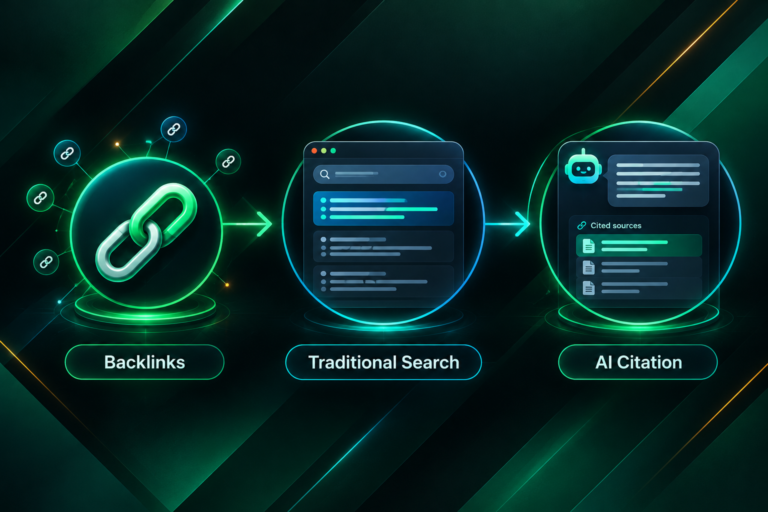
Technical SEO and link building are not competing disciplines — they address different aspects of search engine performance and work best when treated as complementary. Technical SEO determines whether a site can be crawled and understood; link building influences how authoritatively a site is perceived relative to competitors. A site with excellent technical health but a weak backlink profile may struggle to rank in competitive markets. A site with a strong backlink profile but serious technical issues may find that link equity is not flowing to the pages that need it most.
Internal linking is one area where the two disciplines overlap directly. A well-structured internal linking architecture helps distribute the authority gained from external backlinks across the site, directing equity toward priority pages. If internal linking is poor, even high-quality external links may not contribute their full potential value to target pages. This is why technical SEO audits often include an internal linking review alongside crawl and indexing analysis.
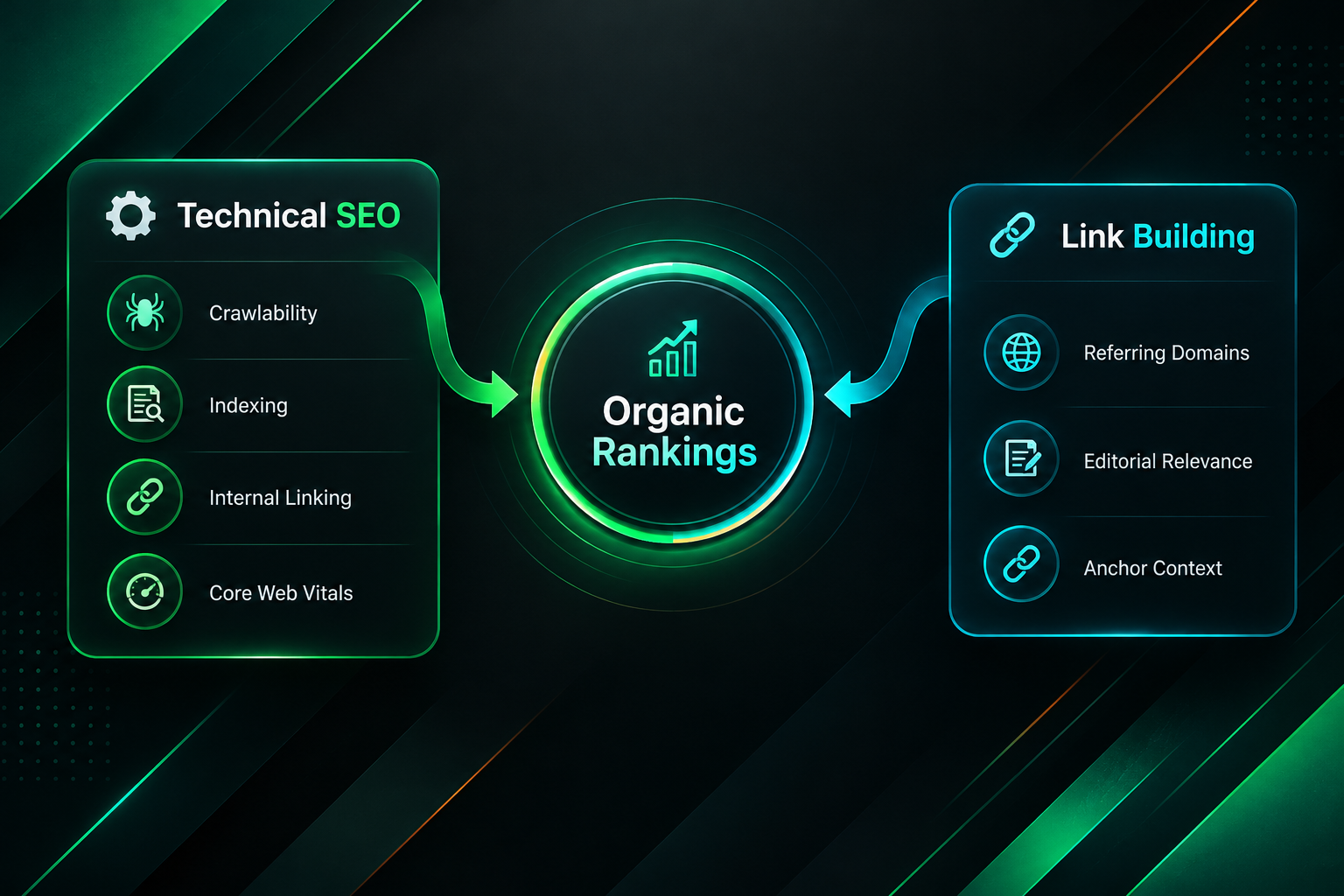
Page speed and Core Web Vitals are another intersection point. While Google has confirmed that Core Web Vitals are a ranking factor, their weight relative to content relevance and backlink signals is generally considered modest for most queries. Improving page speed is unlikely to overcome a significant backlink deficit in a competitive market, but severe performance issues may affect user experience and crawl efficiency in ways that compound other ranking challenges.
The Role of Content Quality in the Prioritization Decision
Both technical SEO and link building depend on content quality to function effectively. Technical SEO ensures that content can be found and indexed; link building depends on content being worth linking to. If the content on target pages is thin, outdated, or misaligned with the search intent of the queries you are targeting, neither technical improvements nor backlink acquisition is likely to produce sustained ranking gains.
Before investing heavily in either discipline, it is worth assessing whether the content on priority pages genuinely serves the reader’s intent better than competing pages. Content that answers a query more completely, more accurately, or more usefully than existing results is more likely to attract editorial links naturally and to retain rankings once they are achieved. This does not mean that link building or technical SEO should wait until content is perfect — but it does mean that content quality is a meaningful variable in the overall prioritization equation.
Low organic visibility is not always caused by a weak backlink profile or technical issues. It can also result from search intent mismatch, where a page targets a keyword but does not match the format or depth that searchers expect. Identifying the actual cause of underperformance — through a combination of technical audit, content review, and competitive backlink analysis — is more reliable than assuming that either link building or technical SEO alone will resolve the problem.
Practical Prioritization Framework
Rather than applying a universal rule, a more reliable approach is to assess the specific condition of your website before deciding where to invest first. The following sequence of questions can help structure that assessment without requiring a full agency engagement upfront.
-
- Are key pages indexed? Check Google Search Console for coverage errors and confirm that priority pages appear in Google’s index. If they do not, technical SEO is the immediate priority.
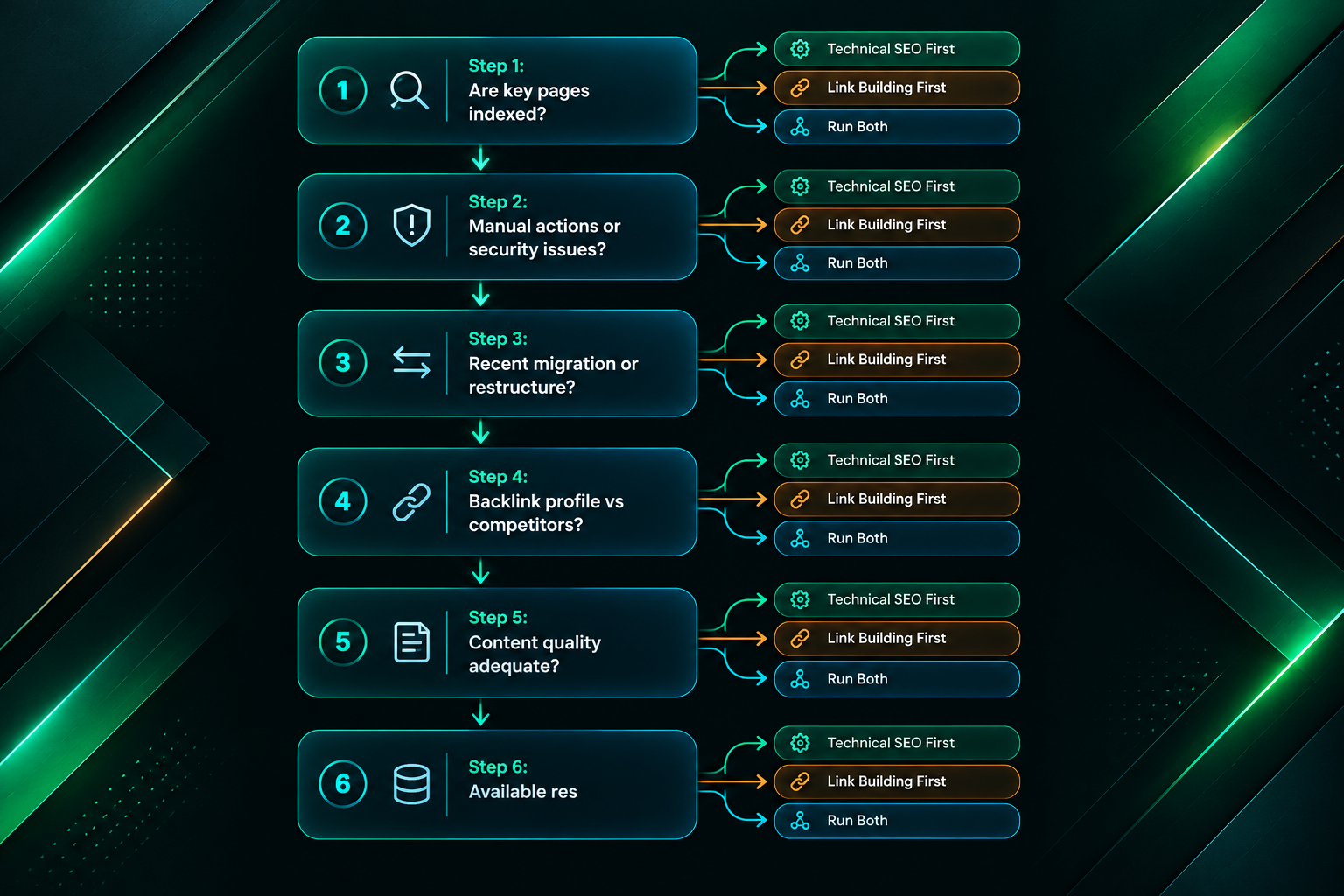
- Are there active manual actions or security issues? These must be resolved before link building can contribute meaningfully to ranking recovery.
- Has the site recently been migrated or restructured? Post-migration technical issues should be stabilized before significant link acquisition investment begins.
- Is the backlink profile substantially weaker than competing pages? Use tools such as Ahrefs or Semrush to compare referring domain counts and link quality for pages targeting the same queries. A significant gap may indicate that link building should begin or run concurrently with technical work.
- Is content quality adequate? If target pages are thin or misaligned with search intent, content improvement may need to precede or accompany both technical and link building investment.
- What are the available resources? If budget and team capacity are limited, the discipline most likely to unblock ranking potential first should take priority. If resources allow, running both workstreams simultaneously is often the most efficient approach.
Risks of Getting the Sequence Wrong
Investing in link building before resolving critical technical issues carries specific risks. If target pages are not indexed, links pointing to them may not contribute to rankings. If redirect chains or canonicalization errors are present, link equity may be diluted or directed to unintended pages. In these scenarios, the budget spent on link acquisition may deliver less value than it would on a technically sound site — not because the links are low quality, but because the site is not in a position to benefit from them fully.
Conversely, delaying link building indefinitely while pursuing technical perfection carries its own risk. Technical SEO improvements can be meaningful, but they rarely overcome a large competitive backlink deficit on their own. In markets where established competitors have accumulated hundreds or thousands of referring domains over years, a technically excellent but link-poor site may still struggle to rank for competitive queries regardless of how well-optimized its pages are.
There is also a risk of misdiagnosing the root cause of poor performance. A site that ranks poorly may have technical issues, a weak backlink profile, poor content quality, or some combination of all three. Investing heavily in one area without understanding the actual cause of underperformance can result in wasted budget and delayed results. A structured SEO audit that covers technical health, content quality, and backlink profile analysis is the most reliable starting point for making an informed prioritization decision.
Frequently Asked Questions
Can link building work if my site has technical SEO problems?
It depends on the severity of the issues. Minor technical imperfections are unlikely to prevent link building from contributing to rankings. However, if key pages are not indexed, have crawl errors, or are affected by a manual action, link acquisition is unlikely to deliver meaningful results until those issues are resolved. A technical audit before starting a link building campaign helps identify whether any blockers need to be addressed first.
How long does it take to see results from technical SEO fixes?
Some technical fixes — such as removing a noindex tag from an important page — can result in that page being re-crawled and indexed within days to weeks. Broader ranking improvements following technical work vary considerably depending on the nature of the issues resolved, the site’s crawl frequency, and competitive factors. Not all technical improvements produce immediate or dramatic ranking changes.
How long does it take to see results from link building?
Manual outreach campaigns typically take several weeks to produce live placements, and a further period — often two to six months or longer — before measurable ranking or traffic changes become visible. Results vary depending on the competitiveness of the target queries, the quality and relevance of acquired links, the existing backlink profile, and other SEO factors. Link building is generally a medium- to long-term investment rather than a quick-win tactic.
Should I do a technical SEO audit before starting link building?
A technical audit is generally a sensible step before committing to a significant link building investment. It helps confirm that target pages are indexed, that internal linking is directing equity appropriately, and that no critical issues are likely to limit the impact of acquired links. Many link building providers or SEO agencies will recommend or conduct a basic technical review as part of campaign onboarding.
Is it possible to run technical SEO and link building at the same time?
Yes, and for many businesses this is the most efficient approach. Technical SEO work and link acquisition address different aspects of search performance and do not need to be strictly sequential. Running both workstreams simultaneously — with a technical specialist addressing crawl and indexing issues while an outreach team builds the backlink profile — can reduce the time before measurable improvements become visible, provided the site does not have critical technical blockers that would prevent links from contributing value.
Does fixing technical SEO issues guarantee better rankings?
No. Resolving technical issues removes barriers to ranking but does not guarantee improved positions. If a page is technically sound but competing against pages with stronger content and more authoritative backlink profiles, technical improvements alone are unlikely to close that gap. Technical SEO is a necessary foundation, not a sufficient condition for ranking in competitive markets.
What if my site has both technical issues and a weak backlink profile?
This is a common situation, and the appropriate response depends on the severity of each problem. Critical technical issues — particularly those affecting indexing — should generally be addressed first. Once the site is in a position to benefit from link acquisition, a structured outreach campaign can begin. In some cases, both workstreams can run concurrently if resources allow and the technical issues are not severe enough to prevent links from contributing value.
Choosing the Right Starting Point for Your Website
The link building vs technical SEO prioritization question does not have a single correct answer that applies to every website. The right starting point depends on your site’s current technical condition, the competitive strength of your backlink profile relative to ranking competitors, the quality of your content, and the resources available to invest in each discipline. For sites with critical crawling or indexing issues, resolving those problems first is the more logical sequence. For technically sound sites competing in markets where backlink signals appear to influence rankings, beginning or continuing link acquisition — potentially in parallel with ongoing technical maintenance — is often the more productive investment.
What is clear is that treating technical SEO and link building as mutually exclusive choices is rarely the right framing. Both disciplines contribute to organic search performance in different ways, and the most effective SEO strategies typically address both over time. The sequencing decision is about identifying which investment is most likely to unblock ranking potential first given your specific situation — not about declaring one discipline permanently more important than the other.
If you are uncertain which area represents the greater opportunity for your website, a structured SEO audit covering technical health, content quality, and backlink profile analysis is the most reliable way to make an informed decision. A qualified SEO provider or link building specialist can help interpret audit findings and recommend a prioritization approach based on your competitive environment and business goals.