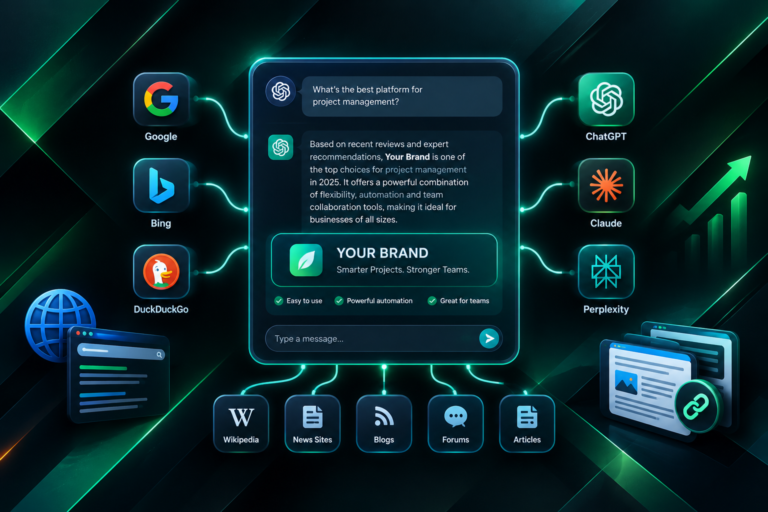
AI-powered search features — from Google’s AI Overviews to standalone tools like ChatGPT Search and Perplexity — are changing how some users find information online. Naturally, businesses and SEO teams are asking whether the backlinks they have built, or plan to build, still matter in this new environment. The honest answer is that the relationship between backlinks and AI search visibility is not yet fully understood, but there are meaningful signals, documented mechanisms, and practical considerations worth examining before adjusting your strategy.
Key Takeaways
- Backlinks remain a documented ranking signal in traditional search, and AI search features often draw from the same ranked pages, meaning link authority may indirectly influence AI-generated answers.
- No search engine or AI platform has published a definitive statement confirming that backlinks directly determine inclusion in AI-generated responses, so claims of a guaranteed connection should be treated with caution.
- Brand mentions, topical authority, and content quality appear to be important factors for AI citation alongside — or sometimes instead of — raw link counts.
- The most defensible approach is to build a strong, relevant backlink profile as part of a broader strategy that also prioritises content quality, entity recognition, and genuine expertise signals.
- Businesses should monitor AI search visibility separately from traditional organic rankings, as the two do not always move together.
How AI Search Features Work and Where Backlinks Fit
AI search features such as Google’s AI Overviews, Bing’s Copilot integration, Perplexity, and ChatGPT Search generate responses by processing large amounts of web content, often drawing on indexed pages to produce summarised answers with cited sources. The precise mechanisms differ between platforms, but most rely on some combination of a retrieval layer — which identifies candidate pages — and a generation layer, which synthesises a response from those candidates. Understanding where backlinks may influence this process requires separating these two stages.
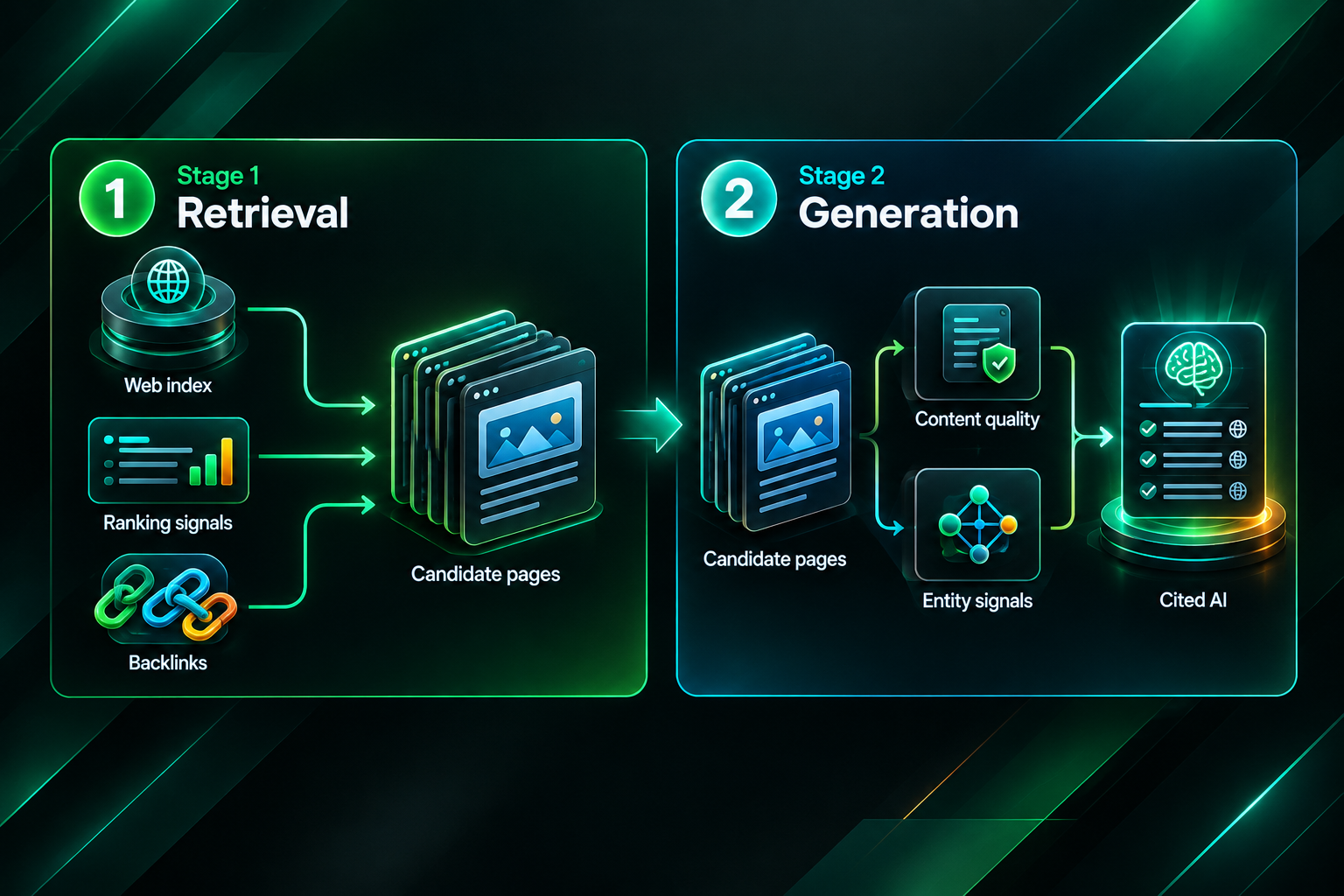
In the retrieval stage, many AI search tools use the same underlying web index as traditional search. Google’s AI Overviews, for example, are built on top of Google Search’s existing index and ranking infrastructure. Because backlinks are a documented ranking signal in Google Search, pages that rank well in traditional organic results are more likely to be retrieved as candidates for AI-generated answers. This is the clearest documented mechanism by which backlinks may help AI search visibility — not by directly influencing the AI model, but by helping pages qualify for retrieval in the first place.
The generation stage is less transparent. Once candidate pages are retrieved, the AI system selects which sources to cite and how to synthesise information. Factors such as content clarity, factual specificity, structured formatting, and the presence of clear entity signals — named organisations, people, products, and concepts — appear to influence citation selection, though the exact weighting is not publicly documented by any major platform. Backlink authority alone does not guarantee citation in an AI-generated answer, even for pages that rank well in traditional search.
What the Evidence Suggests About Backlinks and AI Citations
Several SEO research teams and tool providers have published observational studies examining which pages tend to appear as cited sources in AI-generated answers. These studies consistently find that cited pages tend to have stronger backlink profiles than non-cited pages on similar topics. However, correlation is not causation: pages with strong backlink profiles also tend to have better content, more established brand recognition, and higher traditional search rankings — all of which may independently influence AI citation selection.
Ahrefs, Semrush, and similar SEO platforms have published data suggesting that pages cited in AI Overviews often rank in the top positions for related traditional search queries. This supports the indirect mechanism described above: backlinks help pages rank, ranked pages are more likely to be retrieved, and retrieved pages have a higher chance of being cited. But the relationship is probabilistic, not deterministic. Pages with modest backlink profiles but highly specific, well-structured content are sometimes cited, while pages with strong link profiles but generic content are sometimes excluded.
It is also worth noting that AI search platforms differ meaningfully in how they select sources. Perplexity, for instance, appears to weight recency and source diversity alongside authority signals. ChatGPT Search behaviour has been observed to vary by query type. Google’s AI Overviews appear more closely tied to traditional ranking signals, including backlinks, than some third-party AI tools. Treating all AI search features as a single uniform system would be an oversimplification that could lead to poorly targeted strategy decisions.
Brand Authority, Entity Recognition, and AI Visibility
One of the clearest emerging themes in AI search research is the importance of brand and entity recognition. AI language models are trained on large corpora of web content, and entities — organisations, products, people, and concepts — that appear frequently and consistently across authoritative sources tend to be better represented in model knowledge. This has practical implications for how businesses think about their online presence.
Backlinks from editorially relevant, high-quality sources contribute to entity recognition in two ways. First, they signal to search engines that a brand or website is associated with a particular topic or industry, which may strengthen topical authority signals used in retrieval. Second, links from well-known publications, industry resources, and trusted directories increase the likelihood that a brand is mentioned across the broader web, which may influence how AI models represent that entity in generated responses. Unlinked brand mentions — where a publication references a company or product without a hyperlink — may also contribute to entity recognition, though their direct influence on AI citation is even less documented than that of backlinks.
This suggests that the quality and topical relevance of referring domains may matter more for AI search visibility than raw link volume. A backlink from a respected industry publication that covers your niche in depth is likely to contribute more to both traditional ranking and AI entity recognition than a large number of links from low-relevance or low-authority sources. This aligns with established best practice in link building, where editorial relevance and publisher quality are prioritised over quantity.
How Traditional SEO and AI Search Visibility Overlap
For most businesses, traditional organic search and AI-generated answers are not entirely separate channels. Google’s AI Overviews appear most frequently for informational queries, and the pages cited are often the same pages that rank in the top organic positions for those queries. This means that a well-executed link building campaign that improves traditional organic rankings may also improve the probability of appearing in AI-generated answers for related queries — not because backlinks directly influence the AI model, but because they help pages achieve the rankings that make retrieval more likely.
However, the overlap is imperfect. Some queries that previously generated a list of organic results now produce an AI-generated answer that reduces click-through to individual pages. For these queries, appearing as a cited source within the AI answer may be more valuable than ranking in position three or four below it. Businesses that rely heavily on informational content for organic traffic should monitor whether AI Overviews are appearing for their target queries and whether their pages are being cited, rather than assuming that traditional ranking improvements will automatically translate into AI search visibility.
For transactional and commercial queries — product searches, service comparisons, local business queries — AI-generated answers are currently less dominant, and traditional organic rankings, local pack results, and paid search remain the primary visibility channels. Backlinks continue to play a well-documented role in these contexts. Businesses should assess which query types are most important to their goals before deciding how to weight AI search visibility in their overall strategy.
Content Quality and Structured Information as Complementary Factors
Backlinks are unlikely to be sufficient on their own for AI search visibility, even if they contribute meaningfully through the retrieval mechanism. Content quality, factual accuracy, and clear structure appear to influence which pages are selected as cited sources once they have been retrieved as candidates. Pages that directly answer specific questions, use clear headings, include named entities, and present information in a format that is easy to parse tend to perform better as AI citations than pages that are optimised primarily for keyword density or link acquisition.
This means that link building and content strategy are complementary rather than competing priorities for businesses aiming to improve AI search visibility. A page that earns strong backlinks but presents information in a vague, poorly structured way may rank well in traditional search but be passed over in favour of a more clearly written competitor page when an AI system selects sources to cite. Conversely, a page with excellent content but a weak backlink profile may not be retrieved as a candidate at all, regardless of its quality.
Practical content improvements that may support AI citation include: answering specific questions directly and early in the content, using descriptive headings that match likely query phrasing, including accurate factual claims with clear attribution where appropriate, and ensuring that the page clearly identifies the organisation, author, or source behind the content. These improvements support both traditional E-E-A-T signals — experience, expertise, authoritativeness, and trustworthiness — and the kind of clear, parseable content that AI retrieval systems appear to favour.
Risks of Over-Indexing on AI Search Visibility
As AI search features attract more attention, some providers and commentators have begun offering services or strategies specifically marketed as improving AI search visibility or AI citation rates. Businesses should approach these claims carefully. No third party has documented access to the internal ranking or citation mechanisms of Google’s AI Overviews, Perplexity, or ChatGPT Search, and strategies marketed as guaranteed to improve AI citation rates are making claims that cannot currently be verified or supported by transparent evidence.
There is also a risk of neglecting the foundational SEO work — technical health, content quality, and a relevant backlink profile — that supports both traditional and AI search visibility in favour of speculative AI-specific tactics. AI search features are evolving rapidly, and the signals that influence citation today may change as platforms update their models and retrieval systems. A backlink profile built from editorially relevant, high-quality sources is likely to retain value across algorithm changes in a way that tactics optimised for a specific AI feature’s current behaviour may not.
Link building campaigns that prioritise low-quality or topically irrelevant placements carry their own risks, including potential violations of Google’s spam policies, which remain relevant regardless of whether the primary goal is traditional ranking or AI search visibility. Paid links that are not properly disclosed, links from private blog networks, and large-scale link schemes remain against Google’s documented guidelines, and these risks do not diminish because AI search features have become more prominent.
Practical Implications for Link Building Strategy
For businesses and SEO teams trying to account for AI search visibility in their link building decisions, the most defensible approach is to focus on the factors that are well-documented and likely to remain relevant as AI search continues to evolve. These include building links from editorially relevant, topically appropriate sources; prioritising publisher quality and audience relevance over domain authority metrics alone; and ensuring that linked pages contain clear, well-structured content that directly addresses the queries you want to be associated with.
Manual outreach and guest posting on genuine industry publications remain among the most reliable methods for acquiring editorially relevant backlinks. These placements tend to come from sources that are themselves indexed and potentially cited by AI search systems, which may provide an additional indirect benefit beyond the traditional ranking signal. Digital PR campaigns that generate coverage in recognised publications can also contribute to both backlink acquisition and the kind of broad brand mention footprint that may support entity recognition in AI models.
Niche edits — placements within existing, indexed content on relevant websites — can be a useful complement to new content placements, particularly for pages that need to build topical relevance signals quickly. As with all link acquisition methods, the quality and relevance of the referring page and domain matter more than the volume of placements when the goal is to support both traditional ranking and AI search visibility.
Businesses considering outsourcing link building should look for providers that prioritise publisher quality assessment, editorial relevance, and transparent reporting over guaranteed placement volumes. A campaign that delivers a smaller number of genuinely relevant, high-quality placements is likely to contribute more to both traditional and AI search visibility than one that prioritises quantity at the expense of quality.
Monitoring AI Search Visibility Alongside Traditional Metrics
Traditional SEO metrics — organic rankings, referring domains, domain authority scores from tools like Ahrefs or Moz, and organic traffic from Google Search Console or Google Analytics — do not directly measure AI search visibility. Businesses that want to understand their presence in AI-generated answers need to monitor this separately, using a combination of manual query testing, emerging AI visibility tracking tools, and analysis of which pages are being cited for relevant queries.
It is worth noting that AI search visibility is not yet a standardised metric with agreed measurement methodology. Different tools measure it differently, and the results can vary significantly depending on query selection, geography, and the specific AI feature being tracked. Businesses should treat current AI visibility data as directional rather than definitive, and should be cautious about making major strategy changes based solely on AI citation metrics that may not yet be reliably measured.
Referral traffic from AI search tools — where users click through from a cited source to the underlying page — can be tracked in Google Analytics and similar platforms, though attribution may be incomplete depending on how different AI tools handle referral data. Monitoring this alongside traditional organic traffic can provide a more complete picture of how AI search features are affecting overall visibility and site visits.
Frequently Asked Questions
Do backlinks directly influence which pages are cited in AI-generated answers?
No major AI search platform has published documentation confirming that backlinks are a direct citation signal. The most plausible documented mechanism is indirect: backlinks help pages rank in traditional search, and AI search features that use the same underlying index are more likely to retrieve highly ranked pages as candidates for citation. Whether a retrieved page is then selected as a cited source appears to depend on additional factors including content quality, structure, and topical specificity.
Is it worth continuing to build backlinks if AI search is growing?
For most businesses, yes — with appropriate expectations. Backlinks remain a documented ranking signal in traditional search, which continues to drive the majority of organic search traffic for most websites. Because many AI search features draw from the same index, a strong backlink profile may also indirectly support AI search visibility. The case for link building does not depend on AI search alone, and the foundational value of editorially relevant backlinks is unlikely to disappear as AI features evolve.
Does the quality of referring domains matter more for AI search visibility than for traditional SEO?
Quality and topical relevance of referring domains appear to matter for both traditional SEO and AI search visibility, and the two are not easily separated. High-quality, topically relevant backlinks tend to support stronger traditional rankings, which in turn may improve the probability of AI retrieval. There is also a plausible argument that links from well-known, frequently indexed publications contribute to entity recognition in AI models, though this is less directly documented than the traditional ranking mechanism.
Can unlinked brand mentions help with AI search visibility?
Unlinked brand mentions — references to a company, product, or person without a hyperlink — may contribute to entity recognition in AI language models, since these models are trained on broad web content rather than link graphs alone. However, the direct influence of unlinked mentions on AI citation selection is not well documented, and they should be considered a complementary signal rather than a substitute for a relevant backlink profile.
How should I measure whether my backlinks are helping AI search visibility?
There is no single standardised metric for AI search visibility. Practical approaches include manually testing target queries in AI search tools to check whether your pages are cited, using emerging AI visibility tracking tools with an understanding of their methodological limitations, and monitoring referral traffic from AI platforms in Google Analytics. Traditional metrics such as organic rankings and referring domain growth remain useful as indirect indicators, since they reflect the underlying signals that influence AI retrieval.
Are there risks to link building strategies specifically aimed at AI search visibility?
Yes. Strategies marketed as guaranteed to improve AI citation rates are making claims that cannot currently be verified. There is also a risk of neglecting foundational SEO work in favour of speculative AI-specific tactics. Link building campaigns that prioritise low-quality or irrelevant placements carry risks under Google’s spam policies regardless of the stated goal, and these risks remain relevant whether the target is traditional rankings or AI search visibility.
What to Consider Before Adjusting Your Link Building Strategy for AI Search
The relationship between backlinks and AI search visibility is real but indirect, and the evidence base is still developing. Backlinks help pages rank in traditional search, and AI search features that draw from the same index are more likely to retrieve well-ranked pages as citation candidates. Beyond retrieval, content quality, entity clarity, and topical specificity appear to influence which pages are actually cited in AI-generated answers. Neither backlinks alone nor content quality alone is likely to be sufficient.
For most businesses, the practical implication is that a well-executed link building strategy — one that prioritises editorially relevant placements from quality publishers, supports strong traditional rankings, and is paired with clear, well-structured content — is likely to contribute to AI search visibility as a by-product of doing foundational SEO well. Chasing AI-specific tactics at the expense of this foundation carries more risk than reward given the current state of evidence.
If you are considering a link building campaign and want to understand how it might support both traditional and AI search visibility for your specific website, a site-specific assessment is the appropriate starting point. The right approach will depend on your existing backlink profile, content quality, target queries, industry, and the competitive landscape — factors that vary significantly between businesses and cannot be assessed without relevant data.