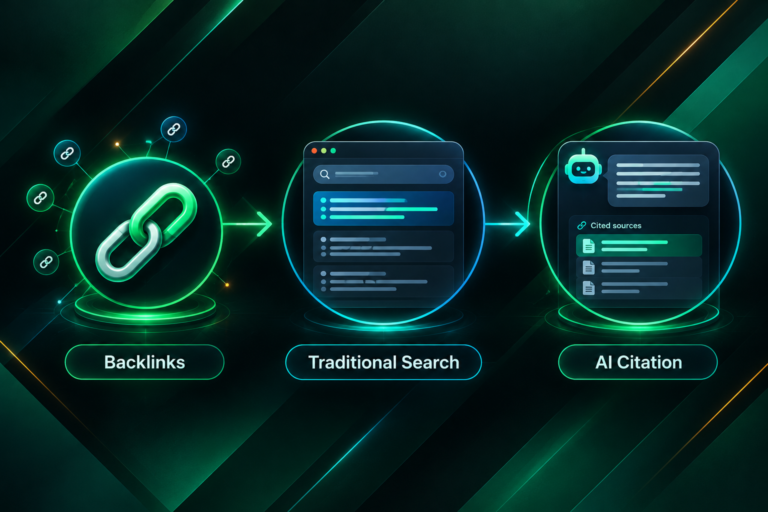
AI-powered answer engines such as ChatGPT, Google’s AI Overviews, Perplexity, and Microsoft Copilot are increasingly shaping how people discover brands, products, and services. When a potential customer asks an AI tool for a recommendation or comparison, the brands mentioned in that response gain significant visibility — and those that are absent may lose ground to competitors. Monitoring whether and how your brand appears in AI-generated answers has become a meaningful part of modern brand visibility management, and understanding how to do it systematically is the first step toward improving your position.
Key Takeaways
- AI answer engines draw on a combination of training data, indexed web content, and cited sources, meaning your brand’s presence in authoritative online content directly influences whether it appears in AI responses.
- No single tool currently offers complete, real-time coverage of all AI answer engines, so effective monitoring requires a combination of manual checks, emerging specialist tools, and structured tracking processes.
- Brand mentions in AI answers are closely linked to the quality and breadth of your brand’s digital footprint, including editorial coverage, backlinks from credible sources, and consistent brand signals across the web.
- Monitoring alone is not enough — the insights you gather should inform a content and link acquisition strategy designed to improve how AI systems perceive and represent your brand.
- This is an emerging discipline; best practices, tools, and AI platform behaviours are evolving rapidly, and any monitoring approach should be reviewed regularly.
Why Brand Mentions in AI Answers Matter
Traditional SEO has long focused on ranking positions in search engine results pages. AI-generated answers introduce a different dynamic: instead of a list of links, users receive a synthesised response that may name specific brands, recommend particular products, or describe a market landscape. If your brand is consistently mentioned in these answers, you benefit from a form of visibility that does not depend on a user clicking through to a results page. If your brand is absent, a competitor’s name fills that space instead.
The commercial implications are significant for businesses in competitive categories. Research into AI answer behaviour suggests that the brands most frequently cited tend to be those with strong editorial coverage, high-quality backlinks from authoritative sources, and consistent brand signals across multiple credible websites. This means that the factors influencing AI mentions overlap substantially with the factors that have always driven organic search authority — but the output format and user behaviour are different enough to warrant dedicated attention.
For SEO teams and agency decision-makers, monitoring AI brand mentions provides early intelligence about how your brand is being represented in an increasingly important channel. It also reveals gaps: categories where competitors are named and you are not, or contexts where your brand appears but with inaccurate or outdated information.
How AI Answer Engines Decide Which Brands to Mention
Understanding the mechanics behind AI brand mentions helps clarify what monitoring can and cannot tell you. Large language models such as those powering ChatGPT are trained on large datasets of web content up to a specific knowledge cutoff date. Their responses reflect patterns in that training data, meaning brands with extensive, credible, and widely referenced online coverage are more likely to appear. Retrieval-augmented generation (RAG) systems — used by tools like Perplexity and Google’s AI Overviews — go further by retrieving and citing live web content at the time of the query, making current indexing and link authority more directly relevant.
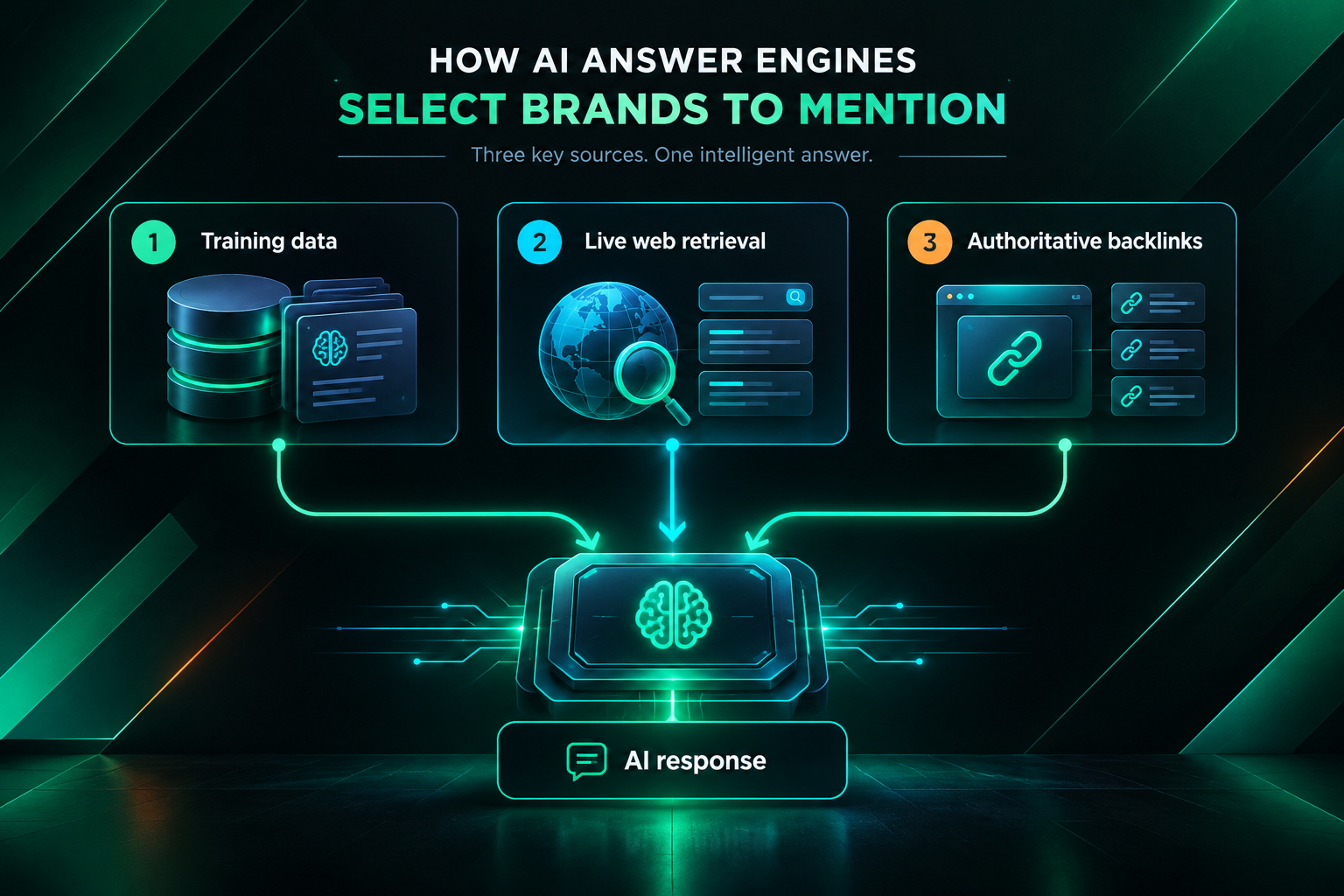
Google’s AI Overviews, in particular, appear to draw heavily on content that Google already considers authoritative for a given query. Pages that rank well organically, that attract editorial backlinks from relevant and credible domains, and that clearly demonstrate expertise on a topic are more likely to be surfaced as source material. This means that improving your brand’s representation in AI Overviews is closely connected to improving your overall organic search authority — though the relationship is not perfectly predictable and outcomes vary by query type, industry, and competitive landscape.
For retrieval-based systems, the quality and relevance of the sources that mention your brand matter considerably. A mention in a well-regarded industry publication that is itself frequently cited and linked to carries more weight than a mention on a low-authority directory. This is one reason why editorial link building and digital PR — strategies that earn genuine coverage on credible, topically relevant websites — are increasingly discussed in the context of AI visibility as well as traditional SEO.
What to Monitor: Key Signals and Dimensions
Effective brand mention monitoring in AI answers involves tracking several distinct dimensions rather than simply checking whether your brand name appears.
Presence and Frequency
The most basic question is whether your brand is mentioned at all when relevant queries are submitted to AI tools. Tracking presence across a defined set of queries — product category questions, comparison queries, recommendation requests, and problem-solution queries relevant to your market — gives you a baseline. Frequency matters because AI responses are not always consistent; the same query submitted at different times or with slight variations may produce different results, particularly in retrieval-based systems where live content influences the output.
Sentiment and Accuracy
Being mentioned is not always positive. AI systems can reproduce inaccurate information, outdated descriptions, or unfavourable characterisations drawn from their training data or from the sources they retrieve. Monitoring should include an assessment of how your brand is described: whether the information is accurate, whether the framing is neutral or negative, and whether the context matches how you want to be positioned in your market.
Competitor Presence
Understanding which competitors are mentioned alongside or instead of your brand in AI answers is strategically valuable. If a competitor consistently appears in responses to queries where your brand does not, that signals a gap in your brand’s digital authority or content coverage for that topic area. Competitor analysis within AI monitoring helps prioritise where to focus content and link acquisition efforts.
Source Attribution
In retrieval-based AI systems that cite sources, identifying which websites are being used as references for your brand or category provides actionable intelligence. If certain publications, review platforms, or industry directories are consistently cited, those become priority targets for earning coverage or ensuring your brand is accurately represented.
Tools and Methods for Monitoring AI Brand Mentions
The tooling landscape for AI brand mention monitoring is still maturing. No single platform currently provides comprehensive, automated tracking across all major AI answer engines with the reliability that established SEO tools offer for traditional search. However, a combination of approaches can provide meaningful coverage.
Manual Query Testing
The most accessible starting point is systematic manual testing. Define a set of queries that represent how your target audience might ask AI tools about your product category, use case, or competitive landscape. Submit these queries regularly to the AI tools most relevant to your audience — which may include ChatGPT, Google’s AI Overviews (visible in Google Search), Perplexity, Microsoft Copilot, and others depending on your market. Record the responses, note which brands are mentioned, how your brand is described, and which sources are cited. This process is time-consuming but provides direct, unfiltered insight into how AI tools are currently representing your brand.
Emerging AI Monitoring Platforms
A growing number of specialist tools are being developed specifically to track brand mentions in AI-generated answers. Platforms such as Brandwatch, Mention, and newer AI-focused tools are beginning to incorporate AI answer monitoring features alongside their traditional social and web mention tracking capabilities. Some SEO platforms are also adding AI visibility reporting. The capabilities, coverage, and reliability of these tools vary considerably, and the market is evolving quickly. When evaluating any tool, it is worth assessing which AI platforms it covers, how frequently it samples responses, whether it tracks query variations, and how it handles the inherent inconsistency of AI-generated outputs.
Traditional Brand Monitoring as a Foundation
Established brand monitoring tools — including Google Alerts, Semrush’s Brand Monitoring, Ahrefs Content Explorer, and Mention — track brand mentions across indexed web content. While these tools do not directly monitor AI-generated responses, they serve an important supporting function: the web content they surface is often the same content that AI systems draw on. Monitoring where your brand is mentioned online, which publications cover your category, and which competitors receive editorial coverage helps you understand and influence the inputs that shape AI answers.
Google Search Console and AI Overviews
Google Search Console provides data on impressions and clicks from Google Search, and as AI Overviews become more prevalent, the queries that trigger them are increasingly relevant to brand visibility monitoring. Tracking which queries generate impressions without clicks — a pattern that may indicate AI Overviews are satisfying the query without a click-through — can help identify where AI-generated responses are intercepting your potential traffic and where your brand’s presence in those responses matters most.
Building a Structured Monitoring Process
Ad hoc checks are useful for initial discovery but insufficient for ongoing brand management. A structured monitoring process improves consistency and makes it easier to identify trends over time.
Define Your Query Set
Start by identifying the queries most likely to surface brand recommendations in your category. These typically include comparison queries (“best [product type] for [use case]”), recommendation requests (“which [service] should I use for [goal]”), and problem-solution queries (“how do I [achieve outcome] using [product type]”). Aim for a manageable set of 20 to 50 queries that represent genuine user intent in your market, and review this set periodically as your product offering or competitive landscape changes.
Establish a Testing Cadence
AI responses can change as models are updated, as new content is indexed, or as retrieval systems incorporate fresher sources. A monthly testing cadence is a reasonable starting point for most businesses, with more frequent checks warranted during periods of active content or link building campaigns, after significant product or brand changes, or when a competitor appears to be gaining AI visibility rapidly.
Document and Track Responses Systematically
Record AI responses in a structured format that allows comparison over time. Useful data points include the date of the query, the AI platform tested, the exact query submitted, whether your brand was mentioned, the context and sentiment of the mention, which competitors were mentioned, and which sources were cited. A simple spreadsheet can serve this purpose initially; more sophisticated tracking may warrant a dedicated tool as the process scales.
Assign Ownership and Review Intervals
Brand mention monitoring in AI answers is most effective when it has a clear owner — whether that is an in-house SEO team member, a content strategist, or an agency partner — and when findings are reviewed at regular intervals with a defined process for acting on them. Without ownership and review, monitoring data accumulates without producing strategic action.
Turning Monitoring Insights into Action
Monitoring reveals the current state of your brand’s AI visibility; improving that visibility requires deliberate action on the factors that influence AI responses.
Strengthen Your Brand’s Digital Footprint
AI systems that draw on web content are more likely to mention brands that have broad, credible coverage across authoritative sources. Earning editorial mentions and backlinks from well-regarded industry publications, review platforms, and relevant directories increases the likelihood that your brand appears in the training data and retrieved sources that AI tools use. This is where link building strategy and AI visibility intersect directly: a campaign focused on earning genuine editorial coverage from topically relevant, authoritative websites serves both traditional organic search goals and AI mention goals simultaneously.
Create Clear, Authoritative Brand Content
AI systems often draw on content that clearly and accurately describes what a brand does, who it serves, and what distinguishes it. Ensuring that your website, press coverage, and third-party profiles contain accurate, up-to-date, and clearly written descriptions of your brand reduces the risk of AI systems reproducing outdated or inaccurate information. Structured data markup, clear about pages, and consistent brand descriptions across your digital presence all contribute to how AI systems understand and represent your brand.
Address Inaccurate or Negative Representations
When monitoring reveals that an AI tool is describing your brand inaccurately or unfavourably, the most effective response is usually to address the underlying source content rather than attempting to interact directly with the AI system. If the inaccuracy originates from a specific publication or review platform, working to correct that source — through outreach, updated press materials, or reputation management — is more likely to produce lasting improvement than any direct intervention with the AI tool itself.
Prioritise Cited Sources
In retrieval-based AI systems, the sources cited in responses are direct indicators of which content is being used to inform AI answers. If monitoring reveals that certain publications are consistently cited in your category but do not mention your brand, those publications become priority targets for digital PR outreach or guest contribution. Earning coverage in the sources that AI tools already trust for your topic area is one of the most direct ways to improve AI brand mention frequency.
Limitations and Realistic Expectations
Brand mention monitoring in AI answers is a valuable practice, but it comes with meaningful limitations that are worth understanding before investing significant resources.
AI responses are inherently variable. The same query can produce different responses at different times, across different sessions, or with minor wording changes. This variability makes it difficult to establish stable baselines or to attribute changes in AI mention frequency to specific actions with confidence. Unlike traditional search rankings, which are relatively stable and measurable, AI answer monitoring involves a degree of uncertainty that requires a more qualitative and trend-based interpretation of data.
The tooling for AI mention monitoring is still developing. Many tools that claim to track AI brand mentions are in early stages, and their coverage, accuracy, and methodology vary considerably. Claims made by tool vendors about their AI monitoring capabilities should be evaluated critically, and any tool should be tested against manual checks before being relied upon for strategic decisions.
Improving AI brand mentions is not a guaranteed outcome of any specific action. The relationship between web content, backlinks, and AI responses is complex and not fully transparent. Actions that improve traditional organic search authority — earning high-quality editorial backlinks, creating authoritative content, building a consistent brand presence across credible sources — are generally considered the most reliable way to improve AI visibility, but results vary by market, query type, and AI platform. There is no equivalent of a guaranteed first-page ranking in the AI answer context.
Finally, the AI answer landscape itself is changing rapidly. The platforms, their underlying models, their retrieval mechanisms, and their citation behaviours are all subject to significant change. A monitoring approach that is effective today may need substantial revision as AI tools evolve, making regular review of your monitoring methodology as important as the monitoring itself.
Frequently Asked Questions
Can I directly submit corrections to AI tools if my brand is described inaccurately?
Most major AI platforms do not offer a direct mechanism for brands to submit corrections to their responses. The most effective approach is to address inaccuracies at the source — correcting the web content, press coverage, or review platform entries that the AI system is drawing on. For retrieval-based systems like Perplexity or Google’s AI Overviews, improving the accuracy of indexed source content is more likely to produce lasting change than any direct intervention with the AI tool.
How often should I check AI answers for brand mentions?
A monthly cadence is a reasonable starting point for most businesses. More frequent checks may be warranted during active campaigns, after significant brand or product changes, or when competitive dynamics in your category are shifting quickly. The key is consistency: irregular checks make it difficult to identify meaningful trends.
Does improving my traditional SEO also improve my AI brand mentions?
There is a meaningful overlap. AI systems that retrieve live web content — including Google’s AI Overviews — tend to draw on content that already performs well in organic search. Earning high-quality editorial backlinks, creating authoritative and well-structured content, and building a credible brand presence across relevant sources all contribute to both traditional organic rankings and AI visibility. However, the relationship is not perfectly predictable, and AI-specific monitoring is still worthwhile to understand how your brand is actually being represented.
Which AI platforms should I prioritise for brand mention monitoring?
The answer depends on where your target audience is most active. For most businesses, Google’s AI Overviews warrant priority attention given Google’s dominant search market share. ChatGPT and Perplexity are also widely used and worth including. Microsoft Copilot may be relevant for B2B audiences. Start with the platforms most used by your customers and expand your monitoring scope as resources allow.
Can link building help improve my brand’s presence in AI answers?
Earning editorial backlinks from authoritative, topically relevant sources can improve your brand’s overall digital authority and increase the likelihood that credible content mentioning your brand is indexed and retrieved by AI systems. This is particularly relevant for retrieval-based AI tools that cite sources. Link building is not a direct or guaranteed mechanism for improving AI mentions, but it is one of the factors that influences the broader digital footprint on which AI systems draw.
Is AI brand mention monitoring worth the investment for smaller businesses?
For smaller businesses with limited resources, a lightweight manual monitoring process — testing a defined set of queries monthly across the most relevant AI platforms — can provide useful intelligence without significant cost. Investing in specialist AI monitoring tools may be more appropriate once the business has established a baseline understanding of its current AI visibility and has the resources to act on monitoring insights systematically.
What to Do Next with Your AI Brand Visibility Data
Monitoring brand mentions in AI answers is most valuable when it connects directly to a broader strategy for improving your brand’s digital authority. The insights you gather — which queries surface your brand, which competitors appear instead, which sources are cited, and how your brand is described — should inform decisions about content creation, digital PR outreach, and link acquisition priorities. If monitoring reveals that your brand is consistently absent from AI answers in a category where you compete, that is a signal worth investigating: it may point to gaps in editorial coverage, insufficient backlinks from relevant authoritative sources, or content that does not clearly establish your brand’s expertise in that area.
For businesses and SEO teams considering how to act on AI visibility gaps, the most durable approach is to focus on the underlying factors that AI systems respond to: genuine editorial coverage from credible sources, a well-structured and authoritative web presence, and consistent brand signals across the digital landscape. These are the same factors that support long-term organic search performance, which means that investment in improving AI brand visibility and investment in traditional SEO authority are largely complementary rather than competing priorities. If you are unsure where to start, a structured assessment of your current backlink profile, editorial coverage, and content authority — ideally with input from an experienced SEO professional — can help identify the highest-priority actions for your specific situation.