Enterprise link building operates at a scale and complexity that makes informal processes unreliable. When multiple teams, agencies, and stakeholders are involved in acquiring backlinks, the absence of clear governance leads to duplicated outreach, inconsistent quality standards, compliance gaps, and campaigns that are difficult to measure or defend. Organizing a governance framework gives large organizations the structure to run link acquisition systematically, maintain editorial standards, and align link building activity with broader SEO and business objectives.
Key Takeaways
- Enterprise link building governance defines who approves campaigns, who sets quality standards, and who is accountable for outcomes across teams and external partners.
- A governance framework should cover roles and responsibilities, link quality criteria, outreach policies, approval workflows, and reporting structures before campaigns begin.
- Without documented standards, large organizations risk inconsistent link quality, duplicated outreach to the same publishers, and difficulty identifying which campaigns are producing measurable SEO value.
- Governance does not eliminate the need for skilled execution; it creates the conditions under which skilled teams can work efficiently and consistently at scale.
- Suitability and the right level of governance complexity depend on the organization’s size, the number of teams involved, the markets targeted, and the existing SEO maturity of the business.
What Enterprise Link Building Governance Actually Means
Link building governance at the enterprise level is the set of policies, processes, roles, and standards that determine how an organization plans, approves, executes, monitors, and reports on its link acquisition activity. It is not a single document or a one-time audit. Governance is an ongoing operational structure that keeps link building aligned with the organization’s SEO strategy, brand guidelines, legal requirements, and risk tolerance.
For smaller businesses, link building decisions are often made informally by one or two people. At enterprise scale, the same decisions may involve in-house SEO teams, content teams, legal or compliance reviewers, brand managers, regional marketing leads, and one or more external agencies or outsourced providers. Without a governance structure, each of these groups may apply different standards, pursue conflicting priorities, or create outreach conflicts that damage publisher relationships and campaign effectiveness.
Governance also addresses the relationship between link building and other SEO disciplines. Backlink acquisition does not operate in isolation. The pages being linked to need to be technically sound, well-optimized, and genuinely useful to the audiences of the linking publishers. A governance framework ensures that link building campaigns are coordinated with content production, technical SEO work, and commercial priorities rather than running as a disconnected activity.
Core Components of an Enterprise Link Building Governance Framework
A practical governance framework for enterprise link building typically covers six interconnected areas. The right level of detail in each area depends on the organization’s size, the number of markets it operates in, and how many internal and external teams are involved in link acquisition.
Roles and Accountability
Defining who is responsible for each part of the link building process is the foundation of effective governance. At minimum, an enterprise organization needs to identify who owns the overall link building strategy, who approves individual campaigns or placements, who manages relationships with external agencies or outsourced providers, and who is responsible for monitoring link quality and reporting outcomes to senior stakeholders.
In practice, these responsibilities are often distributed. An in-house SEO director or head of organic search may own the strategy and set quality standards, while campaign execution is delegated to an internal team or an outsourced link building partner. Regional marketing managers may need to approve outreach in specific markets. Legal or compliance teams may need to review placements in regulated industries such as finance, healthcare, or legal services. Documenting these roles clearly prevents decisions from stalling because no one knows who has authority to approve a placement or resolve a quality dispute.
Link Quality Standards
Enterprise organizations need documented criteria for what constitutes an acceptable backlink. These criteria should cover the types of publishers the organization will and will not pursue, the minimum editorial standards expected from placements, the topical relevance requirements for linking pages, and the link attributes that are appropriate for different campaign goals.
Third-party metrics from tools such as Ahrefs, Semrush, Moz, or Majestic — including Domain Rating, Domain Authority, Authority Score, and Trust Flow — can be useful as initial filters, but they are proprietary estimates rather than Google-provided signals. Governance standards should treat these metrics as one input among several rather than as the sole determinant of link quality. Publisher traffic, editorial independence, content quality, topical alignment, and the context of the linking page are all relevant factors that metrics alone do not capture.
Quality standards should also address what the organization will not accept: links from sites with thin or auto-generated content, sites that exist primarily to sell links, sites with no genuine editorial audience, or placements that require payment without disclosure in contexts where disclosure is required. These exclusions protect the organization from accumulating a backlink profile that may attract search engine scrutiny over time.
Outreach Policies and Publisher Relationship Management
At enterprise scale, multiple teams or agencies may be conducting outreach simultaneously. Without coordination, the same publisher may receive outreach from different parts of the organization within a short period, which damages credibility and reduces the likelihood of future placements. A governance framework should include a centralized record of publisher relationships, active outreach, and completed placements so that different teams can see what contact has already been made.
Outreach policies should also define the tone and approach that represents the organization’s brand, the types of content or value exchange that are acceptable in outreach, and how teams should handle publisher responses, including rejections and requests for payment. Where external agencies or outsourced providers are conducting outreach on the organization’s behalf, the governance framework should specify what information those partners need to share and at what frequency.
Approval Workflows
An approval workflow defines the steps a proposed link placement must pass through before it is accepted and before any content is produced or submitted. For enterprise organizations, a tiered approval process is often practical: routine placements that meet all documented quality standards may be approved by the campaign manager, while placements on high-profile publishers, placements in sensitive topic areas, or placements involving unusual link attributes may require sign-off from a senior SEO lead or a compliance reviewer.
Approval workflows should be documented and, where possible, supported by a shared project management or campaign tracking system so that the status of each placement is visible to relevant stakeholders. Delays in approval are a common source of campaign inefficiency at enterprise scale; a well-designed workflow reduces bottlenecks by making the criteria for each approval tier explicit and by assigning clear ownership of each decision.
Reporting and Performance Measurement
Governance requires that link building activity is measured and reported in a way that connects campaign outputs to meaningful SEO and business outcomes. Reporting at the enterprise level typically needs to serve multiple audiences: campaign managers need granular data on placements, link attributes, and publisher quality; SEO directors need to understand how the backlink profile is developing relative to competitors; and senior business stakeholders need to understand how link building investment relates to organic search performance.
It is important to distinguish between what can be directly measured and what can only be inferred. The number of referring domains acquired, the topical distribution of placements, and changes in third-party authority metrics are directly measurable. Changes in organic rankings and organic traffic are measurable but are influenced by many factors beyond link acquisition, including content quality, technical SEO, algorithm updates, and competitor activity. Revenue or lead generation attributed to organic search is even further removed from any individual link building campaign. Governance frameworks should set realistic reporting expectations and avoid presenting correlation between link acquisition and traffic changes as proof of causation.
Risk Management and Compliance
Enterprise organizations face reputational and search engine policy risks from link building activity that smaller businesses may be less exposed to. A governance framework should include a documented risk policy that addresses how the organization approaches paid placements, sponsored content disclosure, and the distinction between editorially earned links and commercially arranged placements.
Google’s spam policies document guidance on link schemes, and organizations operating at scale should ensure that their link building activity is consistent with current documented guidance rather than relying on assumptions about what is or is not detectable. This does not mean that all commercially arranged placements are automatically problematic, but it does mean that governance should include a clear position on which types of placements the organization will pursue and what disclosures or link attributes are appropriate for each type.
Building the Governance Structure: A Practical Sequence
Establishing enterprise link building governance is more manageable when approached in a deliberate sequence rather than attempting to implement every component simultaneously.
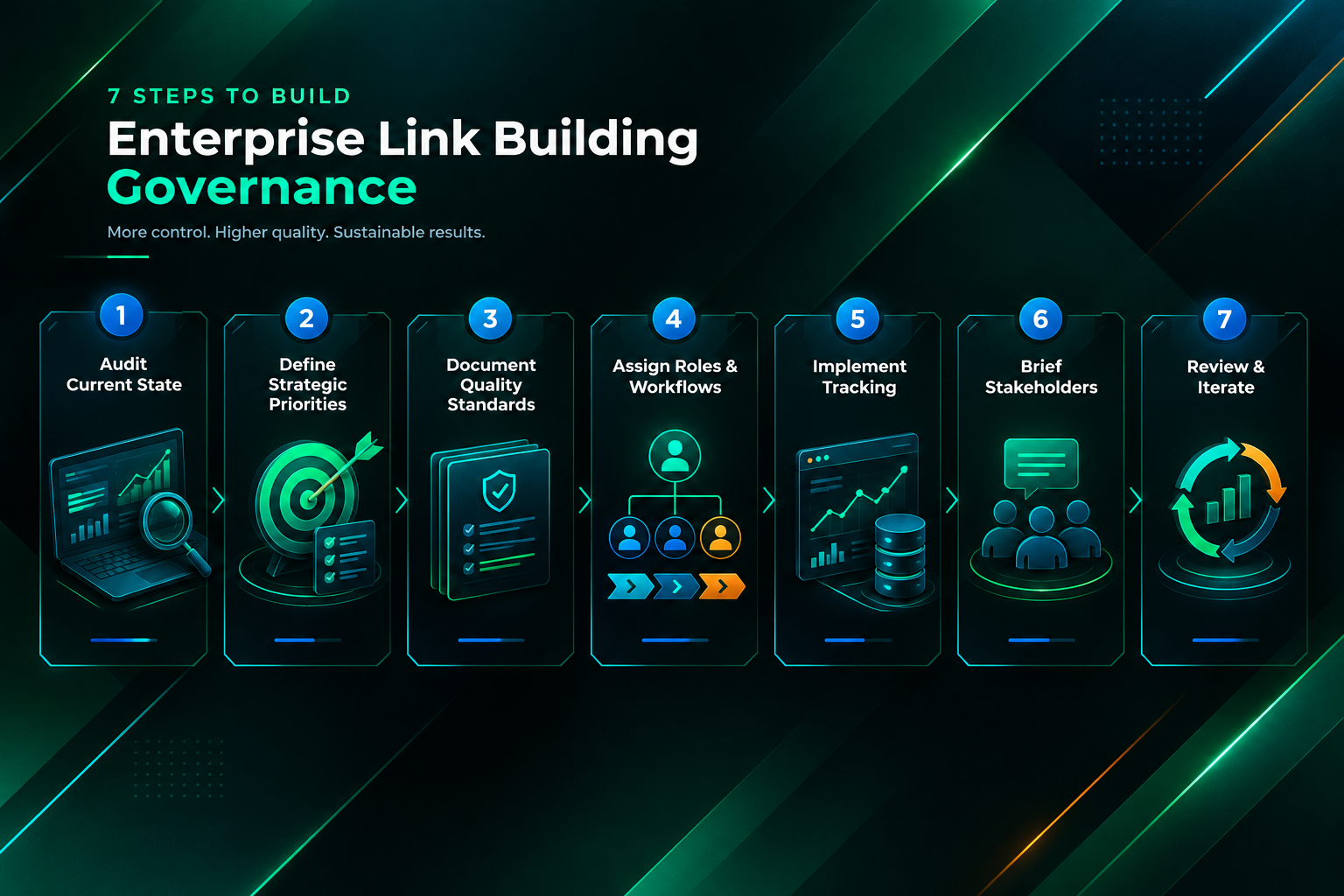
- Audit the current state. Before designing a governance framework, document how link building is currently being conducted across the organization. Identify which teams and external partners are involved, what standards they are applying, what records exist of past and current campaigns, and where the most significant gaps or inconsistencies are.
- Define strategic priorities. Governance should serve the organization’s actual SEO and business goals. Identify which pages or sections of the website are the priority targets for link acquisition, which markets or geographies are most important, and how link building fits within the broader organic search strategy.
- Document quality standards and policies. Translate the organization’s risk tolerance and quality expectations into written criteria that can be applied consistently by different teams and external partners. These standards should be specific enough to guide decisions but flexible enough to accommodate legitimate variation across markets and publisher types.
- Assign roles and build approval workflows. Map the documented standards to specific roles and create approval workflows that reflect the organization’s actual decision-making structure. Avoid creating workflows that are so complex they slow campaigns to a halt, but ensure that high-risk or high-value decisions have appropriate oversight.
- Implement tracking and reporting infrastructure. Choose or configure the tools and systems that will be used to track outreach, record placements, monitor the backlink profile, and report on campaign performance. This may involve a combination of SEO platforms such as Ahrefs or Semrush, project management tools, and custom reporting dashboards.
- Brief all stakeholders and partners. Governance only works if everyone involved understands and applies the framework. Internal teams, external agencies, and outsourced link building partners should all receive a clear briefing on the standards, workflows, and reporting requirements that apply to their work.
- Review and iterate. Link building governance is not a static document. The framework should be reviewed regularly to reflect changes in the organization’s SEO strategy, changes in search engine guidance, and lessons learned from campaign experience.
Managing External Partners Within a Governance Framework
Many enterprise organizations use a combination of in-house teams and external partners for link acquisition. Outsourced link building providers, specialist agencies, and white-label partners can extend the organization’s capacity and bring publisher relationships or outreach expertise that would be difficult to develop internally. Integrating these partners effectively into a governance framework requires clear contractual and operational alignment.
External partners should receive the same documented quality standards and outreach policies that apply to internal teams. Governance frameworks should specify what information external partners are required to report, at what frequency, and in what format. This typically includes details of each placement such as the publisher, the linking page URL, the target page, the link attribute, and any relevant third-party metrics, as well as a record of outreach activity and publisher responses.
Where multiple external partners are working simultaneously, the centralized publisher relationship record becomes especially important. Coordination between partners prevents outreach conflicts and ensures that the organization’s overall link acquisition activity presents a coherent and professional face to publishers. Some organizations appoint an internal link building program manager whose primary responsibility is to coordinate between external partners and ensure that all activity is consistent with the governance framework.
It is also worth establishing clear expectations about what happens when a placement does not meet the agreed quality standards after publication, or when a link is removed by a publisher. Governance frameworks should include a documented process for identifying and addressing link loss, and external partners should understand what replacement or remediation obligations apply to their work.
Common Governance Failures and How to Avoid Them
Several recurring problems tend to undermine enterprise link building governance in practice. Understanding these failure modes makes it easier to design a framework that avoids them.

- Standards that exist on paper but are not applied. Quality criteria are only useful if they are consistently applied in campaign decisions. Governance frameworks should include a mechanism for auditing whether standards are being followed, not just documenting what the standards are.
- Approval workflows that create bottlenecks without adding value. Overly complex approval processes slow campaigns and frustrate teams without necessarily improving link quality. Tiered approval structures that reserve senior oversight for genuinely high-stakes decisions are more effective than requiring sign-off on every routine placement.
- Reporting that measures outputs rather than outcomes. Counting the number of links acquired each month is a useful operational metric, but it does not tell the organization whether link building is contributing to its SEO objectives. Governance frameworks should connect link acquisition data to organic search performance data, even if the relationship between the two is complex and not directly causal.
- Siloed teams with no shared publisher record. When different teams or partners conduct outreach independently without a shared record, publisher conflicts are inevitable. A centralized outreach and placement log is one of the most practical tools an enterprise organization can implement to prevent this problem.
- Governance that does not adapt to market or industry differences. Link building standards that work well for one market or content type may not translate directly to another. Organizations operating across multiple geographies, languages, or regulated industries should build flexibility into their governance framework to accommodate legitimate variation.
Governance, Scalability, and Long-Term Link Building Strategy
One of the primary benefits of a well-designed governance framework is that it makes link building activity scalable. When quality standards, approval workflows, and reporting structures are documented and consistently applied, it becomes possible to increase campaign volume, add new external partners, or expand into new markets without a proportional increase in management overhead or quality risk.
Governance also supports the long-term value of link building investment. Backlinks acquired through editorially credible placements on relevant, high-quality publishers tend to retain their value over time, while links acquired through lower-quality methods may be removed, devalued, or attract search engine scrutiny as algorithms and policies evolve. A governance framework that maintains consistent quality standards protects the organization’s backlink profile over the long term, not just within individual campaign cycles.
It is worth noting that link building governance does not substitute for the other elements of a strong organic search strategy. Technical SEO, content quality, site architecture, and user experience all influence how effectively backlinks contribute to search visibility. Organizations that invest in link building governance alongside these other disciplines are better positioned to see meaningful and sustainable improvements in organic search performance than those that treat link acquisition as an isolated activity.
Frequently Asked Questions
How many people does an enterprise need to manage link building governance effectively?
There is no fixed number. The right team size depends on the volume of link acquisition activity, the number of markets and languages involved, and how much work is handled by external partners. At minimum, someone needs to own the strategy and quality standards, and someone needs to coordinate outreach and track placements. Larger organizations with multiple external partners often benefit from a dedicated program manager role.
Should link building governance be managed by the SEO team or a broader marketing function?
In most organizations, the SEO team is best placed to own the technical standards and campaign strategy, but effective governance often requires input from content, legal, brand, and regional marketing teams. The governance framework should define how these functions interact rather than assigning all responsibility to a single team.
How do we prevent different agencies from contacting the same publishers?
A centralized publisher relationship log, accessible to all teams and external partners involved in outreach, is the most practical solution. This log should record active outreach, completed placements, and any publishers that have been designated as off-limits for a defined period. Regular coordination calls between partners can supplement the log for high-priority publisher relationships.
What should be included in a link quality standard document?
A useful link quality standard document typically covers acceptable publisher types, minimum editorial standards, topical relevance requirements, guidance on third-party metrics as filters rather than guarantees, link attribute policies, and a list of publisher or placement types that are excluded. It should also address how quality decisions are made when a placement falls into a grey area.
How often should an enterprise link building governance framework be reviewed?
At minimum, an annual review is advisable. More frequent reviews may be appropriate after significant changes in the organization’s SEO strategy, after notable search engine algorithm updates or policy changes, or when campaign experience reveals gaps or inconsistencies in the existing framework.
Can governance frameworks apply to outsourced link building partners as well as internal teams?
Yes, and they should. External partners should receive the same documented quality standards and reporting requirements as internal teams. Governance frameworks are most effective when they apply consistently across all parties involved in link acquisition, regardless of whether those parties are employed directly or engaged as external providers.
Building Governance That Supports Sustainable Link Acquisition
Enterprise link building governance is not a bureaucratic overhead — it is the operational infrastructure that allows large organizations to acquire backlinks consistently, at scale, and in a way that holds up to scrutiny over time. The organizations that benefit most from link building investment are typically those that have taken the time to define clear standards, assign accountable roles, coordinate outreach across teams and partners, and connect campaign activity to meaningful SEO performance data.
Getting governance right takes time and requires honest assessment of how link building is currently being managed across the organization. For businesses that are building or restructuring their link acquisition programs, working with an experienced outsourced link building partner can provide both the execution capacity and the process knowledge needed to establish effective governance from the outset. The key is ensuring that any external partner operates within the organization’s documented framework rather than independently of it — and that the governance structure itself is treated as a living system that evolves alongside the organization’s SEO strategy and the broader search landscape.