Link building statistics are widely cited in SEO discussions, but the numbers are often presented without context, cherry-picked to support a particular service, or drawn from studies with limited methodology. This article examines what the available data actually shows about backlinks and search rankings, where the evidence is strong, where it is mixed or uncertain, and what these figures mean for businesses and SEO teams making practical decisions about link acquisition.
Key Takeaways
- Backlinks remain one of the most consistently documented signals associated with higher search rankings, but correlation between link counts and rankings does not prove that acquiring more links will automatically improve a specific website’s position.
- Link quality indicators such as topical relevance, editorial context, and the referring domain’s own authority profile matter more than raw link volume according to most large-scale SEO studies.
- Outreach-based link acquisition has measurable response and conversion rates, but these vary significantly by industry, target domain type, and outreach quality.
- The SEO impact of new backlinks is rarely immediate; most studies and practitioner observations suggest measurable ranking changes take weeks to months after links are indexed.
- Statistics from third-party SEO tools reflect proprietary metrics, not Google’s internal signals, and should be interpreted as directional indicators rather than definitive measures of link value.
Why Link Building Statistics Are Difficult to Interpret
Most link building statistics come from one of three sources: large-scale correlation studies conducted by SEO tool providers, survey-based research asking practitioners about their experiences, or aggregated data from outreach campaigns. Each source has meaningful limitations. Correlation studies can show that pages ranking in position one tend to have more referring domains than pages ranking in position ten, but they cannot isolate backlinks as the cause of those rankings. Survey data reflects practitioner perception rather than controlled outcomes. Outreach campaign data is often self-reported and rarely includes a control group.
Google has publicly confirmed that links are a significant ranking signal, and this is reflected in its Search Essentials documentation and various statements from search quality team members over the years. However, Google has also indicated that the weight given to links has evolved, that not all links are treated equally, and that content quality and relevance are assessed alongside the backlink profile. Treating any single statistic as a universal rule for link building strategy is therefore likely to produce misleading conclusions.
With those caveats in place, the available data does offer useful directional guidance for businesses evaluating whether and how to invest in link acquisition.
Backlinks and Search Rankings: What Correlation Studies Show
Large-scale ranking correlation studies, including those published by Ahrefs, Semrush, and Moz, consistently find a positive association between the number of unique referring domains pointing to a page and that page’s average search ranking position. Pages appearing in the top positions of Google search results tend to have significantly more referring domains than pages appearing further down the results. This pattern holds across many industries and keyword types, though the strength of the association varies by niche and search intent.

Ahrefs has published data suggesting that the vast majority of pages with no external backlinks receive little to no organic search traffic. While this finding is frequently cited as evidence that link building is essential, it is worth noting that pages with no backlinks may also have other characteristics that limit their visibility, including thin content, poor keyword targeting, or weak internal linking. The absence of backlinks and the absence of traffic are correlated, but the relationship is not necessarily causal in a simple direction.
Semrush ranking factor studies have similarly found referring domain count to be among the metrics most strongly associated with higher rankings, alongside content-related signals. Moz’s research has historically pointed to domain-level authority, measured through its proprietary Domain Authority metric, as a useful predictor of ranking potential, though Moz itself notes that Domain Authority is a predictive model rather than a direct reflection of Google’s assessment.
The practical implication of these studies is that building a meaningful referring domain profile is associated with competitive organic visibility, particularly in markets where competing pages already have established backlink profiles. However, the data does not support a fixed number of links as a threshold for ranking, and it does not indicate that link building alone will overcome weak content, technical SEO problems, or a significant mismatch between a page and the search intent it targets.
Link Quality Signals: What the Data Suggests Matters Most
Beyond raw link counts, SEO research and Google’s own guidance point to several quality-related characteristics that appear to influence how much value a backlink contributes. Topical relevance between the linking page and the target page is consistently highlighted in both Google’s documentation and practitioner research as an important factor. A backlink from a page covering a closely related subject is generally considered more valuable than one from an unrelated domain, even if the unrelated domain has a higher authority score.
Editorial context also appears to matter. Links placed within the body of relevant content, surrounded by topically appropriate text, are generally treated differently from links in footers, sidebars, or low-content directories. Google’s spam policies explicitly address links that are placed primarily for ranking purposes rather than for genuine editorial reasons, and the Penguin algorithm update, first introduced in 2012 and later incorporated into Google’s core ranking systems, was specifically designed to reduce the influence of manipulative link patterns.
Referring domain diversity is another factor that appears in multiple studies. A backlink profile consisting of links from many different domains tends to be associated with stronger rankings than a profile with a similar total link count concentrated in a small number of sources. This suggests that acquiring links from a range of editorially relevant publishers may be more effective than repeatedly building links from the same small set of sites.
Anchor text distribution is frequently discussed in link building research. Studies have found that pages with highly concentrated exact-match anchor text profiles can be associated with algorithmic or manual penalties, while more varied anchor text distributions that include branded, generic, and partial-match variations tend to appear in healthier backlink profiles. However, prescribing specific anchor text ratios as universally safe or effective is not supported by the available evidence, and the appropriate distribution will vary by website history, existing profile, and competitive context.
Outreach and Guest Posting: What Response Rate Data Shows
Manual outreach for link acquisition, including guest post outreach and link insertion requests, has been studied through practitioner surveys and published campaign data. Response rates vary considerably depending on the quality of the outreach message, the relevance of the pitch to the target publisher, the domain type being contacted, and the industry. Reported average email response rates for cold link building outreach typically fall in a range of five to fifteen percent across published studies and practitioner reports, though some campaigns targeting highly relevant publishers with strong value propositions achieve higher rates, while mass outreach to low-relevance targets often performs significantly below this range.
Conversion from response to a live placement is a further step, and the overall conversion rate from initial outreach email to published link tends to be lower than the response rate alone suggests. Factors that influence conversion include whether the outreach offers genuine editorial value such as a well-researched guest post, whether the target publisher has clear editorial standards, and whether the proposed content or link fits naturally within the publisher’s existing content. Campaigns that prioritize publisher relevance and content quality over volume tend to report better placement rates per outreach contact, though they typically require more time and resource investment per link acquired.
Digital PR campaigns, which aim to earn links through newsworthy content, data studies, or expert commentary, operate differently from direct outreach. Published data on digital PR link acquisition suggests that well-executed campaigns targeting journalists and editors can generate a significant number of referring domains from high-authority news and media sites within a relatively short period. However, the success of digital PR is highly dependent on the quality and originality of the underlying content asset, the relevance of the story to the target publications, and the timing of the campaign relative to news cycles.
Link Building Timelines: When Do Backlinks Affect Rankings?
One of the most practically important questions for businesses investing in link acquisition is how long it takes for new backlinks to influence search rankings. The available evidence suggests this is not a simple or uniform process. Several stages are involved: the link must be published on the referring page, Googlebot must crawl and index that page, Google must process the link signal and incorporate it into its ranking calculations, and any resulting ranking change must become measurable against the baseline.

Ahrefs has published research suggesting that pages that eventually rank in the top ten for competitive keywords typically take many months to reach those positions, and that the age of a page and the gradual accumulation of backlinks over time are associated with stronger rankings. This does not mean that newly acquired links have no effect, but it does suggest that expecting rapid ranking changes from a short-term link building campaign is generally unrealistic for competitive queries.
Practitioner observations and case studies generally indicate that measurable ranking movement following a link building campaign may begin to appear within four to twelve weeks of links being indexed, though this varies considerably by the competitiveness of the target keyword, the authority of the referring domains, the existing strength of the target page, and other concurrent SEO activity. In highly competitive niches, the effect of individual link acquisitions may be difficult to isolate from other ranking factors.
Link retention is another timeline consideration. Not all acquired backlinks remain live indefinitely. Publishers update or remove content, websites change ownership, and pages are occasionally deleted. Monitoring the live status of acquired links and understanding a provider’s approach to link replacement or reporting is a practical consideration for any link building campaign.
What Statistics Say About Link Building Investment and Returns
Survey-based research from organizations including Ahrefs and various industry publications has found that link building is consistently ranked among the most resource-intensive SEO activities. Practitioner surveys indicate that a significant proportion of SEO professionals consider link acquisition to be one of the most challenging aspects of organic search optimization, with time investment in outreach, content creation, and relationship management cited as primary barriers.
Cost data for link building varies widely depending on the acquisition method, the quality of the target publisher, and whether the work is handled in-house or outsourced. Published industry surveys suggest that the cost per acquired link through manual outreach can range from relatively modest amounts for lower-authority placements to several hundred or more for placements on established, high-traffic editorial sites. These figures reflect market rates rather than guaranteed outcomes, and the appropriate investment level depends on the competitiveness of the target market and the business goals of the campaign.
Return on investment from link building is difficult to measure directly because ranking improvements and traffic increases result from multiple interacting factors. Businesses that track organic traffic, keyword ranking positions, and conversion rates before and after a link building campaign can observe correlations, but attributing specific revenue outcomes to individual link acquisitions is methodologically challenging. The available evidence suggests that link building contributes to organic visibility improvements over time when combined with strong content and sound technical SEO, but it is not a standalone solution and does not produce guaranteed financial returns.
Statistics on Backlink Profile Risks and Penalties
Google’s manual actions data, which is accessible to website owners through Google Search Console, provides some insight into the scale of link-related penalties. Google has confirmed that it issues manual actions for unnatural link patterns, including both links pointing to a site and links pointing out from a site. The Disavow Tool, introduced in 2012, was created to allow website owners to request that Google ignore specific backlinks that they believe may be harming their site’s standing.
Research into the prevalence of manual actions for link-related issues suggests that they affect a relatively small proportion of websites overall, but the impact on affected sites can be significant, including substantial drops in organic visibility. Algorithmic adjustments related to link quality, such as those associated with Penguin, affect a broader range of sites without generating a manual action notification.
The risk profile of different link acquisition methods varies. Links acquired through genuine editorial outreach and published on relevant, independently operated websites carry a different risk profile than links purchased through link networks, placed in low-quality directories, or built through automated tools. Google’s spam policies explicitly identify paid links that pass PageRank, link exchanges conducted primarily for ranking purposes, and links generated by automated programs as practices that violate its guidelines. Businesses should understand that no link acquisition method is entirely without risk, and that the risk level depends on the quality of execution, the nature of the publishers involved, and the overall pattern of the backlink profile.
How Third-Party Metrics Relate to Actual Link Value
Domain Rating from Ahrefs, Domain Authority from Moz, Authority Score from Semrush, and Trust Flow from Majestic are proprietary metrics designed to estimate the relative strength of a domain’s backlink profile. These metrics are widely used in link building as proxies for link quality, and research has found moderate correlations between these scores and actual search ranking performance. However, they are not Google metrics, they are not used by Google in its ranking calculations, and they can be manipulated through artificial link building on the scored domain itself.
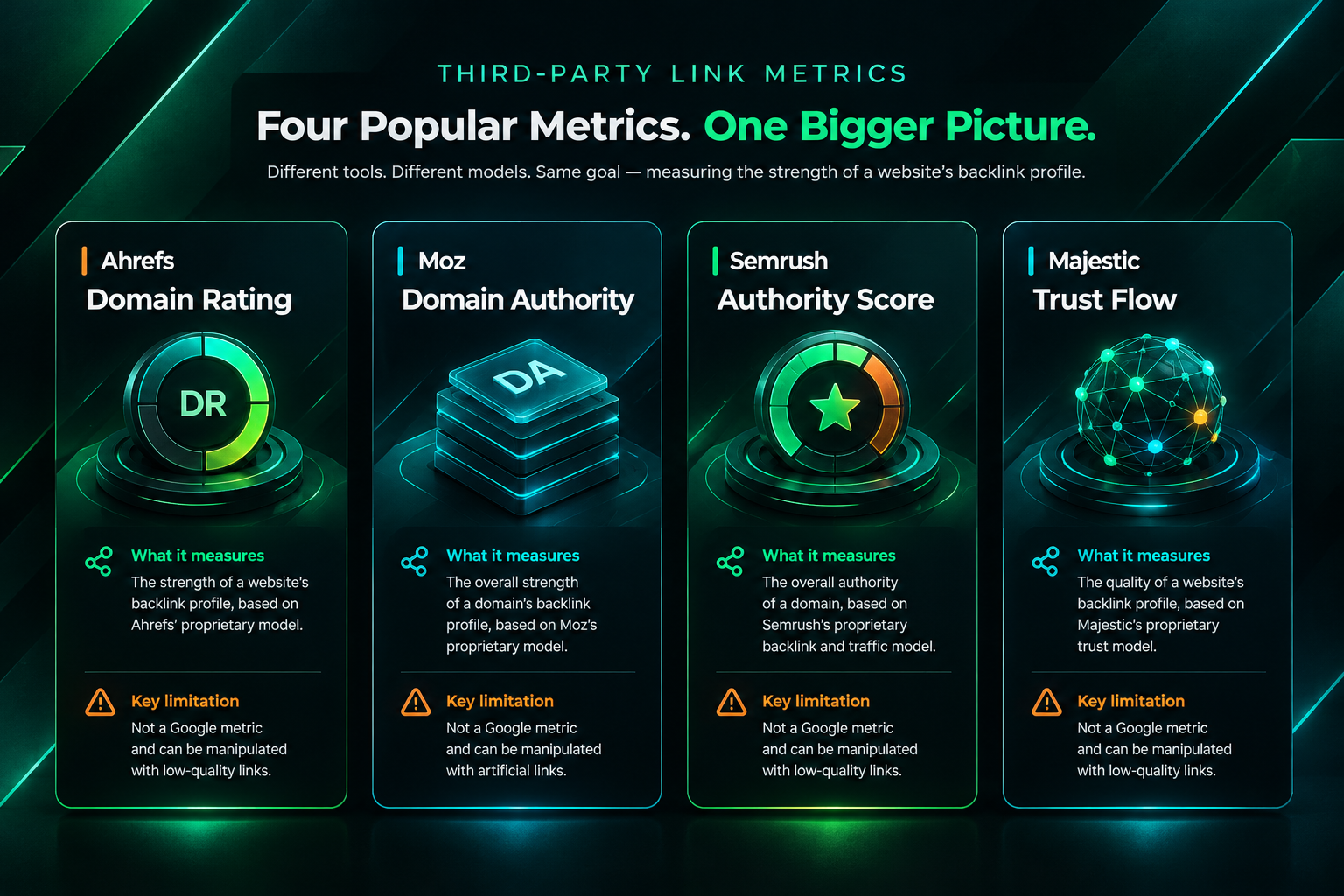
Using a minimum threshold for one of these metrics as the sole quality criterion for link acquisition has meaningful limitations. A domain with a high Domain Rating but low topical relevance to the target site may contribute less ranking benefit than a domain with a moderate score but strong editorial relevance. Similarly, a high-scoring domain that publishes large volumes of paid links across many unrelated industries may carry a different risk profile than its metric score suggests. These tools are useful for directional assessment and for filtering out clearly low-quality domains, but they work best as one input among several rather than as a definitive measure of link value.
Frequently Asked Questions
Do more backlinks always mean better rankings?
Not necessarily. Correlation studies show that pages with more referring domains tend to rank higher on average, but this relationship is not linear or universal. The quality, relevance, and diversity of referring domains appear to matter alongside quantity. A smaller number of editorially relevant, high-quality backlinks may contribute more to ranking performance than a large volume of low-quality or irrelevant links.
How reliable are link building statistics from SEO tool providers?
Statistics from providers such as Ahrefs, Semrush, and Moz are based on their own web crawl data and proprietary algorithms. Their coverage of the web is extensive but not complete, and their metrics are models rather than direct reflections of Google’s signals. These statistics are useful for comparative analysis and directional decision-making but should not be treated as precise measurements of how Google values specific links.
What is a realistic outreach response rate for link building?
Published data and practitioner reports suggest average cold outreach response rates of roughly five to fifteen percent, with significant variation depending on outreach quality, publisher relevance, and industry. Highly targeted campaigns with strong editorial value propositions can exceed this range, while mass outreach to low-relevance targets typically performs below it. Conversion from response to a live placement is a further step with its own variable rate.
How long does it take for new backlinks to affect rankings?
The process involves link publication, crawling and indexing by Google, signal processing, and measurable ranking change. Practitioner observations generally suggest that ranking effects may begin to appear within four to twelve weeks of a link being indexed, but this varies considerably by keyword competitiveness, referring domain quality, and the existing strength of the target page. Expecting immediate results from newly acquired links is generally unrealistic for competitive queries.
Can link building statistics tell me how many links I need to rank?
No reliable statistic can prescribe a specific link count that will produce a ranking outcome for a particular website. The number of referring domains associated with top-ranking pages varies enormously by keyword, industry, and search intent. A competitive analysis of the pages currently ranking for a target keyword can provide a directional benchmark, but the appropriate link building investment depends on many site-specific factors that require individual assessment.
Are there statistics on how often link building causes penalties?
Google does not publish comprehensive data on the frequency of link-related manual actions or algorithmic adjustments. Available evidence suggests that manual actions for unnatural links affect a relatively small proportion of websites, but the impact on affected sites can be severe. The risk level depends significantly on the acquisition method, publisher quality, and overall link profile pattern rather than on link building activity in general.
Using Link Building Statistics to Make Better Decisions
Link building statistics are most useful when they inform the direction of a strategy rather than dictate specific targets or guarantee outcomes. The consistent finding across multiple large-scale studies is that referring domain diversity, topical relevance, and editorial quality are associated with stronger organic search performance. This points toward prioritizing genuine editorial placements on relevant, independently operated websites over volume-focused approaches that prioritize metric scores or link counts alone.
For businesses evaluating whether to invest in link acquisition, the data suggests that backlinks remain a meaningful component of competitive organic search visibility, particularly in markets where competing pages already have established referring domain profiles. However, the evidence also consistently shows that link building works best as part of a broader SEO strategy that includes strong content, sound technical foundations, and alignment between target pages and search intent. Businesses with significant technical SEO issues, thin content, or a mismatch between their pages and the queries they target may find that addressing those factors produces more measurable improvement than link acquisition alone.
If you are considering a link building campaign and want to understand how the available data applies to your specific website and competitive context, discussing your goals with an experienced SEO provider who can assess your existing backlink profile, content quality, and competitive landscape is a practical starting point. A site-specific assessment is more reliable than applying industry-wide statistics to an individual situation.