Original surveys can attract editorial backlinks from journalists, bloggers, and industry publications that need credible data to support their content. When executed well, a single well-designed survey can generate multiple links from relevant, authoritative sources. However, the strategy requires careful planning, realistic expectations, and a clear understanding of what makes survey data genuinely linkable — and what causes it to be ignored.
Key Takeaways
- Original survey data earns backlinks by giving publishers a credible, citable source they cannot find elsewhere — but only if the data is genuinely interesting and methodologically sound.
- Survey-based link building typically requires significant upfront investment in research design, data collection, and content production before outreach begins.
- The number of backlinks a survey earns varies considerably depending on topic relevance, sample size, outreach quality, and how the findings are presented.
- This strategy tends to work best for businesses with established content, a recognisable brand, and the resources to run credible research at scale.
- Surveys are one of several data-driven link acquisition methods; alternatives such as original studies, industry reports, and expert roundups may suit different budgets and timelines.
Why Publishers Link to Survey Data
Journalists, content marketers, and bloggers regularly cite statistics to support their arguments. When they cannot find a reliable, up-to-date figure from an established source, they look for original research they can reference. A well-conducted survey fills that gap. The backlink is a natural byproduct of the publisher crediting the source of the data — which is why survey-based link building is often described as an earned media or digital PR strategy rather than a traditional outreach-and-placement approach.
The key distinction is editorial intent. A publisher links to your survey because the data adds value to their content, not because you paid for placement or exchanged a guest post. This editorial quality is what makes survey-derived backlinks particularly useful from an SEO perspective: they tend to come from contextually relevant pages, carry natural anchor text, and are less likely to be flagged as manipulative under search-engine link policies. That said, the quality of the linking domain still matters, and a survey that attracts links from low-quality or irrelevant sites provides limited SEO benefit.
What Makes a Survey Linkable
Not every survey earns backlinks. Publishers are selective about the data they cite, and a poorly designed or uninteresting survey is unlikely to attract meaningful coverage regardless of how aggressively it is promoted. Several characteristics consistently separate linkable survey research from content that goes unnoticed.
Genuine novelty
The survey must reveal something that was not previously documented. If the findings confirm what everyone already knows, there is little reason for a publisher to cite your research rather than a more established source. Novelty does not require a dramatic or counterintuitive result — it simply means the data answers a question that has not been answered elsewhere, or updates an existing figure with more recent or more specific information.
Methodological credibility
Publishers and their editors are increasingly cautious about citing research with obvious methodological weaknesses. A survey with a very small sample, a self-selected audience, or leading questions is unlikely to be taken seriously by reputable publications. Clearly stating the sample size, the recruitment method, the survey period, and any relevant limitations makes the research more credible and easier to cite responsibly. Surveys conducted through established panels or verified respondent pools tend to attract more trust than those distributed only through a brand’s own social channels.
Topical relevance to a specific audience
A survey about remote working habits is relevant to HR publications, business media, and productivity blogs. The same survey is unlikely to attract links from technology or finance publications unless the findings have a clear connection to those sectors. Defining the target audience before designing the survey — and aligning the questions to topics those publications regularly cover — significantly improves the chances of earning relevant backlinks from authoritative domains.
Presentation and accessibility
Raw data is rarely linkable on its own. Publishers need a clear, well-written summary of the key findings, ideally with supporting charts or visualisations that can be referenced or embedded. A dedicated landing page or press release that presents the headline statistics, explains the methodology, and provides contact details for further information makes it easier for journalists to cite the research quickly and accurately.
Designing a Survey for Link Acquisition
Survey design for link building differs from survey design for internal market research. The goal is not simply to gather data useful to your business — it is to produce findings that other publishers will want to reference. This requires thinking about the survey from the perspective of the journalist or content creator who might eventually link to it.

Start by identifying the questions your target publications are already asking. Review the content those sites have published recently, note the statistics they have cited, and look for gaps where original data is missing or where existing figures are outdated. A survey that directly addresses one of those gaps is far more likely to earn coverage than one designed around internal business priorities.
Keep the survey focused. A questionnaire covering too many unrelated topics produces a dataset that is difficult to summarise and harder to pitch. A tightly scoped survey with ten to twenty well-constructed questions typically yields cleaner, more citable findings than a sprawling questionnaire attempting to cover every aspect of a broad subject.
Consider the framing of individual questions carefully. Questions should be neutral in wording to avoid introducing bias that undermines the credibility of the results. Where possible, include questions that allow for year-on-year comparison with publicly available data, as this gives publishers a reason to return to your research in future cycles and potentially link again.
Sample Size, Recruitment, and Data Quality
Sample size is one of the most visible indicators of survey credibility. There is no universal minimum that guarantees a survey will be taken seriously, but samples below 100 respondents are generally considered too small for meaningful generalisation, and many reputable publications set informal thresholds of 500 or 1,000 respondents before they will cite a finding as representative. The appropriate sample size depends on the specificity of the target population: a survey of a niche professional group may be credible with a smaller sample than a survey claiming to represent the general public.
Respondent recruitment method affects both data quality and perceived credibility. Surveys distributed exclusively through a brand’s own email list or social media channels introduce self-selection bias, since respondents are not representative of the broader population. Using a third-party research panel, a market research platform, or a verified opt-in database produces a more defensible sample and is more likely to satisfy the editorial standards of quality publications. The additional cost of panel recruitment is often justified by the improved linkability of the resulting data.
Data quality checks — such as removing responses completed in an implausibly short time, filtering out straight-line responses, or including attention-check questions — improve the reliability of the findings and reduce the risk of a publication questioning the methodology after publication.
Turning Survey Data into Link-Earning Content
The survey itself is the raw material. The content built around it determines how effectively the data earns backlinks. A well-structured research report or data study page serves as the primary linkable asset, giving publishers a stable URL to cite and providing enough context for readers who follow a link to understand the findings.
The report should lead with the most surprising or significant finding, since this is what journalists are most likely to use as a hook. Supporting statistics, demographic breakdowns, and trend comparisons add depth and give different publications multiple angles to cover. Including a methodology section — even a brief one — signals transparency and makes the research easier to cite responsibly.
Supplementary assets can extend the reach of the campaign. A press release summarising the key findings in journalistic style makes it easier for busy writers to cover the story quickly. Standalone charts or data visualisations formatted for easy embedding can attract links from publications that prefer visual content. An infographic summarising the headline statistics may earn additional placements from sites that regularly publish visual content.
A dedicated landing page with a clean URL, clear headings, and structured data markup helps search engines understand and index the content. If the survey is intended to attract links over an extended period, the page should be designed to remain useful after the initial outreach cycle — for example, by framing the findings as an annual benchmark that will be updated in future years.
Outreach Strategy for Survey-Based Link Building
Publishing survey data without a structured outreach plan significantly reduces the number of backlinks the campaign is likely to earn. Most publications will not discover original research independently; they need to be informed about it through targeted, personalised outreach.
Identify the specific journalists, editors, and content creators who cover topics directly related to your survey findings. Generic press release distribution to large media lists produces low response rates. A shorter list of highly relevant contacts, each approached with a personalised pitch that explains why the data is relevant to their specific audience, consistently outperforms mass distribution.
The pitch should lead with the most compelling finding, explain the methodology briefly, and make it easy for the recipient to access the full data. Offering an exclusive embargo period to a small number of high-authority publications before the general release can increase the likelihood of securing coverage from outlets that value being first to report a story.
Follow-up timing matters. A single outreach email is often insufficient, but excessive follow-up damages relationships with journalists. One or two well-timed follow-ups, spaced several days apart, are generally appropriate. Tracking open rates and responses allows the outreach team to refine the pitch and prioritise contacts who have shown interest.
Beyond direct media outreach, sharing the survey findings through industry communities, professional networks, and relevant online forums can generate organic discovery and additional links from sources that were not on the original outreach list. Social amplification by the brand and by individual team members with relevant professional networks can also extend the reach of the campaign.
Realistic Timelines and Expected Results
Survey-based link building is not a fast strategy. From initial survey design to the first backlinks appearing in a link analysis tool, the process typically spans several weeks to several months. The design and data collection phase alone may take two to four weeks depending on the complexity of the survey and the recruitment method used. Content production, quality review, and outreach preparation add further time before the campaign goes live.
Once outreach begins, backlinks tend to accumulate gradually rather than appearing all at once. Some publications respond and publish within days; others may take weeks or months to use the data, particularly if they are planning a longer feature or waiting for a relevant news hook. A well-executed survey campaign may continue earning links for months after the initial outreach cycle, particularly if the findings are evergreen or if the data is updated annually.
The number of backlinks a survey earns varies considerably. A survey on a highly relevant topic with a credible methodology, strong findings, and targeted outreach to appropriate publications might earn dozens of links from authoritative domains. A survey on a less compelling topic, with a smaller sample or weaker outreach, might earn only a handful. Predicting exact outcomes in advance is not reliably possible, and any provider or strategy guide claiming guaranteed link counts should be treated with caution.
SEO effects from survey-derived backlinks follow the same general pattern as other editorial link building: there is typically a delay between a link being published, being crawled and indexed by search engines, and any measurable change in rankings or organic traffic becoming apparent. The timeline for observable SEO impact depends on the authority and relevance of the linking domains, the competitive landscape for the target keywords, and the overall state of the website’s backlink profile and content quality.
Limitations and Risks
Survey-based link building has meaningful limitations that are worth understanding before committing resources to the strategy.

- High upfront cost: Credible surveys require investment in respondent recruitment, data analysis, content production, and outreach. The cost per link earned can be higher than some alternative link acquisition methods, particularly if the survey does not generate the expected level of coverage.
- Uncertain returns: Unlike guest posting or niche edits, where a placement is agreed before content is produced, survey campaigns do not guarantee a specific number of links. A survey that fails to generate compelling findings or attract media interest may earn very few backlinks despite significant investment.
- Methodological scrutiny: As data literacy improves among journalists and editors, surveys with weak methodology are increasingly likely to be rejected or publicly criticised. A poorly designed survey that attracts negative attention can damage brand credibility rather than building it.
- Topic saturation: Some industries have been saturated with survey-based content marketing, making it harder to earn coverage with findings that do not offer a genuinely fresh perspective. Publications in competitive niches may receive dozens of survey pitches and accept only a small fraction.
- Link quality is not guaranteed: Not every publication that cites your survey will be a high-authority, topically relevant domain. Some links may come from low-quality aggregator sites or content farms that add little SEO value. Monitoring which sites link to the survey and assessing their quality is an important part of campaign evaluation.
- Data can be misrepresented: Once survey data is published, other sites may cite it inaccurately or out of context. While this can generate additional links, it can also create reputational issues if the misrepresentation is significant.
Who This Strategy May Suit
Survey-based link building tends to be most effective for businesses and websites that meet certain conditions. It is not universally the right approach, and a site-specific assessment is advisable before committing to this strategy.
Businesses with an established brand and existing content authority are better positioned to earn coverage from reputable publications, since journalists are more likely to cite research from a recognisable source. Companies operating in industries where data-driven content is regularly published — such as technology, human resources, finance, marketing, and healthcare — have a larger pool of relevant publications to target.
The strategy may be less suitable for very small businesses with limited budgets, websites in highly localised niches where the relevant publication landscape is narrow, or brands in industries where survey data is rarely cited in editorial content. Websites with significant technical SEO issues or thin content may also find that additional backlinks have limited impact until those underlying problems are addressed.
For agencies managing link building campaigns on behalf of clients, survey-based research can be a high-value deliverable — particularly for clients in competitive sectors where standard outreach methods face diminishing returns. However, the resource requirements and uncertain timelines mean it is typically more appropriate as a periodic campaign element rather than a primary ongoing link acquisition method.
Alternatives to Survey-Based Link Building
Original surveys are one of several data-driven link acquisition approaches. Depending on budget, timeline, and industry context, alternative methods may be more practical or more efficient.
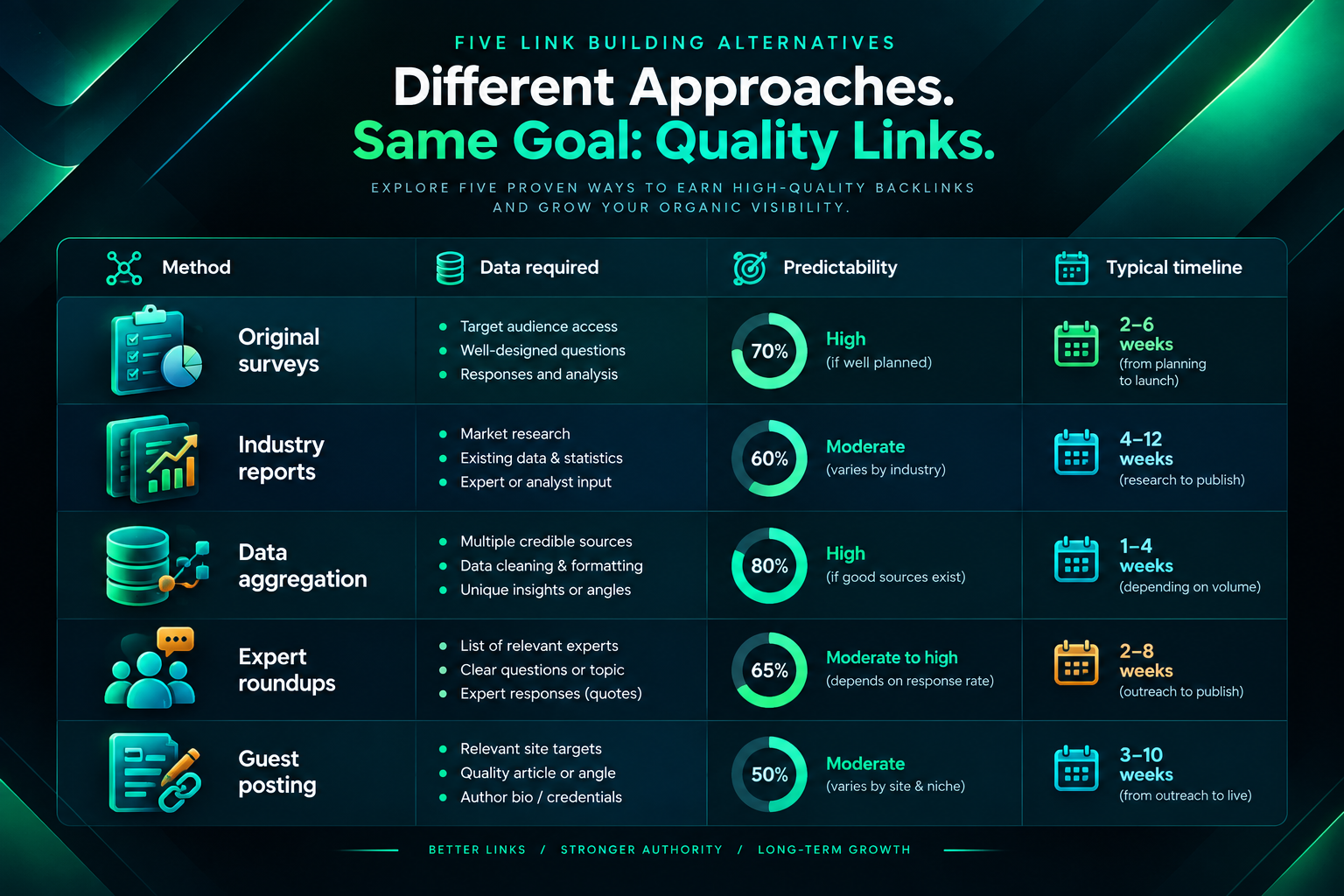
- Original industry reports: Longer-form research reports combining multiple data sources, expert commentary, and trend analysis can attract links from high-authority publications. They require more production effort but may be more credible than a standalone survey if the methodology is robust.
- Data aggregation studies: Compiling and analysing publicly available data — such as government statistics, platform data, or academic research — can produce linkable findings without the cost of primary data collection. The challenge is adding sufficient original analysis to justify citation.
- Expert roundups and commentary: Gathering original quotes or predictions from recognised industry figures creates citable content that earns links through the networks of the contributors as well as through outreach. This approach requires less data infrastructure but depends on access to credible experts.
- Guest posting and manual outreach: For businesses that need a more predictable link acquisition process, manual outreach for guest post placements on relevant, editorially controlled publications offers greater certainty over timelines and placement quality. The links are earned through content contribution rather than data citation.
- Digital PR campaigns: Broader digital PR strategies may combine survey data with news hooks, expert commentary, and reactive media outreach to maximise coverage from a single campaign. This approach requires more coordination but can amplify the reach of original research significantly.
Frequently Asked Questions
How many respondents does a survey need to earn backlinks from reputable publications?
There is no fixed minimum, but samples of 500 or more respondents are generally more credible to editorial teams at established publications. For surveys targeting a specific professional niche, a smaller but carefully recruited sample may be acceptable if the methodology is clearly explained. Very small samples — below 100 respondents — are unlikely to be cited by quality publications without significant caveats.
How long does it take to earn backlinks from a survey campaign?
From initial design to the first backlinks appearing, the process typically takes six to twelve weeks or longer. Data collection, content production, and outreach preparation all take time before the campaign goes live. Once outreach begins, links may accumulate over several months as different publications cover the story at different times.
Can a survey earn backlinks without a large media outreach budget?
Yes, but the reach of the campaign will be more limited. Targeted outreach to a small number of highly relevant publications, combined with organic sharing through professional networks and industry communities, can generate links without a large paid distribution budget. The trade-off is typically a lower total link count and a longer time to results.
Does the topic of the survey affect how many backlinks it earns?
Topic relevance and novelty are among the most important factors. A survey on a topic that is actively covered by many publications, addresses a genuine knowledge gap, and produces surprising or counterintuitive findings is likely to earn more links than a survey on a saturated or niche topic with predictable results. Aligning the survey topic with the editorial interests of target publications before designing the questionnaire significantly improves outcomes.
Are backlinks from survey citations considered editorial links?
Links earned when a publisher cites your survey data to support their own content are generally considered editorial in nature, since the publisher chose to include the link based on the value of the data rather than as part of a paid or reciprocal arrangement. However, the quality and relevance of the linking domain still matter, and links from low-quality sites provide limited SEO benefit regardless of how they were earned.
Should the survey data be gated or freely accessible?
For link building purposes, freely accessible data almost always performs better than gated content. Publishers are unlikely to link to a page that requires registration or payment to access the findings. A freely available summary page with the key statistics, methodology, and contact information maximises the chances of earning citations and backlinks.
Is Survey-Based Link Building the Right Approach for Your Campaign?
Original surveys can be a genuinely effective way to earn editorial backlinks from relevant, authoritative publications — but the strategy is resource-intensive, the outcomes are uncertain, and it is not the right fit for every business or campaign. The strongest candidates are brands with the budget for credible data collection, the content infrastructure to present findings professionally, and the outreach capability to reach the right journalists and editors with a compelling pitch.
For businesses where those conditions are met, a well-executed survey campaign can produce links that are difficult to replicate through standard outreach methods — links earned because the data is genuinely useful, not because a placement was negotiated. That editorial quality can make survey-derived backlinks particularly durable and contextually relevant over time.
If you are evaluating whether survey-based link building fits your current SEO goals, it is worth discussing the approach with an experienced link building team who can assess your existing backlink profile, content quality, and target audience before recommending a strategy. A campaign that combines original research with targeted outreach and complementary link acquisition methods is often more effective than relying on any single approach alone.