Seasonal content presents a genuine link building opportunity, but only when the campaign is planned well in advance. Unlike evergreen pages, seasonal articles, landing pages, and guides have a narrow window of peak relevance, which means outreach, placement, and indexing all need to happen before that window opens rather than during it. This article explains how to structure a seasonal link building campaign, what timelines to work with, which acquisition methods tend to suit time-sensitive content, and what realistic outcomes look like.
Key Takeaways
- Seasonal link building campaigns typically require outreach to begin eight to twelve weeks before the target content reaches peak search demand.
- The most effective approach combines early publisher identification, content preparation, and a phased outreach schedule rather than a single burst of activity close to the seasonal peak.
- Link acquisition methods such as manual guest post outreach and niche edits to existing seasonal articles can both be appropriate, depending on the target page type and the publisher’s editorial calendar.
- Links acquired for seasonal content can retain long-term value if the target page is maintained and updated each year, rather than being replaced or left to decay.
- Results vary depending on the website’s existing authority, the competitiveness of the seasonal niche, content quality, and how early the campaign begins.
Why Seasonal Content Needs a Different Link Building Approach
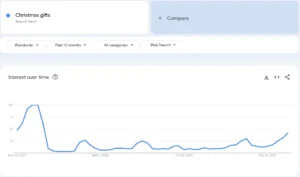
Evergreen content accumulates links gradually over months or years, and a slow outreach pace rarely causes serious problems. Seasonal content operates on a different logic. A Christmas gift guide, a Black Friday deals page, a summer travel roundup, or a tax-season resource has a predictable traffic peak that arrives whether or not the page has sufficient link equity to rank for it. If the backlink profile is thin when that peak arrives, the page may not rank competitively, and the opportunity is lost until the following year.
This time pressure changes how a campaign should be structured. Publisher identification, content creation, outreach, and placement all need to be sequenced so that links are live and indexed before the seasonal search volume begins to rise. Search engines need time to crawl and process new backlinks, and that processing time is not guaranteed to be fast. A link placed two weeks before a seasonal peak may not contribute meaningfully to rankings during that peak, even if the placement itself is high quality.
The other important difference is that seasonal content often competes against established pages from large publishers, retailers, and media outlets that have been building links to the same seasonal URLs for several years. A new or recently updated seasonal page is competing against accumulated link equity, which means the campaign needs to be both well-timed and strategically targeted to have a measurable effect.
Planning the Campaign Timeline
A practical seasonal link building timeline works backwards from the date when search demand typically begins to rise, not from the peak itself. For most seasonal topics, search interest starts climbing several weeks before the main event. A campaign targeting Christmas shopping content, for example, should aim to have links live by late October, because search volume for gift-related queries often begins increasing in early November.
Working backwards from that target date, a realistic schedule might look like this:
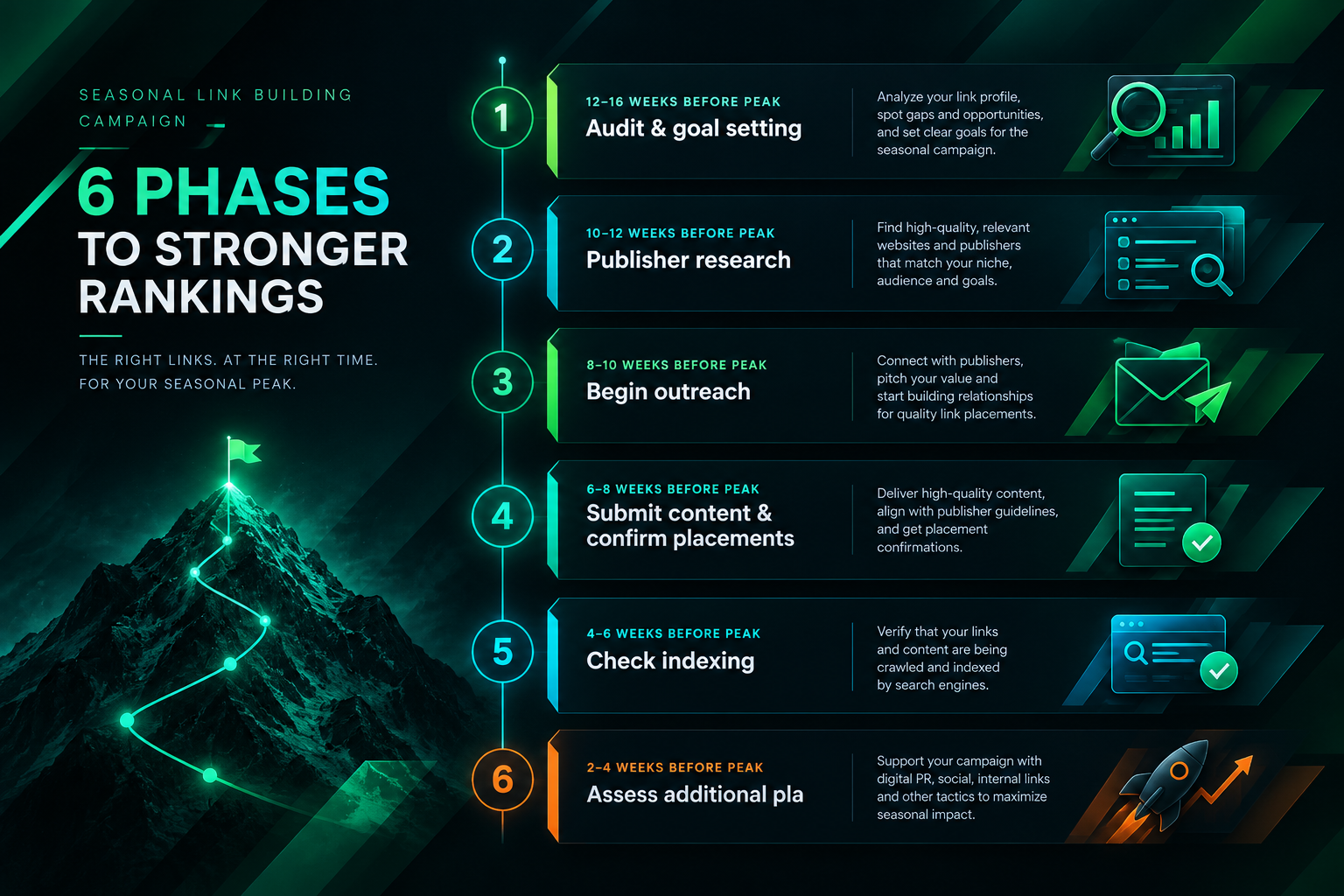
- Twelve to sixteen weeks before the seasonal peak: Audit the target page, assess the existing backlink profile, identify content gaps, and define the link acquisition goals. Determine whether the page needs new referring domains, stronger topical relevance in its backlink profile, or both.
- Ten to twelve weeks before the peak: Research and qualify target publishers. For guest post outreach, this means identifying websites with relevant audiences, assessing their editorial standards, and checking that they publish seasonal or topically relevant content. For niche edit opportunities, this means finding existing seasonal articles where a contextual link would be editorially appropriate.
- Eight to ten weeks before the peak: Begin outreach. Personalised, relevant outreach takes time to receive responses, negotiate placements, and complete editorial review. Expecting a fast turnaround from cold outreach is unrealistic, particularly for quality publishers who receive many requests.
- Six to eight weeks before the peak: Submit content or confirm placements. Guest posts require writing, editorial approval, and scheduling. Niche edits require agreement and implementation. Both involve publisher timelines that are outside the campaign’s direct control.
- Four to six weeks before the peak: Confirm that placements are live and that links are correctly attributed. Monitor for indexing using Google Search Console or a comparable tool. Flag any placements that have not been indexed and investigate whether the publisher page itself is indexed.
- Two to four weeks before the peak: Assess whether additional placements are needed and whether any supplementary tactics, such as internal linking improvements or digital PR activity, should be deployed to support the target page.
This schedule assumes a moderately competitive seasonal niche. Highly competitive categories such as Black Friday deals, holiday travel, or financial products may require campaigns to begin even earlier, and may need a larger volume of placements to move rankings meaningfully. Less competitive seasonal niches may allow a shorter lead time, but starting early remains the lower-risk approach.
Choosing the Right Link Acquisition Methods
Not every link building method is equally well-suited to seasonal content. The choice of acquisition approach should reflect the target page type, the publisher landscape, and the available lead time.
Manual Guest Post Outreach
Manual guest post outreach involves identifying relevant publishers, pitching original content ideas, writing the article, and securing a contextual link back to the target seasonal page. This method gives the campaign team control over the anchor text, the surrounding content, and the topical relevance of the placement. For seasonal content, guest posts work well when the target page covers a topic that naturally fits within a broader editorial article, such as a buying guide, a how-to resource, or a seasonal tips piece.
The main limitation for seasonal campaigns is time. Quality publishers often have editorial queues, and a guest post pitched eight weeks before a seasonal peak may not be published until after the peak has passed if the publisher’s schedule is full. Outreach for guest posts targeting seasonal content should therefore begin earlier than outreach for evergreen placements, and the pitch should acknowledge the time-sensitive nature of the content where appropriate.
Niche Edits to Existing Seasonal Content
A niche edit, sometimes called a curated link or contextual link insertion, involves adding a link to an already-published article on a relevant website. For seasonal campaigns, this can be particularly effective because many publishers already have established seasonal articles that rank well and receive consistent annual traffic. Securing a contextual link within one of these existing articles can deliver link equity from a page that already has topical authority and search visibility.
The editorial standards applied to niche edits vary considerably between publishers. A genuine editorial niche edit, where the publisher agrees that the linked resource adds value to their existing content, is meaningfully different from a paid insertion with no editorial review. The distinction matters both for link quality and for compliance with search engine guidelines on paid links. Campaigns should assess publisher standards carefully and avoid placements that appear to exist solely for link selling.
Digital PR and Content-Led Link Acquisition
Digital PR campaigns that produce original data, research, or creative content can attract editorial links from news publishers, industry blogs, and aggregator sites. For seasonal topics, a well-timed data study, a consumer survey, or a creative seasonal resource can generate coverage and links from publishers who would not accept a guest post pitch. This approach tends to require more upfront investment in content production and media outreach, and the results are less predictable than direct outreach campaigns. However, the links acquired through genuine editorial coverage are typically from high-authority domains and carry strong topical signals.
Broken Link Building and Resource Page Outreach
Broken link building involves identifying dead links on relevant publisher pages and suggesting the target seasonal content as a replacement. Resource page outreach involves finding curated lists or seasonal roundups and requesting inclusion. Both methods can be effective for seasonal content, particularly when the target page is a genuinely useful resource rather than a commercial landing page. These approaches tend to work better for informational seasonal content than for product or category pages.
Publisher Selection and Quality Assessment
The quality of a seasonal link building campaign depends heavily on the publishers selected for outreach. A placement on a low-quality or irrelevant website is unlikely to contribute meaningfully to rankings, and in some cases may create risks rather than benefits. Publisher assessment should consider several factors beyond simple domain-level authority metrics.
Topical relevance is particularly important for seasonal content. A link from a website that regularly covers the same seasonal topic, or that serves the same audience as the target page, is likely to carry stronger topical signals than a link from a high-authority website with no thematic connection. For example, a link to a Christmas gift guide from a parenting or lifestyle publisher is likely to be more relevant than a link from a general technology news site, even if the technology site has a higher domain rating according to a tool such as Ahrefs or Semrush.
Publisher quality assessment should also consider organic traffic trends, editorial standards, the ratio of sponsored to editorial content, and whether the publisher’s existing seasonal content ranks and receives genuine readership. A website that publishes seasonal content only to sell links, with no real audience engagement, is unlikely to provide meaningful link equity regardless of its domain-level metrics.
Third-party metrics such as Domain Rating, Domain Authority, and Trust Flow are useful as initial filters but should not be treated as guarantees of link quality or ranking impact. These are proprietary tool metrics, not signals provided by search engines, and they do not directly measure the value a link will contribute to a specific target page in a specific competitive context.
Maintaining Seasonal Pages for Long-Term Link Value
One of the most common mistakes in seasonal link building is treating the target page as a temporary asset. A seasonal page that is deleted, redirected, or left without updates after the season ends loses the link equity that was built into it, and the campaign investment is effectively wasted. A more sustainable approach is to treat seasonal pages as recurring annual assets that are updated and re-promoted each year.
Maintaining a consistent URL for a seasonal page across multiple years allows the page to accumulate referring domains over time. Each year’s link building campaign adds to the existing backlink profile rather than starting from zero. Publishers who linked to the page in a previous year may be more receptive to future outreach, and the page’s historical performance data can inform decisions about which placements delivered the most measurable benefit.
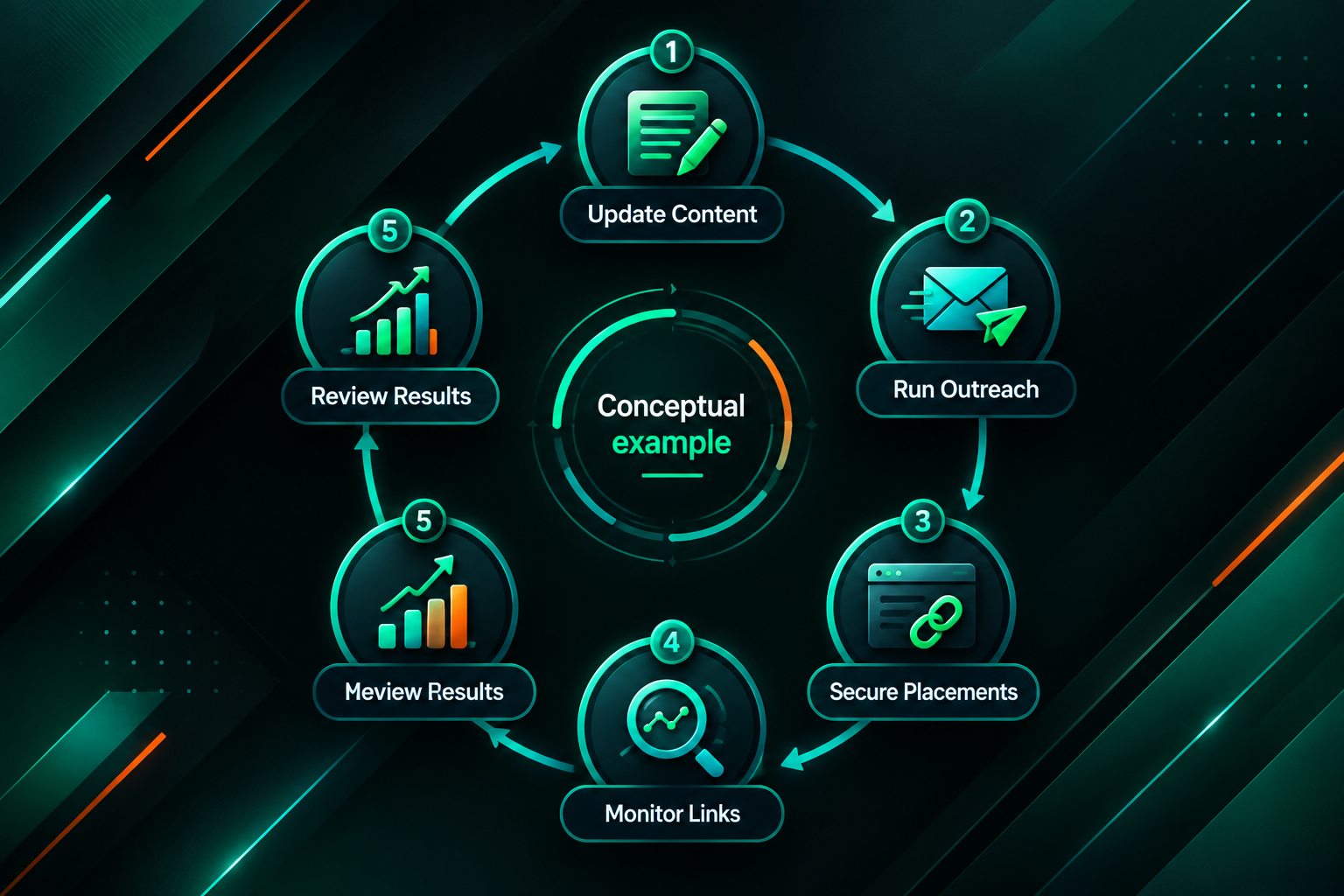
Updating the page’s content before each seasonal peak is also important. A page with outdated information, old product recommendations, or stale statistics is less likely to attract new links and may lose existing ones if publishers notice the content has not been maintained. Content updates also give the campaign team a reason to re-engage previous publishers and pitch new placements based on the updated resource.
Realistic Expectations and Limitations
Seasonal link building can improve a page’s competitive position in search results, but the degree of improvement depends on factors that vary considerably between websites, niches, and campaigns. A page on a website with a strong existing backlink profile and good technical SEO may see measurable ranking improvements from a focused seasonal campaign. A page on a newer website competing against established seasonal publishers may see more modest results, particularly in the first year of the campaign.
It is also worth recognising that link building is one of several factors that influence seasonal rankings. Content quality, page experience, internal linking, and the overall relevance of the website to the seasonal topic all contribute to how a page performs. A seasonal link building campaign is unlikely to compensate for thin content, poor page structure, or a significant mismatch between the page’s content and the search intent behind the target queries.
Timelines for measurable results vary. Links that are placed and indexed six to eight weeks before a seasonal peak may contribute to rankings during that peak, but the effect is not guaranteed and depends on how quickly search engines process the new signals. Campaigns that begin too close to the seasonal peak are unlikely to deliver meaningful ranking improvements in time, regardless of placement quality.
Link loss is also a realistic consideration. Publishers occasionally remove or change content, which can result in previously acquired links becoming inactive. Monitoring the backlink profile of seasonal pages after each campaign and following up on lost placements is a practical part of campaign management, particularly for pages that are maintained as annual assets.
When to Consider Outsourcing Seasonal Link Building
Managing a seasonal link building campaign in-house requires dedicated time for publisher research, outreach, content production, negotiation, and monitoring. For businesses or agencies that run multiple seasonal campaigns simultaneously, or that lack the internal resources to execute outreach at the required pace, outsourcing the campaign to a specialist provider can be a practical option.
An outsourced campaign should still be planned with the same lead times described above. Handing a brief to an external provider two weeks before a seasonal peak and expecting meaningful results is not a realistic expectation. Effective outsourcing requires early briefing, clear target page definitions, agreed publisher quality standards, and a shared understanding of the campaign timeline.
When evaluating a provider for seasonal link building, it is worth asking how they assess publisher quality, what their typical placement timelines look like, how they handle placements that are not indexed or that are removed after delivery, and whether they have experience with time-sensitive campaigns. A provider that treats seasonal outreach identically to evergreen campaigns may not account for the additional lead time and scheduling constraints that seasonal content requires.
Frequently Asked Questions
How far in advance should I start link building for seasonal content?
Most seasonal link building campaigns benefit from beginning outreach eight to twelve weeks before the target seasonal peak. For highly competitive niches, starting twelve to sixteen weeks in advance gives more time for publisher identification, content preparation, and placement scheduling. Starting too close to the peak reduces the likelihood that links will be indexed and processed in time to influence rankings during the relevant period.
Can I build links to a seasonal page that only goes live close to the season?
It is possible, but the results are likely to be limited. A page that goes live a few weeks before a seasonal peak has very little time to accumulate link equity and for search engines to assess its relevance and authority. Where possible, seasonal pages should be published well in advance of the peak and kept live year-round with updated content, rather than being created and removed each season.
Are niche edits or guest posts better for seasonal content?
Both methods can be appropriate depending on the target page and the publisher landscape. Niche edits to existing seasonal articles that already rank and receive traffic can deliver link equity from pages with established topical authority. Guest posts allow more control over the surrounding content and anchor text but require longer lead times due to editorial scheduling. A campaign that uses both methods in combination is often more effective than relying on a single approach.
What happens to the links after the seasonal period ends?
Links acquired for seasonal content remain live on the publisher’s website unless the publisher removes or changes the content. If the target seasonal page is maintained at a consistent URL and updated each year, those links continue to contribute to the page’s backlink profile and may support rankings in future seasonal cycles. Deleting or redirecting the target page after the season ends typically results in the loss of that accumulated link equity.
How do I measure whether a seasonal link building campaign worked?
Useful indicators include changes in the target page’s search rankings for relevant seasonal queries, changes in organic traffic to the page during the seasonal period compared to the previous year, and the number of new referring domains acquired during the campaign. Google Search Console provides ranking and traffic data for specific pages, while tools such as Ahrefs or Semrush can track referring domain growth. Attribution is rarely straightforward, as rankings are influenced by multiple factors simultaneously, but comparing year-on-year performance for the same seasonal page provides a useful baseline.
Should I build links to the seasonal page itself or to the homepage?
Links should generally point to the specific seasonal page that is intended to rank for the target queries. Building links to the homepage does not directly strengthen the ranking signals for a specific seasonal landing page or article. Internal linking from the homepage or other high-authority pages on the same website can complement external link building, but the external campaign should target the page that needs to rank.
Planning Seasonal Link Building as a Repeatable Annual Process
The most effective seasonal link building programmes are not one-off campaigns but repeatable annual processes that build on the previous year’s work. Each campaign cycle adds referring domains to an established page, refines the publisher list based on what delivered measurable results, and updates the content to maintain editorial relevance. Over two or three annual cycles, a well-maintained seasonal page can accumulate a backlink profile that is genuinely competitive against established publishers, rather than starting from a weak position each year.
The practical implication is that the first year of a seasonal link building campaign is often the most resource-intensive and the least immediately rewarding. The groundwork laid in that first cycle, including publisher relationships, content assets, and the initial backlink profile, creates the foundation for more efficient and more impactful campaigns in subsequent years. Businesses and agencies that approach seasonal link building with this longer-term perspective are better positioned to see compounding improvements in seasonal search visibility over time.
If your team is considering a seasonal link building campaign and would benefit from specialist support with publisher outreach, placement scheduling, or campaign management, discussing your specific seasonal targets and timelines with an experienced provider early in the planning process is likely to produce better outcomes than engaging a provider close to the seasonal deadline.