Original discussions published within online communities can attract genuine editorial backlinks when they surface unique data, perspectives, or debates that content creators and journalists cannot find elsewhere. Understanding how this process works helps marketers and SEO teams decide whether community-driven link acquisition deserves a place in their broader strategy, and what realistic effort and outcomes look like.
Key Takeaways
- Online communities earn backlinks to original discussions primarily when those discussions contain unique insights, first-hand data, or perspectives that external publishers find worth citing.
- The most linkable community content tends to be structured, searchable, and publicly accessible rather than locked behind logins or buried in low-authority forums.
- Community-based link acquisition is a slow, unpredictable process that works best as a complementary tactic alongside manual outreach, guest posting, or digital PR rather than as a standalone strategy.
- Quality signals such as topical relevance, domain authority of the linking site, and the context of the citation matter more than the raw number of links a discussion receives.
- Businesses and agencies considering this approach should assess whether their community platform, content format, and audience size can realistically generate the kind of original material that earns editorial attention.
What Makes a Community Discussion Linkable
Not every forum thread or comment section attracts backlinks. The discussions that earn citations from external websites tend to share a set of identifiable characteristics. First, they contain information that is genuinely difficult to find elsewhere. This might be a practitioner sharing real campaign data, a community poll aggregating opinions from hundreds of professionals, or a debate that surfaces a meaningful disagreement within an industry. When a journalist, blogger, or researcher encounters this kind of content, citing it becomes a natural editorial choice rather than a favour.
Second, linkable discussions are usually well-structured and easy to quote. A thread where the most valuable insight is buried under dozens of off-topic replies is unlikely to attract citations even if the core idea is strong. Communities that encourage clear formatting, upvoting of high-quality responses, or editorial summaries at the top of long threads make it easier for external writers to identify and reference the most useful content.
Third, the platform itself matters. A discussion hosted on a community with a strong topical reputation, consistent moderation, and a publicly indexed archive is far more likely to earn backlinks than one hosted on a low-authority forum with thin content or restricted access. Search engines need to be able to crawl and index the discussion page for it to appear in search results and be discovered by potential linking sites.
Finally, the timing of a discussion relative to an emerging topic or industry event can significantly affect its link-earning potential. A community thread that captures early practitioner reactions to a major platform update, regulatory change, or market shift can become a primary source for journalists covering that story, earning links that a later, more polished article might not.
Formats That Tend to Attract Editorial Citations
Certain discussion formats consistently outperform others when it comes to earning backlinks from external publishers. Understanding these formats helps community managers and content strategists create conditions where linkable content is more likely to emerge.
Aggregated Practitioner Opinions
Threads that collect responses from multiple experienced practitioners on a specific question function similarly to a micro-survey. When a community moderator or active member poses a well-framed question and the responses represent a genuine cross-section of professional opinion, the resulting thread becomes a citable source. Writers covering industry trends often prefer linking to a community discussion over a single expert opinion because the aggregated format signals broader consensus or meaningful disagreement.
First-Hand Data and Case Studies
Community members who share original campaign results, test outcomes, or operational data create content that is inherently unique. A member of a marketing community posting a detailed breakdown of how a specific tactic affected their organic traffic over a defined period gives external writers something they cannot replicate from general knowledge. These posts tend to attract links from industry blogs, newsletters, and resource pages that curate practical evidence for their audiences.
Structured Debates and Contrarian Positions
Discussions that surface a genuine disagreement between experienced practitioners can attract links precisely because they represent a live, unresolved question. A well-moderated debate thread where multiple credible voices argue different positions gives journalists and bloggers a richer source than a single authoritative statement. The key is that the disagreement must be substantive rather than superficial, and the participants must have enough credibility within the community for their positions to carry weight.
Resource Compilations and Curated Lists
Community threads where members collaboratively build a list of tools, resources, or references over time can accumulate significant link equity if the list becomes a recognised reference point within the industry. These threads work best when they are actively maintained, clearly organised, and hosted on a platform with enough authority for the page itself to rank in search results.
How the Link Acquisition Process Actually Works
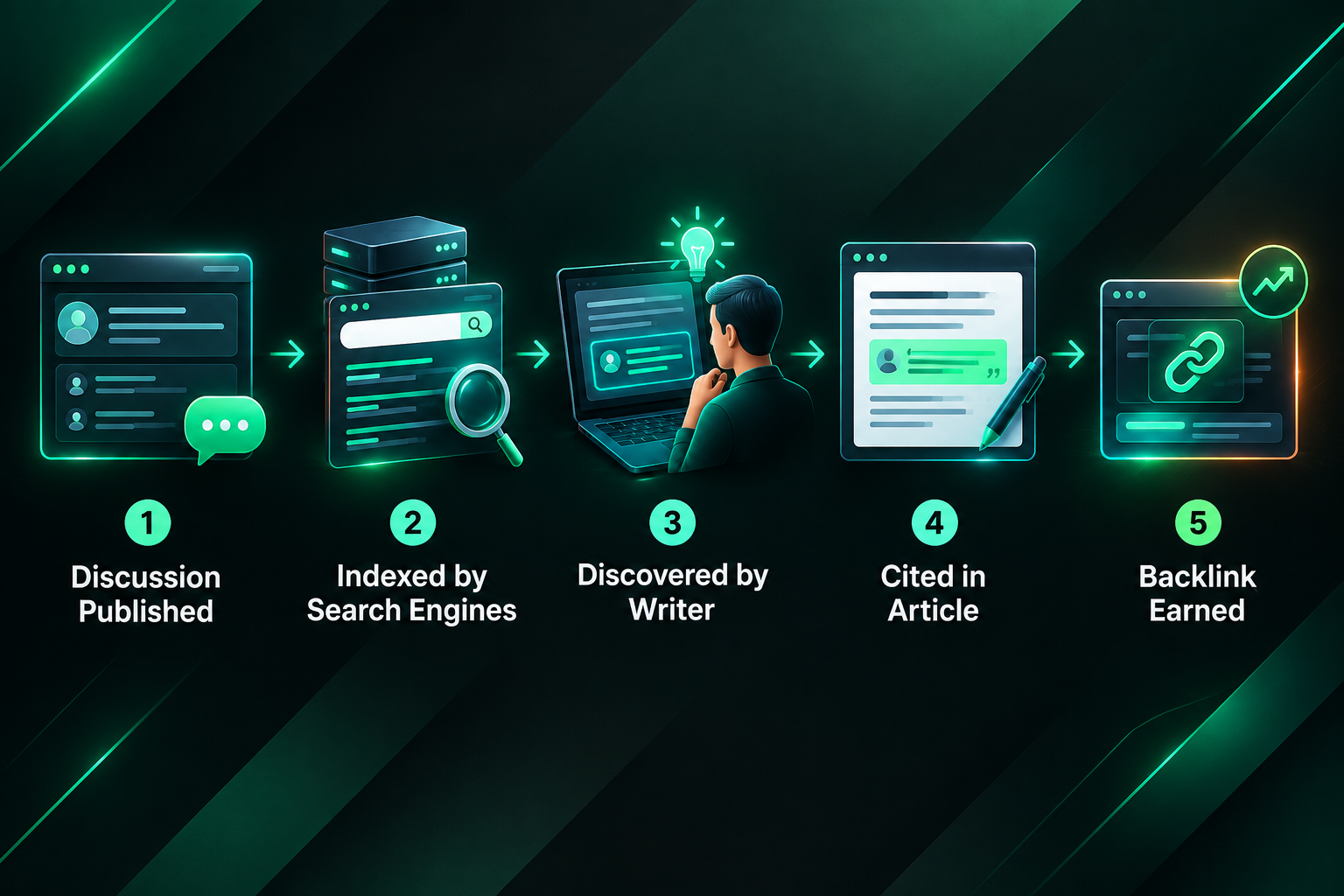
Backlinks to community discussions are almost always earned rather than built through direct outreach. The typical acquisition pathway begins with a discussion that contains genuinely useful content, which then gets indexed by search engines and discovered by writers researching a topic. The writer cites the discussion in their article, creating an editorial backlink. This process is largely passive from the community’s perspective, which is both its strength and its limitation.
Some communities and brands accelerate this process by actively promoting their most valuable discussions through newsletters, social media, or direct outreach to journalists and bloggers who cover the relevant topic. This hybrid approach combines the credibility of organic community content with the reach of proactive distribution. When a community manager identifies a thread that contains genuinely citable material, sharing it with relevant journalists or including it in a weekly digest can meaningfully increase the likelihood of earning a backlink without compromising the editorial integrity of the citation.
It is worth noting that the link acquisition timeline for community discussions is typically longer and less predictable than for purpose-built link building tactics such as manual guest post outreach or digital PR campaigns. A discussion might earn its first backlink months after it was originally published, as new writers discover it through search. This delayed and unpredictable nature means that community-based link acquisition is difficult to plan around specific campaign timelines or target-page goals.
Platform and Technical Considerations
The technical setup of the community platform has a direct effect on whether discussions can earn backlinks at scale. Several factors are worth assessing before investing in community content as a link acquisition channel.
Indexability and Crawl Access
Discussion pages that require a login to view, or that are blocked from search engine crawlers through robots.txt settings or noindex tags, cannot be discovered organically by writers researching a topic. For community discussions to earn editorial backlinks, the pages must be publicly accessible and indexable. This is a basic but frequently overlooked requirement, particularly for communities hosted on platforms that default to restricted access.
URL Structure and Page Authority
Individual discussion threads need stable, descriptive URLs to accumulate link equity over time. Platforms that generate dynamic or session-based URLs make it difficult for external sites to link to a specific discussion reliably. A clean URL structure that reflects the topic of the discussion also improves the likelihood that the page will rank in search results for relevant queries, increasing its discoverability by potential linking sites.
Domain Authority of the Host Platform
A discussion hosted on a community platform with a strong backlink profile and established topical authority is more likely to rank in search results and attract editorial citations than the same discussion hosted on a newer or lower-authority domain. This does not mean that discussions on smaller communities cannot earn links, but the platform’s existing authority affects how quickly individual threads can gain search visibility. Third-party metrics such as Domain Rating from Ahrefs or Domain Authority from Moz can provide a rough indication of platform strength, though these are proprietary estimates rather than direct measures of Google’s assessment.
Risks and Realistic Limitations
Community-based link acquisition carries a different risk profile from tactics such as manual outreach or guest posting, but it is not without limitations. Understanding these constraints helps businesses and SEO teams set appropriate expectations.
The most significant limitation is the lack of control over outcomes. Unlike a guest posting campaign where a team can set targets for the number of placements, the domain authority of host sites, and the anchor text of links, community discussions earn backlinks on their own terms. A discussion that the community considers highly valuable may attract no external citations, while a thread that seemed unremarkable at the time becomes widely referenced. This unpredictability makes it difficult to use community discussions as the primary driver of a link building campaign with defined deliverables.
There is also a quality ceiling on the links that community discussions typically attract. The sites most likely to link to a forum thread or community post are often blogs, newsletters, and secondary publications rather than high-authority editorial outlets. While these links can still contribute to a backlink profile, they may not carry the same weight as links earned through digital PR placements in major industry publications or through carefully placed guest posts on authoritative sites.
Community platforms that allow low-quality participation or that have a history of spam can also affect the perceived credibility of discussions hosted there. A backlink from a well-moderated, topically focused community carries more contextual relevance than the same link from a general-purpose forum with inconsistent content quality. The surrounding content and the reputation of the platform both influence how a linking site’s editorial team and search engines interpret the citation.
Finally, there is a risk that discussions which attract significant external attention can become targets for manipulation. Community managers should be aware that once a thread becomes a recognised reference point, it may attract attempts to insert promotional content or low-quality contributions that dilute the original value of the discussion.
How Community Discussions Fit Into a Broader Link Building Strategy
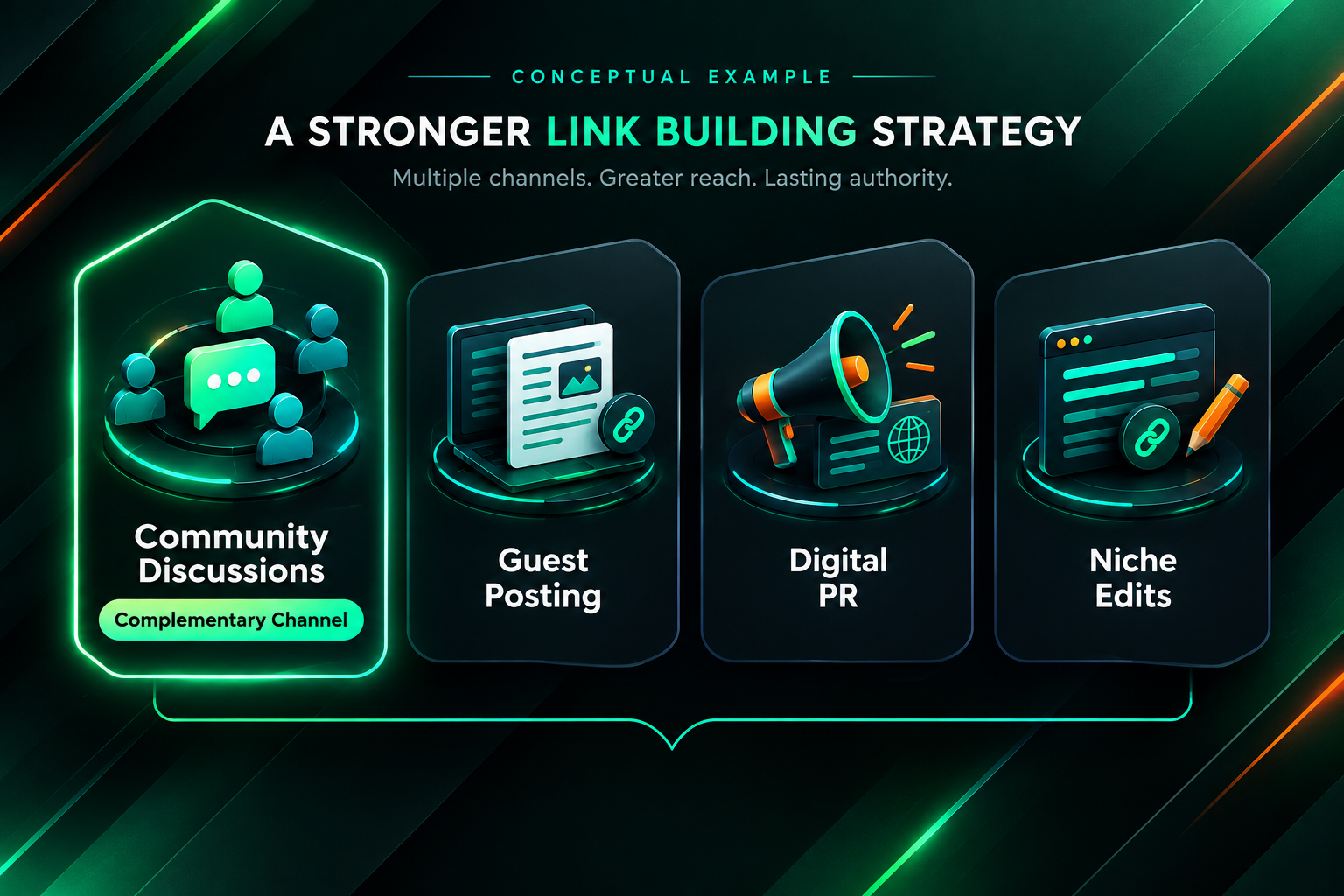
Community-based link acquisition works best as one component of a diversified link building strategy rather than as a standalone channel. Its primary value lies in generating a category of links that is difficult to replicate through direct outreach: citations that arise from genuine practitioner engagement with a topic, which carry a different kind of editorial credibility than links acquired through formal placement processes.
For businesses and agencies running structured link building campaigns, community discussions can serve several supporting roles. They can provide a source of original data or perspectives that can be referenced in guest posts or digital PR pitches, strengthening the credibility of outreach content. They can also function as a form of topical authority building, demonstrating to search engines that a brand or domain is associated with substantive conversations within its industry.
Manual outreach campaigns can incorporate community discussions by identifying threads that contain genuinely useful content and pitching them to relevant journalists or bloggers as a resource. This approach treats the community discussion as a linkable asset in the same way that a well-researched data study or an original survey might be used in a digital PR campaign. The difference is that the content was created organically by community members rather than produced specifically for link acquisition purposes.
For SEO agencies managing campaigns on behalf of clients, community discussions represent a relatively low-cost source of linkable content when the client already has an active community or a strong presence on relevant platforms. The investment required is primarily in identifying and promoting the most valuable discussions rather than in creating new content from scratch. However, agencies should be transparent with clients about the unpredictable nature of this channel and avoid presenting it as a reliable substitute for tactics with more defined delivery timelines.
Assessing Whether This Strategy May Suit Your Situation
Community-based link acquisition is not equally suitable for every business or campaign. Several factors are worth considering before allocating significant resources to this approach.
- Existing community presence: Businesses that already participate actively in relevant online communities, or that host their own community platforms, are better positioned to leverage this strategy than those starting from scratch. Building a credible community presence takes time, and the link acquisition benefits typically follow rather than precede that investment.
- Industry and niche characteristics: Some industries have active, well-established online communities where practitioners regularly share original insights and data. Others are more fragmented or operate primarily through private channels. The link-earning potential of community discussions varies significantly depending on how active and publicly accessible the relevant communities are.
- Content production capacity: Generating the kind of original, data-rich discussions that attract editorial citations requires genuine expertise and a willingness to share substantive information publicly. Businesses that can consistently contribute this kind of content are more likely to see link acquisition benefits than those whose community participation is primarily promotional.
- Campaign timeline and deliverables: If a link building campaign has specific targets for the number of placements or the authority of linking sites within a defined timeframe, community discussions are unlikely to be a reliable primary channel. The unpredictable nature of organic link acquisition makes this approach better suited to longer-term brand and authority building than to campaigns with short-term deliverable requirements.
- Technical SEO condition of the target site: Backlinks to community discussions benefit the platform hosting the discussion rather than necessarily the brand associated with it. If the goal is to build links directly to a specific target page on a business website, community discussions are an indirect route at best. A site-specific assessment is needed to determine whether this approach aligns with the actual link building goals of the campaign.
Alternatives Worth Considering
For businesses and agencies that find community-based link acquisition too unpredictable or indirect for their current goals, several alternative approaches may be worth evaluating depending on the specific campaign context.
Manual guest post outreach involves identifying relevant, authoritative publications and pitching original articles that include a contextual link to a target page. This approach offers more control over the placement, the anchor text, and the authority of the linking site, though it requires significant outreach effort and editorial approval from the host publication. The timeline from initial outreach to published placement is typically several weeks to a few months, depending on the publication and the quality of the pitch.
Digital PR campaigns create original research, data studies, or newsworthy content specifically designed to attract coverage from journalists and bloggers. When executed well, digital PR can earn links from high-authority editorial outlets that are difficult to reach through other tactics. The investment required is higher than for community discussions, but the potential link quality and the predictability of the process are generally greater.
Niche edits, also known as link insertions, involve adding a contextual link to an existing published article on a relevant site. This approach can be faster than guest posting because it does not require creating new content, but the quality of the placement depends heavily on the editorial standards of the host site and the relevance of the existing article to the target page.
Resource page link building targets pages on authoritative sites that curate links to useful tools, guides, or references within a specific topic area. If a business has created genuinely useful content, outreach to relevant resource pages can earn contextually appropriate links with a relatively straightforward pitch.
Frequently Asked Questions
Do backlinks to community discussions help the brand’s own website?
Backlinks to a community discussion page primarily benefit the domain hosting that discussion. If the brand owns the community platform, those links contribute to the platform’s authority. If the discussion is hosted on a third-party platform such as Reddit or an industry forum, the link equity accrues to that platform rather than to the brand’s website. Brands can benefit indirectly through referral traffic, brand visibility, and the credibility signals associated with being cited as a source, but direct SEO benefit to the brand’s own domain requires links pointing to that domain specifically.
How long does it typically take for a community discussion to earn backlinks?
There is no reliable universal timeline. Some discussions attract citations within days of publication if they are shared proactively with relevant journalists or if they address a topic that is actively being covered. Others may sit unlinked for months before being discovered through search. The unpredictability of this timeline is one of the main reasons community-based link acquisition is better suited to long-term authority building than to campaigns with defined short-term deliverables.
Can a business manufacture linkable community discussions, or does the content need to be organic?
Discussions that are clearly manufactured or promotional rarely earn genuine editorial citations. External writers and journalists are generally able to distinguish between authentic practitioner conversations and content that has been staged for marketing purposes. The most effective approach is to create conditions where genuine, substantive discussions are more likely to occur, such as by posing well-framed questions, sharing original data, or inviting credible practitioners to contribute, rather than scripting the content in advance.
What types of sites are most likely to link to community discussions?
Industry blogs, newsletters, and secondary publications are the most common sources of backlinks to community discussions. High-authority editorial outlets occasionally cite community threads when the discussion contains genuinely unique data or perspectives that are not available elsewhere, but this is less common. The authority and topical relevance of the linking sites vary significantly depending on the community platform, the topic of the discussion, and how actively the content is promoted.
Is it against search engine guidelines to promote community discussions for link acquisition purposes?
Promoting a community discussion through newsletters, social media, or direct outreach to journalists is generally consistent with editorial link acquisition practices, provided the promotion is transparent and the content is genuinely useful. The concern from a search engine policy perspective arises when links are exchanged, purchased, or otherwise manipulated rather than earned on editorial merit. Businesses should review current search engine guidelines and consult with a qualified SEO professional if they are uncertain about the compliance implications of a specific promotional approach.
How do I assess whether a community discussion has earned a high-quality backlink?
Useful quality indicators include the topical relevance of the linking page to the discussion content, the authority of the linking domain as estimated by tools such as Ahrefs, Semrush, or Moz, the context in which the link appears within the linking article, and whether the link uses a descriptive anchor text that reflects the content of the discussion. A link from a topically relevant, well-regarded publication that cites the discussion in a substantive editorial context is generally more valuable than a link from an unrelated or low-quality site, regardless of the raw domain authority score.
Deciding Whether Community Discussions Deserve a Place in Your Link Building Strategy
Community discussions can earn genuine editorial backlinks when they contain original insights, first-hand data, or substantive debates that external publishers find worth citing. The process is largely organic, which gives these links a credibility that is difficult to replicate through direct placement tactics, but it also makes the channel unpredictable and difficult to plan around specific campaign targets.
For businesses with an active community presence, the investment required to surface and promote linkable discussions is relatively modest compared to the potential long-term benefit. For those without an established community, building the kind of credible participation that generates citable content takes time and consistent effort before any link acquisition benefit is likely to materialise.
The most practical approach for most businesses and agencies is to treat community discussions as a complementary channel within a broader link building strategy that includes more controllable tactics such as manual outreach, guest posting, or digital PR. A qualified SEO provider can help assess whether community-based link acquisition is a realistic fit for a specific campaign’s goals, timeline, and target pages, and how it might be integrated with other acquisition methods to build a more diverse and resilient backlink profile.