Job boards occupy a competitive corner of the web where thousands of similar sites compete for the same organic rankings. Paid job listings and employer profiles rarely attract editorial links on their own, but original labor market data is a different matter. When a job board publishes credible, well-structured research about hiring trends, wage movements, or regional employment patterns, journalists, policy researchers, HR professionals, and industry bloggers have a genuine reason to cite it. This article explains how that process works, which data formats tend to attract links, what the outreach workflow looks like, and where the strategy has realistic limits.
Key Takeaways
- Original labor market data gives job boards a linkable asset that transactional listing pages cannot provide on their own.
- The most link-worthy formats combine proprietary platform data with clear methodology, accessible visualizations, and a newsworthy angle.
- Earning links from this type of content requires active outreach to journalists, researchers, and industry publications rather than passive publishing.
- Results depend on data quality, topical relevance, outreach volume, and the competitive strength of the job board’s existing backlink profile.
- Data-led link acquisition is a medium-to-long-term strategy; measurable SEO impact typically takes several months to appear.
Why Transactional Job Board Pages Rarely Attract Editorial Links
Most job board pages are designed to convert visitors into applicants or employers into paying customers. A page listing software engineering roles in Austin or nursing vacancies in Manchester serves a clear commercial purpose, but it gives an external publisher no reason to link to it. Journalists covering the technology sector are not going to cite a job listing as a source. HR bloggers writing about talent shortages need data, not a search results page. This structural mismatch between what job boards publish and what link-worthy content requires is the core problem that a labor market data strategy is designed to solve.
The solution is to create a category of content that sits alongside the commercial listings but serves an informational purpose. When a job board aggregates and analyzes its own platform data, it can produce original research that no other source can replicate. That originality is what makes the content citable. A journalist writing about the rise in remote work vacancies needs a source with actual numbers. If a job board has published a quarterly report showing the percentage change in remote listings across different sectors, that report becomes a natural citation target. The commercial pages benefit indirectly through improved domain-level authority signals and internal linking from the research content.
Types of Labor Market Data That Tend to Attract Links
Not all data content earns links at the same rate. The formats that tend to perform best share a few characteristics: they contain information that cannot easily be found elsewhere, they are presented clearly enough for a non-specialist to understand and quote, and they are updated or published on a schedule that gives journalists a recurring reason to return.
Proprietary Platform Data Reports
A job board’s own database is its most defensible data asset. Aggregated and anonymized figures on job posting volumes, application rates, time-to-fill by sector, or salary ranges by location are genuinely original. No government agency or research firm has access to the same dataset. Quarterly or annual reports built from this data can attract links from HR publications, business media, and regional news outlets looking for employment statistics. The key requirement is transparent methodology: publishers who cite data need to understand how it was collected, what the sample size was, and what limitations apply. Without that transparency, credible outlets are unlikely to use the figures.
Salary and Compensation Benchmarks
Salary data is consistently one of the most-cited categories of labor market research. Employers use it for compensation planning, job seekers use it to evaluate offers, and journalists use it to illustrate stories about cost of living, skills shortages, and economic inequality. A job board that publishes detailed, regularly updated salary benchmarks by role, sector, experience level, and geography creates a resource that HR professionals and business writers will reference repeatedly. Each update cycle is an outreach opportunity. The limitation is that salary data requires a sufficiently large sample to be credible; a small or niche job board may not have enough postings in every category to produce statistically meaningful figures.
Hiring Trend Indexes and Demand Signals
Indexes that track changes in hiring demand over time are particularly attractive to business journalists and economic commentators because they provide a forward-looking signal. A monthly or quarterly index showing which roles are growing fastest, which sectors are contracting, or how hiring intent compares to the same period in the previous year gives writers a ready-made data point for trend stories. These indexes work best when they are branded, consistently updated, and accompanied by brief expert commentary that journalists can quote directly.
Regional and Local Employment Data
National-level data competes with government statistics offices and large research firms. Regional or city-level data is often underserved and attracts strong interest from local news outlets, regional business publications, and local government bodies. A job board with meaningful coverage in a specific metropolitan area or region can publish employment data that local journalists cannot easily find elsewhere. Local links from credible regional publishers can be valuable for both domain authority signals and geographically relevant ranking improvements, though the volume of available linking opportunities is naturally smaller than at the national level.
Skills Gap and Talent Shortage Research
Research that identifies mismatches between employer demand and available candidate skills tends to attract links from education institutions, industry associations, training providers, and policy-focused publications. A report showing that demand for a specific technical skill has grown significantly faster than the supply of qualified candidates gives universities, coding bootcamps, and professional bodies a reason to cite the job board as a source. This category of content also tends to generate social sharing and media coverage because it speaks to a widely recognized economic concern.
Building the Linkable Asset: Practical Requirements
Publishing data is not sufficient on its own. The content needs to meet a quality threshold that makes external publishers comfortable citing it. Several practical requirements apply regardless of the specific data format chosen.
Methodology transparency is non-negotiable for credible citations. The report should explain what data was used, how it was collected or aggregated, what time period it covers, what geographic scope applies, and what limitations the reader should be aware of. A brief methodology section at the end of the report is standard practice in research publishing and signals that the job board is treating its data responsibly.
Accessible presentation matters because most journalists and bloggers are not data analysts. Charts, summary statistics, and clearly labeled key findings make the content easier to quote and share. Interactive data visualizations can increase engagement and time on page, but static charts with clear labels are often more practical for publishers who want to embed or screenshot a figure for their own content.
A newsworthy angle helps the content travel. Raw data tables are less likely to attract coverage than data presented around a specific finding or trend. Framing the report around a question that is already in the news cycle, such as the impact of automation on entry-level hiring or the geographic distribution of a skills shortage, increases the likelihood that journalists will find the content relevant to a story they are already working on.
A dedicated, crawlable URL ensures that the content can be indexed and that any links pointing to it pass authority signals to the job board’s domain. Research content should live on the job board’s own domain rather than being published as a PDF hosted on a third-party platform, since links to a PDF on an external server do not benefit the job board’s domain directly.
The Outreach Workflow for Data-Led Link Acquisition
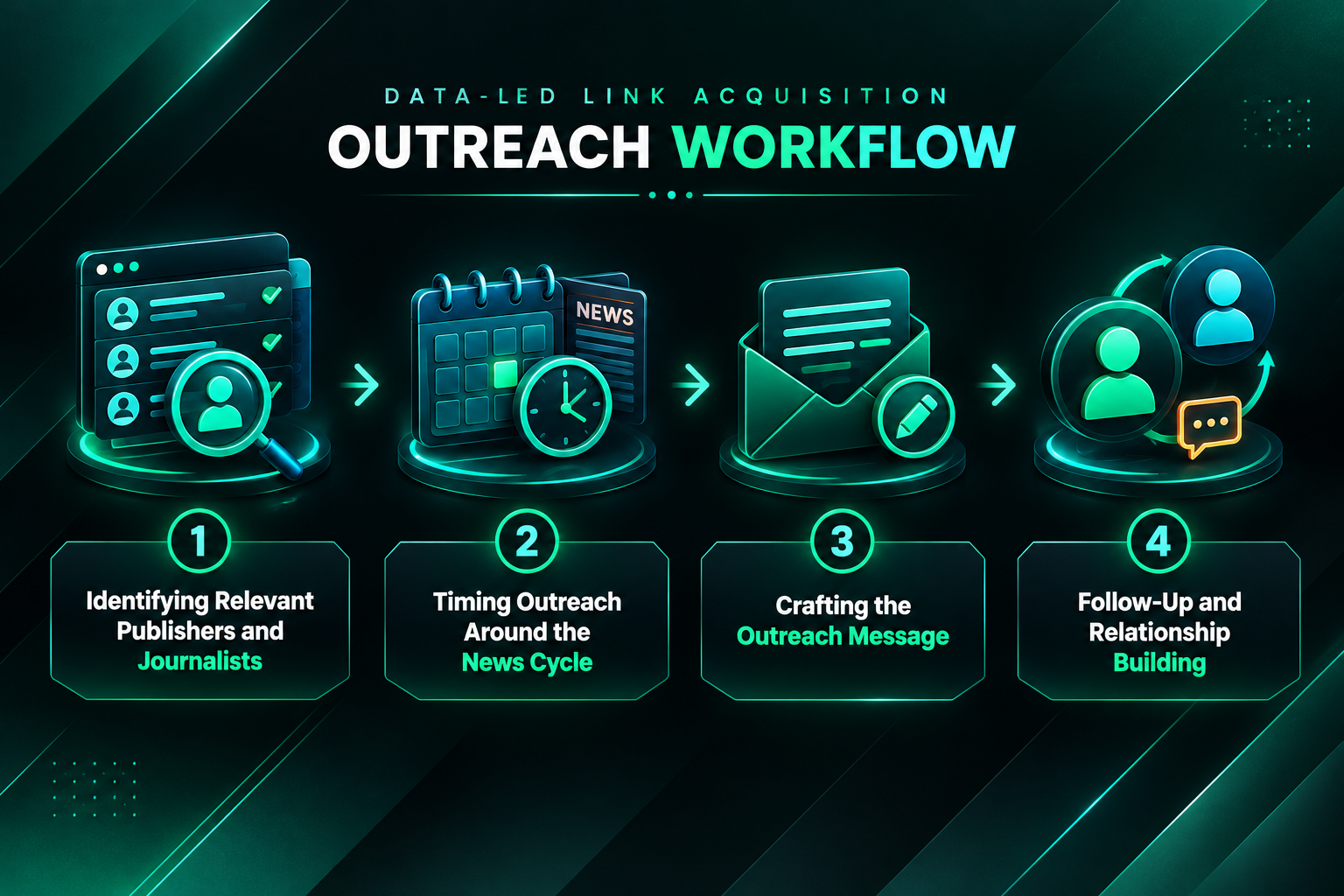
Publishing strong research content is the foundation, but most links from journalists and industry publications require active outreach rather than passive discovery. The outreach process for data-led content follows a recognizable sequence.
Identifying Relevant Publishers and Journalists
The first step is building a targeted list of publications and individual writers who cover labor market topics, HR trends, business economics, or the specific sectors the job board serves. Tools such as Ahrefs or Semrush can identify which publications have previously linked to similar research from other sources, which indicates they are receptive to this type of content. Journalist databases and media monitoring tools can help identify writers who have recently covered related topics and are therefore likely to be working on stories where the data would be relevant.
Timing Outreach Around the News Cycle
Data-led outreach is most effective when it connects to a story that journalists are already covering. Monitoring industry news, government economic announcements, and seasonal hiring patterns allows the job board to time the release of its research to coincide with periods of heightened media interest. A report on holiday season hiring trends released in October is more likely to attract coverage than the same report released in February. Similarly, research on a sector experiencing a widely reported skills shortage will find a more receptive audience than research on a sector that is not currently in the news.
Crafting the Outreach Message
Outreach emails to journalists should be brief, specific, and focused on the data’s relevance to the recipient’s coverage area. The message should lead with the most newsworthy finding, explain why the data is original and credible, and make it easy for the journalist to access the full report. Attaching a one-page summary or linking directly to the key findings reduces the friction involved in evaluating the content. Generic mass outreach is less effective than personalized messages that reference the journalist’s recent work and explain why this specific dataset is relevant to their audience.
Follow-Up and Relationship Building
A single outreach email rarely produces consistent results. A structured follow-up sequence, typically one or two additional contacts spaced several days apart, increases response rates without becoming intrusive. Over time, consistent publication of credible research builds relationships with journalists who come to regard the job board as a reliable data source. These ongoing relationships can produce recurring citations across multiple report cycles, which is more sustainable than one-off link acquisition campaigns.
Realistic Timelines and SEO Impact
Data-led link acquisition is not a fast strategy. Producing a credible research report takes time, and the outreach process adds further lead time before links begin to appear. A realistic timeline from initial data collection to the first published citations is typically two to four months for a well-resourced campaign. SEO effects, such as measurable changes in domain authority signals or organic ranking improvements for target pages, may take an additional three to six months to become visible, depending on the job board’s existing backlink profile, the competitiveness of its target keywords, and how quickly search engines crawl and process the new links.
It is also important to distinguish between different types of measurable outcomes. An increase in referring domains from credible publishers is a meaningful signal, but it does not automatically translate into improved rankings for specific job listing pages. The relationship between backlinks and rankings involves many other factors, including content quality, technical SEO health, internal linking structure, and the relevance of the linking pages to the job board’s target topics. Data-led link acquisition is most effective as part of a broader SEO strategy rather than as a standalone fix for ranking problems.
Limitations and Risks of This Approach
Labor market data as a link acquisition strategy has genuine strengths, but it also has meaningful limitations that job boards should understand before committing resources to it.
- Data volume requirements: Small or niche job boards may not have enough postings in specific categories to produce statistically credible figures. Publishing data based on a small sample risks producing misleading conclusions and damaging the job board’s credibility if the figures are challenged.
- Ongoing resource commitment: A single report rarely produces sustained link acquisition. The strategy works best when research is published on a regular schedule, which requires ongoing investment in data analysis, content production, and outreach.
- Competition from established sources: Government labor statistics agencies, large HR research firms, and well-funded job platforms already publish extensive labor market data. A smaller job board needs a differentiated angle, such as a specific sector, geography, or data type, to compete for citations in the same space.
- No guarantee of coverage: Even well-produced research does not guarantee media coverage or links. Journalists receive many pitches and may not cover a report even if the data is strong. Outreach volume and persistence matter, but outcomes remain uncertain.
- Link quality varies: Not every citation will come from a high-authority publisher. Some links may come from smaller blogs or aggregator sites that provide limited SEO value. Monitoring the quality of incoming links using tools such as Ahrefs or Semrush helps assess whether the campaign is producing the type of links that are likely to contribute to meaningful authority signals.
How This Strategy Fits Within a Broader Link Building Campaign
Labor market data content is one component of a link acquisition strategy for job boards, not a complete solution on its own. It works well alongside other approaches that address different parts of the backlink profile. Manual outreach for guest posts on HR, recruitment, and career development publications can build topically relevant links to specific pages. Digital PR campaigns around newsworthy hiring announcements or platform milestones can generate coverage from business media. Niche edits, where a job board’s content is cited within existing relevant articles, can add links to pages that are already indexed and ranking.
The data-led approach is particularly well suited to building links to the job board’s homepage or to dedicated research and insights sections, which can then pass authority signals to commercial listing pages through internal linking. A job board that combines original research with a well-structured internal linking strategy is better positioned to distribute the SEO value of earned links across its most commercially important pages.
For job boards that lack the internal resources to manage data production, content creation, and outreach simultaneously, working with a specialist link building provider that has experience in digital PR and data-led campaigns can reduce the operational burden. Any provider should be evaluated on their outreach methodology, publisher quality standards, and transparency about what types of links they are likely to produce rather than on promises of specific link volumes or ranking outcomes.
Frequently Asked Questions
Does a job board need a large dataset to use this strategy?
A meaningful dataset is necessary for credible research, but size is relative to the scope of the claims being made. A regional job board with strong coverage in a specific city or sector can produce credible local or sector-specific data without needing national-scale volumes. The key is matching the scope of the research to the actual data available and being transparent about sample size and limitations.
How many links can a single data report realistically earn?
This varies considerably depending on the newsworthiness of the findings, the quality of the outreach, and the job board’s existing relationships with publishers. A well-executed campaign around a timely report might earn between five and thirty links from credible sources, though outcomes are not predictable and some campaigns produce fewer results despite strong content. Treating each report as one component of an ongoing program rather than expecting a single piece to generate a large link volume is a more realistic approach.
Should the research content live on the job board’s main domain?
Yes. Hosting research on the job board’s own domain ensures that links pointing to the content contribute to the domain’s authority signals. Publishing research as a PDF on a third-party platform or as a standalone microsite on a separate domain means that earned links do not directly benefit the main job board domain.
How does this strategy compare to buying links for a job board?
Paid link schemes carry policy risks under Google’s spam guidelines, which classify links intended to manipulate PageRank as a violation regardless of how they are acquired. Data-led link acquisition aims to earn editorial citations based on the genuine value of the content, which is consistent with the type of link acquisition that search engines describe as legitimate. That said, no link building strategy is entirely without risk, and the quality and context of individual placements always matter.
Can a job board outsource the data analysis and outreach?
Yes, though the job board typically needs to provide access to its platform data or aggregated figures, since that proprietary information is what makes the research original. External providers can assist with data visualization, report writing, media list building, and outreach execution. The job board’s internal team usually needs to review and approve the research before publication to ensure accuracy and appropriate representation of the data.
How long before this strategy produces measurable SEO results?
Measurable changes in organic rankings or traffic attributable to a data-led link campaign typically take several months to appear after links are published, and results depend heavily on the job board’s existing SEO foundation, the authority of the linking publishers, and the competitiveness of the target keywords. This is a medium-to-long-term strategy rather than a quick fix.
Is a Data-Led Link Strategy the Right Approach for Your Job Board?
Labor market data as a link acquisition method is well suited to job boards that have a meaningful volume of platform data, the resources to produce credible research on a regular schedule, and the patience to build media relationships over time. It is particularly effective for job boards that want to earn links from authoritative publishers in the HR, business, and economic journalism space, where transactional content simply cannot compete.
The strategy is less immediately practical for very small job boards with limited data, for platforms that need fast link acquisition results, or for sites that have unresolved technical SEO issues that would limit the impact of new backlinks regardless of their quality. In those cases, addressing technical foundations or pursuing faster-turnaround outreach methods may be a more appropriate starting point.
For job boards that are a reasonable fit for this approach, the combination of original research, structured outreach, and consistent publication can build a genuinely differentiated backlink profile over time. If you are considering how data-led content might fit within a broader link acquisition strategy for your platform, discussing the specifics with an experienced link building team can help clarify which methods are most likely to produce meaningful results given your current domain profile, data assets, and competitive landscape.