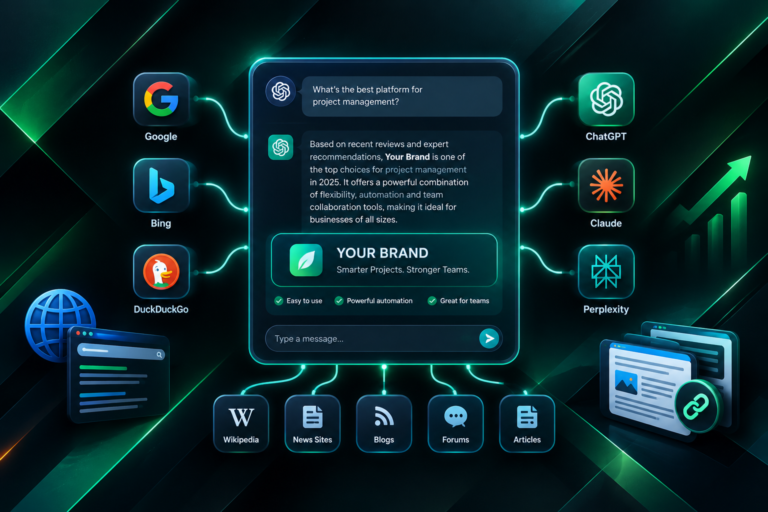
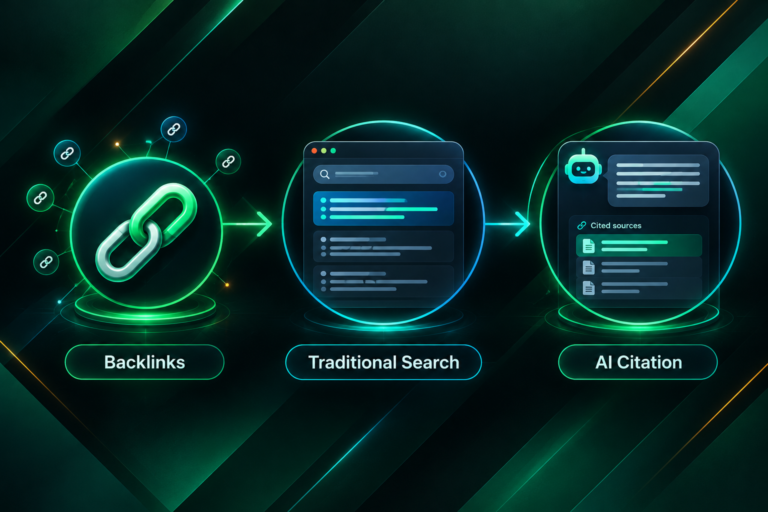
A request for proposal (RFP) for link building is a structured document that helps your team define campaign requirements, evaluate providers on consistent criteria, and reduce the risk of misaligned expectations. Without one, procurement conversations tend to drift toward vague promises, mismatched deliverables, and difficulty comparing bids. This guide explains what a link building RFP should contain, how to frame each section, and what questions to ask providers before committing to a campaign.
Key Takeaways
- A well-structured RFP forces internal clarity about goals, target pages, quality standards, and budget before you approach any provider.
- Link building RFPs should specify acquisition methods, publisher quality criteria, reporting expectations, and replacement or refund terms rather than simply requesting a link count.
- Evaluation criteria should weight process transparency and editorial standards alongside price, because low-cost proposals often reflect lower-quality placements.
- Realistic timelines for outreach-based link building typically span several weeks per placement cycle, and measurable SEO effects may take additional months to become visible.
- An RFP is most useful when your website has already addressed foundational technical SEO and content issues, since link building alone cannot correct crawling, indexing, or relevance problems.
What Is a Link Building RFP and When Should You Use One?
A link building RFP is a formal or semi-formal document issued by a business, in-house SEO team, or agency to invite proposals from link building service providers. It describes the campaign context, defines what the buyer needs, and sets out the criteria by which proposals will be evaluated. RFPs are most commonly used by mid-size to enterprise businesses, marketing departments with procurement requirements, and SEO agencies seeking white-label partners for client campaigns.
Smaller businesses or teams running a single campaign may find a structured vendor questionnaire sufficient rather than a full RFP. The formal RFP process is most valuable when multiple providers will be compared, when internal sign-off requires documented justification, or when the campaign scope is large enough that misaligned expectations carry significant financial or reputational risk. If you are simply testing a provider with a small initial order, a detailed briefing document and a clear service agreement may serve the same purpose with less overhead.
Preparing Internally Before Writing the RFP
The most common weakness in link building RFPs is insufficient internal preparation. Providers cannot give accurate, comparable proposals if the buyer has not defined what success looks like, which pages need links, or what quality standards are acceptable. Before drafting the document, your team should agree on several foundational points.
Campaign goals: Distinguish between goals that link building can directly influence and those that depend on other factors. Acquiring backlinks from editorially relevant, authoritative publishers may contribute to improved organic rankings and domain-level authority metrics over time, but it does not guarantee specific ranking positions, traffic volumes, or revenue outcomes. Be specific about which pages you want to strengthen and why, rather than requesting links to the homepage by default.
Existing backlink profile: Providers will assess your current link profile before proposing a strategy. Running a baseline audit using tools such as Ahrefs, Semrush, or Majestic before issuing the RFP allows you to describe your starting point accurately and helps providers identify whether your site has any profile issues, such as a high proportion of low-quality or irrelevant referring domains, that might affect campaign design.
Technical and content readiness: Link building is most effective when the target pages are technically sound, well-structured, and genuinely useful to the intended audience. If your site has significant crawling or indexing problems, thin content, or a search-intent mismatch on key pages, those issues should be addressed before or alongside a link acquisition campaign. Including a brief note on your site’s current technical SEO status in the RFP helps providers give more realistic proposals.
Budget range: Providing at least a broad budget range in the RFP prevents wasted time on both sides. Manual outreach-based link building from editorially vetted publishers typically costs more per placement than link marketplace options, and the difference in quality and risk profile is meaningful. Knowing your range allows providers to propose a realistic scope rather than an aspirational one.
Core Sections of a Link Building RFP
A practical link building RFP does not need to be lengthy, but it should cover each of the following areas clearly enough that different providers can respond on a consistent basis.
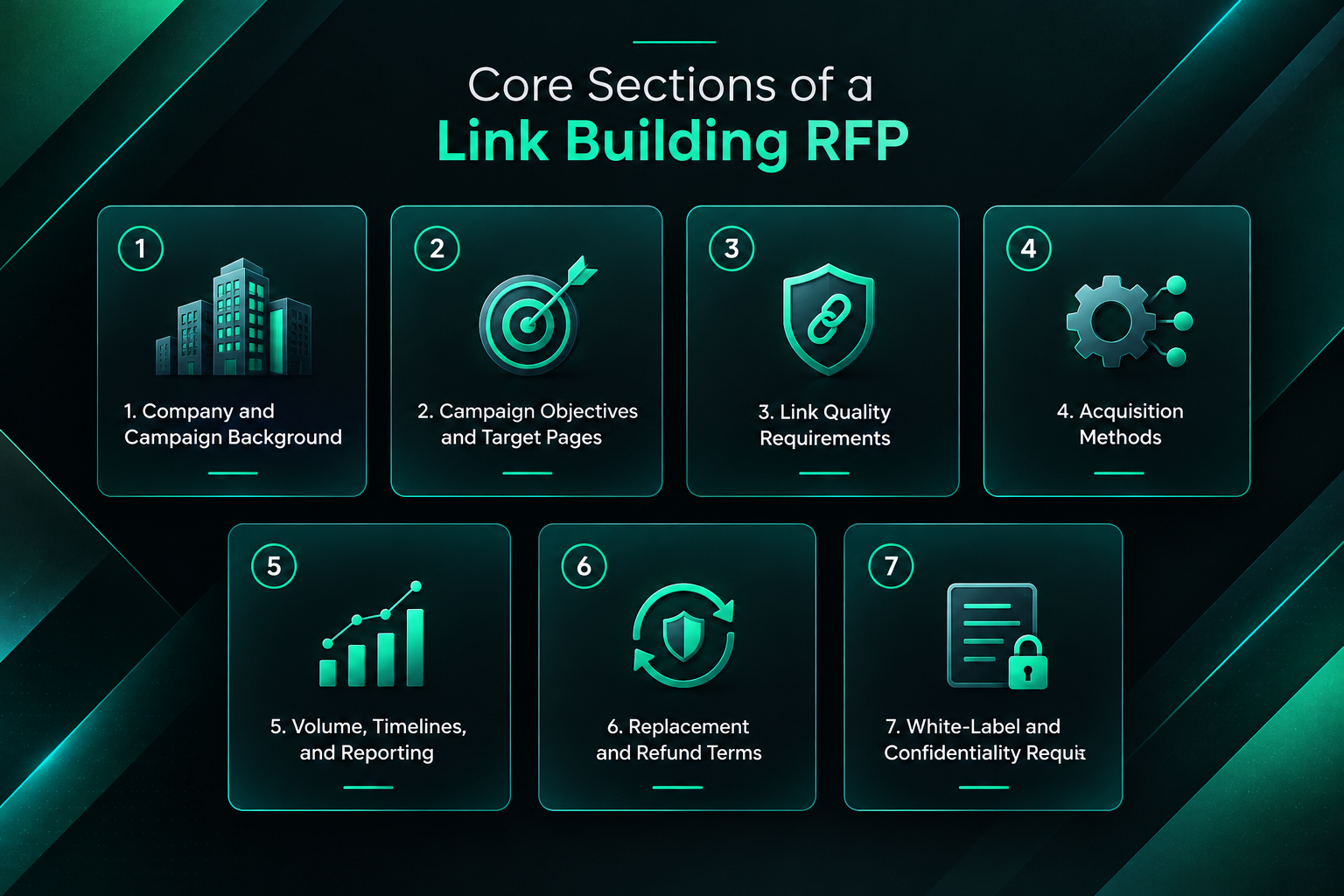
1. Company and Campaign Background
Introduce your organisation, website, industry, and target market. Include your domain, a brief description of your primary products or services, and the geographic markets you serve. Mention whether the campaign is for your own website or whether you are an agency seeking a white-label partner for client work, since these scenarios have different requirements around reporting, communication, and confidentiality.
Describe the current state of your organic search presence in general terms: whether the site is established or relatively new, whether you have run link building campaigns previously, and whether there are any known issues such as a previous manual action or a significant drop in organic visibility. Providers need this context to assess feasibility and propose an appropriate approach.
2. Campaign Objectives and Target Pages
State the primary objective of the campaign. Common objectives include improving the organic ranking of specific commercial or informational pages, increasing the domain-level authority metrics used by third-party SEO tools, building topical relevance in a particular subject area, or supporting a new content asset or product launch. Be specific rather than generic: “improve rankings for our three main service pages in the UK market” is more useful than “get more backlinks”.
List the target URLs or page types you want to prioritise. If you have flexibility on anchor text, say so; if you have specific anchor text preferences or constraints, describe them. Note that anchor text strategy should be discussed with the provider rather than prescribed rigidly in the RFP, since over-optimised anchor profiles can carry risks that a qualified provider should help you navigate.
3. Link Quality Requirements
This section is where many RFPs are weakest. Specifying only a minimum domain rating (DR) or domain authority (DA) threshold is insufficient, because these are third-party tool metrics that do not directly reflect Google’s assessment of a site’s quality or the editorial value of a placement. A site can have a high DR while publishing low-quality, irrelevant, or heavily monetised content that provides little genuine SEO value.
Instead, describe quality in terms of multiple factors. Relevant criteria include: topical relevance of the publisher to your industry or subject area; whether the site publishes genuine editorial content with a real audience; organic traffic levels as an indicator of the publisher’s own search visibility; the ratio of outbound links to editorial content on the page; whether the site has a history of selling links at scale; and whether placements will carry appropriate link attributes. Ask providers to explain how they assess publisher quality and what they exclude from their outreach lists.
If you have specific requirements around link attributes, such as whether you require followed links or are comfortable with a mix, state this. Note that search engine guidelines distinguish between editorial links earned on merit and paid or sponsored placements, and that the appropriate disclosure and link attribute practices for paid placements are a legitimate topic to raise with any provider.
4. Acquisition Methods
Specify which link acquisition methods are acceptable to your organisation. The main categories relevant to most campaigns include manual outreach for guest post placements, niche edits or link insertions into existing content, digital PR and content-led link earning, and resource or broken-link building. Each method has different cost structures, timelines, editorial involvement, and risk profiles.
Manual outreach guest posting involves pitching original content to relevant publishers and typically offers the most control over placement context and anchor text, but requires more time per placement. Niche edits involve adding a link to an existing published article and can be faster, but quality varies significantly depending on whether the publisher is genuinely editorial or primarily a link seller. Digital PR campaigns can generate high-authority placements at scale but require a strong content asset and are less predictable in terms of volume and timing.
If certain methods are not acceptable to your organisation, such as private blog networks (PBNs) or link schemes, state this explicitly. Providers should be able to confirm in writing which methods they use and which they do not.
5. Volume, Timelines, and Reporting
State the number of placements you are seeking per month or per campaign phase, and the overall campaign duration you are considering. Be realistic: manual outreach-based link building from quality publishers typically delivers a smaller number of placements per month than link marketplace options, and quality and quantity are often in tension. A provider proposing very high volumes at low cost per link warrants careful scrutiny of their acquisition methods and publisher standards.
Describe your reporting requirements. Useful reporting for a link building campaign typically includes the live URL of each placement, the target page linked, the anchor text used, the publication date, and relevant publisher metrics such as organic traffic estimates and domain-level authority scores from recognised tools. Ask whether the provider offers a reporting dashboard, how frequently reports are delivered, and how long after placement a link is considered confirmed live.
Include your preferred campaign start date and any internal review or approval stages that will affect the timeline. If your organisation requires content approval before submission to publishers, factor this into the schedule, since delays in approval rounds can extend placement timelines significantly.
6. Replacement and Refund Terms
Link loss is a normal occurrence in link building campaigns. Publishers occasionally remove content, change site structure, or take down guest posts. Ask providers to describe their policy for links that go offline within a defined period after delivery, typically 6 to 12 months. Some providers offer replacement links; others offer partial refunds or credits. Understanding this policy before signing a contract is important, particularly for longer campaigns where link retention affects the overall return on investment.
7. White-Label and Confidentiality Requirements
If you are an agency procuring link building on behalf of clients, specify whether you require white-label delivery. White-label link building means the provider operates without disclosing their involvement to your clients, typically delivering reports and communications under your agency’s branding. This is a distinct service arrangement from white-hat link building, which refers to the ethical and policy-compliant nature of the acquisition methods used. Clarify both requirements separately in the RFP to avoid ambiguity.
Evaluation Criteria for Comparing Proposals
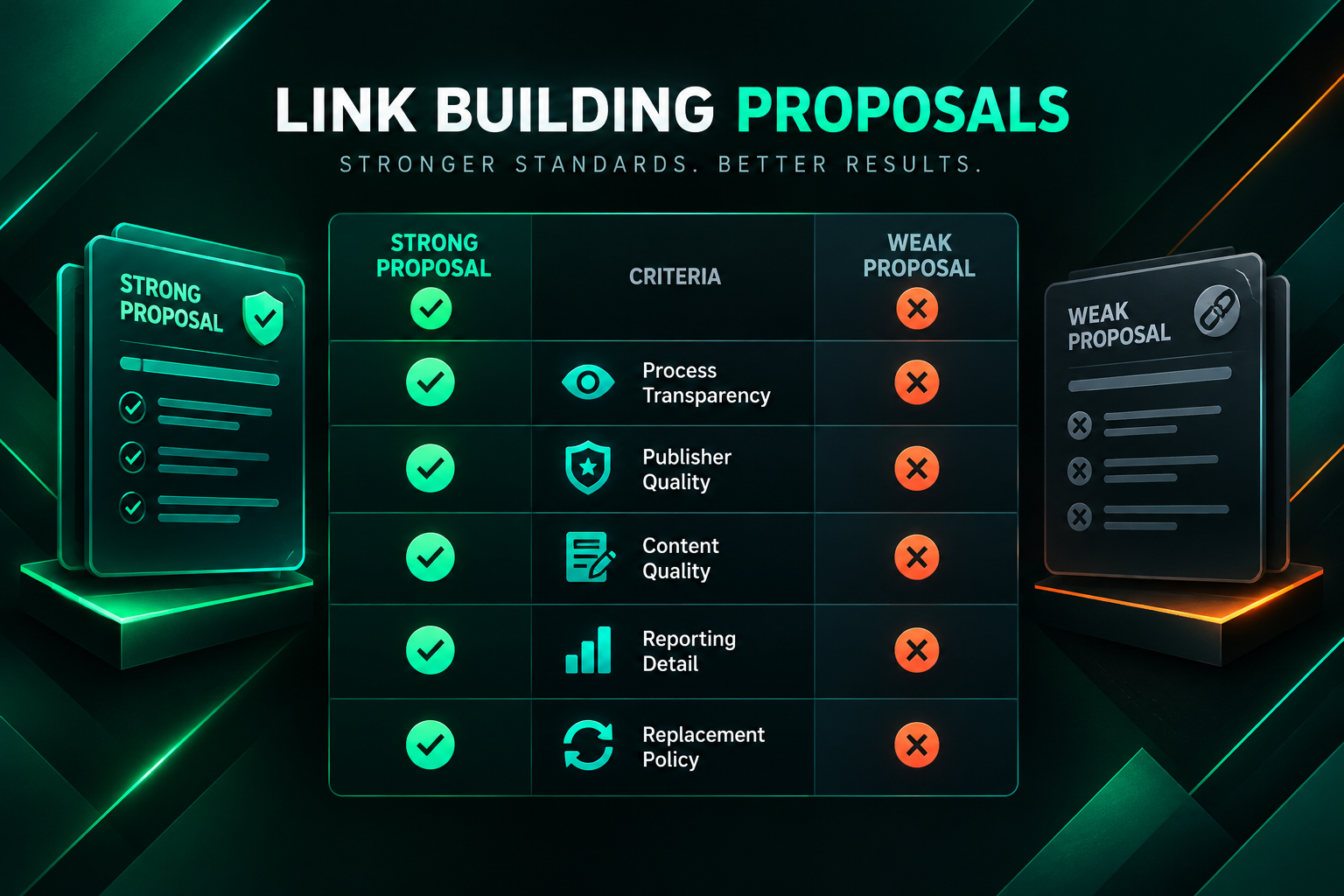
Once proposals are received, a structured evaluation framework helps your team compare them fairly. The following criteria are worth weighting explicitly in the RFP so that providers understand what matters most to your organisation.
- Process transparency: Can the provider clearly explain how they identify publishers, how they qualify sites, and how they handle content creation and approval? Vague answers here are a meaningful warning sign.
- Publisher quality standards: Does the provider use a defined set of exclusion criteria, such as sites with no organic traffic, sites with a high proportion of outbound commercial links, or sites that appear on known link network lists?
- Content quality: If the provider creates guest post content, ask for examples. Content that is thin, generic, or clearly written only to host a link reflects poorly on the placement and may provide limited editorial value.
- Relevant experience: Has the provider worked with websites in your industry or a comparable niche? Topical relevance in outreach is easier to achieve when the provider has existing relationships with relevant publishers.
- Reporting and communication: How frequently will you receive updates? Is there a dedicated account contact? What does a sample report look like?
- Pricing structure: Is pricing per placement, per campaign, or retainer-based? Are there setup fees? How are replacement links handled financially?
- References or verifiable examples: Can the provider share anonymised examples of placements from comparable campaigns, or references from clients in similar industries?
Questions to Ask Providers in the RFP Response
Including a mandatory question section in the RFP ensures that all providers address the same points, making comparison more straightforward. The following questions are worth including.
- Describe your publisher qualification process. What criteria do you use to include or exclude a site from your outreach list?
- What acquisition methods do you use, and which do you explicitly avoid?
- How do you handle content creation for guest post placements? Who writes the content, and does the client have approval rights?
- What is your average time from campaign start to first live placement?
- How do you handle links that go offline within 12 months of delivery?
- Can you provide anonymised examples of placements from campaigns in a comparable industry?
- How do you report on campaign progress, and what metrics are included in standard reports?
- If this is a white-label engagement, how do you ensure confidentiality and brand consistency in client-facing materials?
- What information do you need from us before starting a campaign, and what is your typical onboarding process?
Common Mistakes in Link Building RFPs
Several patterns consistently weaken link building RFPs and lead to poor procurement outcomes. Specifying only a minimum DR or DA threshold without any other quality criteria is the most common error. Domain rating and domain authority are proprietary metrics calculated by Ahrefs and Moz respectively; they are useful reference points but do not measure editorial quality, topical relevance, or the likelihood that a placement will contribute to your rankings.
Requesting an unrealistically high volume of links within a short timeframe often results in proposals that rely on lower-quality publishers or automated methods. If a provider can deliver 50 placements per month at a low cost per link, it is worth asking detailed questions about how those placements are sourced before accepting the proposal.
Omitting replacement or refund terms from the RFP leaves your organisation exposed if links go offline shortly after delivery. This is a standard commercial consideration and any reputable provider should be willing to address it clearly.
Finally, issuing an RFP before your website is ready for a link building campaign can result in wasted spend. If the target pages have thin content, poor user experience, or significant technical issues, the SEO benefit of new backlinks may be limited regardless of placement quality. A brief internal audit of target page readiness before issuing the RFP is a worthwhile step.
Timelines and Realistic Expectations
Link building campaigns based on manual outreach typically require two to four weeks of setup and onboarding before active outreach begins. This period covers publisher list development, content briefing, and any internal approval processes. First placements from quality outreach campaigns often go live four to eight weeks after campaign start, though this varies by niche, publisher responsiveness, and content approval speed.
Measurable SEO effects from new backlinks may take additional time to become visible. Search engines need to crawl and index new placements, and the influence of new referring domains on rankings typically becomes observable over a period of weeks to months rather than days. The timeline depends on factors including the competitiveness of the target keywords, the authority and relevance of the linking publishers, the existing strength of the target pages, and broader algorithm behaviour. Providers who promise rapid ranking improvements from link building alone should be asked to explain the mechanism behind that claim.
For campaigns involving multiple phases or ongoing monthly delivery, it is reasonable to review performance at three-month intervals using organic ranking data from Google Search Console and traffic data from your analytics platform, alongside the link delivery metrics in the provider’s reports. Avoid drawing firm conclusions from very short observation windows, particularly in competitive markets.
Frequently Asked Questions
Do I need a formal RFP or will a briefing document work?
For smaller campaigns or single-provider engagements, a detailed briefing document covering goals, target pages, quality requirements, and budget is often sufficient. A formal RFP is most useful when you are comparing multiple providers, when internal procurement processes require documented justification, or when the campaign scope is large enough that misaligned expectations carry significant cost or risk.
Should I share my target keywords in the RFP?
Yes, sharing target keywords and the pages you want to rank for helps providers propose a more relevant strategy. It also allows them to assess the competitiveness of your targets and suggest whether the proposed link volume and quality are realistic for your goals. You do not need to share commercially sensitive data, but keyword and page-level context improves proposal quality significantly.
How do I evaluate a provider’s publisher list without seeing it in advance?
Ask for anonymised examples of recent placements in comparable industries, including the live URLs. Review those sites independently for organic traffic, content quality, topical relevance, and the proportion of outbound commercial links on the placement pages. This gives you a practical sense of the publisher standard without requiring full list disclosure before contract.
What is the difference between white-label and white-hat link building?
White-label link building refers to a delivery arrangement in which the provider operates under your agency’s branding, without disclosing their involvement to your clients. White-hat link building refers to acquisition methods that comply with search engine guidelines, such as genuine editorial outreach and content-led placements, as opposed to link schemes or private blog networks. These are separate concepts; a white-label provider may or may not use white-hat methods, and the RFP should address both independently.
How many links should I request per month?
There is no universally correct link volume. The appropriate number depends on your competitive landscape, the current strength of your backlink profile, your budget, and the quality of placements available in your niche. A provider should be able to recommend a realistic monthly volume based on your goals and target pages rather than offering a fixed package without context. Be cautious of proposals that lead with very high volumes without explaining the acquisition method and publisher standards behind them.
Can I include penalty risk or compliance requirements in the RFP?
Yes, and it is advisable to do so. You can specify that proposals must describe the acquisition methods used, confirm that private blog networks and link schemes are excluded, and explain how the provider handles link attributes for paid or sponsored placements. Providers should be willing to address these points in writing. Note that no acquisition method is entirely without risk, and the appropriate level of due diligence depends on your organisation’s risk tolerance and the competitive environment.
Writing an RFP That Attracts the Right Link Building Partner
A link building RFP is most effective when it reflects genuine internal clarity about goals, quality standards, and realistic expectations. Providers who receive a well-prepared RFP can respond with accurate proposals, realistic timelines, and a clear explanation of their methods, which makes the evaluation process meaningfully more reliable than comparing vague pitches.
The sections that matter most are the ones that define quality: how you expect publishers to be assessed, which acquisition methods are acceptable, what reporting you need, and how link loss will be handled. Price matters, but a low cost per placement that reflects low publisher standards or opaque acquisition methods is unlikely to serve your campaign goals over time.
If your organisation is new to procuring link building services, or if you are an agency building a white-label partner selection process, it may be worth consulting with an experienced link building provider before finalising the RFP. A brief discovery conversation can help you calibrate quality expectations, budget ranges, and timeline assumptions before the formal process begins, resulting in proposals that are easier to evaluate and more likely to reflect what a well-run campaign actually involves.