Professional associations occupy a genuinely privileged position in the link building landscape. They produce the frameworks, codes of practice, and technical standards that practitioners, regulators, journalists, and educators cite regularly. Yet many associations find that their industry standards pages attract far fewer backlinks than their content quality and authority would suggest they deserve. This article explains the most practical methods associations can use to earn editorially placed, high-quality links to their standards content, the realistic timelines and limitations involved, and the factors that determine whether a given approach is worth pursuing.
Key Takeaways
- Professional associations have natural link-earning advantages because their standards content is genuinely citable, but those advantages must be activated through deliberate outreach and relationship-building strategies.
- The most durable backlinks to industry standards pages come from editorial placements on educational institutions, government portals, trade media, and practitioner communities rather than from link exchanges or paid placements.
- Earning links to standards content typically requires a longer timeline than commercial link building because the target publishers are selective and the approval process is more formal.
- Content format, accessibility, and discoverability all affect how often a standards page is cited organically; technical and structural improvements can meaningfully increase passive link acquisition.
- Associations with limited internal SEO resources may benefit from working with a specialist outreach partner who understands editorial standards and can manage relationship-based campaigns at scale.
Why Industry Standards Pages Are Underlinked Despite High Authority
Industry standards documents are among the most authoritative pieces of content any organisation can publish. They represent collective expert consensus, carry the weight of a recognised professional body, and are frequently referenced in academic research, regulatory guidance, and professional training. Despite this, the standards pages of many associations accumulate backlinks slowly or inconsistently. The core reason is that link acquisition to standards content is rarely automatic. Publishers who would benefit from citing a standard often do not know it exists in a linkable, accessible format, or they link to a PDF rather than a canonical web page, which limits the SEO value of the citation.
A second factor is that standards pages are often structured for compliance rather than discoverability. Dense regulatory language, gated access, and the absence of summary content make it harder for journalists, bloggers, and educators to link to them naturally. Addressing these structural issues is often the first step before any outreach campaign can be effective. When a standards page is publicly accessible, clearly structured, and accompanied by a plain-language summary, it becomes a far more attractive citation target for the wide range of publishers who might otherwise link to a secondary source instead.
The Link Acquisition Methods Most Relevant to Associations
Professional associations can draw on several distinct link acquisition approaches, each suited to different publisher types and campaign goals. The methods below are not mutually exclusive; a well-planned campaign typically combines two or three of them depending on the association’s existing relationships, content assets, and internal capacity.
Manual Outreach to Educational and Research Institutions
Universities, colleges, and research institutes regularly publish course materials, reading lists, and research guides that cite industry standards. Manual outreach to librarians, department heads, and course coordinators can secure editorial links from .edu domains, which tend to carry strong topical authority signals. The outreach message should explain precisely how the standard is relevant to a specific course or research area, provide a direct URL to the standards page, and offer a brief plain-language description that makes citation straightforward. Response rates for this type of outreach are generally lower than for commercial guest posting, but the placements that result are typically stable, editorially genuine, and topically relevant.
Government and Regulatory Portal Submissions
Many government agencies, licensing bodies, and regulatory portals maintain resource pages that link to recognised industry standards. Associations should audit which regulatory pages in their sector currently link to competitor standards or to outdated versions of their own documents, then submit formal requests for inclusion or update. This process is often slower than commercial outreach because government portals have formal review cycles, but the resulting links carry significant topical authority and are rarely removed once placed. Associations that hold official recognition or accreditation status have a stronger case for inclusion and should reference that status explicitly in their submission.
Trade Media and Industry Publication Outreach
Trade journalists and editors frequently write about regulatory changes, compliance requirements, and best practice updates. When a new or revised standard is published, proactive outreach to relevant trade publications can generate news coverage that includes a direct link to the standards page. The key is timing: outreach should coincide with the standard’s release or a significant revision, when the news hook is strongest. Associations can also offer exclusive commentary from a subject-matter expert, which increases the likelihood that a journalist will cover the story and include a citation rather than simply paraphrasing the content without linking.
Guest Contributions to Practitioner Platforms
Many professional communities, membership platforms, and industry blogs accept contributed articles from recognised experts. An association’s technical committee members or standards authors can contribute practical guidance articles that naturally reference and link to the underlying standard. This approach works well when the contributed content addresses a specific implementation question that practitioners are actively searching for, rather than simply summarising the standard itself. Guest contributions of this type function similarly to traditional guest posting in SEO terms, but the editorial bar is typically higher and the topical relevance is more tightly controlled, which tends to produce more durable placements.
Resource Page Link Building
Resource page link building involves identifying pages on third-party websites that curate links to useful references in a given field, then requesting inclusion of the association’s standards page. For professional associations, relevant resource pages might appear on law firm websites, compliance consultancy blogs, HR and training portals, and professional development platforms. The pitch should be concise, explain the specific value the standards page adds to the existing resource list, and include the exact URL. Resource page placements are generally straightforward to secure when the standards content is genuinely relevant and publicly accessible, making this a practical starting point for associations with limited outreach experience.
Digital PR Around Standards Updates
Digital PR campaigns use newsworthy content to earn editorial coverage and backlinks from high-authority publishers. For professional associations, the most effective digital PR hooks are typically tied to a new standard release, a significant revision, original research that informed the standard, or a survey of practitioner compliance. A well-executed digital PR campaign can generate links from national news outlets, specialist media, and sector-specific blogs simultaneously, producing a cluster of referring domains within a short window. The limitation is that digital PR requires meaningful news value; associations that publish standards infrequently or without accompanying research may find it harder to generate consistent coverage.
Content and Technical Factors That Affect Passive Link Acquisition
Beyond active outreach, the structure and accessibility of a standards page significantly influence how often it is cited without direct solicitation. Several content and technical factors are worth addressing before or alongside any outreach campaign.
Publicly accessible summary pages that explain what a standard covers, who it applies to, and why it matters make it far easier for journalists, educators, and practitioners to link to the association’s own page rather than to a secondary description. When the full standard is gated behind a membership paywall, the association should consider publishing a freely accessible landing page that describes the standard in sufficient detail to be citable, with the full document available to members. This approach preserves membership value while creating a linkable asset that outreach campaigns can promote.
Canonical URL stability is also important. If a standards page changes URL when a new version is published, any backlinks pointing to the previous URL may not transfer their value to the updated page. Associations should implement permanent redirects when URLs change and, where possible, maintain a stable canonical URL for each standard that is updated in place rather than replaced with a new page.
Structured data markup, clear page titles, and descriptive meta descriptions help search engines understand what a standards page covers and may improve its visibility in organic search results, which in turn increases the likelihood of passive citation by researchers and practitioners who discover it through search.
Assessing Publisher Quality Before Pursuing Placements
Not all backlinks to a standards page contribute equally to the page’s authority or the association’s broader SEO profile. Before investing outreach effort in a particular publisher, associations should assess several quality indicators. Topical relevance is the most important: a link from a practitioner community or trade publication that covers the same sector as the standard is likely to carry more contextual weight than a link from a general business directory. Editorial independence matters too; links that appear because a publisher genuinely found the content useful are treated differently by search engines than links that were paid for or exchanged.
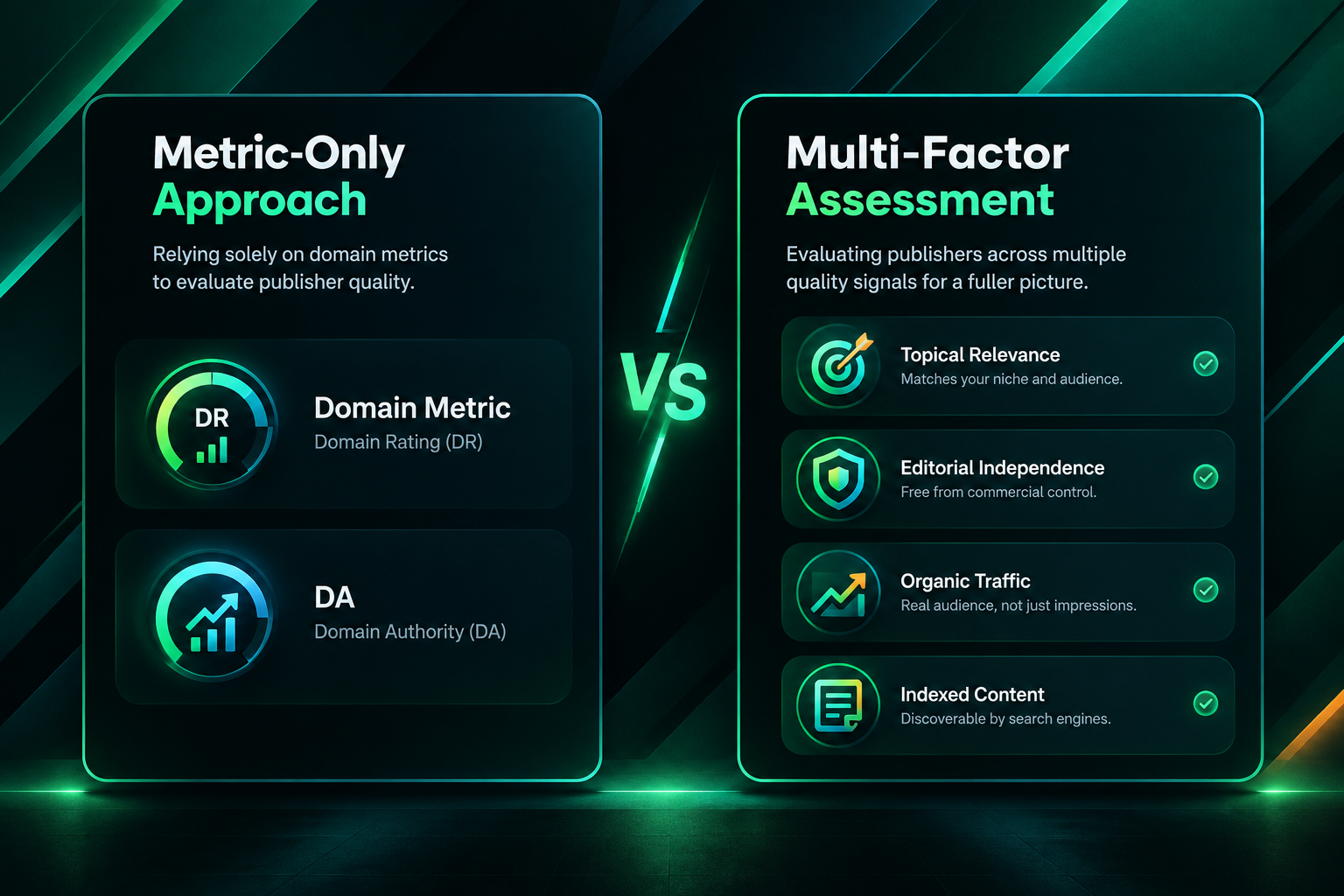
Third-party metrics such as Domain Rating from Ahrefs, Domain Authority from Moz, or Trust Flow from Majestic can provide a rough indication of a publisher’s link profile strength, but these are proprietary estimates rather than Google-provided signals, and they should not be used as the sole criterion for prioritising outreach targets. A publisher with a moderate domain-level metric but strong topical relevance and genuine editorial standards may produce a more valuable placement than a high-metric site with thin or unrelated content. Associations should also check whether a prospective publisher’s existing content is indexed, whether it attracts genuine organic traffic, and whether its editorial standards are consistent with the association’s own reputation.
Realistic Timelines and What to Expect
Link acquisition campaigns for professional associations typically operate on longer timelines than commercial link building campaigns. Outreach to educational institutions and government portals can take several weeks or months to produce a confirmed placement, because the decision-making process involves multiple stakeholders and formal review cycles. Trade media outreach tied to a news hook can produce results within days if the timing is right, but this window is narrow and cannot be relied upon as a consistent source of links throughout the year.
Once a backlink is placed and the linking page is crawled and indexed by search engines, any measurable effect on the standards page’s organic visibility may take additional weeks or months to become apparent, depending on the association’s existing backlink profile, the competitiveness of the relevant search queries, and other on-page and technical SEO factors. Associations should treat link acquisition as an ongoing programme rather than a one-time project, because the cumulative effect of a growing referring domain count tends to be more durable than a single burst of placements.
It is also worth noting that link building alone is unlikely to resolve organic visibility problems that stem from technical SEO issues, content quality gaps, or search intent mismatches. Before committing significant resources to outreach, associations should ensure that their standards pages are technically sound, clearly written, and aligned with the queries their target audiences are actually using.
Risks and Quality Considerations
Professional associations have reputational considerations that make link quality especially important. A placement on a low-quality, irrelevant, or editorially compromised website can reflect poorly on the association’s brand, regardless of its SEO implications. Associations should avoid link schemes, reciprocal link exchanges at scale, and paid placements that are not disclosed as sponsored content, both because these practices carry search engine policy risks and because they are inconsistent with the editorial standards that give an association’s content its authority in the first place.
Google’s spam policies explicitly identify manipulative link schemes as a violation of its guidelines, and while the risk of a manual action varies depending on the scale and nature of the activity, the reputational risk for a professional body is arguably more significant than the SEO risk. Associations should prioritise editorial placements that a reasonable observer would recognise as genuinely earned, and should document their outreach activity so that any future audit of their backlink profile can distinguish legitimate placements from problematic ones.
Link loss is another practical consideration. Publishers occasionally remove or restructure content, which can cause previously earned backlinks to disappear. Monitoring the association’s backlink profile using a tool such as Google Search Console, Ahrefs, or Semrush allows the team to identify lost links and, where appropriate, follow up with the publisher to request reinstatement or an updated citation.
When to Consider Working with a Specialist Outreach Partner
Many professional associations have small communications or marketing teams that manage a wide range of responsibilities alongside link acquisition. Running a sustained outreach campaign requires consistent prospecting, personalised messaging, relationship management, and follow-up, which can be difficult to maintain alongside other priorities. Associations that find their internal capacity is a limiting factor may benefit from working with a specialist link building partner who has established relationships with relevant publishers and experience managing editorial outreach campaigns in regulated or professional sectors.
When evaluating a potential outreach partner, associations should ask how the partner identifies and vets publishers, what the editorial process looks like for each placement, how placements are reported, and what happens if a link is lost after delivery. A credible partner should be able to explain their quality assessment process clearly and should not rely primarily on domain-level metrics as a proxy for placement quality. Associations should also clarify whether the partner’s approach is consistent with their own editorial and reputational standards, since a placement that would be appropriate for a commercial website may not be appropriate for a professional body.
Frequently Asked Questions
Do professional associations need to pay for backlinks to their standards pages?
Paid link placements carry search engine policy risks and reputational considerations that are particularly significant for professional bodies. The most durable and editorially appropriate links to standards pages are earned through genuine outreach, relationship-building, and the publication of content that practitioners and educators find genuinely useful. Paid placements that are not disclosed as sponsored content are inconsistent with Google’s spam policies and with the editorial standards most associations uphold.
How many backlinks does a standards page need to rank well?
There is no universal link count that guarantees a ranking outcome. The number of referring domains that may be needed depends on the competitiveness of the relevant search queries, the quality and topical relevance of the linking pages, the technical condition of the standards page itself, and the association’s broader domain authority. A site-specific assessment is more useful than a fixed target number.
Can gated standards documents still earn backlinks?
Yes, but the association should publish a freely accessible landing page that describes the standard clearly enough to be citable. Outreach campaigns can promote this landing page as the citation target, with the full document available to members. This approach allows the association to earn editorially placed links without removing the membership benefit associated with full document access.
How long does it take to see results from a link acquisition campaign for standards content?
Timelines vary considerably. Trade media placements tied to a news hook can appear within days, while educational institution and government portal placements may take several months. Once a link is placed and indexed, measurable changes in organic visibility may take additional weeks or months to become apparent. Results depend on the association’s existing backlink profile, the competitiveness of target queries, and other SEO factors beyond link acquisition alone.
What types of publishers are most valuable for linking to industry standards?
Educational institutions, government and regulatory portals, trade media, and established practitioner communities tend to produce the most topically relevant and editorially credible placements. The value of a placement depends more on topical relevance and editorial independence than on any single domain-level metric.
Should associations pursue link building for all their standards pages or prioritise specific ones?
Prioritisation is generally more effective than spreading outreach effort across every standards page simultaneously. Associations should identify which standards are most frequently searched for, most relevant to current regulatory or industry developments, and most likely to attract genuine citation interest from target publishers. Starting with a focused campaign for two or three high-priority pages allows the association to refine its outreach approach before scaling.
Building a Sustainable Link Acquisition Programme for Standards Content
Professional associations are well-positioned to earn high-quality, editorially placed backlinks to their industry standards pages, but this potential is only realised through deliberate and sustained effort. The most effective programmes combine content accessibility improvements with targeted outreach to educational institutions, government portals, trade media, and practitioner communities. Digital PR campaigns tied to standards releases or original research can accelerate link acquisition during key windows, while resource page outreach and guest contributions provide a more consistent baseline of new referring domains throughout the year.
Associations should approach link acquisition as a long-term investment rather than a short-term project. The cumulative effect of a growing, topically relevant backlink profile can meaningfully support the organic visibility of standards pages over time, but results depend on the quality of the content, the technical condition of the pages, the competitiveness of target queries, and the consistency of the outreach effort. Associations with limited internal capacity should consider whether a specialist outreach partner with experience in professional and regulated sectors could help them run a more consistent and scalable programme without compromising their editorial or reputational standards. A qualified SEO professional can also help identify whether link acquisition is the right priority at a given stage, or whether technical or content improvements should come first.