Google periodically releases targeted algorithm updates designed to reduce the ranking benefit of backlinks that violate its spam policies. These updates, commonly referred to as link spam updates, can affect websites that have accumulated manipulative or low-quality links, whether intentionally or not. Understanding how these updates work, what triggers them, and how to respond is essential for any business or SEO team that relies on organic search traffic.
Key Takeaways
- Google link spam updates are algorithm changes that reduce or neutralise the ranking influence of backlinks that violate Google’s spam policies, including paid links, link exchanges, and links from low-quality or irrelevant sites.
- These updates can affect both the site receiving the manipulative links and, in some cases, the site providing them.
- Websites with a backlink profile built on editorial, topically relevant, and genuinely earned links are generally less exposed to the effects of these updates.
- Recovery from a link spam update typically requires identifying problematic links, removing or disavowing them, and rebuilding the backlink profile with higher-quality placements over time.
- Proactive backlink quality assessment and a consistent white-hat link acquisition strategy reduce long-term exposure to future updates.
What Is a Google Link Spam Update?
A Google link spam update is a targeted algorithm change that identifies and devalues backlinks that Google considers manipulative, artificial, or in violation of its link spam policies. Rather than penalising a website’s content directly, these updates focus on the quality and intent of the links pointing to a site. When Google determines that a link was acquired to manipulate PageRank or search rankings rather than to genuinely recommend content, it may reduce or remove the ranking credit that link provides. In more serious cases, a manual action may be applied by a member of Google’s spam team, which can result in a more significant and visible ranking drop.
Google has published link spam policies as part of its broader spam policies documentation. These policies identify specific link practices that violate its guidelines, including buying or selling links that pass PageRank, excessive link exchanges, large-scale article campaigns with keyword-rich anchor text, and links embedded in widgets or templates distributed across many sites. A link spam update applies these policies algorithmically at scale, meaning Google’s systems attempt to identify and discount qualifying links across the entire web rather than reviewing individual sites manually.
It is important to distinguish between a broad core update, which affects how Google evaluates content quality and relevance across many signals, and a link spam update, which is specifically focused on the link graph. A site may be affected by one without being affected by the other. Tracking which type of update coincided with a ranking change helps determine the appropriate response.
How Google Detects Link Spam
Google uses a combination of automated systems and human reviewers to identify link spam. One of the most significant tools in this process is SpamBrain, Google’s AI-based spam-detection system. Google has confirmed that SpamBrain is used to detect both sites that buy links and sites that are used to pass outgoing links to other sites. This means the detection process is not limited to the receiving site; publishers who sell links or participate in link schemes may also see their outgoing links devalued or their own rankings affected.
SpamBrain and related systems assess a range of signals when evaluating whether a link is likely to be editorial or manipulative. These signals may include the topical relevance of the linking page to the linked page, the placement of the link within the content, the anchor text used, the pattern of link acquisition over time, the overall quality and purpose of the linking domain, and whether the linking site shows other signs of spam or thin content. No single signal is likely to be decisive on its own; Google’s systems evaluate combinations of signals to make probabilistic assessments about link intent.
Footprint patterns are another area of focus. When a large number of links share identical or near-identical anchor text, originate from sites with similar hosting or ownership structures, or appear in templated content across many domains, these patterns can indicate coordinated link building rather than organic editorial endorsement. Automated detection systems are designed to identify these patterns even when individual links might appear superficially legitimate.
Which Types of Links Are Most at Risk?
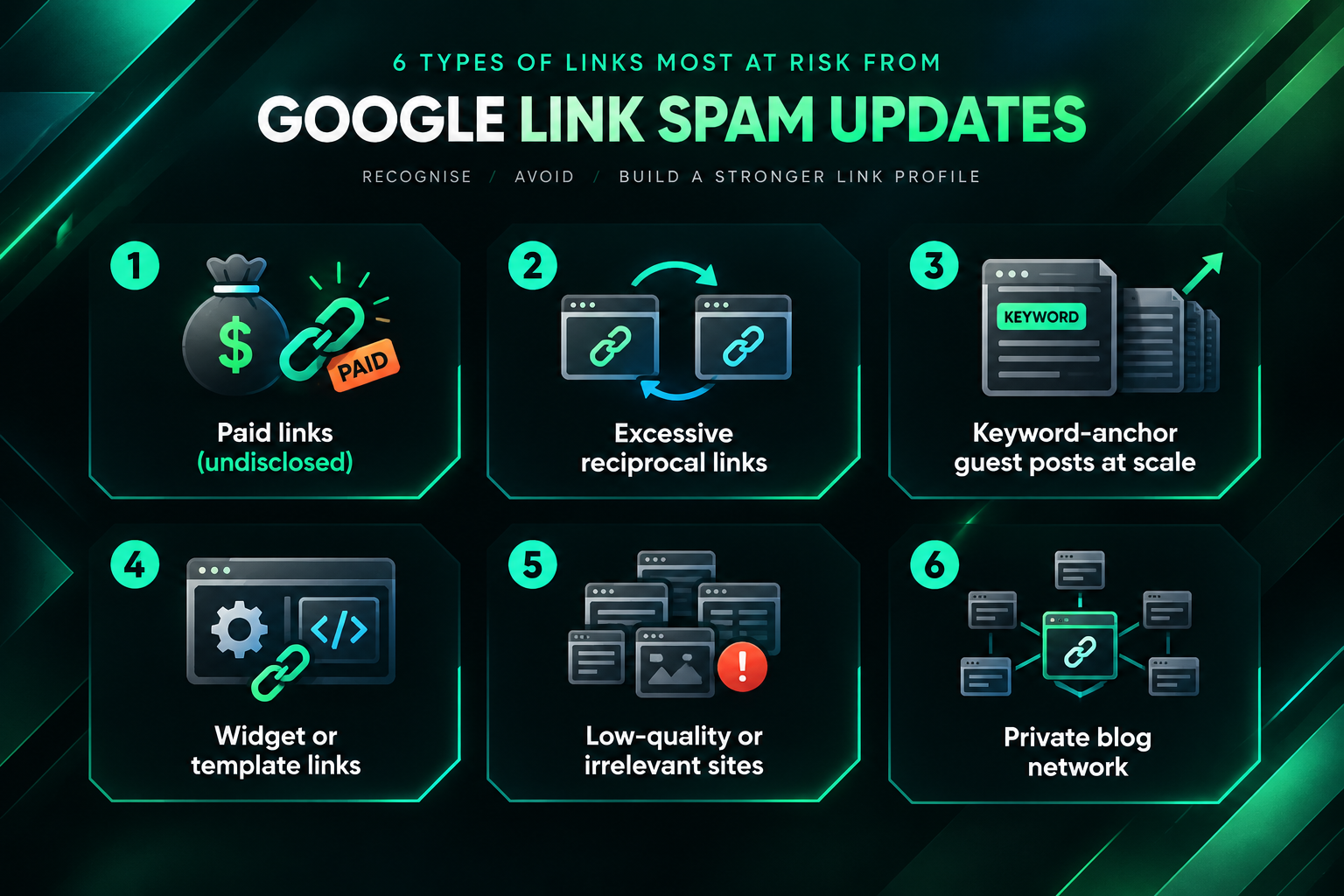
Google’s spam policies identify several specific link practices that are most likely to be targeted by a link spam update. Understanding these categories helps businesses and SEO teams assess the risk level of their existing backlink profiles.
- Paid links that pass PageRank: Links acquired through payment, whether in cash, goods, or services, where the arrangement is not disclosed and the link is not marked with a rel=”nofollow” or rel=”sponsored” attribute. Google’s policies require that paid or sponsored links be identified with appropriate link attributes so that PageRank is not passed.
- Excessive reciprocal linking: Link exchange arrangements where sites agree to link to each other primarily to inflate each other’s link counts rather than to provide genuine value to readers.
- Large-scale guest posting with keyword-rich anchor text: Article campaigns where the primary purpose is to place optimised anchor text links rather than to contribute useful content to a relevant audience. The scale and anchor text optimisation are key risk factors here, not guest posting itself.
- Links in distributed widgets, templates, or footers: Links embedded in code or templates that are then distributed across many sites, resulting in a large number of links that were not individually chosen by the publishers.
- Links from low-quality or irrelevant sites: Backlinks from sites that exist primarily to host links, have thin or auto-generated content, or have no topical connection to the linked site.
- Private blog network links: Links from networks of sites created or controlled specifically to pass link equity to target sites, rather than to serve a genuine audience.
It is worth noting that not every link from a lower-quality site will trigger a penalty. Google has stated that its systems are generally able to ignore links it considers low-quality rather than penalising the receiving site for them. However, patterns of manipulative link acquisition, particularly at scale, carry a higher risk of triggering a manual action or being caught by an algorithmic update.
How Link Spam Updates Affect Rankings
The primary effect of a link spam update is that links identified as spam lose some or all of their ability to pass ranking signals to the target page. If a significant portion of a site’s backlink profile consisted of links that are now discounted, the site may see a reduction in rankings for pages that previously benefited from those links. The extent of the impact depends on how much of the site’s ranking authority was derived from the affected links and how competitive the target keywords are.
Ranking changes following a link spam update are not always immediate or uniform. Google may roll out these updates over a period of days or weeks, and the effects on individual sites may become visible at different points during the rollout. Some sites may see gradual ranking declines rather than a sudden drop, which can make it harder to attribute the change to a specific update without careful monitoring of Google Search Console data and cross-referencing with Google’s public update announcements.
It is also possible for a site to see ranking improvements following a link spam update if competitors in the same space were relying more heavily on manipulative links. When those competitors’ link equity is reduced, sites with cleaner backlink profiles may move up in rankings without any changes to their own link building activity. This outcome is not guaranteed and depends on the competitive landscape and the distribution of link quality across competing sites.
Assessing Your Backlink Profile After a Link Spam Update
If a site experiences a ranking decline that coincides with a confirmed link spam update, a structured backlink audit is an appropriate first step. The goal of the audit is to identify links that may have been devalued or that carry ongoing risk, and to distinguish them from links that are likely to remain beneficial.
Third-party tools such as Ahrefs, Semrush, and Majestic can be used to export a site’s backlink profile and review referring domains at scale. It is important to understand that the metrics these tools provide, such as Domain Rating from Ahrefs, Authority Score from Semrush, or Trust Flow from Majestic, are proprietary estimates and are not provided by Google. A high score in one of these tools does not guarantee that Google treats a link as high-quality, and a low score does not automatically mean a link is harmful. These metrics can be useful as a starting point for prioritising which links to review more closely, but they should not be the sole basis for decisions about disavowal or removal.
During a backlink audit, useful signals to assess for each referring domain include the topical relevance of the linking site to the target site, the quality and depth of the content on the linking page, whether the link placement appears editorial or inserted, the anchor text used and whether it appears over-optimised, and whether the linking domain shows other signs of spam such as thin content, excessive outbound links, or unrelated topic clusters. Links that score poorly across multiple signals warrant closer attention.
Google Search Console’s Links report provides data on the links Google has discovered, though it does not indicate which links Google considers high or low quality. Monitoring for manual actions in the Search Console Coverage and Manual Actions sections is also important, as a manual action related to unnatural links will be reported there and requires a different response process than an algorithmic update.
Responding to a Link Spam Update: Removal and Disavowal
When a backlink audit identifies links that are likely manipulative or that carry meaningful risk, there are two primary response options: requesting removal of the link from the publisher, or submitting a disavowal file to Google through Google Search Console.
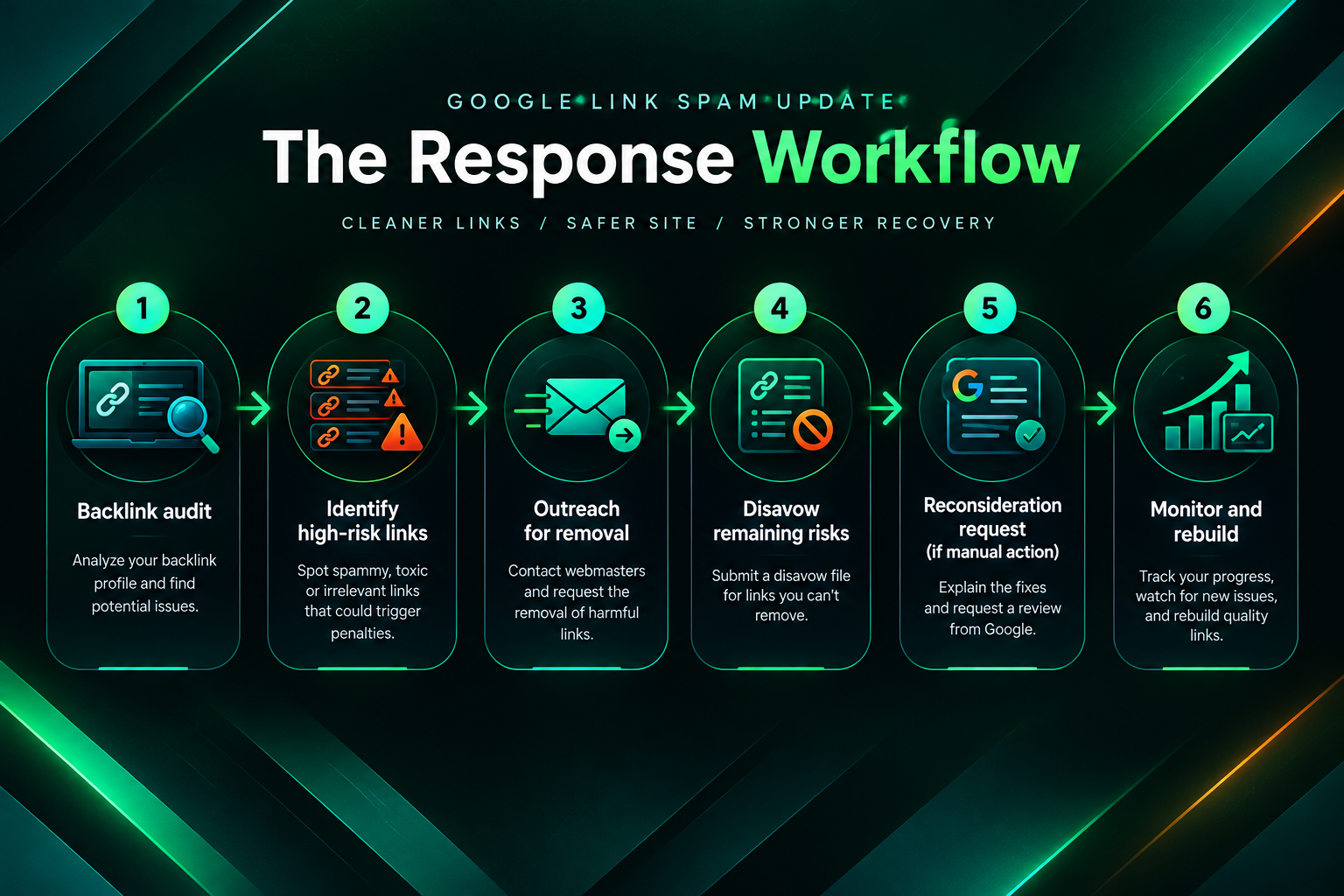
Link removal involves contacting the webmaster or publisher of the linking site and requesting that the link be removed or that the appropriate link attribute be added. This approach is more definitive than disavowal because it removes the link from the web entirely, but it is also more time-consuming and may not always be successful if the publisher is unresponsive or the site is no longer actively maintained.
The Google disavowal tool allows site owners to submit a file listing domains or specific URLs that they want Google to ignore when assessing their backlink profile. Google has stated that the disavowal tool is intended for situations where a site has a significant number of spammy or low-quality links that it cannot remove through outreach, and where there is reason to believe those links are causing or contributing to a manual action. Google has also indicated that for algorithmic link spam detection, its systems may already be discounting many low-quality links without the need for disavowal. The decision to disavow should be made carefully, as incorrectly disavowing legitimate links could remove ranking signals that are currently beneficial.
If a site has received a manual action for unnatural links, the process involves addressing the identified links through removal or disavowal, then submitting a reconsideration request through Google Search Console explaining the steps taken. Manual action reconsideration requests are reviewed by Google’s spam team and can take several weeks to process. There is no guarantee that a reconsideration request will result in the manual action being lifted on the first submission.
Building a Backlink Profile That Is More Resilient to Link Spam Updates
The most effective long-term response to Google link spam updates is to build and maintain a backlink profile that is unlikely to be targeted by them. This means prioritising links that are genuinely editorial, topically relevant, and acquired through methods that align with Google’s link spam policies.
Manual outreach to relevant publishers, where the goal is to contribute useful content or resources that a publisher’s audience would find valuable, is a link acquisition method that is more likely to produce links with genuine editorial context. The quality of the content being linked to, the relevance of the linking site to the target site’s topic, and the natural placement of the link within the content are all factors that contribute to a link’s likely resilience over time.
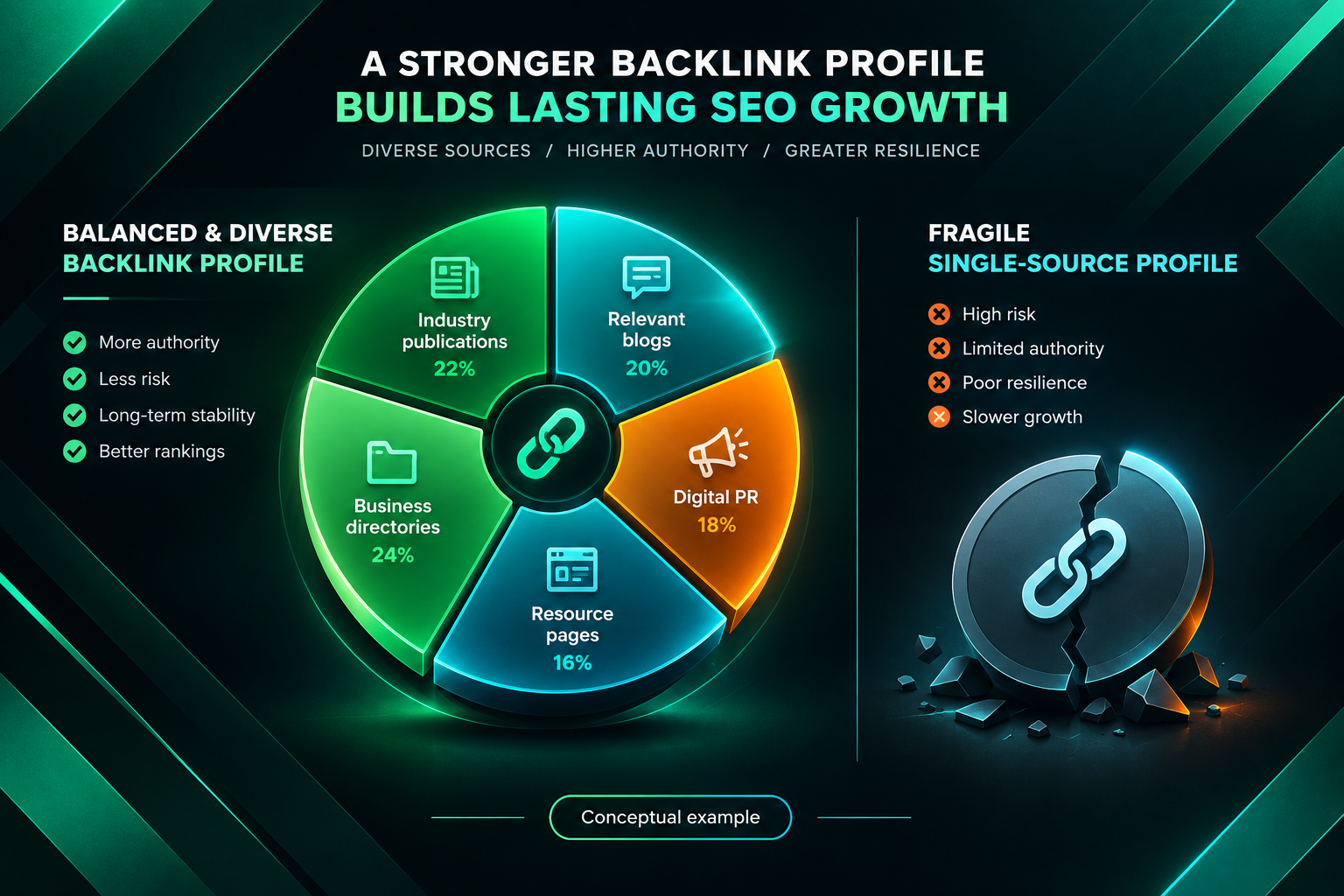
Diversifying the types of links in a backlink profile also reduces concentration risk. A profile that includes links from a range of source types, such as industry publications, relevant blogs, resource pages, digital PR placements, and business directories where appropriate, is generally less vulnerable than one that relies heavily on a single acquisition method or a narrow set of source domains.
Anchor text diversity is another relevant factor. A backlink profile where a disproportionate share of links use exact-match commercial anchor text can appear unnatural to automated detection systems. A more natural distribution includes branded anchors, partial-match phrases, generic terms, and naked URLs alongside occasional keyword-optimised anchors. There is no universally correct ratio, and prescribing specific percentages without a site-specific assessment would be misleading, but the general principle is that anchor text patterns should reflect how links are naturally given rather than how they have been engineered.
Ongoing monitoring of a backlink profile, rather than periodic audits only after a ranking drop, allows teams to identify and address potentially problematic links before they accumulate to a level that creates meaningful risk. Tools such as Google Search Console, Ahrefs, and Semrush can be configured to alert teams to significant changes in referring domain counts or the appearance of new links from unusual sources.
Link Spam Updates and Outsourced Link Building
For businesses that outsource their link building to an agency or specialist provider, understanding link spam updates is directly relevant to evaluating the quality and risk profile of the service being provided. Link building campaigns that prioritise placement volume over editorial quality, that rely on link networks or paid placements without appropriate link attributes, or that use aggressive anchor text optimisation across many placements carry a higher risk of being affected by a link spam update.
When evaluating an outsourced link building provider, it is reasonable to ask how the provider assesses the quality of potential linking sites, what methods are used to acquire placements, how link attributes are handled for any paid or sponsored placements, and what the provider’s approach is to anchor text distribution. A provider that is transparent about its acquisition methods and that prioritises editorial relevance over raw link counts is generally better positioned to deliver links that remain valuable through algorithm updates.
It is also worth understanding that even well-intentioned link building campaigns can occasionally produce links that are later devalued by an algorithm update, because Google’s assessment of link quality evolves over time and its systems make probabilistic judgements rather than definitive ones. No link building method can be described as entirely immune to future algorithm changes. The goal is to reduce exposure by focusing on quality, relevance, and editorial integrity rather than to eliminate all risk.
Frequently Asked Questions
How often does Google release link spam updates?
Google does not release link spam updates on a fixed schedule. Historically, Google has announced specific named link spam updates at irregular intervals, while also noting that its SpamBrain system operates continuously to detect and discount spam signals. Businesses should monitor Google’s official Search Central blog and Search Status Dashboard for confirmed update announcements rather than relying on third-party speculation about update timing.
Will a link spam update always cause a ranking drop?
Not necessarily. A site whose backlink profile consists primarily of editorial, relevant links acquired through legitimate methods may see little or no impact from a link spam update. In some cases, a site may see ranking improvements if competitors were relying on links that are now discounted. The impact depends on the composition of the site’s backlink profile and the competitive environment for its target keywords.
Is it possible to recover from a link spam update?
Recovery is possible but typically requires time and sustained effort. The process generally involves auditing the backlink profile, removing or disavowing links that are likely contributing to the problem, and continuing to build higher-quality links over time. If the ranking drop was caused by an algorithmic update rather than a manual action, recovery may happen gradually as Google’s systems re-evaluate the site’s link profile. There is no guaranteed timeline for recovery, and results depend on the extent of the original problem and the quality of the remediation steps taken.
Does Google penalise sites for receiving spam links they did not build?
Google has stated that its systems are generally designed to ignore low-quality links rather than penalise the receiving site for them, recognising that site owners cannot always control who links to them. However, in cases where a site appears to have actively participated in link schemes, or where the volume and pattern of manipulative links is significant, the risk of a manual action or algorithmic impact increases. The disavowal tool exists partly to allow site owners to distance themselves from links they did not request.
What is the difference between a link spam update and a manual action for unnatural links?
A link spam update is an algorithmic change applied automatically across many sites based on Google’s spam detection systems. A manual action for unnatural links is applied by a member of Google’s spam team after a human review of a specific site. Manual actions are reported in Google Search Console and require a formal reconsideration request after the issues are addressed. Algorithmic impacts do not appear as manual actions in Search Console and do not require a reconsideration request; they may resolve over time as the backlink profile improves.
Should I disavow all low-metric links after a link spam update?
Disavowing links solely based on low third-party metrics such as Domain Rating or Authority Score is generally not recommended. These metrics are proprietary estimates and do not directly reflect Google’s assessment of link quality. Indiscriminate disavowal risks removing links that may still provide some ranking benefit. A more careful approach involves assessing links against multiple quality signals and prioritising disavowal for links that show clear signs of being manipulative or that are associated with a confirmed manual action.
What to Do If a Link Spam Update Has Affected Your Site
A Google link spam update affecting your site’s rankings is a signal to review the quality of your backlink profile rather than a reason to abandon link building as a strategy. The appropriate response is methodical: confirm that the ranking change coincides with a documented update, conduct a structured backlink audit using available tools and Google Search Console data, address the highest-risk links through removal or disavowal where warranted, and focus future link acquisition on editorial quality and topical relevance.
For businesses that are uncertain about how to interpret their backlink data or how to prioritise remediation steps, working with an experienced SEO professional or a link building specialist who understands Google’s spam policies can help ensure that the response is proportionate and effective. Equally important is the longer-term shift toward a link acquisition approach that is less likely to create the same problem again. Links that are earned through genuine relevance, useful content, and transparent outreach are more likely to retain their value as Google’s spam detection systems continue to evolve.