Backlink APIs give SEO teams and developers programmatic access to link data that would otherwise require manual exports, spreadsheet juggling, and repeated tool logins. If you manage link building campaigns at scale, run a white-label SEO service, or need to integrate backlink intelligence into your own reporting stack, understanding how to use backlink APIs for custom analysis can save significant time and surface insights that standard tool dashboards do not expose by default.
Key Takeaways
- Backlink APIs allow you to pull referring domain, anchor text, link attribute, and authority metric data directly into custom workflows, dashboards, or scripts without manual exports.
- The most widely used providers include Ahrefs, Semrush, Moz, and Majestic, each with different data coverage, rate limits, pricing structures, and proprietary metrics.
- Custom analysis is most valuable when standard dashboards cannot answer your specific question, such as tracking link velocity across a campaign, comparing competitor backlink profiles at scale, or flagging low-quality placements automatically.
- API data reflects the provider’s own crawl index, not Google’s view of your backlink profile; treat third-party metrics as directional signals rather than definitive quality scores.
- Effective use requires some technical capability, a clear analytical goal, and an understanding of each provider’s data freshness, coverage gaps, and usage limits.
What Is a Backlink API and How Does It Work?
A backlink API is an application programming interface that exposes a link data provider’s index to external queries. Instead of logging into a tool’s interface and downloading a CSV, you send a structured HTTP request to an API endpoint, specify parameters such as a target domain, link type, or date range, and receive a machine-readable response, typically in JSON or XML format. Your application, script, or dashboard can then process, filter, store, or visualise that data according to your own logic.
Most major SEO platforms offer backlink API access as part of their paid plans or as a separate add-on. Ahrefs provides its API through higher-tier subscriptions and charges based on rows of data returned. Semrush offers API units that are consumed per request. Moz’s Link Explorer API is available through its paid plans. Majestic provides API access with its Pro and API plans, exposing its Fresh Index and Historic Index. Each provider crawls the web independently, so their indexes differ in size, freshness, and the domains they have discovered.
When you query a backlink API, you typically specify a target URL, subdomain, or root domain, and choose which data fields to return. Common fields include the source URL, target URL, anchor text, link attribute (such as dofollow or nofollow), first seen date, last seen date, and the provider’s proprietary authority or trust metrics. The response is paginated for large datasets, so your code needs to handle pagination logic to retrieve a complete dataset.
Common Use Cases for Custom Backlink Analysis
Standard tool dashboards answer common questions well, but they are designed for general use. Custom API analysis becomes worthwhile when your question is specific to your campaign structure, client reporting format, or competitive research methodology.
Campaign Link Tracking and Velocity Monitoring
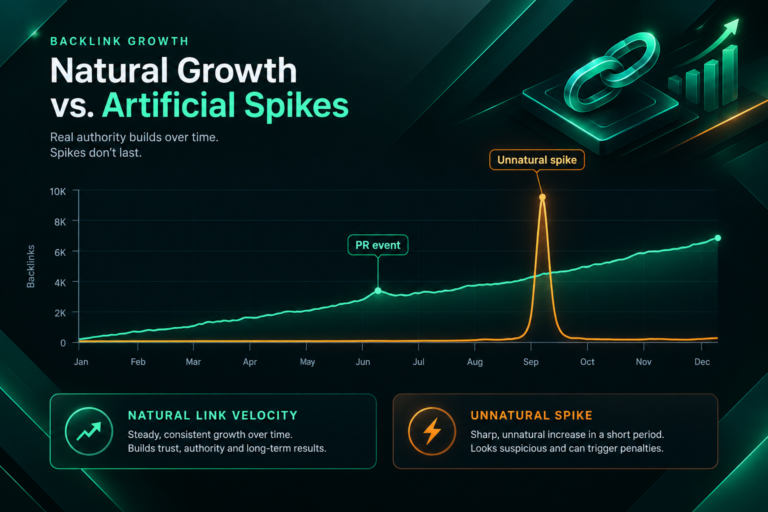
Link building campaigns produce placements over weeks or months. By querying a backlink API on a scheduled basis, such as weekly or fortnightly, and storing the results in a database, you can track when new referring domains appear, measure link velocity (the rate at which new links are acquired), and detect whether recently placed links have been removed or changed from dofollow to nofollow. This kind of longitudinal tracking is difficult to replicate reliably through manual tool checks, particularly when managing multiple clients or campaigns simultaneously.
Competitor Backlink Profile Comparison
Pulling backlink data for several competing domains through an API allows you to build a structured comparison that goes beyond what a tool’s built-in competitor analysis provides. You can identify referring domains that link to multiple competitors but not to your target site, a technique sometimes called link gap analysis. You can also segment competitor links by industry, link type, anchor text pattern, or estimated authority tier, and prioritise outreach targets based on that segmentation. Doing this for ten or twenty competitors simultaneously is practical with API access; it is time-consuming through manual exports.
Automated Quality Flagging
When reviewing a large backlink profile, manually assessing each referring domain for relevance, spam signals, and link attribute is impractical. An API-driven workflow can pull all referring domains, apply your own scoring logic based on fields such as domain rating, spam score, topical category, and anchor text distribution, and automatically flag domains that fall below a threshold for human review. This is particularly useful for agencies conducting backlink audits before starting a new campaign or assessing a site that may have accumulated low-quality links over time.
White-Label Reporting Dashboards
Agencies providing white-label link building services often need to deliver client reports in a branded format that does not expose the underlying tools. A backlink API integration allows you to pull placement data, format it according to your reporting template, and present it under your own brand. This approach also allows you to combine backlink data with other data sources, such as Google Search Console organic click data or rank tracking results, in a single unified dashboard.
Disavow File Preparation
Preparing a disavow file for Google Search Console requires identifying potentially harmful referring domains. An API-driven workflow can pull the full referring domain list, apply spam signal filters, and generate a formatted disavow file automatically. This reduces the manual effort involved in large-scale link audits and makes the process repeatable when the audit needs to be refreshed periodically.
Choosing the Right Backlink API Provider
No single backlink API provider has a complete or perfectly accurate view of the web’s link graph. Each provider’s index reflects its own crawl frequency, crawl depth, and domain prioritisation. Choosing the right provider for custom analysis depends on your specific use case, budget, and the markets or niches you are working in.
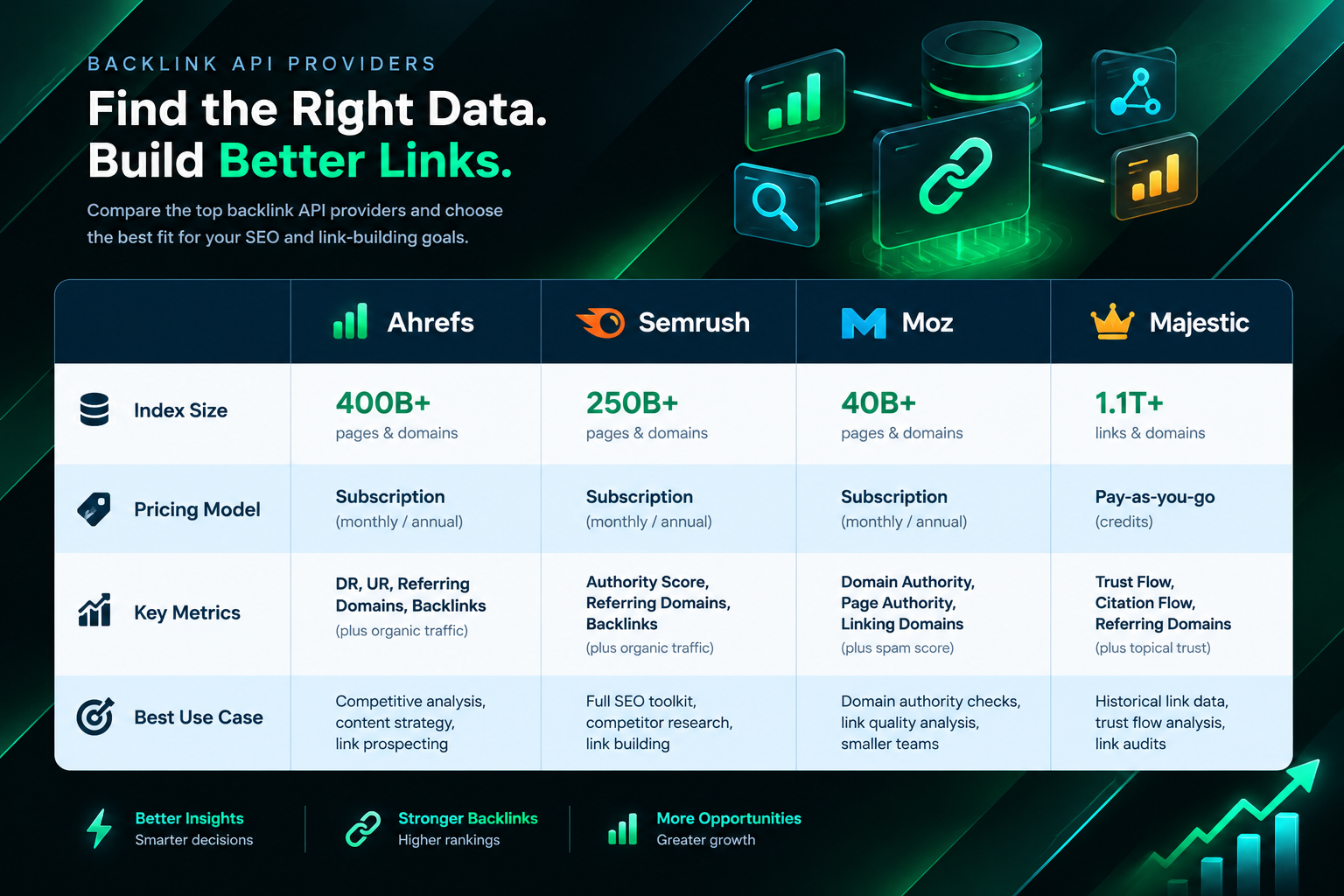
Ahrefs is widely regarded as having one of the largest and most frequently updated backlink indexes among commercial SEO tools. Its API exposes detailed link-level data including anchor text, link attributes, URL rating, and domain rating. API access is priced per row of data returned, which can make large-scale queries expensive if not managed carefully.
Semrush provides backlink data through its API using a unit-based consumption model. Its backlink database includes authority score, referring domain counts, and anchor text data. Semrush’s API is often used by agencies already using the platform for keyword and rank tracking, as it allows consolidation of multiple data types within one API integration.
Moz offers the Link Explorer API, which exposes domain authority, page authority, spam score, and linking root domains. Moz’s spam score metric can be useful as one signal in automated quality flagging workflows, though it should not be treated as a definitive indicator of a link’s value or risk.
Majestic provides access to its Trust Flow and Citation Flow metrics through its API, along with topical trust flow data that categorises referring domains by subject area. Topical trust flow can be a useful signal for assessing the thematic relevance of a referring domain, which is a meaningful factor in link quality assessment.
When evaluating providers, consider data freshness (how recently the index was crawled), index size relative to your target niches, rate limits and pagination behaviour, pricing per query or per row, and the specific fields available in the API response. Some use cases benefit from combining data from two providers to cross-reference coverage gaps.
Setting Up a Basic Backlink API Workflow
A practical custom analysis workflow does not require a complex engineering setup. The following steps describe a common approach for SEO teams with basic scripting capability.
Step 1: Define Your Analytical Goal
Before writing a single line of code or making an API call, define precisely what question you are trying to answer. Vague goals such as “analyse our backlinks” produce unfocused outputs. Specific goals such as “identify all referring domains acquired in the last 90 days that have a domain rating below 20 or contain anchor text that does not match our target keyword themes” produce actionable outputs. Your goal determines which API endpoints you need, which fields to request, and what filtering logic to apply.
Step 2: Obtain API Credentials and Review Documentation
Each provider requires API authentication, typically through an API key passed in the request header or as a query parameter. Review the provider’s official API documentation carefully before building your integration. Pay attention to rate limits (the maximum number of requests per minute or per day), pagination requirements, available endpoints, and the data fields returned by each endpoint. Exceeding rate limits can result in temporary blocks, and misunderstanding pagination can cause incomplete data retrieval.
Step 3: Write and Test Your Data Retrieval Script
Python is a common choice for backlink API scripts due to its readable syntax and the availability of libraries such as requests for HTTP calls and pandas for data manipulation. A basic script queries the API endpoint, handles pagination to retrieve all results, and writes the output to a CSV file or database table. Test with a small dataset first to verify that your pagination logic is correct and that the fields you expect are present in the response.
Step 4: Apply Filtering and Scoring Logic
Once you have raw data, apply your analytical logic. This might involve filtering out referring domains below a domain rating threshold, grouping links by anchor text category, identifying duplicate referring domains, or flagging links where the last seen date is more than 60 days in the past (a potential indicator of link loss). The specific logic depends on your goal from Step 1. Keeping this logic in a separate function or configuration file makes it easier to adjust without rewriting the entire script.
Step 5: Visualise or Report the Output
Raw filtered data is more useful when presented in a format that supports decision-making. Options include exporting to a formatted spreadsheet for client review, connecting the data to a business intelligence tool such as Google Looker Studio or Tableau, or building a simple web dashboard using a framework such as Streamlit. For white-label reporting, the output format should match your agency’s reporting template and avoid exposing the underlying API provider’s branding.
Understanding the Limitations of Backlink API Data
Backlink API data is a useful analytical input, but it has meaningful limitations that affect how you should interpret and act on the results.
Third-party backlink indexes do not represent Google’s view of your link profile. Google’s own crawl is separate, and the links it has discovered, indexed, and chosen to count as signals may differ substantially from what any commercial API returns. A referring domain that appears in an Ahrefs or Semrush API response may not have been crawled by Google recently, or Google may have chosen to ignore it for reasons that are not visible in third-party data.

Proprietary metrics such as domain rating, domain authority, authority score, trust flow, and spam score are each calculated differently by their respective providers. They are not interchangeable, they are not provided or endorsed by Google, and an improvement in one of these metrics does not directly translate to a ranking improvement. Use them as directional signals within your own analytical framework rather than as definitive quality scores.
Data freshness varies by provider and by the specific domain being queried. Newly acquired links may not appear in an API response for days or weeks after they go live, depending on the provider’s crawl frequency for that domain. Conversely, links that have been removed may continue to appear in the index for some time after removal. This lag affects velocity tracking and link loss detection workflows.
API costs can scale quickly with data volume. Pulling full backlink datasets for large domains or running frequent scheduled queries can consume significant API credits or row allowances. Designing your queries to retrieve only the fields and date ranges you actually need, and caching results where appropriate, helps manage costs.
Backlink API Analysis in the Context of Link Building Campaigns
Custom backlink API analysis is most valuable when it is connected to a clear link building strategy rather than used as a standalone data exercise. For agencies managing outsourced link building campaigns, API-driven analysis can support several practical campaign functions.
Before a campaign begins, an API-driven audit of the target site’s existing backlink profile can identify the current referring domain count, anchor text distribution, link attribute mix, and any clusters of low-quality or irrelevant referring domains. This baseline assessment informs decisions about which pages to target for new links, what anchor text themes to prioritise, and whether a disavow review is warranted before new link acquisition begins.
During a campaign, scheduled API queries can verify that placed links are live, confirm their link attributes match what was agreed with the publisher, and detect early link loss. This kind of automated monitoring reduces the manual checking burden on campaign managers and provides an auditable record of placement status over time.
After a campaign phase, comparing the pre-campaign and post-campaign backlink profiles through API data provides a structured record of what was acquired, from which referring domains, with what anchor text, and at what link attribute. This data supports client reporting and informs decisions about the next campaign phase. It is important to note that changes in rankings or organic traffic following a link building campaign may be influenced by many factors beyond the links themselves, including content quality, technical SEO condition, competitor activity, and search engine algorithm updates. API data documents the link acquisition; it does not establish a causal relationship between those links and any observed ranking changes.
Practical Considerations for Agencies and In-House Teams
For in-house SEO teams, the decision to build a custom backlink API integration depends on whether the analytical questions you need to answer cannot be adequately addressed through existing tool dashboards, and whether your team has the technical capability to build and maintain the integration. A well-designed API workflow can save significant time for teams managing large or complex backlink profiles, but it requires ongoing maintenance as API endpoints, authentication methods, and data schemas change over time.
For agencies, particularly those offering white-label link building or outsourced campaign management, backlink API integrations can differentiate your reporting quality and reduce the manual effort involved in campaign monitoring. However, the development and maintenance cost of a custom integration should be weighed against the volume of campaigns that will benefit from it. For smaller agencies, a combination of scheduled tool exports and lightweight scripting may provide most of the benefit at lower development cost.
If your team lacks the technical resources to build and maintain a custom API integration, several third-party reporting and SEO dashboard platforms offer pre-built backlink API connectors that can be configured without custom code. These platforms typically support connections to Ahrefs, Semrush, Moz, and Majestic, and allow you to build filtered views and scheduled reports through a visual interface rather than a script.
Frequently Asked Questions
Do I need coding experience to use a backlink API?
Basic scripting experience in Python or JavaScript is helpful for building custom integrations, but not strictly required for all use cases. Several reporting platforms and no-code tools offer pre-built connectors to major backlink API providers, allowing you to configure queries and dashboards without writing code. For more complex or bespoke analytical workflows, some programming capability is generally needed.
Which backlink API has the most accurate data?
No provider has a complete or perfectly accurate view of the web’s link graph. Ahrefs, Semrush, Moz, and Majestic each have different index sizes, crawl frequencies, and domain coverage strengths. For most use cases, choosing the provider whose index best covers your target niches and whose metrics align with your analytical framework is more important than seeking a single “most accurate” source. Cross-referencing two providers can help identify coverage gaps for critical domains.
How often should I query a backlink API for campaign monitoring?
Weekly or fortnightly queries are sufficient for most link building campaign monitoring purposes. More frequent queries increase API credit consumption without proportionally improving data freshness, since most providers update their indexes on a crawl cycle rather than in real time. For time-sensitive situations such as verifying a newly placed link, a single on-demand query is more appropriate than increasing your scheduled frequency.
Can backlink API data tell me why my rankings changed?
Backlink API data can document changes in your referring domain profile, anchor text distribution, and link attributes over a given period. It cannot establish why rankings changed, because rankings are influenced by many factors including content quality, technical SEO, user engagement signals, competitor activity, and algorithm updates. Treat backlink data as one input in a broader diagnostic process rather than a standalone explanation for ranking movements.
Are third-party authority metrics like Domain Rating or Domain Authority reliable quality signals?
These metrics are useful as directional signals within a comparative framework, but they have meaningful limitations. They are calculated differently by each provider, they are not provided or endorsed by Google, and they can be manipulated through artificial link acquisition. A high domain rating or domain authority score does not guarantee that a link from that domain will be beneficial, and a lower score does not automatically indicate a low-quality or harmful link. Topical relevance, editorial context, and link attribute are also important factors in assessing link quality.
What is the difference between a referring domain and a backlink in API data?
A backlink is an individual hyperlink from one URL to another. A referring domain is the unique root domain from which one or more backlinks originate. A single referring domain can contribute many individual backlinks if multiple pages on that domain link to your site. For most link building and authority analysis purposes, referring domain count is a more meaningful metric than raw backlink count, because multiple links from the same domain typically provide diminishing incremental value compared to links from new unique domains.
Deciding Whether Custom Backlink API Analysis Is Right for Your Workflow
Custom backlink API analysis is a practical capability for SEO teams and agencies that manage link building at scale, need to integrate link data into their own reporting systems, or require analytical flexibility that standard tool dashboards do not provide. The investment in building and maintaining an API integration is most justified when the volume of campaigns, clients, or domains you are working with makes manual processes genuinely inefficient, or when your specific analytical questions cannot be answered through existing tool interfaces.
For teams that are earlier in their link building journey, or whose analytical needs are well served by existing tool dashboards, the priority is usually to establish a sound link acquisition strategy and quality assessment process before investing in custom API infrastructure. A well-executed manual outreach campaign with clear quality criteria and consistent reporting will generally produce more meaningful results than a sophisticated API dashboard built on top of an underdeveloped link building strategy.
If you are considering how backlink API analysis might fit into a broader outsourced link building programme, or if you want to discuss how campaign data and reporting can be structured to support your specific goals, speaking with an experienced link building provider is a practical next step. The right approach depends on your existing backlink profile, campaign objectives, technical resources, and the competitive landscape of your target market.