Page Authority is a proprietary metric developed by Moz that estimates how likely a specific webpage is to rank in search engine results. It is widely used by SEO professionals and link builders as a quick reference point when evaluating the relative strength of individual pages, but it is frequently misunderstood, misapplied, or confused with actual Google ranking signals. This article explains what Page Authority measures, how it is calculated, where it is genuinely useful, and where its limitations matter most for link building and SEO decision-making.
Key Takeaways
- Page Authority (PA) is a Moz-developed score from 1 to 100 that estimates a page’s likelihood of ranking, based primarily on its link profile data.
- PA is a third-party predictive metric, not a Google ranking factor, and should not be treated as a direct measure of search performance.
- The score is most useful as a comparative tool when assessing publisher quality or benchmarking pages within the same niche or campaign.
- A high PA score does not guarantee referral traffic, rankings, or link equity transfer to your own pages.
- Effective link building decisions should combine PA with other quality signals such as topical relevance, organic traffic, content quality, and link placement context.
What Is Page Authority?
Page Authority, commonly abbreviated as PA, is a logarithmic score ranging from 1 to 100 assigned to individual URLs by Moz. The score is designed to predict how well a specific page is likely to perform in organic search results relative to other pages. A higher score indicates a stronger predicted ranking ability, while a lower score suggests limited link equity or authority at the page level. Because the scale is logarithmic, moving from a PA of 20 to 30 is considerably easier than moving from 70 to 80.
Moz calculates Page Authority using data from its own web index, drawing primarily on the quantity and quality of external links pointing to a given page, as well as internal linking signals. The underlying model uses machine learning to correlate these link-based inputs with actual search ranking data, producing a score that is intended to be predictive rather than descriptive. Moz updates the algorithm periodically, which means a page’s PA score can change even when its actual link profile has not changed significantly.
It is important to distinguish Page Authority from Domain Authority (DA), another Moz metric. Domain Authority evaluates the overall strength of an entire domain or subdomain, while Page Authority focuses exclusively on a single URL. A page on a high-DA domain can still have a low PA if it has few inbound links pointing directly to it. Conversely, a page on a lower-DA domain can accumulate a relatively high PA if it has attracted a strong concentration of relevant external links.
How Page Authority Is Calculated
Moz does not publish the precise formula behind Page Authority, but the company has confirmed that the metric is built primarily on link data drawn from the Moz Link Explorer index. The key inputs include the number of unique referring domains linking to a page, the authority of those linking pages, the anchor text distribution of inbound links, and internal link signals from the same domain. Moz applies a machine learning model to these variables and calibrates the output against real-world search ranking data.
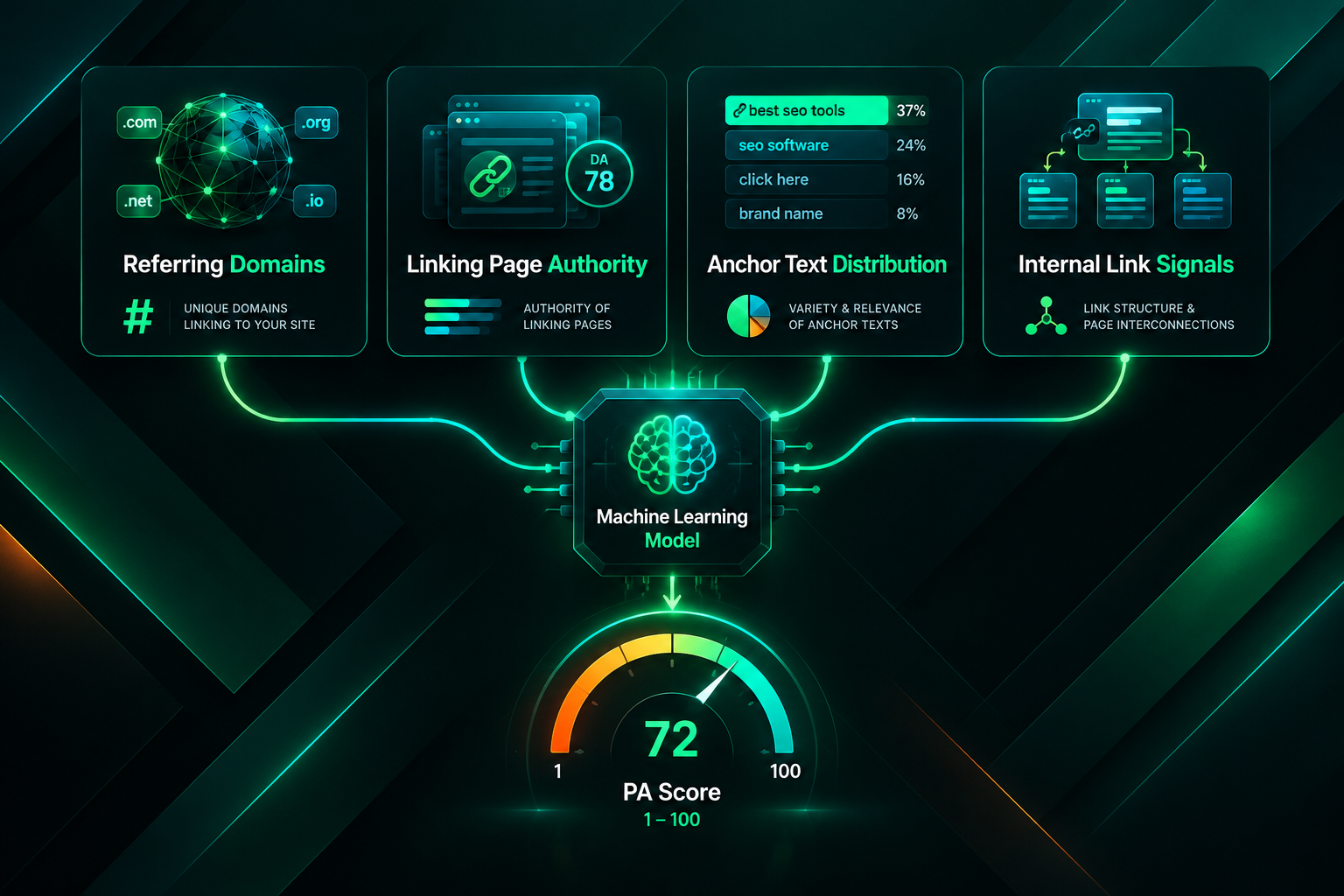
Because Page Authority relies on Moz’s own crawl index rather than Google’s index, the data it reflects may differ from what Google has actually discovered and evaluated. Pages that have been recently linked to, or pages on websites that Moz crawls infrequently, may show PA scores that lag behind their actual link profile. This indexing lag is a practical limitation worth understanding when using PA as a near-real-time quality signal.
The logarithmic scale also has a practical implication for link building campaigns. Improving the PA of a page with a score below 30 is generally more achievable than improving a page already sitting at 60 or above. This does not mean that high-PA pages are unimportant targets for link acquisition; it simply means that the score itself becomes harder to move as it increases, and that marginal gains at the top of the scale require substantially more link equity.
Page Authority vs Domain Authority: Key Differences
SEO professionals sometimes use Page Authority and Domain Authority interchangeably, but the two metrics measure different things and serve different purposes in a link building workflow. Understanding the distinction helps avoid misapplying either score.
| Characteristic | Page Authority (PA) | Domain Authority (DA) |
|---|---|---|
| Scope | Individual URL | Entire domain or subdomain |
| Primary input | Links pointing to that specific page | Links pointing to the whole domain |
| Scale | 1–100 (logarithmic) | 1–100 (logarithmic) |
| Best used for | Evaluating individual publisher pages or target pages | Assessing overall site-level link strength |
| Limitations | Does not reflect content quality, traffic, or relevance | Does not reflect page-level link concentration |
| Google relationship | Third-party metric; not a Google signal | Third-party metric; not a Google signal |
When evaluating a potential guest post placement or niche edit opportunity, checking both PA and DA together provides a more complete picture than either metric alone. A publisher page with a high DA but a very low PA may indicate that the specific page where your link would appear has attracted little direct link equity, even if the domain overall is well-regarded. The placement context matters as much as the domain-level score.
What Page Authority Does and Does Not Measure
Page Authority is a link-based predictive score. It measures the concentration and quality of inbound links to a specific URL as interpreted by Moz’s algorithm. What it does not measure includes organic traffic to that page, the quality or relevance of the page’s content, user engagement signals, topical authority within a subject area, or whether the page is actually indexed and ranking in Google search results.
This distinction matters significantly in link building. A page can carry a high PA score while receiving minimal organic traffic if, for example, it has accumulated links from other strong pages but targets keywords with very low search volume, or if the content no longer matches current search intent. Conversely, a page with a moderate PA score might generate substantial referral traffic if it is well-positioned in a niche with active readers. Neither scenario is captured by the PA score alone.
Page Authority also does not reflect whether the links pointing to a page are followed or nofollowed, whether they appear in editorially relevant contexts, or whether they were acquired through methods that comply with search engine guidelines. A page can accumulate a high PA through link patterns that Google may evaluate differently from how Moz’s algorithm weights them. This is one reason why PA should be treated as one signal among several rather than a definitive quality verdict.
How Page Authority Is Used in Link Building
In practical link building workflows, Page Authority is most commonly used as a quick filter when prospecting for publisher sites, evaluating outreach targets, or comparing the relative strength of pages where a link placement is being considered. It provides a fast, standardised reference point that does not require a full manual audit of every candidate page.
During guest post outreach, for example, a link building team might use PA alongside Domain Authority, organic traffic estimates from tools such as Ahrefs or Semrush, and topical relevance to create a shortlist of suitable publishers. A page with a PA of 35 or above on a topically relevant site with measurable organic traffic is generally a more meaningful placement than a page with a PA of 50 on a site that receives little real visitor traffic. The PA score helps narrow the field, but it does not replace a qualitative assessment of the publisher.
For niche edit campaigns, where a link is inserted into an existing published page rather than a newly created article, Page Authority becomes particularly relevant because the specific page receiving the edit already has an established link profile. A niche edit on a page with a strong PA and genuine organic traffic may offer more link equity transfer potential than a guest post on a new page with no existing inbound links, though outcomes depend on many additional factors including the site’s overall health, the relevance of the surrounding content, and how Google evaluates the placement.
Page Authority is also used when auditing a website’s own internal pages to identify which URLs are accumulating the most link equity and whether that equity is being distributed effectively through internal linking to priority target pages such as product pages, service pages, or key blog content.
Limitations of Page Authority in SEO Decision-Making
Page Authority has several well-documented limitations that are important to understand before relying on it heavily in campaign planning or publisher evaluation.
It is not a Google metric. Google does not use Page Authority, Domain Authority, or any other Moz score as a ranking factor. Google’s own systems evaluate links, content, and relevance through proprietary algorithms that are not publicly disclosed in full. PA is Moz’s best approximation of ranking potential based on available link data, but it is a third-party estimate, not a direct window into Google’s evaluation of a page.
It can be manipulated. Because PA is driven primarily by inbound link counts and the authority of linking pages, it is possible for a page to accumulate a high PA through low-quality or artificial link building. A publisher page with a high PA but a link profile built on link exchanges, private blog networks, or paid link schemes may carry less genuine value than the score suggests. This is why manual review of a publisher’s link profile, traffic, and content quality remains important even when PA looks strong.

It fluctuates with algorithm updates. Moz periodically recalibrates the Page Authority model, which can cause scores to shift across the board even when a page’s actual link profile has not changed. These recalibrations can make it difficult to track meaningful progress over time if PA is the primary benchmark being monitored.
It does not capture content quality or topical relevance. Two pages with identical PA scores can differ substantially in their actual SEO value depending on the quality of their content, the relevance of their topic to your target pages, and the editorial context in which a link appears. A link from a lower-PA page that is highly relevant to your niche and attracts engaged readers may deliver more practical benefit than a link from a higher-PA page on an unrelated topic.
It reflects historical data. Because PA is based on Moz’s crawl index, it may not reflect very recent link acquisitions or link losses. A page that has recently lost significant links may still show a high PA until Moz’s next crawl cycle updates the score.
Page Authority and Link Quality Assessment
Responsible link quality assessment combines Page Authority with a broader set of signals rather than treating PA as a standalone verdict. When evaluating a potential link placement, experienced link builders typically consider the following factors alongside PA:
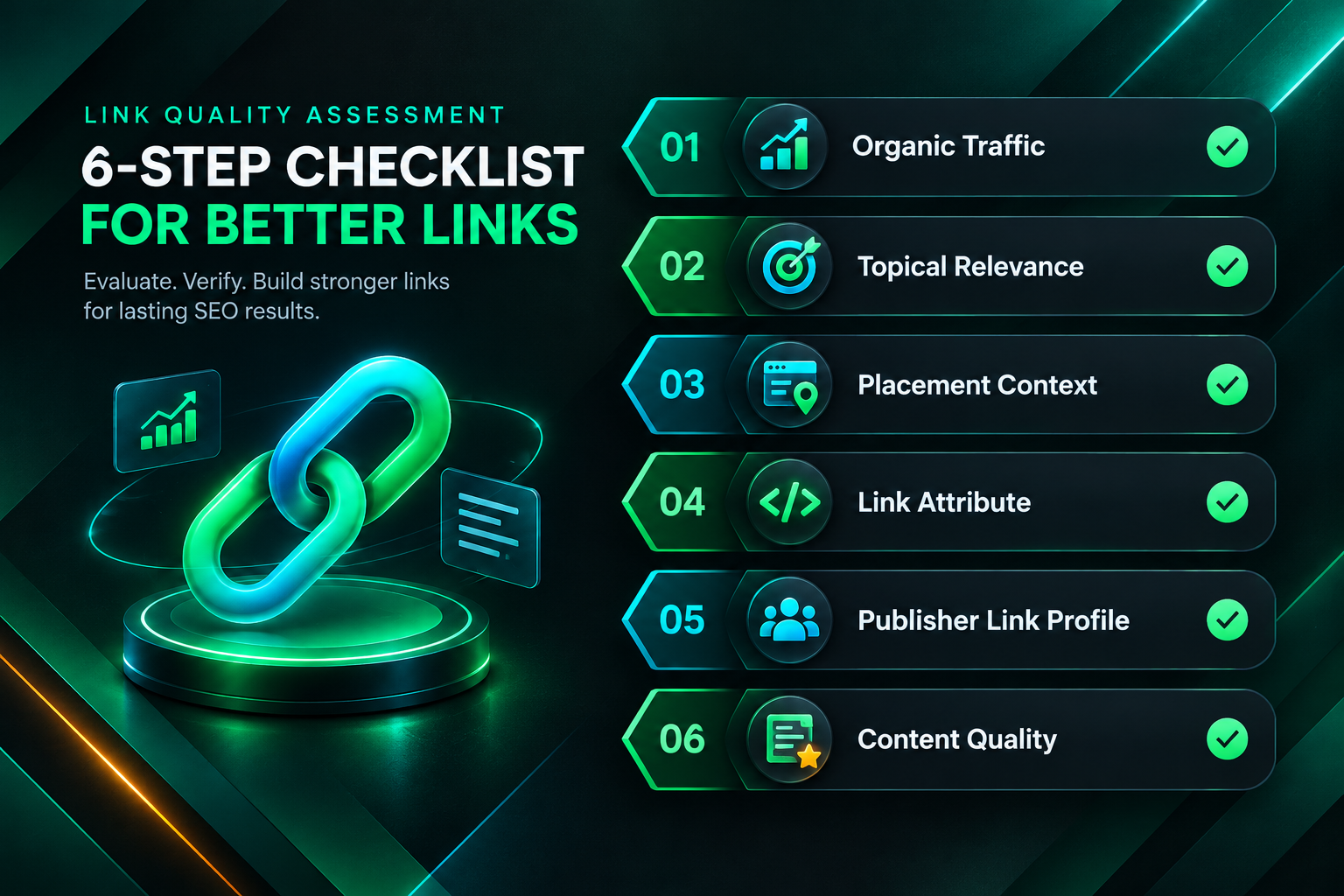
- Organic traffic: Does the publisher page or domain receive genuine visitor traffic from search engines? Tools such as Ahrefs, Semrush, and Moz itself provide traffic estimates that can help identify pages with real audiences versus pages that exist primarily to sell links.
- Topical relevance: Is the publisher page’s subject matter closely related to the target page being linked to? Topical relevance is widely considered an important factor in how search engines evaluate the context of a link.
- Link placement context: Is the link placed within the body of a relevant article, or is it buried in a footer, sidebar, or list of unrelated links? Editorial placement within relevant content is generally considered more valuable than peripheral placement.
- Link attribute: Is the link followed or nofollowed? Sponsored or UGC-attributed? While nofollowed links can still provide referral traffic and brand visibility, followed editorial links are generally the primary target in most link building campaigns.
- Publisher link profile: Does the publisher site have a natural, diverse backlink profile, or does it show signs of artificial link building that might indicate a link farm or PBN-adjacent property?
- Content quality: Is the content on the publisher page well-written, accurate, and genuinely useful to readers? Low-quality or thin content on a publisher page may reduce the perceived editorial value of a link regardless of the PA score.
Using PA as one input within this broader assessment framework produces more reliable quality judgements than relying on the score in isolation. No single metric, including PA, Domain Authority, Ahrefs DR, or Semrush Authority Score, provides a complete picture of link quality on its own.
Improving Page Authority: What Actually Moves the Score
Because Page Authority is driven primarily by inbound link data, the most direct way to improve a page’s PA score is to acquire more high-quality external links pointing to that specific URL. This is distinct from improving Domain Authority, which reflects the overall domain’s link profile rather than any individual page.
Targeted link building to specific pages, sometimes called deep linking, involves directing outreach and placement efforts toward priority URLs such as product pages, service pages, or high-value content assets rather than concentrating all external links on the homepage. When external links point directly to a target page, that page accumulates link equity more directly than if links arrive at the homepage and are then distributed through internal linking.
Internal linking also plays a role in how link equity flows to individual pages within a site. Pages that receive strong external links can pass a portion of that equity to other pages through well-structured internal links. Improving the internal linking structure of a site so that high-PA pages link to priority target pages is a complementary strategy that does not require additional external link acquisition.
It is worth noting that improving a page’s PA score is not the same as improving its actual search rankings or organic traffic. PA is a predictive metric, and a higher score does not guarantee better rankings. The goal of link building should be to improve genuine search visibility and business outcomes, with PA serving as one indicator of progress rather than the primary objective.
Page Authority in the Context of Outsourced Link Building
For businesses and agencies that outsource link building campaigns, Page Authority is a commonly referenced metric in reporting and publisher vetting. Many link building providers include minimum PA or DA thresholds in their service descriptions as a way of communicating baseline quality standards to clients. Understanding what these thresholds do and do not guarantee helps set realistic expectations before a campaign begins.
A minimum PA threshold, such as requiring all placements to appear on pages with a PA of 25 or above, provides a basic filter against very weak pages but does not ensure topical relevance, genuine traffic, editorial quality, or compliance with search engine link policies. Clients reviewing campaign proposals or reports should ask providers how they assess publisher quality beyond PA, including what traffic verification, content review, and link profile analysis they conduct before accepting a placement.
When reviewing link building reports, it is also useful to track changes in the PA of your own target pages over time as one indicator of whether the campaign is building link equity to the right URLs. However, PA changes should be interpreted alongside organic traffic data from Google Search Console or Google Analytics, ranking movement for target keywords, and referral traffic from placed links, rather than treated as the sole measure of campaign success.
Frequently Asked Questions
Is Page Authority the same as Google PageRank?
No. Page Authority is a proprietary metric created by Moz and is not related to Google PageRank. Google PageRank was Google’s original link-based ranking algorithm, and while Google still uses link signals internally, it no longer publicly updates or shares PageRank scores. Moz’s Page Authority is an independent estimate developed by Moz using its own data and methodology.
What is a good Page Authority score?
There is no universally good PA score because the metric is comparative rather than absolute. A PA of 30 may be strong in a low-competition niche and weak in a highly competitive one. When evaluating publisher pages for link placements, it is more useful to compare PA scores within the same niche or against direct competitors than to apply a fixed threshold across all campaigns.
Can I check Page Authority for free?
Moz provides limited free access to Page Authority data through its Link Explorer tool and the MozBar browser extension. Free accounts have monthly query limits. Full access to Moz’s link data and PA scores requires a paid Moz Pro subscription. Other SEO tools such as Ahrefs and Semrush offer their own equivalent page-level metrics, which are calculated differently and may produce different scores for the same URL.
Does a high Page Authority guarantee that a link from that page will improve my rankings?
No. A high PA on a publisher page does not guarantee that a link from that page will improve your rankings. Rankings depend on many factors beyond individual link placements, including the overall quality and relevance of your content, your site’s technical SEO condition, the competitiveness of your target keywords, and how Google evaluates the full context of the link. PA is a predictive estimate, not a ranking guarantee.
How often does Moz update Page Authority scores?
Moz updates Page Authority scores periodically as it recrawls the web and refreshes its link index. The frequency of updates for any specific page depends on how often Moz’s crawler visits that page and its linking pages. Moz also periodically recalibrates the underlying PA model, which can cause score changes across many pages simultaneously even without changes to their actual link profiles.
Should I use Page Authority or Domain Authority when evaluating link building opportunities?
Both metrics provide useful but different information. Domain Authority gives a broad sense of the overall site’s link strength, while Page Authority reflects the specific page where your link would appear. For link building evaluation, checking both alongside organic traffic estimates and topical relevance gives a more complete picture than relying on either metric alone.
Using Page Authority Practically Without Over-Relying on It
Page Authority is a useful, accessible metric for quickly comparing the relative link strength of individual pages, but it works best as one input in a broader quality assessment rather than a standalone decision criterion. For link building campaigns, the most reliable approach combines PA with organic traffic data, topical relevance, content quality review, and an assessment of the publisher’s overall link profile and editorial standards.
Businesses evaluating outsourced link building providers should look beyond minimum PA thresholds and ask how publishers are vetted for traffic, relevance, and content quality. A campaign that delivers placements on genuinely relevant, traffic-generating pages with strong editorial standards is likely to provide more durable SEO value than one that optimises purely for PA scores. If you are considering a link building campaign and want to understand how publisher quality is assessed in practice, discussing your target pages, niche, and goals with an experienced provider is a practical starting point for setting realistic expectations.