Ahrefs URL Rating, commonly abbreviated as UR, is a proprietary metric that estimates the strength of a specific page’s backlink profile on a scale from 0 to 100. If you’re evaluating potential link placements, auditing your own pages, or trying to understand why certain pages rank above others, UR is one of the data points you’ll encounter regularly. This article explains what URL Rating measures, how it’s calculated, where it’s useful, and where it falls short — so you can use it as a practical tool rather than a definitive verdict.
Key Takeaways
- URL Rating (UR) is a page-level metric from Ahrefs that reflects the estimated strength of a page’s backlink profile, not its content quality or ranking guarantee.
- UR uses a logarithmic scale from 0 to 100, meaning the difference between UR 70 and UR 80 represents a much larger gap than the difference between UR 10 and UR 20.
- UR is a useful signal for comparing link equity at the page level, but it should not be used in isolation when assessing link quality or predicting rankings.
- A high UR on a linking page does not automatically translate into ranking improvements for the target page — other factors including content relevance, topical authority, and technical SEO all play a role.
- UR is most useful as one input within a broader link quality assessment framework, alongside metrics like Domain Rating, referring domain diversity, and topical relevance.
What Is URL Rating?
URL Rating is Ahrefs’ page-level authority metric. It attempts to quantify how much link equity a specific URL has accumulated based on the quantity and quality of backlinks pointing to it. The metric operates on a logarithmic scale from 0 to 100, where higher scores indicate a stronger backlink profile at the page level. Because the scale is logarithmic, moving from UR 60 to UR 70 requires substantially more link equity than moving from UR 10 to UR 20.
UR is distinct from Domain Rating (DR), which is Ahrefs’ domain-level metric. DR reflects the overall backlink strength of an entire website, while UR focuses specifically on a single URL. A page on a high-DR domain can have a low UR if few external links point directly to that page. Conversely, a page on a relatively modest domain can achieve a high UR if it has attracted a significant number of quality backlinks over time — for example, a widely cited research article or a popular tool page.
Ahrefs calculates UR using a methodology inspired by the concept of PageRank, the link-graph algorithm originally developed by Google. The calculation considers the number of links pointing to a page, the UR scores of those linking pages, and how many outbound links each linking page contains. A link from a page with a high UR and few outbound links passes more equity than a link from a page with the same UR but dozens of outbound links. Internal links are also factored into the UR calculation, which means a page’s position within a site’s internal linking structure can influence its score.
How URL Rating Is Calculated
The UR calculation follows a recursive logic: each page’s score depends on the scores of the pages linking to it, which in turn depend on the pages linking to them, and so on across Ahrefs’ crawl index. This is why UR is sometimes described as a measure of link equity flow rather than simply a count of backlinks. A page with ten links from high-UR pages will typically score higher than a page with a hundred links from low-UR pages, all else being equal.
Several factors influence how much UR a given link passes to a target page. The linking page’s own UR is the primary driver. The number of outbound links on that page matters because link equity is divided among all the pages being linked to. The link attribute also plays a role: links marked with the nofollow, sponsored, or ugc rel attributes are treated differently by Ahrefs than standard followed links, and this affects how UR flows through the link graph. Ahrefs has noted that its UR calculation does account for nofollow links to some degree, though the precise weighting is not publicly disclosed.
Internal links contribute to UR as well. When a site’s high-authority pages link internally to a target page, that page can accumulate UR even if its external backlink profile is modest. This is one reason why internal linking strategy is relevant to page-level authority, and why UR scores can shift when a site restructures its navigation or adds new internal links to a page.
URL Rating vs Domain Rating: Understanding the Difference
Confusing UR and DR is a common mistake, and the distinction matters when you’re making link building decisions. Domain Rating reflects the cumulative backlink strength of an entire root domain. URL Rating reflects the backlink strength of a single page. Both use the same 0–100 logarithmic scale, but they measure different things and should inform different decisions.
When assessing a potential guest post placement, for example, DR tells you something about the overall authority of the publishing domain, while UR tells you about the specific page where your link will appear. A guest post published on a high-DR site but placed on a newly created, thinly linked page will have a low UR at the time of publication. Over time, if the page attracts links or receives internal links from strong pages on the same domain, its UR may increase. However, at the point of publication, the link equity passed to your target page will reflect the UR of the placement page, not the DR of the domain.

This distinction is practically important. Focusing exclusively on DR when evaluating link placements can lead to overestimating the immediate link equity value of a placement. A more complete assessment considers both the domain-level strength and the page-level strength of the placement URL, alongside other quality signals such as topical relevance, organic traffic, and editorial context.
What URL Rating Does and Does Not Measure
URL Rating is specifically a measure of backlink profile strength at the page level. It does not measure content quality, topical relevance, user engagement, or any on-page SEO factor. A page can have a high UR and rank poorly if its content does not match search intent, if it targets a highly competitive keyword without sufficient topical authority, or if it has technical issues preventing proper indexing. Conversely, a page with a modest UR can rank well if it serves a niche query with limited competition and strong content.
UR is also not a Google metric. Ahrefs calculates UR independently using its own crawl data and link graph. Google’s internal link-scoring systems are not publicly disclosed, and there is no documented equivalence between UR and any Google ranking signal. Treating UR as a proxy for Google’s assessment of a page introduces a meaningful margin of error. Ahrefs’ crawl index, while extensive, does not capture every link on the web, and the timing of crawls means UR scores can lag behind real-world changes to a page’s backlink profile.
UR scores can also be influenced by link schemes, private blog networks, or other manipulative link building practices. A page that has accumulated links through low-quality or artificial means may display a high UR in Ahrefs while offering little genuine SEO value — and potentially carrying risk if those links are identified and discounted or penalised by search engines. This is one reason why UR should be evaluated alongside qualitative signals rather than used as a standalone quality indicator.
How to Use URL Rating in Link Building Decisions
In practical link building, UR is most useful as a comparative and filtering tool rather than an absolute quality threshold. When evaluating a list of potential link placement opportunities, UR can help you prioritise pages that have already accumulated meaningful link equity over pages that have not. A link from a UR 45 page is likely to pass more equity than a link from a UR 15 page on the same domain, assuming other factors are comparable.

When assessing the quality of an existing backlink profile — either your own or a competitor’s — UR distribution gives you a sense of how many of your links come from pages with meaningful authority versus pages with little or no accumulated equity. A backlink profile dominated by links from UR 0–10 pages may indicate a high proportion of low-quality or newly created placements, though this is not a definitive conclusion without further investigation.
For outreach campaigns, UR can inform target selection. Pages with higher UR scores are generally more competitive to earn links from, but they may also deliver more link equity when a placement is secured. Balancing the effort required to earn a placement against the likely equity value is a practical consideration in any outreach strategy. A mix of placements across a range of UR scores is common in well-managed campaigns, reflecting the reality that not every high-UR page is accessible through outreach and not every lower-UR placement is without value.
It is worth noting that UR alone does not determine whether a link will contribute positively to rankings. Topical relevance between the linking page and the target page, the anchor text used, the editorial context of the placement, and the overall composition of the target page’s backlink profile all influence how a link may be interpreted by search engines. A link from a topically relevant UR 35 page may be more valuable in practice than a link from an unrelated UR 55 page, depending on the target page’s niche and competitive landscape.
URL Rating and Page-Level Link Equity in Campaigns
Understanding UR at the campaign level helps explain why some link building efforts produce measurable results while others do not. If a campaign consistently places links on newly created pages with no existing backlink profile, the UR of those pages at the time of placement will be low, and the link equity passed to the target page will be limited. Over time, if those placement pages attract their own links, their UR may increase and the value of the link may grow — but this is not guaranteed and the timeline is unpredictable.
Campaigns that target established pages with existing backlink profiles — such as niche edits or curated link insertions into existing content — may deliver links from pages with higher UR at the point of placement. This is one reason why niche edits are sometimes preferred for campaigns where immediate link equity is a priority. However, the editorial quality, topical relevance, and long-term stability of the placement remain important considerations regardless of the initial UR.
For pages targeting competitive keywords, accumulating links from a diverse set of referring domains with meaningful UR scores is generally more useful than accumulating a large number of links from low-UR pages. Referring domain diversity — the number of distinct domains linking to a page — is a separate but related consideration. A page with links from fifty distinct domains, each with moderate UR, will typically have a stronger backlink profile than a page with fifty links from the same domain, even if the individual UR scores are similar.
Limitations of URL Rating as a Quality Signal
URL Rating has several documented limitations that are worth understanding before relying on it heavily in campaign decisions. First, because Ahrefs’ crawl does not index every page on the web, UR scores are based on a subset of the actual link graph. Pages with links from sources that Ahrefs crawls infrequently or has not yet discovered will have UR scores that underrepresent their actual link equity.
Second, UR scores are dynamic. They change as new links are acquired, as existing links are lost, as linking pages gain or lose their own backlinks, and as Ahrefs updates its crawl data. A UR score observed today may be different in three months, which means point-in-time assessments have limited predictive value for long-term link equity.
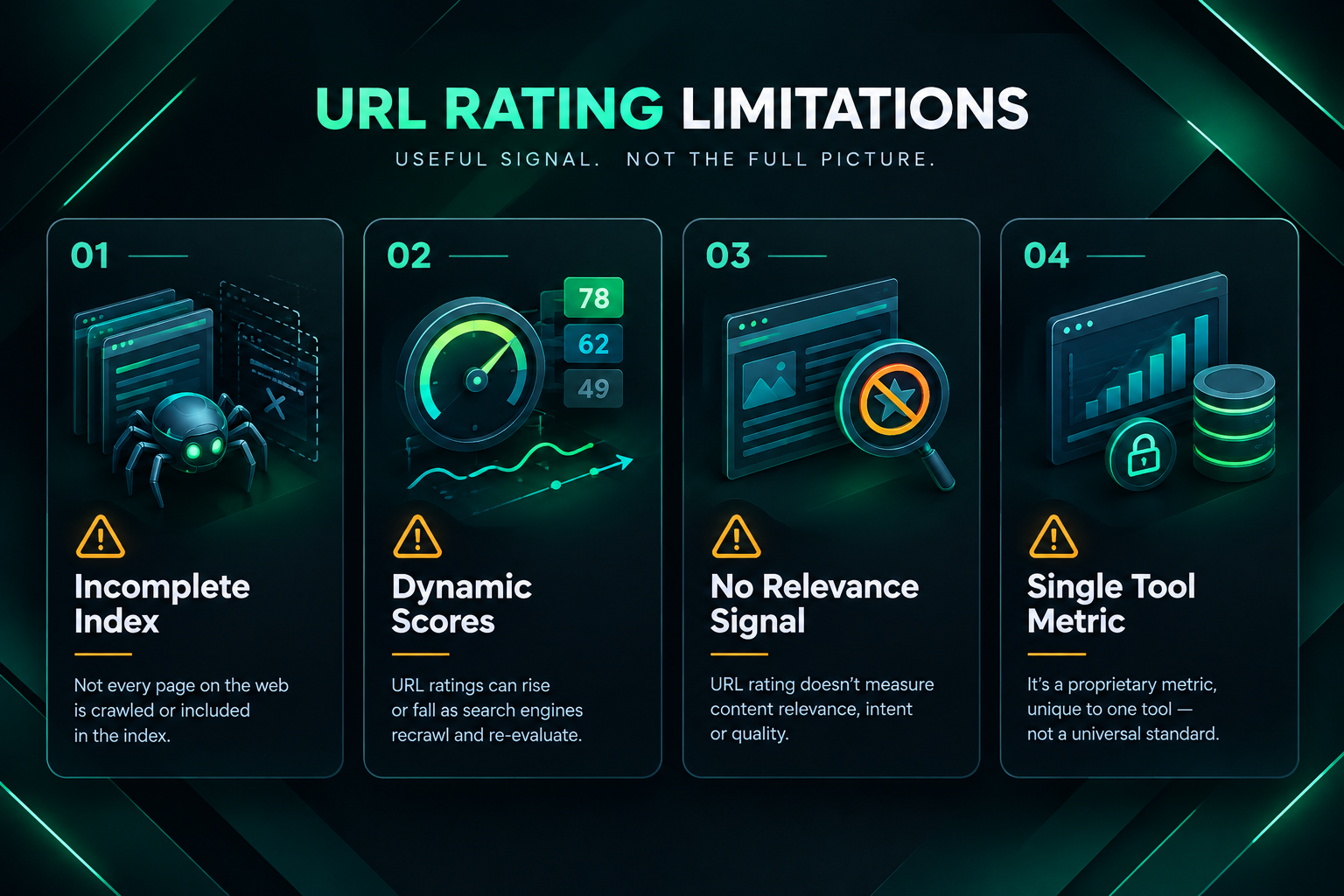
Third, UR does not account for link relevance, editorial quality, or the trustworthiness of the linking domain in any qualitative sense. Two pages with identical UR scores may differ substantially in their actual SEO value depending on the nature of the links they have accumulated. A page that has earned links through genuine editorial coverage from relevant industry sources is likely to be treated differently by search engines than a page that has accumulated links through paid placements or low-quality directories, even if their UR scores are similar.
Finally, UR is a proprietary metric from a single tool vendor. Semrush, Moz, and Majestic each have their own page-level and domain-level authority metrics — Authority Score, Page Authority, and Citation Flow respectively — and these metrics do not always agree. Treating any single proprietary metric as a definitive measure of link quality or ranking potential introduces tool-specific bias into your assessment.
URL Rating Alongside Other Link Quality Signals
The most reliable approach to link quality assessment combines UR with a range of other signals. Domain Rating provides context about the overall authority of the linking domain. Organic traffic data — available in Ahrefs’ Site Explorer — indicates whether the linking page attracts genuine search visitors, which is a useful proxy for editorial quality and indexing health. Topical relevance between the linking page and the target page is a qualitative signal that UR does not capture but that experienced link builders assess manually.
The number of outbound links on the placement page is relevant because it affects how much UR is distributed to each linked page. A placement on a page with two outbound links will pass more equity per link than a placement on a page with fifty outbound links, assuming the same UR. Checking whether the placement page itself is indexed and ranking for relevant queries adds another layer of quality assurance that UR alone cannot provide.
For agencies and in-house teams managing link building campaigns at scale, building a multi-signal assessment framework — rather than relying on a single metric threshold — tends to produce more consistent quality outcomes. UR is a useful and accessible starting point, but it works best as one input among several rather than as a standalone filter.
Frequently Asked Questions
Is a higher URL Rating always better for a link placement?
A higher UR on a linking page generally means more link equity is available to pass to the target page, but it is not the only factor that matters. Topical relevance, the number of outbound links on the page, the link attribute, and the editorial context of the placement all influence the practical value of a link. A high-UR page that is unrelated to your niche or that links to hundreds of other pages may deliver less useful equity than a lower-UR page that is closely relevant and has few outbound links.
What is a good URL Rating for a link placement?
There is no universally agreed threshold for a good UR, and the appropriate benchmark varies by niche, competition level, and campaign goals. In competitive industries, links from pages with UR scores in the 30–60 range are common targets for outreach campaigns. In less competitive niches, links from pages with lower UR scores may still contribute meaningfully. Rather than applying a fixed minimum, assess UR in the context of the domain’s overall authority, the page’s organic traffic, and its topical relevance to your target page.
Does URL Rating directly affect Google rankings?
URL Rating is an Ahrefs proprietary metric and is not a Google ranking signal. Ahrefs calculates UR independently using its own crawl data. While UR is designed to approximate the concept of page-level link equity — which is related to how Google’s algorithms assess links — there is no documented equivalence between UR and any specific Google ranking factor. Rankings depend on a wide range of signals beyond backlink strength, including content quality, search intent alignment, technical SEO, and user engagement.
Can a page have a high URL Rating but low Domain Rating?
Yes. A page on a domain with a modest DR can accumulate a relatively high UR if it has attracted a significant number of quality backlinks over time. This is common for pages that have gone viral, been widely cited in a specific community, or earned links through digital PR campaigns. The reverse is also possible: a page on a high-DR domain can have a low UR if few external links point directly to that page.
How often does Ahrefs update URL Rating scores?
Ahrefs updates its link index on an ongoing basis, and UR scores change as new links are discovered, existing links are lost, and linking pages gain or lose their own backlinks. The frequency of updates for any specific page depends on how often Ahrefs crawls that page and the pages linking to it. Scores for high-traffic, frequently linked pages tend to update more regularly than scores for lower-profile pages.
Should I use URL Rating as the primary filter when selecting link building targets?
Using UR as the sole filter for link building target selection is not recommended. UR is a useful starting point for comparing page-level backlink strength, but it does not capture topical relevance, editorial quality, organic traffic, or the trustworthiness of the linking domain. A multi-signal approach — combining UR with DR, organic traffic, relevance assessment, and manual quality review — tends to produce more reliable results than filtering on UR alone.
Using URL Rating Practically Without Over-Relying on It
URL Rating is a genuinely useful metric for anyone involved in link building, backlink auditing, or competitive analysis. It provides a page-level view of backlink strength that complements domain-level metrics like DR, and it can help prioritise outreach targets, assess the quality of existing placements, and identify pages within your own site that may benefit from additional internal or external links. Understanding how UR is calculated — and what it does not measure — makes it a more reliable tool in practice.
The most important limitation to keep in mind is that UR is a third-party approximation, not a direct measure of how search engines assess a page’s link equity. It is one signal among many, and decisions about link building strategy, target selection, and campaign investment should account for the full picture: domain authority, topical relevance, content quality, organic visibility, and the competitive landscape of the target keyword. If you are planning a link building campaign and want to understand how page-level metrics like UR fit into a broader quality assessment framework, discussing your specific goals and site context with an experienced link building team can help you build a more informed approach.