Customer case studies are one of the few content formats that simultaneously serve sales, credibility, and link acquisition goals. When structured and distributed correctly, a well-documented case study can attract editorial references from industry publications, earn citations from researchers and journalists, and generate organic mentions from peers who find the data genuinely useful. This article explains how that process works in practice, what realistic outcomes look like, and where the strategy has meaningful limitations.
Key Takeaways
- Case studies earn backlinks primarily through original data, documented outcomes, and named methodology — not through generic storytelling.
- Effective link acquisition from case studies requires active outreach, not passive publishing; most placements will not arrive without deliberate promotion.
- The quality of the customer relationship and the specificity of the results directly affect how linkable the asset becomes.
- Case study link building works best as part of a broader content-led strategy and is unlikely to replace other acquisition methods entirely.
- Timelines from publication to measurable SEO impact are typically longer than with direct outreach campaigns, and results vary considerably by industry and niche.
Why Case Studies Attract Backlinks
A customer case study earns backlinks for the same reason that original research and data studies do: it contains information that other writers, editors, and content teams cannot easily replicate. When a case study documents a specific problem, a measurable outcome, and a repeatable process, it becomes a citable reference. Industry bloggers writing about the same challenge may link to it as supporting evidence. Journalists covering a sector trend may cite it as a real-world example. Analysts and consultants may reference it when making recommendations to their own audiences.
The link-earning potential of a case study is not automatic. It depends on whether the documented outcome is specific enough to be useful, whether the methodology is transparent enough to be credible, and whether the publication reaches an audience that would genuinely benefit from the reference. A case study that describes vague improvements without measurable context is unlikely to attract editorial citations, regardless of how well it is written or promoted.
From a search engine perspective, backlinks earned through editorial citation — where a third-party publisher links to a case study because it adds genuine value to their content — are generally considered a stronger signal than links acquired through paid placements or reciprocal arrangements. This does not mean editorially earned links are automatically more valuable in every situation, but the acquisition mechanism aligns with the type of link that search engines have historically described as meaningful.
What Makes a Case Study Linkable
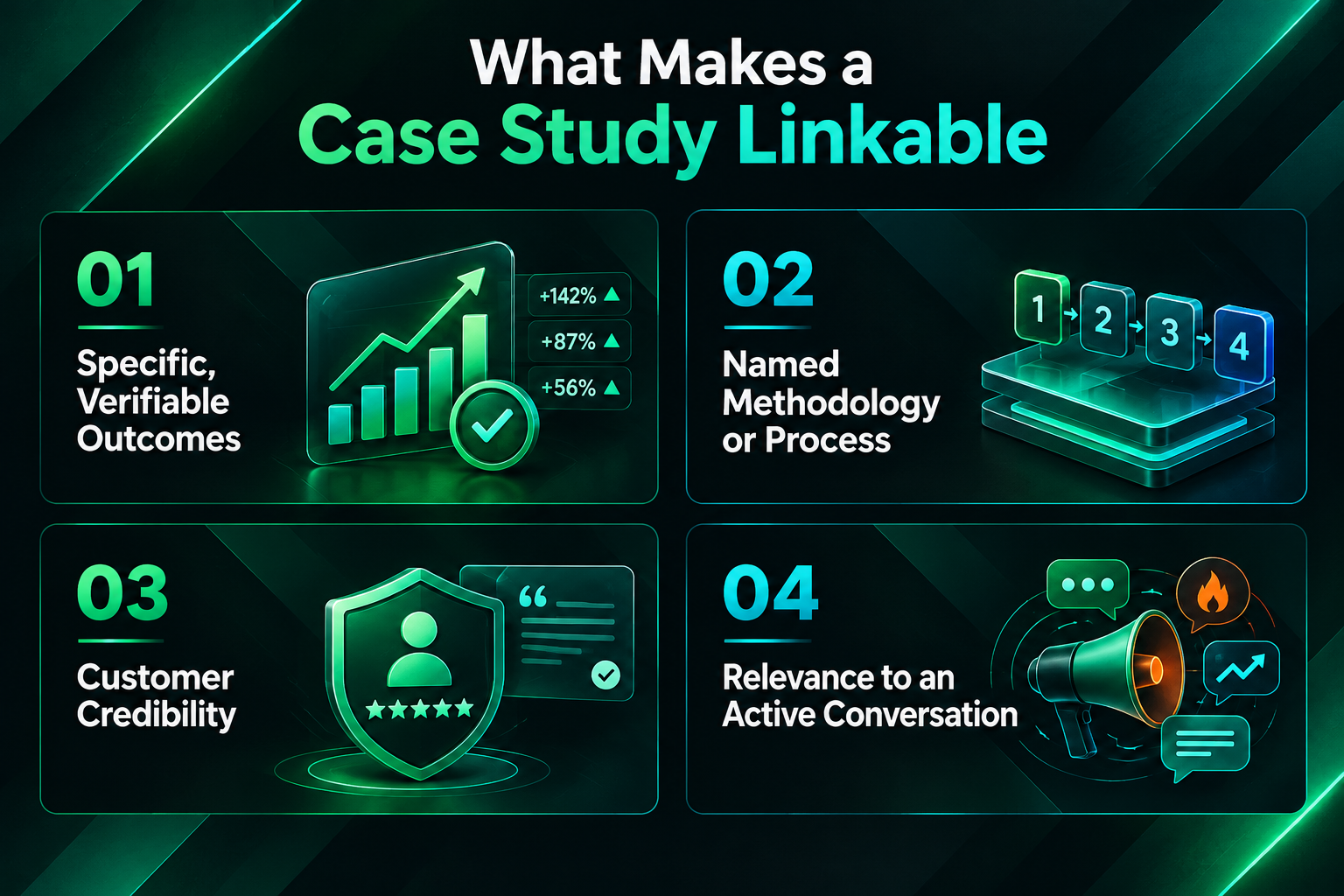
Not every case study will generate backlinks. The characteristics that make a case study linkable are distinct from the characteristics that make it useful for sales conversion, and conflating the two is a common reason the strategy underperforms.
Specific, Verifiable Outcomes
A case study that reports a specific, verifiable outcome — such as a documented reduction in customer acquisition cost, a measurable improvement in a defined operational metric, or a quantified change in a business process — gives other writers something concrete to cite. Vague language such as “significantly improved results” or “helped the client grow” provides nothing a journalist or blogger can responsibly reference. The more precisely the outcome is described, including the baseline, the time frame, and the measurement method, the more useful the case study becomes as a citable source.
Named Methodology or Process
Case studies that describe a named or clearly defined process give readers a framework they can reference and attribute. If your case study introduces a specific approach — even a straightforward one — and names it clearly, other content creators have a natural reason to link back to the original source when they discuss or adapt that approach. This is one reason that case studies from product companies, SaaS platforms, and professional service firms with documented methodologies tend to attract more citations than those from businesses with less defined processes.
Customer Credibility and Named Participants
A case study featuring a named customer, a recognizable brand, or a well-known individual carries more citation weight than an anonymized example. Publishers and journalists are more likely to reference a case study when they can verify the participant and the context. Where customers are willing to be named and to have their outcomes documented publicly, the linkable value of the asset increases substantially. Obtaining this permission is often the most significant practical constraint in case study production.
Relevance to an Active Conversation
A case study that addresses a problem currently being discussed in industry media, research communities, or professional forums is more likely to attract inbound links than one covering a topic that has already been thoroughly documented elsewhere. Timing a case study publication to coincide with a relevant industry trend, a regulatory change, or a widely discussed challenge can meaningfully improve its link acquisition potential.
How to Structure a Case Study for Link Acquisition
The structure of a case study affects both its readability and its citability. A format optimized for link acquisition differs slightly from one optimized purely for sales conversion.
Lead with the Problem, Not the Product
Case studies that open with a clearly described problem — one that other businesses in the same sector are likely to recognize — are more useful to third-party writers than those that open with a product description or a brand narrative. The problem statement is what makes the case study relevant to an audience beyond the immediate customer relationship. Writers covering that problem will find the case study through search or research and may link to it as a documented example.
Document the Baseline
Establishing a clear baseline before describing the intervention is essential for credibility. Without a documented starting point, any reported improvement is unverifiable and therefore less citable. The baseline does not need to include commercially sensitive figures; it can describe a qualitative state, a process inefficiency, or a relative position, as long as it gives the reader a meaningful reference point for the outcome that follows.
Describe the Process in Replicable Terms
The methodology section of a case study is often the most linkable part, because it is the section that other writers can reference when explaining how a particular approach works. Describing the process in enough detail that a reader could understand and attempt to replicate it — even if they would need professional assistance to do so — increases the likelihood that the case study will be cited as a how-to reference rather than simply as a testimonial.
Present Outcomes with Context
Reported outcomes should include the time frame over which they were measured, the conditions under which they occurred, and any relevant caveats. A case study that acknowledges the limits of its own findings is more credible and therefore more citable than one that presents results as universally applicable. This kind of intellectual honesty also reduces the risk that a linking publisher will later need to retract or qualify their reference.
Outreach Strategies for Case Study Link Building
Publishing a well-structured case study is a necessary first step, but it is rarely sufficient on its own to generate a meaningful volume of backlinks. Active outreach is required for most placements, particularly in the early months after publication.
Identifying Relevant Publishers and Journalists
The most productive outreach targets for case study link building are publishers who have already written about the problem your case study addresses. Using tools such as Ahrefs or Semrush to identify content that ranks for queries related to your case study topic allows you to find writers who are actively covering the subject and who may benefit from a documented real-world example. Journalists who cover your industry and who regularly cite research or case studies in their reporting are also strong targets.
Relevance is a more important selection criterion than domain authority metrics alone. A link from a mid-authority publication that is genuinely focused on your industry is likely to carry more topical relevance signal than a link from a high-authority general publication where the placement is contextually weak. Third-party metrics such as Domain Rating from Ahrefs or Domain Authority from Moz can help prioritize outreach targets, but they should be treated as one input among several rather than as the primary filter.
Personalizing Outreach Emails
Generic outreach emails that describe a case study without explaining why it is relevant to the recipient’s specific content are unlikely to generate responses. Effective outreach for case study link building typically references a specific article the publisher has written, explains how the case study adds to or supports that content, and makes it easy for the writer to understand the key finding without needing to read the full document. Brevity and specificity are more effective than comprehensive descriptions of the case study’s contents.
Targeting Resource Pages and Industry Roundups
Many industry publications maintain resource pages, curated reading lists, or periodic roundups of notable case studies and research. Identifying these pages and submitting a case study for inclusion is a lower-friction outreach approach than requesting an editorial link within existing content. Resource page links may carry less contextual relevance than in-content citations, but they can contribute to a diversified backlink profile and may generate referral traffic from readers actively seeking documented examples.
Leveraging the Customer Relationship
The customer featured in a case study often has their own website, blog, or industry presence. Requesting that the customer share or link to the case study from their own channels is a natural and low-effort link acquisition step that is frequently overlooked. If the customer is a recognized brand or has a strong domain, this link may carry meaningful authority. It also creates a natural co-promotion dynamic that can extend the case study’s reach to the customer’s audience.
Distributing Through Industry Communities
Sharing a case study in relevant professional communities — industry forums, LinkedIn groups, Slack communities, or sector-specific newsletters — can generate organic citations from members who find the documented approach useful. These citations may appear in blog posts, newsletters, or social content, and some will include backlinks. This distribution approach is slower and less predictable than direct outreach, but it can produce links from sources that would not respond to a cold email.
Integrating Case Studies into a Broader Link Building Campaign
Case study link building is most effective when it is integrated into a broader content-led link acquisition strategy rather than treated as a standalone tactic. A single case study, however well-structured, is unlikely to generate a sufficient volume of backlinks to meaningfully shift a competitive backlink profile on its own. The strategy works best when case studies are produced consistently, promoted actively, and supported by complementary acquisition methods.
Guest posting campaigns can amplify case study reach by allowing the case study to be referenced within contributed articles on relevant publications. Niche edits — the process of adding a link to an existing published article — can place a case study citation within content that already ranks for relevant queries, potentially increasing both referral traffic and topical relevance signals. Digital PR outreach can position a case study as a news-worthy data point for journalists covering sector trends, generating coverage that may include editorial backlinks from high-authority news and trade publications.
For businesses working with an outsourced link building provider, case studies can serve as linkable assets that the provider promotes through their existing publisher relationships and outreach infrastructure. This approach can accelerate placement timelines compared to building outreach relationships from scratch, though the quality of placements will still depend on the relevance of the publisher network and the strength of the case study itself.
Realistic Timelines and Expected Results
Case study link building operates on longer timelines than direct outreach campaigns. A case study published today may begin attracting organic citations within weeks if it addresses a timely topic and is actively promoted, but it may also take several months before it accumulates a meaningful number of referring domains. The SEO impact of those links — if measurable at all — typically becomes visible over a period of months rather than weeks, and is influenced by many factors beyond the backlinks themselves, including the technical condition of the website, the quality of the target page’s content, and the competitive landscape for the relevant queries.
The volume of backlinks a single case study can realistically generate varies considerably by industry, topic specificity, and promotion effort. In competitive B2B sectors with active trade media, a well-documented case study promoted through targeted outreach might generate a handful of high-quality editorial citations over its first six months. In less active niches, the same effort might produce fewer placements. Setting expectations based on the specific market and the available publisher landscape is more useful than applying generic benchmarks.
It is worth noting that not all backlinks generated through case study promotion will be editorially placed without any form of relationship-building or negotiation. Some publishers may request a contributed article in exchange for a citation, or may only link to the case study if it is referenced within a guest post. This blurs the line between purely earned links and links acquired through outreach-facilitated placements, and is a normal feature of content-led link building in practice.
Limitations and Risks
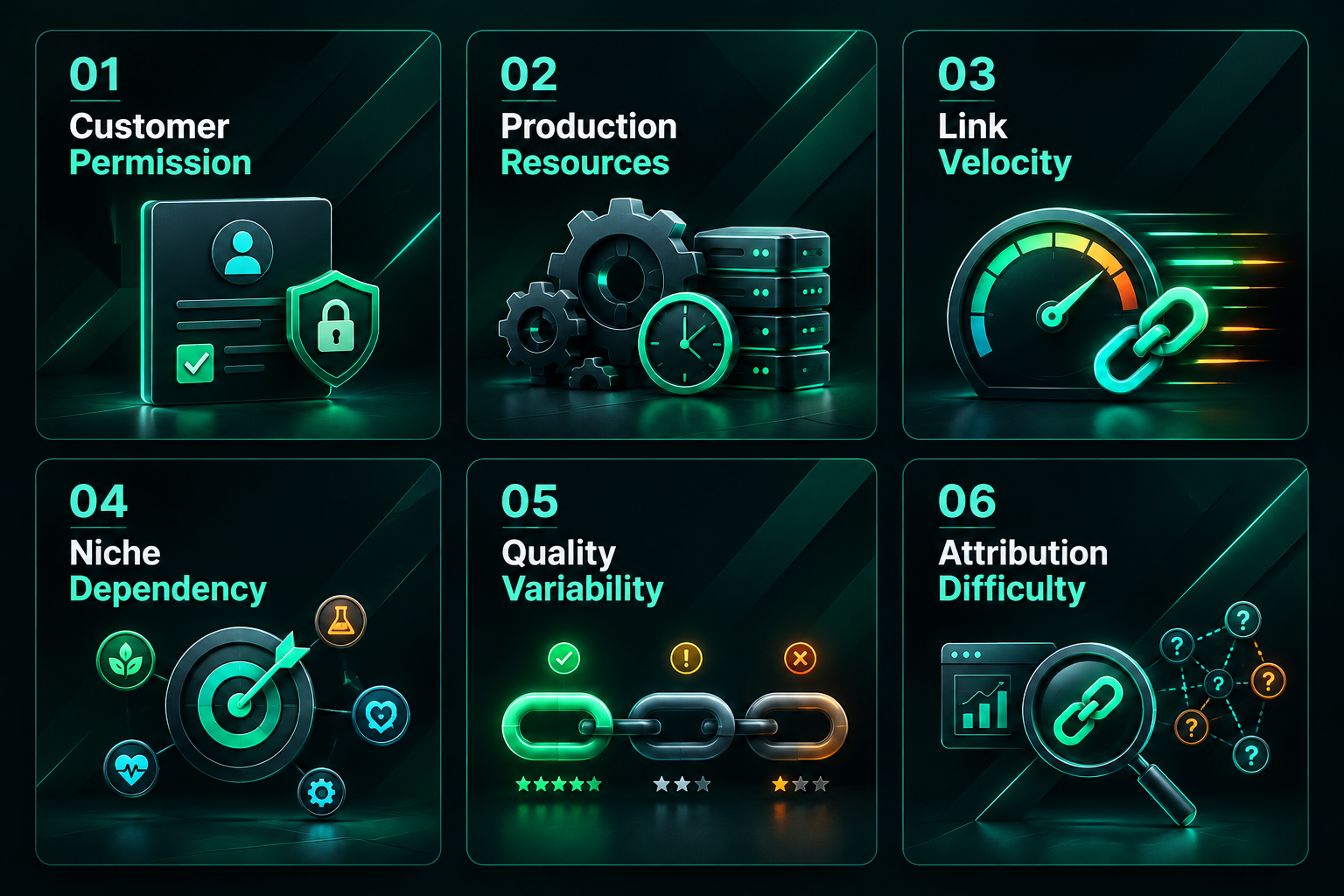
Case study link building has meaningful limitations that are worth understanding before committing significant resources to the strategy.
- Customer permission constraints: Many customers are unwilling to have their results documented publicly, particularly in competitive industries or where the outcomes involve commercially sensitive data. This limits the pool of case studies that can be produced and promoted.
- Production resource requirements: A linkable case study requires meaningful investment in research, writing, and design. Producing a sufficient volume of case studies to support an ongoing link acquisition program is resource-intensive, particularly for smaller teams.
- Unpredictable link velocity: Unlike direct outreach campaigns where placement timelines can be estimated, the rate at which a case study attracts organic citations is difficult to predict. This makes case study link building a poor fit for campaigns with short timelines or specific link velocity targets.
- Niche dependency: The strategy works significantly better in industries with active trade media, research communities, and content-producing peers. In highly specialized or low-content niches, the publisher landscape may be too thin to generate meaningful link volume from case study promotion alone.
- Link quality variability: Not all links generated through case study outreach will be from high-quality, topically relevant publishers. Some outreach will result in placements on low-authority sites or in contexts that add limited SEO value. Quality assessment of each placement is necessary.
- Attribution difficulty: Isolating the SEO impact of case study backlinks from other ranking factors is methodologically difficult. Observed ranking or traffic improvements following a case study campaign may reflect the combined effect of multiple SEO activities rather than the backlinks specifically.
Who May Benefit Most from This Approach
Case study link building is likely to be most productive for businesses that already have documented customer outcomes, operate in industries with active content ecosystems, and have the internal resources or agency support to produce and promote case studies consistently. B2B SaaS companies, professional service firms, marketing technology providers, and specialist consultancies tend to be well-positioned for this strategy because their customers are often willing to participate in documented case studies and because their industries have established trade media and research communities that actively cite real-world examples.
E-commerce businesses and consumer-facing brands may find the strategy less productive unless they can document outcomes that are genuinely interesting to industry publishers — such as supply chain innovations, customer experience improvements, or operational efficiencies — rather than simply reporting sales figures. Local businesses with limited industry media coverage may find that the publisher landscape is too thin to generate meaningful link volume from case study promotion alone, and may be better served by other link acquisition approaches.
Businesses with no existing customer relationships suitable for case study documentation, or those operating in industries where customer confidentiality is a significant constraint, may need to consider alternative linkable asset formats such as original research reports, data studies, or expert-led guides before investing in a case study link building program.
Frequently Asked Questions
How many backlinks can a single case study realistically generate?
This varies considerably by industry, topic relevance, and promotion effort. In active B2B sectors with strong trade media, a well-promoted case study might generate between three and fifteen editorial citations over its first year. In less active niches, the number may be lower. There is no reliable universal benchmark, and results depend heavily on the specificity of the documented outcome and the quality of the outreach campaign.
Do case study backlinks need to be disclosed as sponsored content?
Links that are editorially placed because a publisher finds the case study genuinely useful do not typically require a sponsored content disclosure. However, if a link placement involves any form of payment, reciprocal arrangement, or commercial relationship with the publisher, search engine guidelines generally require that the link be attributed with a rel=”sponsored” or rel=”nofollow” attribute. The specific requirements depend on the nature of the arrangement and the applicable guidelines at the time of publication.
How long does it take for case study backlinks to affect search rankings?
The time between a backlink being placed and any measurable change in search rankings varies and is influenced by many factors, including how quickly search engine crawlers discover and process the new link, the authority and relevance of the linking domain, the competitive landscape for the target queries, and the overall SEO condition of the target website. Measurable ranking changes, if they occur, are typically observed over a period of months rather than days or weeks.
Can case studies be used to build links to product or service pages directly?
Case studies are most naturally linked to from the case study page itself rather than from a product or service page. However, internal linking from a well-linked case study to relevant product or service pages can help distribute link equity across the site. Some outreach campaigns also request that publishers link directly to a product page when referencing a case study, though this is less common and may be less natural for editorial placements.
What is the difference between a case study and a testimonial for link building purposes?
A testimonial is a brief endorsement that typically lacks the documented methodology, baseline data, and outcome specificity needed to function as a citable reference. A case study, by contrast, provides enough documented context that a third-party writer can reference it as evidence for a specific claim. For link acquisition purposes, the depth and specificity of a case study make it substantially more linkable than a testimonial.
Should case studies be gated or publicly accessible for link building?
For link acquisition purposes, publicly accessible case studies are significantly more effective than gated content. A publisher cannot link to a case study that requires registration to access, and search engines cannot index the content of a gated page in a way that supports organic discovery. If a case study serves both sales and link acquisition goals, a publicly accessible version with a separate gated detailed report may be a practical compromise.
Deciding Whether Case Study Link Building Fits Your Strategy
Customer case studies can be a genuinely productive source of editorial backlinks when the documented outcomes are specific, the promotion is active, and the industry has a sufficient content ecosystem to support citation. The strategy aligns well with white-hat link acquisition principles because it creates value for publishers and readers rather than simply acquiring placements through commercial arrangements. However, it is not a fast or predictable link building method, and it works best as one component of a diversified acquisition strategy rather than as a primary or sole approach.
Before investing in a case study link building program, it is worth assessing whether your existing customer relationships can produce the kind of documented, named outcomes that publishers will find citable, whether your industry has the active trade media and content community needed to generate meaningful link volume, and whether your team has the production capacity to create and promote case studies consistently over time. If those conditions are in place, the strategy can contribute meaningfully to a long-term backlink profile built on editorially earned links.
If you are considering how case study link building might fit within a broader outsourced link acquisition campaign, a qualified provider can help assess whether your existing assets are suitable for promotion, identify the most relevant publisher targets in your industry, and integrate case study outreach with complementary methods such as guest posting or digital PR to improve overall link velocity and topical relevance.