

Moz Domain Authority is one of the most widely referenced metrics in SEO, yet it is also one of the most frequently misunderstood. Business owners, marketers, and SEO teams often treat a high DA score as a reliable signal of ranking power or link quality, when in reality it is a third-party predictive score with meaningful limitations. This article explains what Domain Authority actually measures, how Moz calculates it, where it can be genuinely useful in a link building context, and where relying on it too heavily can lead to poor decisions.
Key Takeaways
- Domain Authority is a proprietary score created by Moz, not a metric used or endorsed by Google in its ranking systems.
- DA is calculated on a logarithmic scale from 1 to 100 and is designed to predict a domain’s likelihood of ranking in search results, based on link-related signals.
- A high DA score does not guarantee that a backlink from that domain will improve your rankings or organic traffic.
- DA is most useful as a comparative benchmark when evaluating potential link prospects, not as a standalone quality indicator.
- Effective link building assessment combines DA with topical relevance, traffic data, editorial standards, and link placement context.
What Is Domain Authority?
Domain Authority, commonly abbreviated as DA, is a proprietary SEO metric developed and maintained by Moz. It assigns a numerical score between 1 and 100 to a domain, with higher scores intended to reflect a greater likelihood that the domain will rank well in search engine results pages. Moz introduced Domain Authority as a way to give SEO practitioners a single comparative number for evaluating the relative strength of a website’s backlink profile.
The score is calculated using a machine learning model that incorporates multiple link-related signals, including the total number of linking root domains, the quality and authority of those linking domains, and the overall link profile structure. Because the scale is logarithmic rather than linear, improving a DA score from 20 to 30 is considerably easier than improving it from 70 to 80. This means that small numerical differences at the higher end of the scale represent substantially larger differences in underlying link equity.
It is important to understand that Domain Authority is a Moz-specific metric. Google does not use DA in its ranking algorithm, has not endorsed it, and does not publish an equivalent public domain-level score. Google’s own systems evaluate links through internal signals that are not directly accessible to third-party tools. DA is Moz’s attempt to model and approximate ranking potential based on observable link data, and it should be interpreted with that context in mind.
How Moz Calculates Domain Authority
Moz calculates Domain Authority using data gathered by its web crawler, which indexes linking domains and backlinks across the web. The model then applies a machine learning algorithm that compares a domain’s link profile against the link profiles of other domains in Moz’s index, including the most authoritative sites on the internet. The resulting score reflects where a domain sits relative to this broader population.
Key inputs to the DA calculation include the number of unique referring domains pointing to a website, the authority of those referring domains, and the overall quality and diversity of the inbound link profile. Moz also factors in spam signals, though the precise weighting of individual inputs is not publicly disclosed. Because the model is calibrated against the full range of domains in Moz’s index, DA scores can shift even when a website’s own link profile has not changed, simply because other domains in the index have gained or lost links. This recalibration effect is a known characteristic of the metric and can cause apparent score fluctuations that do not reflect actual changes to a site’s backlink profile.
Moz updates its DA calculations periodically as it recrawls the web and refreshes its index. The frequency and completeness of Moz’s crawl affects the accuracy of the data underlying each score, and there will always be some lag between when a link is acquired and when it is reflected in a domain’s DA score.
Domain Authority vs. Page Authority and Other Metrics
Moz also publishes Page Authority, or PA, which applies the same predictive model at the individual page level rather than the domain level. Page Authority can be a more precise signal when evaluating the likely value of a specific backlink placement, since a high-DA domain may contain individual pages with very low PA if those pages have few or no inbound links of their own.
Domain Authority is frequently compared to similar metrics from other SEO platforms. Ahrefs publishes Domain Rating, known as DR, which measures the strength of a domain’s backlink profile on a 0–100 scale based on the number and quality of referring domains. Semrush offers an Authority Score that incorporates backlink data alongside organic search traffic and spam signals. Majestic provides Trust Flow and Citation Flow, which measure the quality and quantity of links respectively using its own link index. These metrics are all proprietary, calculated differently, and will often produce different scores for the same domain. None of them are Google ranking signals, and none should be treated as interchangeable.

When assessing link prospects or evaluating a backlink profile, using multiple metrics alongside each other tends to produce a more reliable picture than relying on any single score. A domain with a high DA but very low organic traffic, for example, may have accumulated links through methods that do not reflect genuine editorial endorsement, which limits the practical value of a placement there.
Where Domain Authority Is Genuinely Useful in Link Building
Despite its limitations, Domain Authority remains a practical tool in several link building contexts when used appropriately. Its primary value is as a comparative benchmark. When a link building team is evaluating a large list of potential publisher websites, DA provides a quick way to filter out domains that are clearly low-quality or newly registered, and to prioritise outreach toward sites with more established link profiles. This saves time during prospecting without requiring a full manual review of every candidate at the initial screening stage.
DA is also useful for tracking the relative authority of a website’s own backlink profile over time. If a campaign is consistently acquiring links from domains with higher DA scores than the site’s existing referring domain base, this may indicate that the profile is becoming more competitive, though this should be confirmed by looking at actual ranking and traffic data rather than the DA trend alone.
In white-label link building and agency reporting contexts, DA is a widely understood shorthand that clients and stakeholders recognise. Reporting placements alongside DA scores gives clients a familiar reference point for assessing the relative quality of acquired links, provided the reporting also includes other quality indicators such as organic traffic estimates, topical relevance, and editorial standards of the publisher.
For manual outreach campaigns, DA can serve as one filter within a multi-criteria publisher assessment framework. A reasonable minimum DA threshold, combined with checks on organic traffic, content quality, niche relevance, and site history, helps outreach teams focus effort on publishers where a placement is more likely to carry meaningful link equity and contextual relevance.
The Limitations of Domain Authority as a Link Quality Signal
Relying on DA as the primary or sole measure of link quality introduces several risks that can undermine a link building campaign’s effectiveness and, in some cases, its compliance with search engine guidelines.
The most significant limitation is that DA measures a domain’s link profile, not the quality or relevance of an individual link placement. A website with a DA of 60 may publish low-quality, thinly edited content with no genuine audience, while a niche industry publication with a DA of 30 may have a highly engaged readership and strong topical authority in a specific sector. A contextually relevant link from the lower-DA niche site may provide more practical SEO value than a generic placement on the higher-DA site, depending on the target website’s niche, existing backlink profile, and competitive landscape.

DA can also be manipulated. Some link sellers and low-quality link networks have historically inflated DA scores by building large volumes of low-quality links to a domain specifically to raise its apparent authority. This practice means that a high DA score is not, by itself, evidence that a site has earned its authority through genuine editorial recognition. Checking organic traffic data from tools such as Ahrefs or Semrush alongside DA helps identify domains where the score appears disproportionate to actual search visibility.
Another limitation is that DA is a domain-level metric and does not account for the specific page where a link will be placed, the anchor text used, the surrounding content, or whether the link carries a nofollow, sponsored, or UGC attribute. All of these factors influence how a search engine may interpret and weight a given link, and none of them are captured in a DA score.
Finally, because DA is recalibrated against Moz’s full index, scores can fluctuate without any change to a site’s actual link profile. Treating short-term DA movements as meaningful signals of SEO progress or decline can lead to misinterpretation of campaign performance.
Domain Authority and Google’s Link Evaluation
Google has confirmed through its public documentation and statements from its search relations team that it does not use Domain Authority or any equivalent third-party metric as a ranking signal. Google evaluates links through its own internal systems, which assess signals such as the relevance of the linking page’s content, the context in which the link appears, the link’s attributes, and patterns across a site’s broader link profile. These internal signals are not directly observable by third-party tools, which is why metrics like DA are approximations rather than direct measures of Google-assessed link value.
Google’s spam policies identify certain link acquisition practices as violations of its guidelines, including paid links that pass PageRank without appropriate disclosure, links from link schemes, and large-scale guest posting campaigns designed primarily to manipulate rankings. The presence of a high DA score on a publisher site does not make a link placement automatically compliant with these policies. A paid or editorially unearned link on a high-DA site is still a paid or editorially unearned link. Compliance depends on how the link was acquired and disclosed, not on the publisher’s DA score.
For businesses and agencies managing link building campaigns, this distinction matters. A campaign that prioritises DA above editorial quality and genuine relevance may accumulate links that look impressive in a report but carry limited practical value or, in more extreme cases, contribute to a link profile that attracts algorithmic or manual scrutiny.
How to Use Domain Authority Responsibly in a Link Building Campaign
A practical approach to Domain Authority treats it as one input within a broader publisher assessment process rather than a primary quality gate. The following framework reflects how experienced link building teams typically incorporate DA alongside other signals.
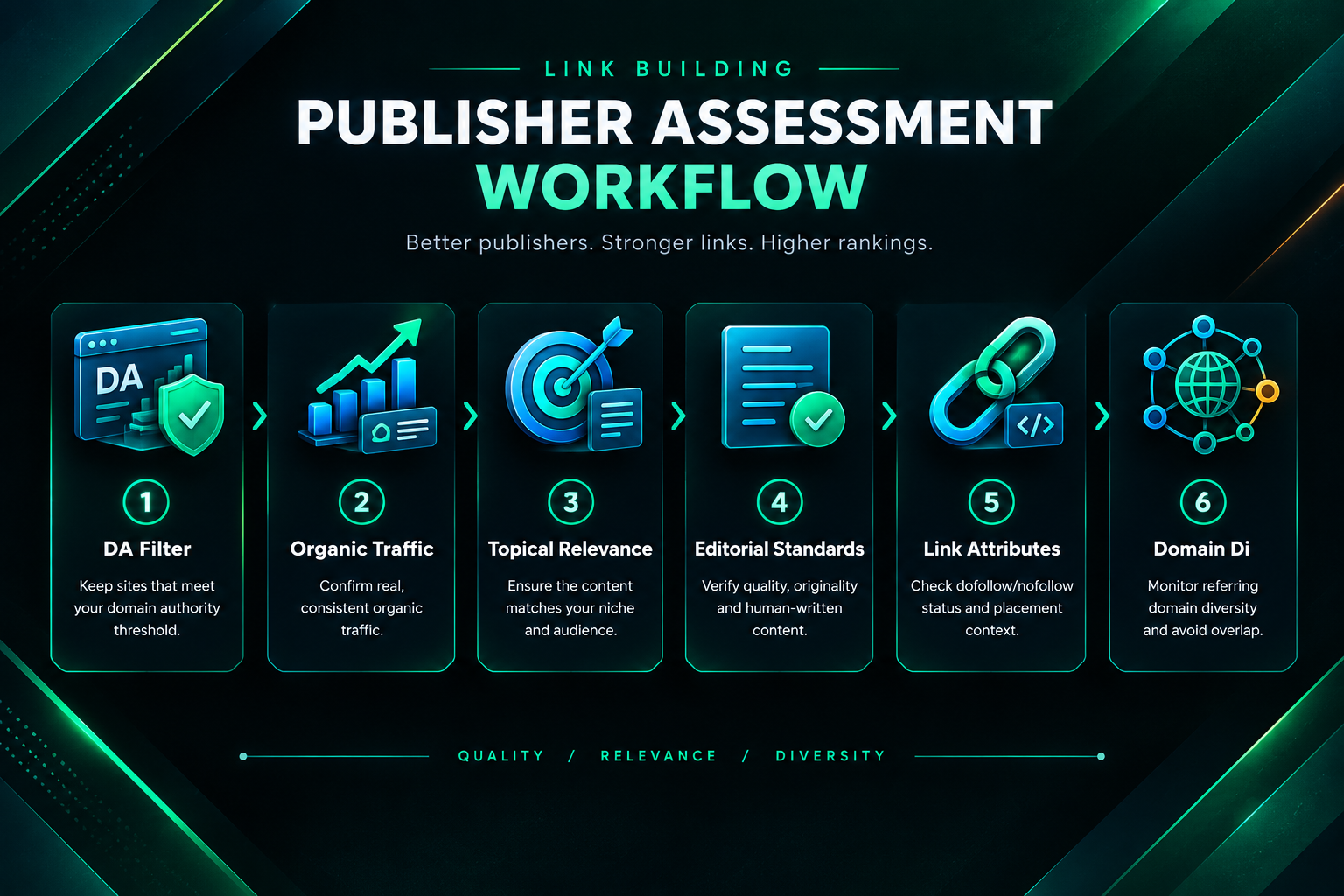
- Set a minimum DA threshold as an initial filter only. Use DA to exclude clearly low-quality or newly registered domains from a prospect list, but do not use it as the sole criterion for accepting or rejecting a publisher.
- Cross-reference DA with organic traffic estimates. A domain with a high DA but negligible organic traffic warrants closer scrutiny. Organic traffic data from Ahrefs, Semrush, or similar tools provides a secondary check on whether the domain’s authority appears genuine.
- Assess topical relevance independently. A link from a topically relevant publisher in the same or adjacent niche is generally more valuable than a link from a high-DA site with no thematic connection to the target website’s content.
- Review editorial standards manually. Check whether the publisher produces original, well-edited content with a real audience. Look at comment activity, social signals, and whether the site accepts clearly paid or low-quality guest posts at scale.
- Check link attributes and placement context. Confirm whether links from the publisher are followed or nofollowed, where on the page they typically appear, and whether the surrounding content is relevant to the target page being linked.
- Monitor referring domain diversity over time. A healthy backlink profile typically includes links from a range of domains across different DA bands, not exclusively high-DA sites. Diversity in referring domains, anchor text, and link types tends to reflect a more natural acquisition pattern.
Domain Authority in the Context of Different Link Building Strategies
The relevance of DA as an evaluation metric varies depending on the link building approach being used. For manual outreach and guest posting campaigns, DA is a commonly used prospecting filter, but the editorial quality of the publisher and the relevance of the content placement carry at least as much weight in determining the likely value of the link.
For niche edit campaigns, where a link is inserted into existing published content on a third-party site, DA helps assess the relative authority of the host domain, but the age, traffic, and topical relevance of the specific page being edited are equally important considerations. An older, well-indexed page on a moderately authoritative domain may provide more practical link equity than a newer page on a higher-DA site with limited inbound links of its own.
For digital PR campaigns, DA is less central to the evaluation process. Digital PR focuses on earning editorial coverage and links from news publications, industry media, and high-authority reference sites. These placements are typically assessed by the publication’s editorial reputation, audience size, and the genuine newsworthiness of the content rather than by a DA threshold.
In SaaS and e-commerce link building, where the goal is often to build authority for specific product, category, or comparison pages, the relevance of the linking page’s content to the target page’s topic is particularly important. A link from a relevant software review or product comparison article on a mid-DA site may drive more qualified referral traffic and stronger topical signals than a generic link from a high-DA directory or resource page.
Frequently Asked Questions
Is a higher Domain Authority always better?
Not necessarily. A higher DA indicates a stronger overall link profile relative to other domains in Moz’s index, but it does not guarantee that a link from that domain will improve your rankings. Topical relevance, editorial quality, organic traffic, and link placement context all influence the practical value of a backlink. A moderately authoritative site that is highly relevant to your niche may provide more useful link equity than a high-DA site with no thematic connection to your content.
Does Google use Domain Authority as a ranking factor?
No. Google has confirmed that it does not use Moz’s Domain Authority or any equivalent third-party metric in its ranking systems. DA is a Moz proprietary score designed to approximate ranking potential based on observable link data. Google evaluates links through its own internal signals, which are not directly accessible to external tools.
Why did my Domain Authority score drop without me losing links?
DA scores are recalibrated periodically against Moz’s full index of domains. If other domains in the index have gained significant authority, your relative score may decrease even if your own backlink profile has not changed. This recalibration effect is a known characteristic of the metric and does not necessarily indicate a problem with your site’s link profile or search performance.
What is a good Domain Authority score for link building purposes?
There is no universally agreed threshold, and the appropriate benchmark depends on your website’s existing DA, your niche, and your competitive landscape. Many link building teams use a minimum DA of 20–30 as an initial filter to exclude very low-quality domains, but the more meaningful question is whether the publisher has genuine organic traffic, editorial standards, and topical relevance to your target pages. A site-specific assessment is more reliable than a fixed DA cutoff.
How is Domain Authority different from Domain Rating?
Domain Authority is Moz’s proprietary metric, while Domain Rating is Ahrefs’ equivalent score. Both measure the strength of a domain’s backlink profile on a 0–100 scale, but they use different link indexes, different calculation methodologies, and different machine learning models. The same domain will often receive different scores from each tool. Neither metric is a Google ranking signal, and they should not be treated as interchangeable.
Can Domain Authority be manipulated?
Yes, to a degree. Some link sellers have historically built large volumes of low-quality links to a domain specifically to inflate its DA score, making it appear more authoritative than it genuinely is. This is one reason why cross-referencing DA with organic traffic data and manual editorial review is important when assessing link prospects. A high DA score that is not supported by meaningful organic search visibility warrants closer scrutiny.
Should I ask my link building provider to guarantee a minimum DA for placements?
Setting a minimum DA threshold as part of your campaign brief is reasonable, but it should not be the only quality criterion. A provider that focuses exclusively on DA without also assessing organic traffic, topical relevance, editorial standards, and link placement context may deliver placements that look strong on paper but provide limited practical SEO value. A balanced quality framework produces more reliable outcomes than a DA floor alone.
Using Domain Authority as a Tool, Not a Target
Domain Authority is a useful comparative benchmark when it is treated as one signal within a broader link quality assessment process. It provides a quick reference point for filtering link prospects, communicating relative publisher quality to clients, and tracking the general trajectory of a backlink profile over time. These are legitimate and practical applications of the metric.
Where DA becomes problematic is when it is treated as a proxy for Google-assessed link value, a guarantee of ranking improvement, or the primary criterion for accepting or rejecting a link placement. A link building strategy built around chasing DA numbers rather than acquiring genuinely relevant, editorially earned placements is unlikely to produce sustainable SEO results and may, in some cases, accumulate links that do not reflect the kind of editorial endorsement that search engines are designed to reward.
For businesses and agencies evaluating link building campaigns or providers, the most useful question is not “what is the average DA of the links?” but rather “are these links coming from relevant, credible publishers with real audiences, and are they placed in content that is genuinely connected to our target pages?” DA can help answer part of that question, but it cannot answer all of it. A qualified link building team will use DA alongside organic traffic data, topical relevance assessment, editorial review, and an understanding of the target website’s specific competitive context to make placement decisions that are more likely to contribute to meaningful SEO outcomes over time.
If you are reviewing a link building campaign or considering outsourcing link acquisition, discussing how your provider assesses publisher quality beyond DA is a practical starting point for understanding whether their approach is likely to deliver durable value for your website.


