A rising Domain Rating alongside falling organic traffic is one of the more confusing situations an SEO team can encounter. On the surface, the numbers seem contradictory: your backlink profile looks stronger, yet fewer people are arriving from search. Understanding why this happens requires separating what Domain Rating actually measures from what drives organic search visibility, and then working through the specific factors that can cause traffic to decline even when a site’s link profile appears to be improving.
Key Takeaways
- Domain Rating (DR) is a proprietary Ahrefs metric that reflects the relative strength of a site’s backlink profile. It does not directly measure Google rankings, organic traffic, or search visibility.
- Traffic can fall for many reasons unrelated to backlinks, including content quality issues, algorithm updates, technical problems, search-intent mismatches, and increased competition.
- A rising DR does not guarantee improved rankings. Low-quality or irrelevant links can inflate DR without delivering any ranking benefit.
- Diagnosing a traffic decline requires checking Google Search Console, crawl data, content performance, and the quality of newly acquired links before drawing conclusions.
- Link building may support recovery in some cases, but it is rarely the only factor and should not be prioritised before addressing technical or content-related causes.
What Domain Rating Actually Measures
Domain Rating is a proprietary metric created by Ahrefs. It scores a website on a logarithmic scale from 0 to 100 based on the quantity and quality of unique referring domains pointing to that site, weighted by those domains’ own DR scores. A site with many high-DR referring domains will typically score higher than one with fewer or lower-quality links. Crucially, DR is a relative measure within Ahrefs’ own index and is not a metric provided, endorsed, or used by Google in any documented way.
Because DR is calculated from Ahrefs’ crawl data rather than from Google’s index, it reflects what Ahrefs can observe about a backlink profile at a given point in time. The metric can rise when a site acquires new referring domains, when existing linking domains themselves gain authority, or when competitors lose links and the relative scoring shifts. None of these events directly cause Google to rank a page higher or send more organic traffic. DR is a useful proxy for understanding a backlink profile’s relative strength, but it should not be treated as a ranking signal or a traffic predictor.
Other tools use similar but distinct metrics: Moz publishes Domain Authority (DA), Semrush uses Authority Score, and Majestic reports Trust Flow and Citation Flow. These metrics are calculated differently and should not be treated as interchangeable. None of them are Google-provided signals, and an increase in any of them does not confirm that Google has assessed the site more favourably.
Why Traffic Can Fall While DR Rises
The disconnect between a rising Domain Rating and declining organic traffic usually has one or more identifiable causes. Working through each systematically is more productive than assuming the link profile is responsible for the traffic drop.
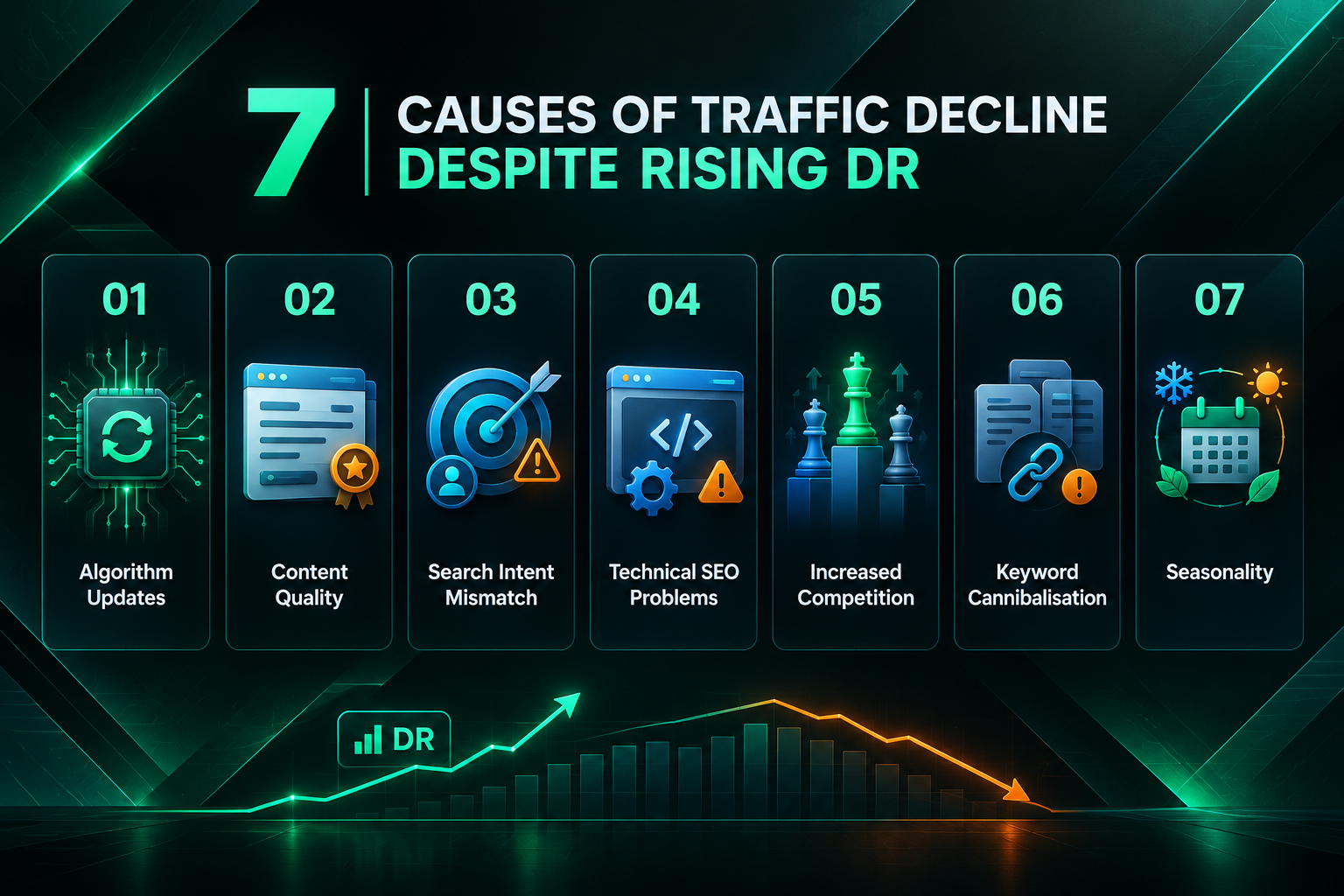
Algorithm Updates
Google updates its ranking systems regularly, and some updates significantly redistribute organic visibility across websites. A site can lose substantial traffic following a core update, a helpful content update, or a spam update regardless of what its DR is doing. If the traffic decline coincided with a documented Google algorithm update, that is a strong signal to investigate content quality, topical authority, and whether the affected pages genuinely satisfy the search intent of the queries they previously ranked for. Backlink acquisition does not reverse the effects of a content-focused algorithm update.
Content Quality and Topical Relevance
Google’s ranking systems increasingly assess whether content demonstrates genuine expertise, experience, authoritativeness, and trustworthiness relative to the query being answered. Pages that rank well for a period can lose visibility if competitors publish more thorough, accurate, or better-structured content. A site may accumulate referring domains over time while its content becomes outdated, thin, or misaligned with how search intent for a topic has evolved. In this scenario, DR rises because link acquisition continues, but traffic falls because the content no longer satisfies what searchers and Google’s systems expect.
Search Intent Mismatch
Search intent describes what a user actually wants when they type a query. Google’s systems attempt to match results to the dominant intent behind a search, which can shift over time. A page optimised for an informational query may lose rankings if Google begins interpreting the same query as transactional, or vice versa. If the pages losing traffic are no longer aligned with the current dominant intent for their target queries, acquiring more backlinks to those pages is unlikely to restore rankings without also addressing the content and format.
Technical SEO Problems
Crawling and indexing issues, slow page speed, Core Web Vitals failures, broken internal links, accidental noindex directives, or changes to a site’s URL structure can all reduce organic visibility independently of the backlink profile. A site migration, a CMS update, or a change to robots.txt can cause significant traffic drops that have nothing to do with links. Google Search Console is the appropriate starting point for identifying whether pages are being indexed correctly and whether any manual actions or coverage issues have been flagged.
Increased Competition
Organic search is competitive, and rankings are relative. A site’s DR may rise while competitors’ DR rises faster, or while competitors publish content that better satisfies search intent. In competitive niches, maintaining traffic often requires ongoing content development and link acquisition rather than a one-time improvement. A site that stops investing in content or outreach while competitors continue may see its rankings erode even as its absolute DR increases.
Keyword Cannibalisation and Internal Linking Issues
When multiple pages on the same site target the same or closely related queries, Google may struggle to determine which page to rank. This can dilute the ranking potential of each page individually. Similarly, poor internal linking can prevent link equity from flowing to the pages that most need it, even when the site’s overall backlink profile is strong. These structural issues can suppress traffic without any change to the external link profile.
Seasonality and Market Changes
Some traffic declines are not caused by SEO problems at all. Seasonal demand fluctuations, changes in market behaviour, or a reduction in search volume for specific queries can reduce traffic even when rankings are stable. Comparing traffic year-over-year rather than month-over-month, and cross-referencing with Google Trends data for relevant queries, can help distinguish a genuine ranking problem from a demand-side change.
When the Links Themselves May Be the Problem
Not all link acquisition activity that raises DR delivers ranking benefit. This is an important distinction for anyone who has been building links specifically to improve search performance.
Low-Quality or Irrelevant Referring Domains
DR can increase when a site acquires links from domains that Ahrefs scores highly, but those links may still provide little or no ranking benefit if they come from pages with no topical relevance to the linked content, from sites with no genuine organic traffic of their own, or from placements that Google’s systems may assess as manipulative. A link from a high-DR domain that exists primarily to sell links, or that publishes content across dozens of unrelated topics, may contribute to DR without contributing meaningfully to rankings.
Link Velocity and Anchor Text Patterns
Acquiring a large number of links in a short period, or building a backlink profile with an unnatural concentration of exact-match anchor text, can attract scrutiny from Google’s spam detection systems. While the effects of such patterns are not always immediate or predictable, a backlink profile that looks engineered rather than editorially earned may not deliver the ranking improvements that the DR increase might suggest. In some cases, aggressive link building can coincide with a traffic decline if Google’s systems reassess the site’s link profile.
Links to the Wrong Pages
Domain-level DR reflects the overall backlink profile, but rankings are determined at the page level. If newly acquired links point to the homepage or to pages that are not the primary ranking targets, the pages that need ranking support may not benefit. A rising DR does not confirm that the pages losing traffic have received relevant, high-quality links pointing directly to them.
How to Diagnose the Actual Cause
A structured diagnostic process is more reliable than guessing. The following steps can help identify why traffic is falling despite a rising DR.
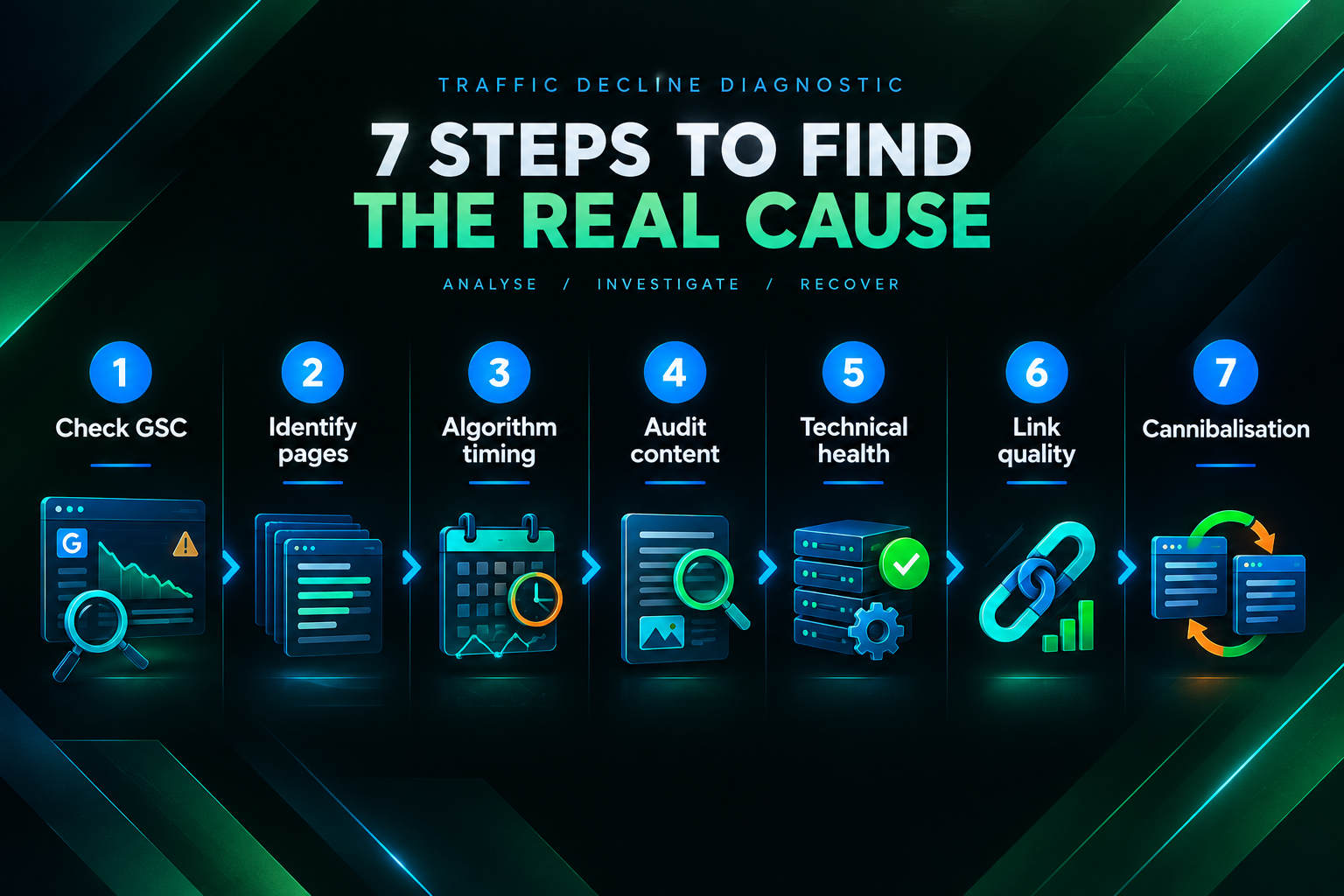
- Check Google Search Console for manual actions and coverage issues. A manual action or a significant indexing problem will directly suppress traffic and should be addressed before anything else.
- Identify which pages and queries have lost traffic. Use Google Search Console’s Performance report to compare impressions and clicks across time periods. Determine whether the decline is concentrated in specific pages, query types, or geographic markets.
- Cross-reference the timing with known algorithm updates. Google’s documented update history can help establish whether a traffic drop coincided with a specific algorithmic change, which narrows the likely cause.
- Audit the content on affected pages. Assess whether the content is accurate, comprehensive, and aligned with the current search intent for the target queries. Compare it with the pages currently ranking in the top positions.
- Review the technical health of the site. Use crawl tools to check for indexing errors, redirect chains, slow load times, and Core Web Vitals issues on the affected pages.
- Assess the quality of recently acquired links. In Ahrefs or a comparable tool, review the referring domains gained in the period before the traffic decline. Evaluate whether those domains have genuine organic traffic, topical relevance, and editorial standards consistent with quality placements.
- Check for cannibalisation. Identify whether multiple pages are competing for the same queries and whether internal linking supports the intended primary page for each topic.
The Role of Link Building in Recovery
Link building may support traffic recovery in some situations, but it is rarely the appropriate first response to a traffic decline and should not be treated as a universal remedy.
If the diagnostic process reveals that affected pages have weak or insufficient backlink support compared with competing pages, and if the content and technical foundations are already sound, then targeted link acquisition to those specific pages may be worth considering. Manual outreach to editorially relevant publishers, guest posting on topically appropriate sites, and digital PR campaigns that earn links through genuinely newsworthy content are approaches that can build page-level authority over time. The key qualifier is that these approaches are most likely to contribute to recovery when the underlying content and technical issues have already been addressed.
If the traffic decline was caused primarily by content quality issues, a search intent mismatch, or a technical problem, then acquiring more links before fixing those issues is unlikely to restore rankings and may not be the best use of budget. A site-specific assessment is needed before deciding whether link building should be part of a recovery strategy.
It is also worth noting that the timeline between acquiring new links and observing measurable changes in rankings or traffic can vary considerably. Links need to be crawled and indexed by Google, and the effect on rankings may take weeks or months to become apparent, depending on crawl frequency, the authority of the linking page, and the competitiveness of the target queries. DR changes in Ahrefs may appear faster than any corresponding change in Google’s assessment of the site.
Backlink Quality Assessment: What to Look For
Whether evaluating an existing backlink profile or planning new link acquisition, assessing link quality at the individual placement level is more informative than relying on DR alone.

A high-quality backlink typically comes from a page that has genuine organic traffic of its own, is topically relevant to the linked content, is published on a site with real editorial standards, uses a natural anchor text that reflects the context of the link, and is placed within the body of a substantive piece of content rather than in a footer, sidebar, or link list. These characteristics are more predictive of ranking benefit than the DR of the referring domain in isolation.
Conversely, links from sites with no organic traffic, from pages that exist primarily to host outbound links, from domains with no clear topical focus, or from placements that appear paid or sponsored without appropriate disclosure are less likely to contribute positively to rankings and may carry policy risk under Google’s spam guidelines. Google’s documented link spam policies make clear that links intended to manipulate PageRank are against its guidelines, regardless of the DR of the linking domain.
Managing Expectations Around DR and Traffic
Domain Rating is a useful tool for benchmarking a backlink profile relative to competitors and for tracking the general trajectory of link acquisition efforts. It is not a reliable predictor of traffic, and treating it as a primary success metric for an SEO campaign can lead to misaligned expectations.
A more informative set of metrics for evaluating whether link building is contributing to business outcomes includes: organic impressions and clicks from Google Search Console for target pages and queries, ranking positions for specific keywords tracked over time, referral traffic from linking domains where relevant, and ultimately the business outcomes such as leads, conversions, or revenue that organic traffic is intended to support. These metrics are more directly connected to the goals that most businesses care about than a third-party domain-level score.
When reporting on link building campaigns, distinguishing between DR changes, referring domain counts, ranking movements, and traffic changes helps avoid the confusion that arises when one metric moves in a different direction from another. Each metric answers a different question, and conflating them makes it harder to identify what is actually working and what needs to change.
Frequently Asked Questions
Does a higher Domain Rating guarantee better Google rankings?
No. Domain Rating is a proprietary Ahrefs metric based on backlink data. Google does not use DR as a ranking signal. Higher DR may reflect a stronger backlink profile, which can support rankings, but rankings also depend on content quality, technical SEO, search intent alignment, and competition. There is no direct or guaranteed relationship between DR and ranking position.
Can link building cause a traffic decline?
In most cases, link building does not directly cause traffic to fall. However, aggressive acquisition of low-quality or manipulative links can attract scrutiny from Google’s spam detection systems, which may negatively affect rankings over time. A traffic decline that coincides with a link building campaign warrants a review of the quality and relevance of the links acquired.
How long does it take for new links to affect traffic?
The timeline varies. Google needs to crawl and index the linking page, then reassess the linked page’s rankings. This process can take anywhere from a few weeks to several months depending on crawl frequency, the authority of the linking page, and the competitiveness of the target queries. DR changes in Ahrefs typically appear faster than any corresponding change in Google’s rankings.
Should I keep building links if my traffic is declining?
Not necessarily, and not without first diagnosing the cause of the decline. If the traffic drop is related to content quality, technical issues, or an algorithm update, continuing to build links without addressing those factors is unlikely to restore rankings. A structured diagnostic process should precede any decision to increase link acquisition activity.
Is Domain Rating the same as Domain Authority?
No. Domain Rating is an Ahrefs metric, while Domain Authority is a Moz metric. Both attempt to estimate the strength of a site’s backlink profile, but they use different methodologies and data sources. Semrush uses Authority Score, and Majestic uses Trust Flow and Citation Flow. These metrics are not interchangeable and should not be compared directly across tools.
What is the most reliable way to measure whether link building is working?
Tracking ranking positions for specific target queries over time, combined with organic impressions and clicks from Google Search Console for the pages receiving links, provides a more direct measure of impact than DR alone. Business outcomes such as leads and conversions from organic traffic offer the most meaningful measure of whether improved rankings are delivering value.
What to Do When DR and Traffic Move in Opposite Directions
A rising Domain Rating alongside declining organic traffic is a signal to investigate rather than a reason to panic or to immediately increase link acquisition. The most productive response is a structured diagnostic process that examines content quality, technical health, algorithm update timing, search intent alignment, and the quality of recently acquired links before drawing conclusions about cause and remedy.
Link building may be part of a recovery strategy in cases where page-level backlink support is genuinely insufficient compared with competing pages and where content and technical foundations are already sound. In those situations, targeted manual outreach and editorially placed links to the specific pages that need support are more likely to contribute to recovery than broad domain-level link acquisition aimed at raising DR. A qualified SEO professional or link building specialist can help assess whether the backlink profile is a meaningful factor in the traffic decline and what type of link acquisition, if any, is appropriate given the site’s current situation.
The key practical takeaway is that DR and organic traffic measure different things. Managing them as separate metrics, understanding what each one does and does not tell you, and making decisions based on the full diagnostic picture rather than a single score will lead to better outcomes than treating a rising DR as evidence that everything is on track.